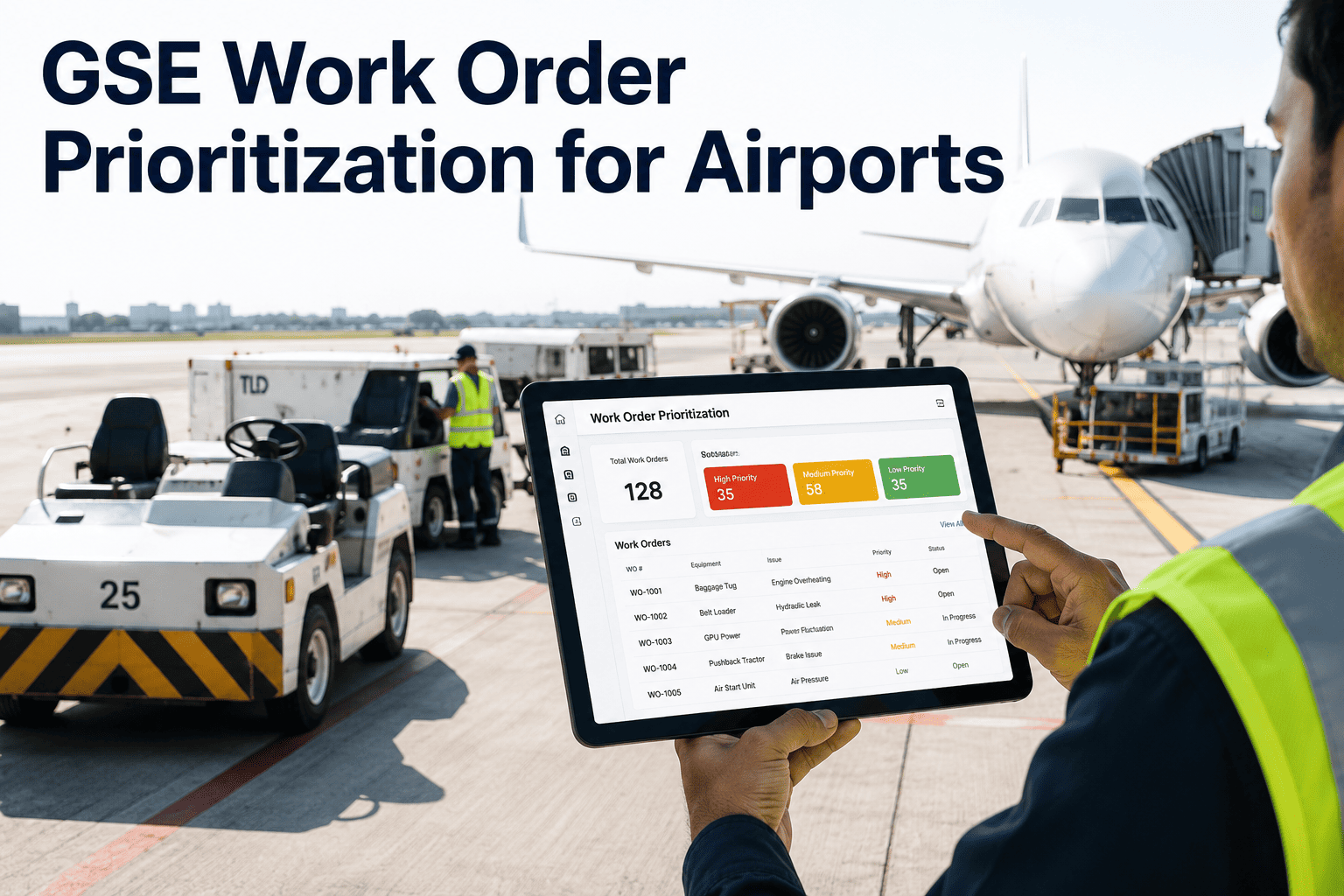
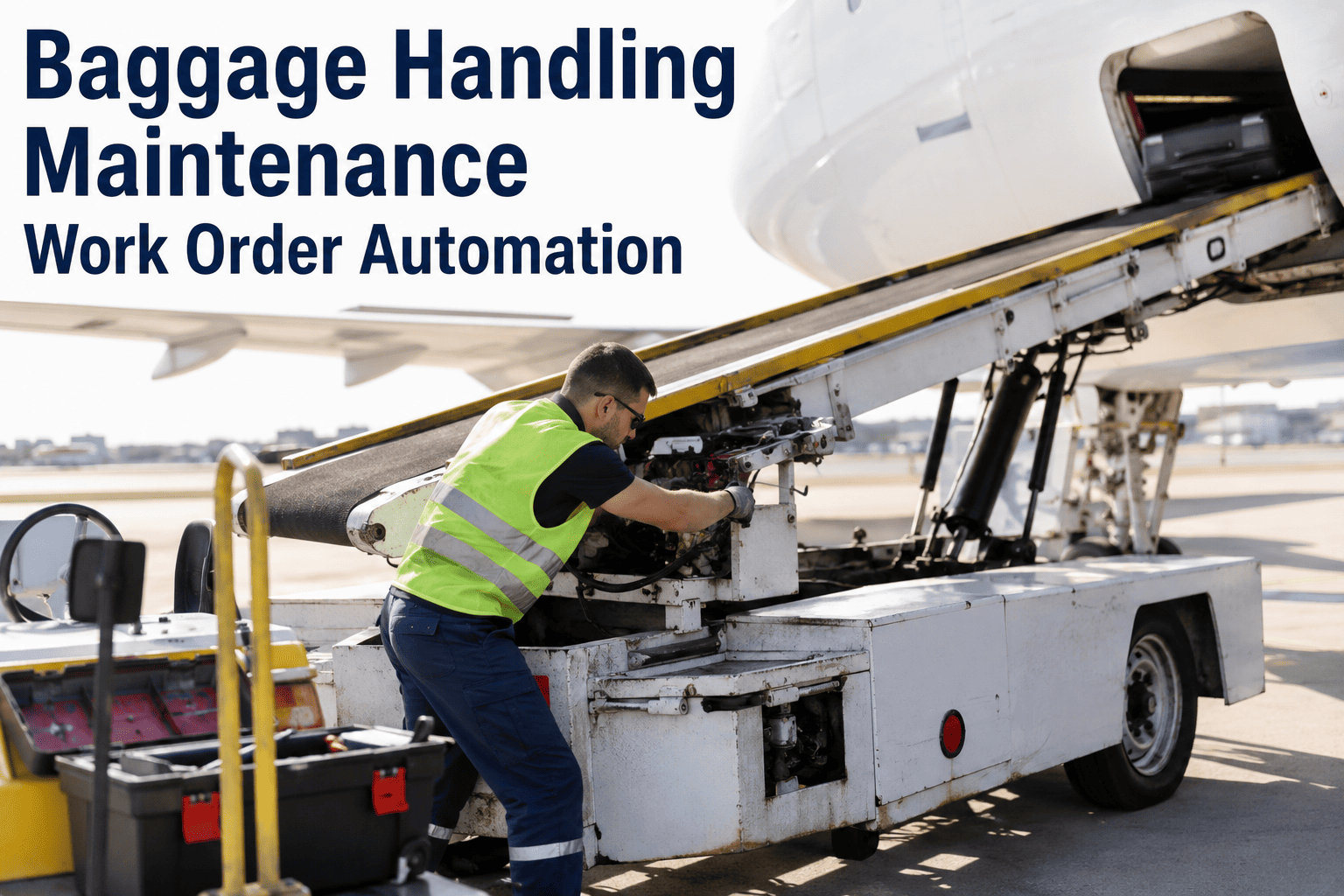
When a pushback tractor throws a hydraulic fault code at 5 AM before the first departure bank, the technician who responds usually has three things to work with: a garbled radio description from the ramp agent, a fault code that could mean six different things, and whatever they remember from the last time this tailstand acted up. Airports run thousands of ground support assets across pushback tractors, belt loaders, ground power units, air start carts, de-icing trucks and boarding bridges, and most work orders still start as a guess dressed up as a diagnosis. The technician drives to the gate, opens three panels, and works backward from symptom to cause with no record of what fixed this exact fault the last four times it happened on a similar unit. Every minute spent diagnosing instead of repairing is a minute closer to a delayed pushback, a missed slot, or an aircraft sitting at the gate with no ground power. Book a demo to see how AI-assisted diagnosis turns a vague symptom report into a ranked list of likely causes before a technician even reaches the gate.
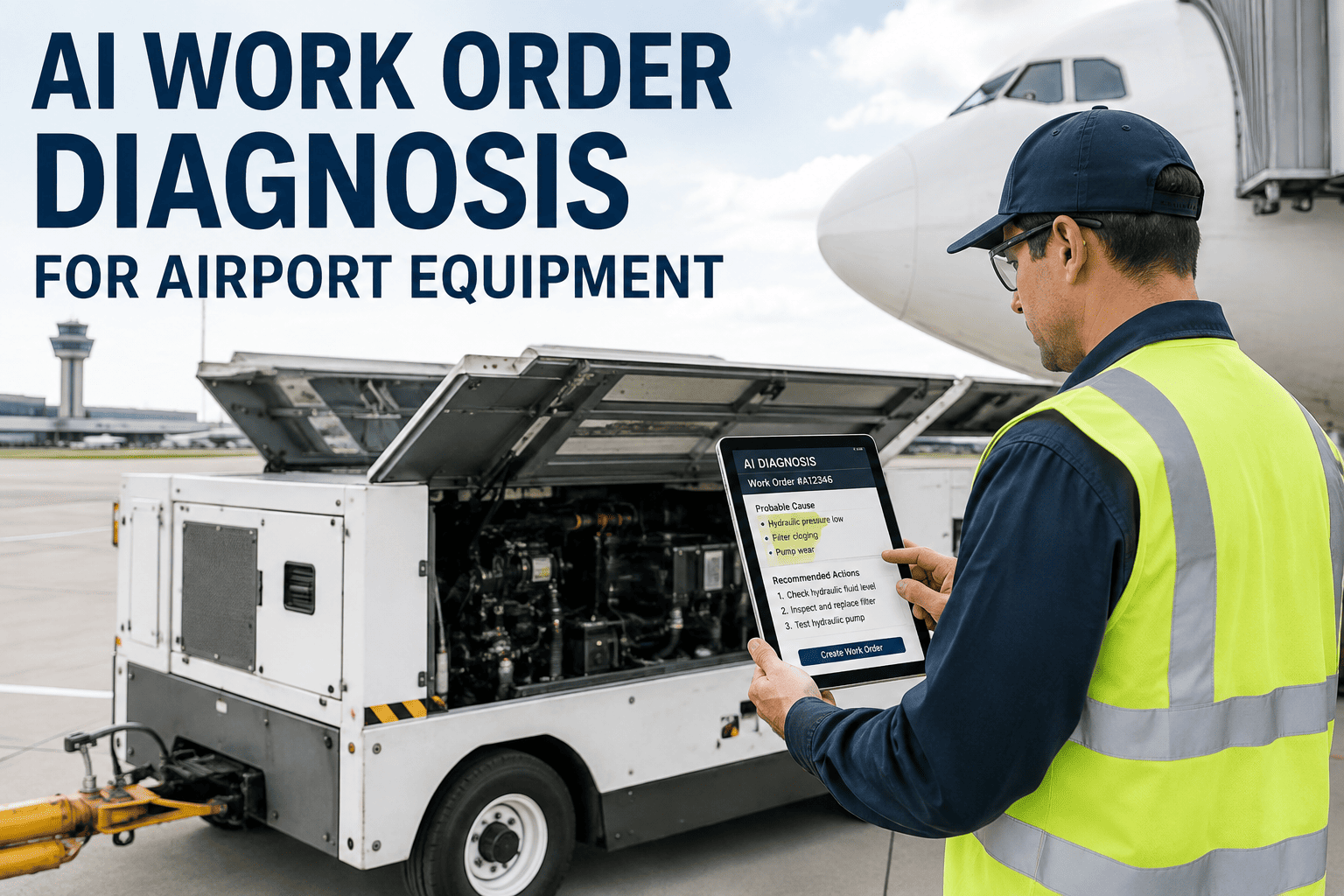
AI Work Order Diagnosis For Airport Equipment
A Ranked Diagnosis Before The Technician Reaches The Gate
iFactory reads fault codes, sensor telemetry and asset history the moment a work order opens, then hands technicians a confidence-ranked list of likely causes, the parts to bring and the fix that worked last time on a similar unit — instead of a blank ticket and a hunch.
1
Symptom Reported
Ramp radio call, fault code or sensor alert logged against the specific asset
Correlated in seconds against fleet history
2
AI Correlation Engine
Fault signature matched against asset history and the cross-fleet failure library
Ranked causes returned before dispatch
3
Work Order Issued
Ranked causes, recommended checks, parts list and matched technician auto-populated
Fault detection to work order assignment
Under 3 min
First-fix rate improvement
Up to 28%
Mean time to repair reduction
30-40%
Diagnosis match accuracy against fault library
92-98%
How AI Work Order Diagnosis Actually Works
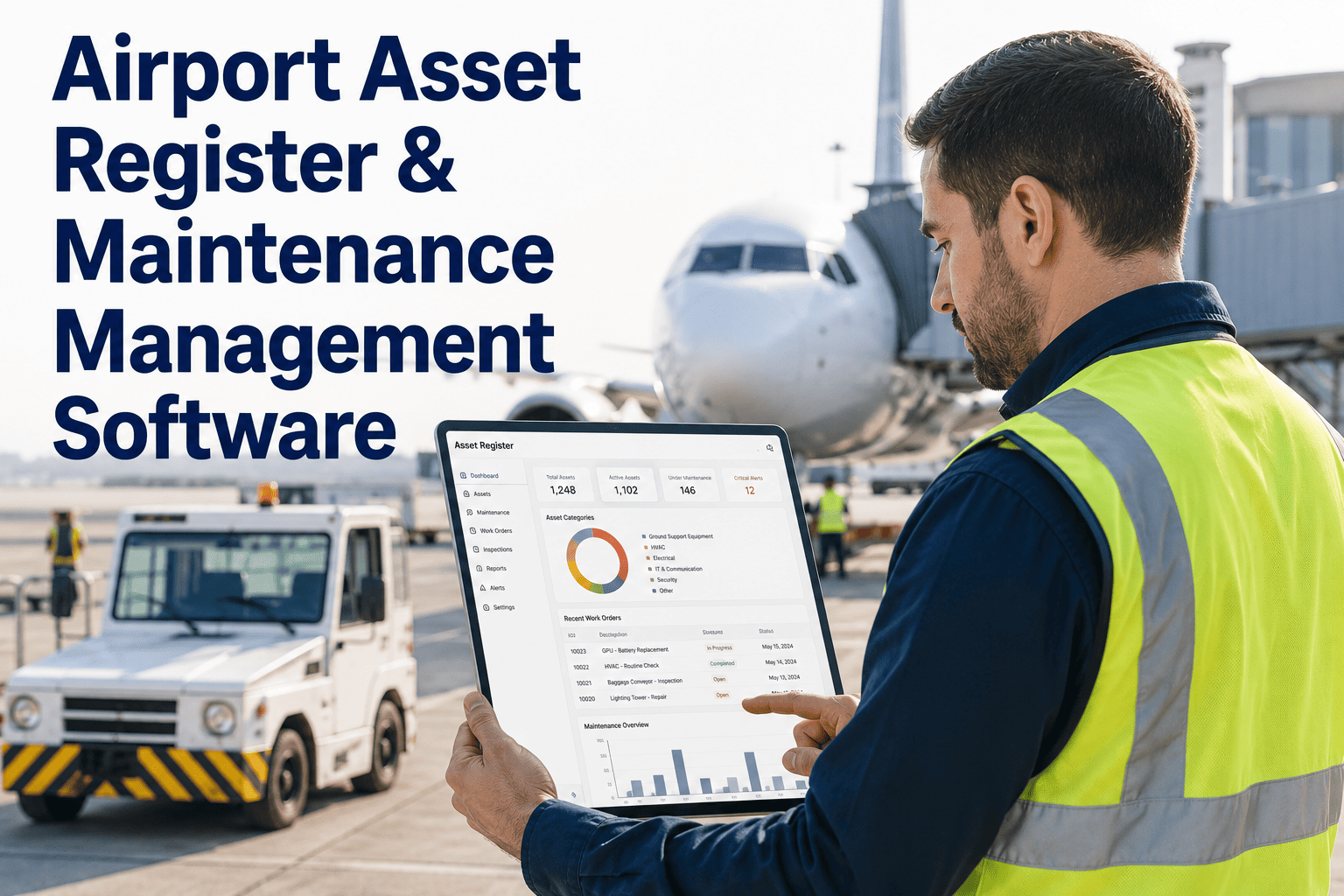
Most airport CMMS platforms are excellent record-keepers and poor diagnosticians. They store the fault after it happens but offer nothing when a technician stands at the tailstand trying to work out why the hydraulic pressure won't build. iFactory's diagnosis layer sits on top of your existing CMMS and telematics feeds, reading every incoming fault the same way an experienced senior technician would — by comparing it against everything similar that has ever happened on that asset and every asset like it. See how the diagnosis engine connects to your current asset registry.
Symptom-To-Cause Matching
Fault Codes And Free-Text Reports Turned Into Ranked Causes
Whether the input is a structured fault code from a telematics unit or a ramp agent's free-text radio note, the engine parses it against a library built from thousands of prior fault-and-repair pairs across every ground support asset type. Instead of a flat troubleshooting checklist, technicians see the two or three most probable causes ranked by confidence, each backed by how often that cause matched that exact symptom pattern in the past.
Asset History Correlation
The full repair history, part-replacement log and prior fault codes for that specific tractor, loader or GPU load automatically before the technician clicks accept on the work order, no separate lookup required.
Cross-Fleet Pattern Library
A hydraulic fault on one pushback tractor is compared against similar faults across every unit of the same make and model in the fleet, surfacing patterns no single technician's memory could hold.
Recommended First Check
Each ranked cause comes with the specific first diagnostic step to run, so the technician's first move at the gate is a targeted check instead of an open-ended teardown.
Technician & Parts Matching
The Right Technician Dispatched With The Right Parts Already Staged
The work order routes to a technician certified on that asset class, and the system checks parts availability at the ramp store against the top-ranked causes before dispatch, so a missing relief valve or brush set doesn't turn one visit into two.
Confidence Scoring
Low-confidence cases where the fault pattern doesn't cleanly match history are flagged for a senior technician review instead of being routed on a guess, keeping the diagnosis honest.
What AI Diagnosis Looks Like On The Ramp
These are representative examples of how a reported symptom translates into a ranked diagnosis and a first check, drawn from common ground support equipment fault patterns.
| Reported Symptom |
Asset Type |
Likely Root Causes, Ranked |
Recommended First Check |
| Won't build hydraulic pressure |
Pushback tractor |
Pump wear, relief valve stuck open, fluid contamination |
Reservoir fluid level and relief valve seat |
| Belt stalls under load |
Belt loader |
Motor brush wear, drive chain tension, overload clutch slip |
Motor brush wear and chain tension |
| Output voltage fluctuates |
Ground power unit |
Voltage regulator drift, loose ground bond, alternator brush wear |
Voltage regulator under simulated load |
| Won't hold charge overnight |
Electric tug battery pack |
Cell imbalance, charger fault, parasitic draw |
Cell-balance diagnostic across the pack |
| Drive motor overheats |
Boarding bridge |
Gearbox binding, motor overload, obstruction sensor fault |
Gearbox lubrication and obstruction sensor |
| Fluid flow drops mid-application |
De-icing truck |
Pump cavitation, inline filter clogging, nozzle wear |
Inline filter and pump inlet pressure |
Manual Diagnosis vs. AI-Assisted Diagnosis
The difference between manual and AI-assisted diagnosis shows up long before a wrench turns — it shows up in how long a technician stands at the gate figuring out what to even check first.
| Capability |
Manual Diagnosis |
AI-Assisted Diagnosis |
| Starting Point |
Technician's own memory and a fault code with no context. |
Ranked cause list built from the asset's full history and fleet-wide patterns. |
| Asset History Access |
Requires a separate CMMS lookup, often skipped under time pressure. |
Full repair and part-replacement history surfaces automatically with the work order. |
| Cross-Fleet Learning |
Limited to what one technician has personally encountered. |
Every similar unit's fault history informs the current diagnosis. |
| Parts Readiness |
Parts identified after the teardown, often triggering a second trip. |
Likely parts checked against inventory before the technician is dispatched. |
| Technician Assignment |
Based on availability rather than certification match to the fault type. |
Routed to a technician certified on that asset class and fault pattern. |
| Uncertain Cases |
Handled the same way as confident ones, with no built-in escalation. |
Low-confidence matches flagged automatically for senior review. |
Why Diagnosis Time Is The Hidden Cost Center On The Ramp
Airport maintenance budgets get scrutinized for parts spend, overtime hours and contractor callouts, but the minutes a certified technician spends standing at a gate figuring out where to even start rarely show up as a line item anywhere. That time is invisible on a work order that only logs when the ticket opened and when it closed, yet it is often the single largest component of total repair time on ground support equipment. A pushback tractor that sits idle for forty minutes while a technician traces a hydraulic fault costs the airport in three separate ways at once: the technician's labor hour, the tractor's unavailability during a departure bank, and the downstream schedule risk if that tractor was the only spare covering that gate cluster. None of those costs are visible in a standard maintenance report, which is exactly why diagnosis time has stayed an unmanaged variable at most airports even as parts inventory, preventive schedules and compliance documentation have all become tightly tracked.
Ramp Operations
Faster diagnosis means fewer minutes a spare asset spends unavailable during peak departure and arrival banks, directly reducing the odds a diagnosis delay cascades into a gate hold.
Maintenance Shop
Technicians spend their certified hours repairing instead of investigating, and shift coverage can be planned around actual repair volume rather than buffered for open-ended diagnosis time.
Finance & Procurement
Parts ordered against a confirmed cause instead of a guess reduces the returns and re-orders that quietly inflate ground support equipment parts spend every quarter.
Stop Sending Technicians To Diagnose In The Dark
iFactory reads fault signatures against your fleet's own repair history and hands technicians a ranked diagnosis, a first check and a parts list before they leave the shop.
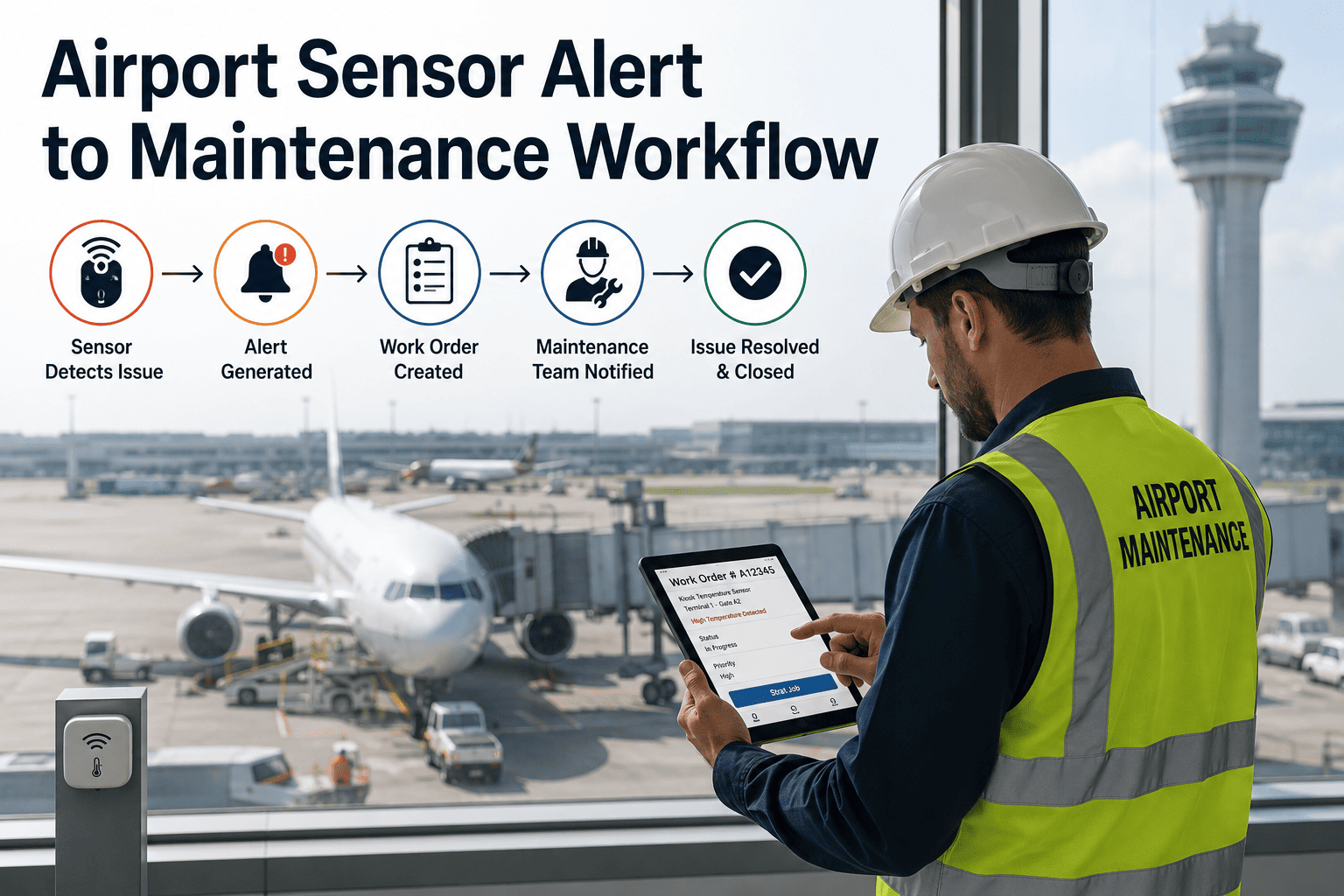
From Symptom To Resolution: The Diagnosis Workflow
The workflow runs as a continuous loop, and every completed repair makes the next diagnosis on that asset type sharper than the one before it.
1
Symptom Capture
A ramp agent or technician logs the fault through a mobile app, or a fault code reads automatically from the asset's telematics unit.
2
Historical Correlation
The engine pulls the asset's complete fault and repair history along with any live sensor telemetry available for that unit.
3
Cross-Fleet Pattern Match
The fault signature is compared against similar faults recorded across every unit of that asset type across the fleet.
4
Confidence-Ranked Cause List
The top probable causes return with a confidence score and the historical evidence that supports each one.
5
Work Order Auto-Generation
Technician assignment, parts list and estimated repair time populate automatically against the top-ranked cause.
6
Outcome Feedback Loop
The actual root cause and repair action feed back into the failure library, sharpening the next diagnosis on that asset type.
This loop is what separates AI-assisted diagnosis from a static troubleshooting manual bolted onto a CMMS. A printed flowchart never learns that this specific fleet's belt loaders fail differently than the manufacturer's generic guide assumes. The feedback loop does, closing the gap between what the documentation says should happen and what actually happens on your ramp, asset by asset, repair by repair.
Diagnosis Results Across The Ground Support Fleet
These outcomes reflect how ground support teams describe diagnosis performance after moving from manual troubleshooting to AI-assisted work order diagnosis.
Pushback Tractor Fleet
Hydraulic Fault Diagnosis Cut From 45 Minutes To 8
A ground operations team running roughly forty pushback tractors previously treated every hydraulic fault as a fresh investigation, often opening multiple panels before finding the actual cause. Once fault codes and technician notes fed the diagnosis engine, recurring patterns across the fleet's relief valves and pump seals surfaced immediately, and technicians started each call with a ranked short list instead of a blank slate.
8 min
Average diagnosis time, down from 45 minutes
34%
Fewer repeat faults on the same unit
22%
Reduction in unnecessary parts replacement
Belt Loader & GPU Fleet
First-Fix Rate Rises To 91 Percent
Belt loaders and ground power units generated the highest volume of repeat truck rolls, largely because technicians arrived without the part the fault actually needed. With parts availability checked against the top-ranked cause before dispatch, second trips for missing brushes, regulators and belts dropped sharply within the first two months.
91%
First-fix rate, up from 63%
40%
Fewer truck rolls for missing parts
3 min
Average work order creation time
Boarding Bridge & De-Icing Fleet
Diagnosis Backlog Eliminated During Peak Winter Operations
During peak winter de-icing season, fault volume on boarding bridges and de-icing trucks used to outpace the shop's ability to triage which unit needed attention first. Confidence-ranked diagnosis let dispatchers prioritize units with high-severity, high-confidence faults over low-risk anomalies, keeping the backlog from building even as fault volume climbed.
0
Backlogged diagnosis tickets at peak season
30-40%
Mean time to repair reduction fleet-wide
92-98%
Diagnosis match accuracy against fault library
What Ground Support Teams Say About AI Diagnosis
The following comments are from maintenance and ramp operations leaders currently running AI-assisted work order diagnosis on their ground support fleets.
Our technicians used to spend the first fifteen minutes of every call just figuring out where to start. Now the ranked diagnosis is waiting on their phone before they even reach the tractor.
GSE Maintenance Manager
Regional Hub Airport
A delayed pushback because a technician was still troubleshooting used to be a monthly headache. Diagnosis time dropping this much changed how we schedule shift coverage entirely.
Ramp Operations Director
International Gateway Airport
New technicians used to lean on the two senior guys for every unusual fault. Now the system carries that institutional knowledge and the whole team diagnoses at that level.
Fleet Technician Lead
Cargo & Ground Handling Operator
Second trips for missing parts were quietly eating a full shift a week across the shop. Checking parts against the top-ranked cause before dispatch closed that gap almost immediately.
Airport MRO Supervisor
Mid-Size Commercial Airport
Frequently Asked Questions
These are the questions maintenance managers and IT teams ask most often before rolling AI-assisted diagnosis out across a ground support fleet, covering how the system learns, how it handles uncertainty, and what it takes to connect to what you already run.
Does AI work order diagnosis replace the technician's judgment?
No. The engine narrows a wide field of possible causes down to the two or three most probable ones based on the asset's history and fleet-wide patterns, but the technician still confirms the cause and performs the repair. Think of it as handing an experienced senior technician's institutional knowledge to every technician on shift, rather than replacing the person doing the diagnosis. Low-confidence cases are flagged for senior review rather than resolved automatically, which keeps a human decision in every ambiguous call.
How does the system build its failure pattern library for our specific fleet?
The library builds from your own fleet's fault codes, technician notes and completed repair records as they accumulate, supplemented by manufacturer failure data for common ground support asset types. Accuracy improves steadily as more repairs are logged, since every closed work order becomes a data point the next diagnosis can draw on.
Talk to support about how historical CMMS records can be imported to accelerate this from day one.
What happens when the AI isn't confident in a diagnosis?
Any fault pattern that doesn't cleanly match prior history returns a lower confidence score and routes automatically to a senior technician or supervisor for review rather than being presented as a confident answer. This escalation path matters most for new equipment types or unusual failure combinations where historical data is still thin. The system is deliberately conservative about confidence rather than forcing a ranked answer when the evidence doesn't support one.
Does this integrate with our existing CMMS and telematics?
Yes. iFactory's diagnosis layer connects to existing CMMS platforms and telematics or fault-code feeds through standard connectors, reading fault data and asset history as it already exists rather than requiring a separate system or a data migration project.
Book a demo to see how it maps against your specific CMMS and telematics setup.
How long before technicians see ranked diagnoses on new equipment types?
For asset types with existing fault and repair history in your CMMS, ranked diagnoses are typically available within the first two to three weeks as historical data is ingested and validated. For newly introduced equipment types with little history, the system starts with manufacturer failure data and sharpens quickly as your own technicians log the first rounds of repairs against it.
Give Every Technician The Diagnosis Instincts Of Your Best One
iFactory turns fault codes and symptom reports into a ranked, confidence-scored diagnosis with the right parts and the right technician matched automatically — before anyone drives to the gate.
Ranked diagnosis returned in under 3 minutes
First-fix rate improvements of up to 28%
Parts and technician matched before dispatch
Works with your existing CMMS and telematics