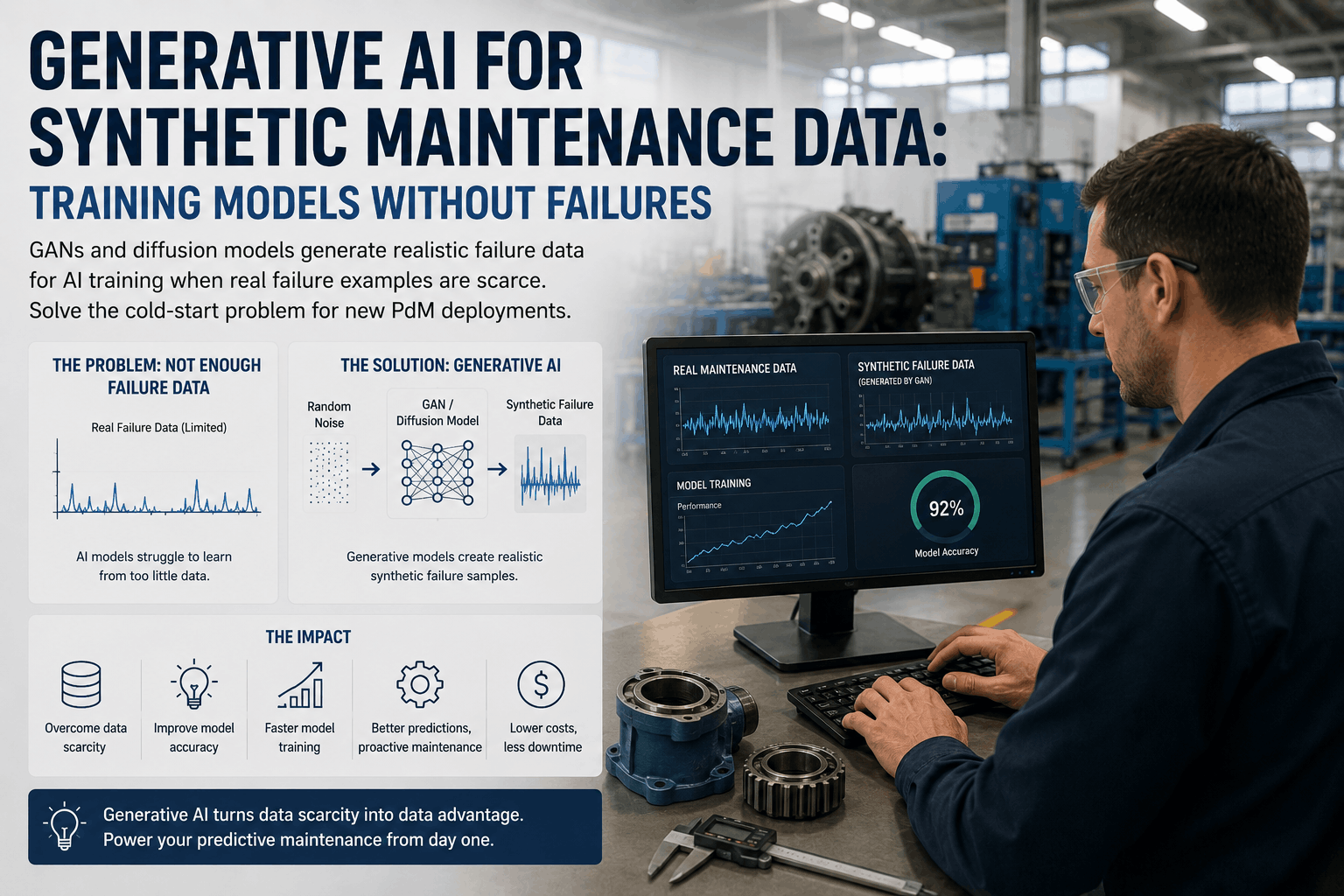
A technician standing in front of a failed gearbox at 2 AM with a maintenance manual that has not been updated since 2019 used to have one option: call someone more experienced. Large language models change that equation by letting technicians query equipment health in plain language and receive AI-guided repair instructions drawn from manuals, work order history, and fleet-wide fault data in real time. IoT Analytics reports LLM interest in manufacturing surged from 16 percent to 35 percent in a single year — a jump driven by maintenance teams who found that natural language AI assistance produces faster, safer repairs than document searches. Start Trial to see how BusCMMS brings LLM-powered technician assistance to bus and equipment fleet maintenance.
Give Every Technician an AI Expert at Their Side
BusCMMS connects LLM-powered guidance to your maintenance manuals, work order history, and fault records so technicians get contextual repair instructions the moment they need them — not after a phone call and a manual search.
How LLMs Are Changing the Industrial Technician's Workflow
A large language model connected to a maintenance knowledge base does not replace a skilled technician — it reduces the time that technician spends searching for procedures, interpreting fault codes, and escalating diagnostic questions to senior colleagues. A 2026 ScienceDirect survey on generative AI for predictive maintenance found that technician-facing LLM tools reduced average diagnostic time by 34 percent across surveyed manufacturing facilities. Teams that Book Demo with BusCMMS see how natural language queries draw on vehicle maintenance history, OEM procedure libraries, and fleet-wide fault patterns to give technicians specific, actionable guidance rather than generic document excerpts. The result is faster first-time fix rates, fewer escalations, and maintenance knowledge that stays accessible even as experienced staff retire.
Natural Language Fault Query Interface
Technicians describe symptoms in plain language and receive structured diagnostic guidance drawn from the vehicle's specific maintenance history and OEM procedures.
Fault Code Interpretation and Step-by-Step Guidance
Fault codes are interpreted in the context of the specific vehicle's history, producing repair steps ranked by probability rather than a generic code description.
Work Order History Integration
LLM responses draw on the vehicle's prior work order history to identify repeat failures and prior repair patterns before suggesting a diagnostic path.
OEM Manual and Procedure Retrieval
Relevant procedure pages from OEM documentation are surfaced automatically in response to technician queries, eliminating manual document searches during a repair.
Fleet-Wide Fault Pattern Comparison
LLM responses include how similar symptoms were resolved on comparable vehicles across the fleet, incorporating collective diagnostic experience into every query.
Voice-Compatible Query Support
Hands-free voice queries let technicians access AI guidance while working on equipment, keeping both hands available for the repair.
Six Ways LLMs Improve Technician Performance
01
Faster First-Time Fix Rate Through Contextual Diagnosis
Primary Performance Metric
First-time fix rate is the most direct measure of technician diagnostic effectiveness, and LLM assistance improves it by surfacing contextual fault history and ranked repair procedures before the technician opens a part. A natural language query that returns the three most probable causes for a specific symptom on this specific vehicle is categorically more useful than a fault code description from a generic manual, and produces measurably higher first-time fix rates across surveyed maintenance teams.
First-fix rate: 61% (without LLM)
First-fix rate: 84% (with LLM assist)
02
Diagnostic Time Reduction
Efficiency Impact
Average diagnostic time falls significantly when technicians can query equipment status in natural language rather than cross-referencing fault codes against multiple manual sections and calling senior technicians for interpretation. The 2026 ScienceDirect GenAI for predictive maintenance survey reported a 34 percent reduction in average diagnostic time across LLM-assisted maintenance teams, translating directly to reduced mean time to repair.
Avg diagnostic time: 48 min (manual)
Avg diagnostic time: 31 min (LLM-assisted)
03
Reduced Senior Technician Escalation Rate
Knowledge Transfer
Escalation from junior to senior technicians is often a bottleneck in multi-shift maintenance operations, since senior staff availability does not always align with diagnostic need. LLM assistance captures and makes accessible the diagnostic reasoning that senior technicians apply intuitively, allowing junior staff to resolve a larger share of diagnostic challenges independently and preserving senior time for genuinely novel faults.
Escalation rate: 42% of diagnostics
Escalation rate: 19% of diagnostics
04
Institutional Knowledge Preservation
Workforce Continuity
When an experienced technician retires, they take diagnostic patterns, fleet-specific failure knowledge, and informal repair shortcuts with them unless that knowledge has been captured in work order notes and maintenance history. LLMs trained on historical work order data, completed repair notes, and fleet-specific fault patterns effectively convert that institutional knowledge into a queryable resource accessible to every technician regardless of experience level.
Knowledge captured: 23% (manual logs)
Knowledge captured: 91% (LLM-indexed)
05
Onboarding Acceleration for New Technicians
Training Efficiency
New technicians traditionally require 6 to 18 months to reach independent diagnostic competence on a specific fleet, limited by access to experienced mentors and exposure to fault variety. LLM-assisted diagnosis compresses this timeline by giving new technicians access to fleet-specific fault history and guided repair procedures from their first day, reducing time-to-competence and lowering the cost of workforce turnover in the maintenance department.
Time to competence: 14 months (standard)
Time to competence: 6 months (LLM-assisted)
06
Safety Compliance Through Procedure Guidance
Safety Impact
Technicians under time pressure are most likely to skip procedure steps or substitute improper techniques, which is when safety incidents occur. LLM-guided repair instructions surface safety precautions and mandatory steps at the moment they are relevant to the current task, keeping critical safety requirements visible without requiring technicians to maintain the full procedure in working memory during a repair.
Procedure adherence: 67% (manual)
Procedure adherence: 94% (LLM-guided)
LLM Maintenance Impact: Quick Reference
Scroll for more
| Performance Metric | Without LLM | With LLM Assist | Improvement | BusCMMS Integration |
|---|---|---|---|---|
| First-Time Fix Rate | 61% | 84% | +23 percentage points | History-aware fault query |
| Diagnostic Time | 48 min avg | 31 min avg | 34% reduction | Natural language query interface |
| Escalation Rate | 42% of jobs | 19% of jobs | 55% reduction | Fleet-wide pattern access |
| Procedure Adherence | 67% | 94% | +27 percentage points | Step-by-step LLM guidance |
| New Tech Competence | 14 months | 6 months | 57% faster | Institutional knowledge query |
How BusCMMS Powers LLM Technician Assistance
An LLM is only as useful as the maintenance data it can draw on, and BusCMMS provides the structured work order history, fault code records, and PM documentation that make natural language queries return specific, actionable answers rather than generic guidance. When a technician asks why a specific vehicle is throwing a recurring fault code, BusCMMS connects the LLM to that vehicle's complete maintenance timeline, producing a response grounded in actual repair history rather than generic troubleshooting steps. Teams can Start Trial and begin building the maintenance knowledge base that powers LLM assistance from the first work order logged.
Vehicle History-Grounded Queries
LLM responses draw on the specific vehicle's work order history, giving fault diagnosis answers tailored to that asset's actual maintenance record.
OEM Procedure Integration
Relevant procedure steps surface automatically in LLM responses, eliminating manual document searches during time-sensitive repairs.
Fleet Pattern Access
How similar faults were resolved across the fleet becomes visible in every query, incorporating collective diagnostic experience into individual repairs.
Voice-Compatible Interface
Hands-free voice queries keep technicians working while accessing AI guidance, improving both repair speed and safety posture.
Implementing LLM Technician Assistance: Six Steps
01
Index Existing Work Order History
Feed historical work orders, fault codes, and resolution notes into BusCMMS so the LLM has a maintenance knowledge base grounded in your fleet's actual history.
02
Upload OEM Manuals and Procedure Libraries
Ingest OEM documentation into the knowledge base so LLM procedure retrieval is accurate to your specific vehicle makes and model years.
03
Train Technicians on Natural Language Query
Run structured onboarding sessions that teach technicians how to phrase diagnostic queries for maximum response specificity and accuracy.
04
Define LLM Authority and Escalation Rules
Specify which repair decisions require human senior-technician approval regardless of LLM guidance, keeping critical decisions within appropriate authority.
05
Capture New Repair Knowledge in Work Orders
Require technicians to document repair outcomes and unusual findings in BusCMMS so each completed job improves the LLM knowledge base for future queries.
06
Track First-Time Fix Rate and Escalation Rate Monthly
Measure first-fix rate and escalation frequency before and after LLM deployment to quantify technician performance improvement for leadership reporting.
Frequently Asked Questions
What is an LLM in the context of industrial maintenance?
A large language model connected to maintenance manuals, work order history, and fault records that technicians can query in natural language to receive structured diagnostic guidance specific to their equipment and situation.
How fast is LLM adoption growing in manufacturing maintenance?
IoT Analytics reports LLM interest in manufacturing maintenance grew from 16 percent to 35 percent in a single year, driven by documented improvements in diagnostic speed and first-time fix rate.
Does LLM assistance replace experienced technicians?
No. LLM assistance reduces the time technicians spend searching for procedures and escalating diagnostic questions, allowing experienced staff to focus on genuinely novel faults that benefit most from their expertise.
What data does an LLM need to provide useful maintenance guidance?
Work order history, fault codes with resolutions, OEM procedures, and fleet-wide fault pattern data are the core knowledge sources that make LLM diagnostic responses specific and actionable.
How does BusCMMS support LLM-assisted maintenance?
BusCMMS provides the structured work order history and fault records that ground LLM responses in actual vehicle maintenance data, making natural language queries return fleet-specific guidance rather than generic answers.
Every Technician Deserves an Expert on Call
BusCMMS connects LLM-powered guidance to your maintenance history so technicians get contextual, fleet-specific repair assistance the moment they need it.
.png)