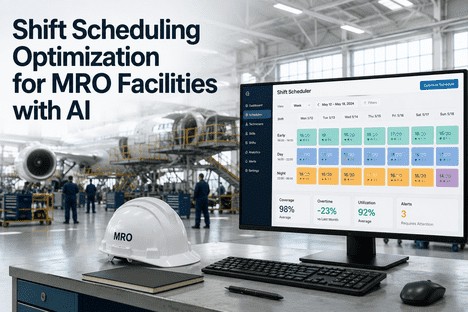
Shift Scheduling Optimization for MRO Facilities with AI
By Grace on June 3, 2026
Every morning at a 200-technician MRO facility, the shift supervisor arrives to a familiar scene: three mechanics called out sick, two A-checks landed overnight that were not on the forecast, and an engine change that should have been scheduled next week but just became urgent. The spreadsheet roster built yesterday afternoon is already obsolete. The supervisor spends the next 90 minutes on the phone — calling standby lists, checking who holds the right certification for each open task, and negotiating overtime approvals for the technicians who answer. By the time the hangar floor is staffed, productive work has already lost two hours. Across a 250-day operational year, that pattern alone costs the facility more than $400,000 in supervisory labor and delayed shift starts. AI-based shift scheduling does not just automate the roster. It eliminates the conditions that make the roster wrong before the shift begins.
IFACTORY AI SHIFT SCHEDULER
Shift Scheduling Optimization for MRO Facilities With AI
How artificial intelligence replaces spreadsheet-based rosters with demand-driven scheduling that cuts overtime by 34%, improves technician utilization by 18%, and delivers audit-ready compliance — all from live work order data.
Manual scheduling is not simply slower than AI — it is structurally incapable of solving four compounding problems that determine whether a shift runs at cost or over budget. These patterns are invisible to a spreadsheet but immediately visible to an AI scheduler that reads live operational data.
01
Overtime Blindness
19-24% of labor spend
Manual schedulers approve overtime shift-by-shift with no visibility into cumulative technician exposure. The same mechanic can work 18 hours of overtime in a week without any single approver seeing the total. MRO facilities running spreadsheet-based scheduling average 19-24% of total labor spend on overtime — 8-11 points above AI-scheduled peers.
02
Skill Mismatch Chain
11% rework rate
When scheduling prioritizes availability over certification, technicians routinely receive tasks outside their authorized scope. The task is returned to queue, reassigned at overtime rates, and the initial work must be re-inspected. Facilities with unstructured scheduling report rework rates averaging 11% of completed tasks — each carrying compliance documentation overhead.
03
Callout Chaos
14% avg absence rate
A single technician calling out sick triggers a manual replacement chain — supervisors calling standby lists, negotiating overtime premiums, often settling for a less-qualified substitute. At 14% unplanned absence rates, this is not an edge case. It is a structural daily bottleneck that delays shift starts by 30-90 minutes across the operation.
04
Fatigue Exposure
Highest risk period
Without automated fatigue tracking, consecutive duty hours accumulate silently. A technician assigned to back-to-back overtime shifts may reach the hangar floor with a fatigue score that exceeds regulatory thresholds — yet the manual roster has no mechanism to detect this. FRMS data shows fatigue-related errors peak in the final two hours of extended shifts.
DEMAND-DRIVEN SCHEDULING
How AI Builds a Roster That Responds to Live Work
The fundamental difference between manual and AI scheduling is not speed — it is the data source. A manual scheduler works from a static headcount estimate. An AI scheduler works from the live work order queue. Every aircraft induction, task completion, and priority escalation updates the roster in real time.
Spreadsheet Scheduling
Static roster built from headcount estimates
Overtime approved shift-by-shift with no cumulative view
Certification matching done from memory
Absence triggers 40 min of supervisor phone calls
Fatigue risk invisible until an incident occurs
Schedule compliance discovered during audit
No visibility into tomorrow's coverage gaps
vs
iFactory AI Scheduling
Roster built from live work order demand
Overtime triggered only after AI distributes load across workforce
Certification scope validated before every assignment
Best-qualified standby identified in under 3 minutes
Fatigue score calculated per technician per shift automatically
Every schedule action audit-ready at approval
Coverage gaps flagged days in advance
CORE CAPABILITIES
What an AI Scheduler Actually Does Inside Your MRO
iFactory's AI Shift Scheduler is built into the same platform that manages your work orders, asset records, and compliance documentation. The capabilities below operate from live maintenance demand — not a manually entered headcount estimate.
01
Live Demand-Driven Rostering
The AI reads the live work order queue — task types, estimated durations, certification requirements, and priority levels — and generates an optimized roster in under 90 seconds. Rosters are presented with an explanation of each allocation decision. Supervisors approve rather than build. When three heavy checks land simultaneously, the roster adjusts before the shift starts, not after.
02
Certification-Aware Assignment
Every technician's license, type rating, and task authorization is tracked with expiry alerts at 90, 30, and 7 days. Expired certifications are automatically excluded from eligible roster slots. The system cannot produce a compliance violation — even under shift pressure — because scheduling a technician without the correct authorization is structurally impossible.
03
Automated Fatigue Risk Management
Fatigue scores are calculated per technician per shift using configurable FRMS models aligned to EASA ORO.FTL, FAA 117, or custom fatigue rules. Technicians exceeding risk thresholds are moved to non-safety-critical tasks or rest status automatically. The AI will not schedule a technician into a safety-critical task if their fatigue score exceeds the configured limit — regardless of headcount pressure.
04
Instant Callout Replacement
When a technician reports absent, the system instantly identifies the best-qualified available standby — ranked by certification fit, fatigue score, and overtime exposure — and issues the replacement recommendation automatically. What previously took 40 minutes of supervisor phone calls is completed in under 3 minutes with a compliance-verified assignment.
05
Coverage Forecasting and Alerting
A live view of shift coverage by bay, task type, and certification tier updates every time a work order changes or a technician clocks in or out. Coverage gaps are flagged days in advance — not discovered when a shift starts short-staffed. Supervisors receive proactive alerts with recommended adjustments before gaps become delays.
06
Audit-Ready Scheduling Records
Every shift generated is audit-ready from the moment it is approved. Scheduling rules — FTL limits, rest minimums, certification expiry dates, labor agreement constraints — are encoded directly. If a schedule action would breach a rule, it is blocked before the roster is issued. Regulatory auditors see a complete, immutable scheduling record with every decision traceable.
IFACTORY AI SHIFT SCHEDULER
From Spreadsheet to AI-Optimized Roster in Under 90 Seconds
iFactory's AI Shift Scheduler reads your live work order queue, matches every task to the right technician, enforces fatigue limits and certification rules, and handles callout replacement automatically — from the same platform your team already uses for maintenance management.
What the First Six Months of AI Scheduling Look Like
Facilities deploying AI-based shift scheduling see measurable results on a predictable timeline. The data below represents median outcomes across MRO facilities of 80-250 technicians that transitioned from manual spreadsheets to demand-driven AI scheduling.
Most facilities see measurable overtime reduction within the first four weeks of live scheduling. This happens before any behavior change from the workforce — it is simply the AI distributing load more evenly across available headcount than a manual scheduler can manage under time pressure. The first month typically delivers 15-20% of the total overtime improvement.
Certification compliance improvements are immediate from day one. The system blocks scheduling errors that previously required audit discovery to identify. Facilities with compliance-driven scheduling see their first audit gap eliminated before the first AI-generated roster is even executed on the hangar floor.
Facilities tracking turn-around time typically see the first measurable improvement in week 6-8, once scheduling accuracy cascades into fewer task holds and rework cycles. The right certifications are present for scheduled work, so tasks are not paused waiting for sign-off authority to arrive from another bay.
Fatigue risk metrics improve progressively over weeks 8-12 as the system builds a fuller picture of each technician's cumulative exposure patterns. The AI identifies technicians approaching FRMS thresholds before their fatigue score enters the risk zone — enabling proactive adjustment rather than reactive reassignment.
The median payback period across facilities of 80 or more technicians is under four months from go-live. By month six, overtime is reduced by a median of 34%, technician utilization has improved by 18%, and the facility arrives at every regulatory audit with a complete, immutable scheduling record.
IMPACT METRICS
Measurable Outcomes Across Deployed MRO Facilities
34%
Overtime reduction
Median reduction within 6 months. Driven by proactive load distribution across the full available workforce before premium rates apply.
18%
Technician utilization improvement
Productive hours per technician per shift increase when demand-driven scheduling eliminates idle overstaffing and skill mismatches.
22%
On-time aircraft release improvement
Faster TAT when the right certifications are present for scheduled work and fewer task holds wait for sign-off authority.
<4 mo
Median payback period
For facilities with 80+ technicians. Driven by overtime reduction, compliance cost avoidance, and labor utilization gains.
FAQ
Common Questions About AI Shift Scheduling in MRO
Does AI scheduling replace the shift supervisor's role? ▼
No. AI scheduling replaces the manual labor of roster construction — the 60-90 minutes per shift spent matching names to tasks, checking certifications, and phoning standby lists. The shift supervisor's role shifts from roster builder to roster approver. The AI presents an optimized schedule with explanations for each allocation decision. The supervisor reviews, adjusts for factors the AI cannot know (technician morale, team dynamics, upcoming leave requests), and approves. The time saved — approximately 10 hours per week at a 100-technician facility — is redirected to hangar floor oversight, coaching, and safety observation.
How does the system handle union rules and collective bargaining agreements? ▼
iFactory's AI Shift Scheduler encodes labor agreement rules directly into the scheduling engine — shift bid systems, seniority-based assignment preferences, overtime distribution rules, minimum rest periods, and jurisdictional scope limitations. If a proposed schedule action would violate a contractual rule, the system blocks it before the roster is issued. This ensures every AI-generated schedule is contract-compliant at the moment of approval, eliminating grievances that arise from manual scheduling errors. Labor agreement rule sets are configurable per facility and can be updated when contracts are renegotiated.
What data does the AI need to start producing optimized rosters? ▼
The AI requires three data sets to begin generating schedules: technician profiles (certifications, type ratings, task authorizations, shift preferences, contract terms), work order history (task types, durations, certification requirements by task), and current shift patterns (existing shift templates, coverage requirements by bay or line). Most facilities have all three available in existing HR and CMMS records. iFactory's integration layer connects to AMOS, TRAX, SAP, and standard HR platforms. Deployment to first AI-generated roster typically completes within 30 days — with the first measurable overtime reduction visible within four weeks of go-live.
TRANSITION FROM SPREADSHEET TO AI IN 30 DAYS
See How iFactory's AI Shift Scheduler Optimizes Your MRO Workforce
Reduce overtime by 34%, improve technician utilization by 18%, and arrive at every audit with a clean scheduling record. iFactory reads your live work order data and delivers optimized rosters in under 90 seconds — from the same platform your team already uses.