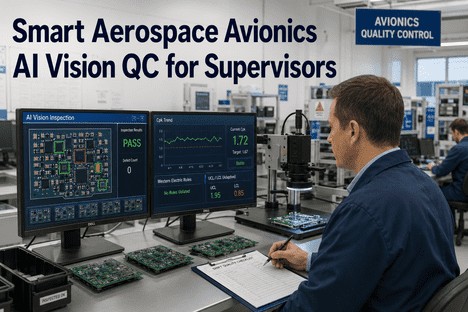
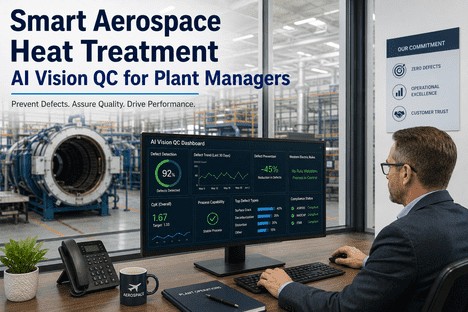
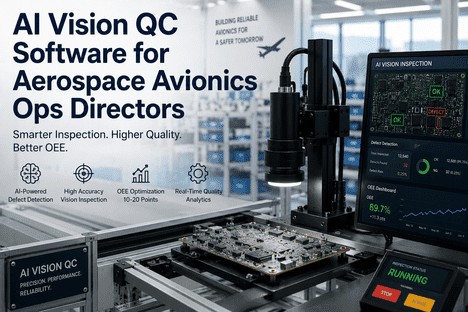
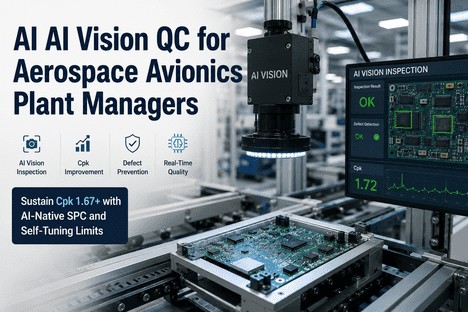
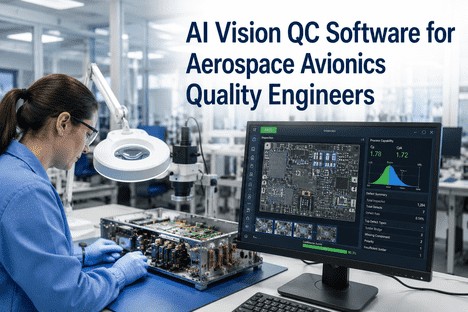
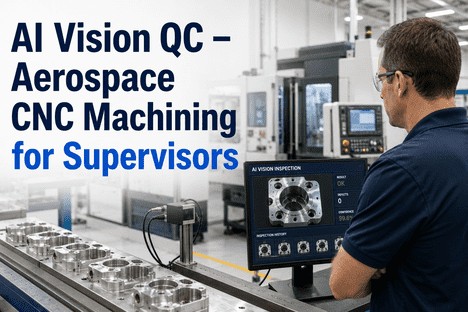
Smart Aerospace Avionics AI Vision QC for Supervisors
By Grace on June 15, 2026
Every avionics PCB crossing a reflow line carries hidden quality risk that end-of-line inspection cannot catch in time to prevent the defect. A BGA void forming beneath the component body where no AOI camera can see it. A 50-micron placement shift that passes electrical test but fails under vibration after 500 flight hours. A conformal coating pinhole that does not produce a failure until the assembly is deep into its service life. Shift supervisors managing these risks with static control charts calibrated months ago and visual inspection at the end of the line are working with a detection architecture that is structurally too slow for the throughput and quality demands of modern aerospace production. AI Vision Inspection changes the timeline: from hours of detection lag to real-time identification, from reactive sorting to proactive process adjustment, from defect management to defect elimination. This is what the technology delivers for avionics supervisors in 2026 — and why it is becoming the standard for aerospace electronics manufacturing.
AI Vision Inspection · Adaptive SPC · Real-Time Cpk · Western Electric Rules
Avionics Supervisors Are Sustaining Cpk 1.67+ With AI Vision Inspection — Not Static Control Charts.
iFactory's AI Vision Inspection platform gives shift supervisors real-time defect detection, self-tuning control limits that adapt to every production run, and live Western Electric rule monitoring across every avionics line — all in one quality intelligence layer built for aerospace.
Sustained Cpk on safety-critical avionics characteristics when AI vision inspection replaces manual sampling with 100% automated coverage
99%+
Defect detection accuracy of neural-network vision systems on avionics PCB assemblies — catching BGA voids, tombstoning, and cold solder joints at line speed
50-70%
False alarm reduction when adaptive control limits replace static UCL/LCL boundaries — restoring operator trust in every alert the system generates
3.5x
Inspection throughput improvement reported by aerospace shops deploying AI vision — converting hours of manual microscope inspection into seconds of automated classification per board
Why Avionics Inspection Is Where Aerospace Quality Is Won or Lost
Avionics assemblies are not ordinary electronics. A single solder joint failure in a flight-control module does not produce a warranty claim — it triggers an airworthiness investigation that cascades through the entire supply chain. The AS9100 and AS13100 frameworks exist precisely because the consequence of undetected defects in aerospace electronics is measured in safety risk, not dollars. And yet, the inspection methods most avionics lines still depend on — manual microscope review, end-of-line AOI with static pass-fail thresholds, and sampled X-ray inspection — all share the same structural limitation: they inspect after the value has been committed, when the only available action is sorting good product from bad rather than preventing the defect from occurring.
For the shift supervisor on the line, this creates an impossible tension. Production targets demand throughput. Quality requirements demand zero defects. The inspection system, positioned at the end of the process, can only report what already went wrong. The supervisor is left managing fallout — rework loops, containment decisions, deviation write-ups — instead of managing the process. AI Vision Inspection resolves this tension by moving detection from the end of the line into the middle of the process, where defects are still preventable. The supervisor's role shifts from firefighting to process stewardship, and the quality metrics that define success — Cpk, PPM defect rates, first-pass yield — begin moving in the direction that satisfies both production and quality.
The Four Avionics Defect Categories AI Vision Detects Before They Escape the Line
BGA and Solder Joint Defects
Bottom-terminated components hide their solder joints from traditional AOI. A BGA void exceeding IPC-7095 limits, a head-in-pillow defect, or a solder ball short can pass electrical test and fail months later under thermal cycling. AI-powered 3D AXI and multi-angle vision models detect volumetric void percentage, joint geometry anomalies, and coplanarity deviations per ball on every BGA array — delivering 100% inspection coverage where sampled X-ray was the previous best practice.
AI detection: Per-joint void measurement and geometry analysis. Alert fires on IPC limit approach, not after failure confirmation.
Component Placement and Orientation Errors
Pick-and-place offsets within specification on individual components can accumulate into functional failures in high-density designs. Tombstoning, skew, billboarding, and tombstone reversion are detectable at the individual component level by vision models trained on thousands of aerospace-grade assembly images. The model classifies each placement against the nominal position with sub-micron precision and flags deviations trending toward the specification limit before a single nonconforming placement is produced.
AI detection: Per-component placement classification with trending against spec limits, not against fixed pass-fail thresholds.
Conformal Coating and Contamination Defects
Conformal coating pinholes, insufficient coverage on high-voltage areas, and ionic contamination under components are among the most difficult defects to detect at production speed. Vision models trained on fluorescence and UV imaging detect coating thickness variation and pinhole defects that manual UV inspection under magnification would catch only on a sampled basis. Combined with process variable monitoring of spray parameters and cure profiles, the system correlates coating application conditions with downstream defect risk in real time.
AI detection: UV-fluorescence vision plus process variable fusion identifies coverage gaps and contamination risk during application, not after cure.
PCB Laminate and Trace Integrity Anomalies
Laminate delamination, trace undercut, and via barrel cracks are process-induced defects that originate in lamination, plating, and etching steps upstream of assembly. While the avionics line does not control those upstream processes, the defects appear in the incoming material stream and must be caught before assembly. Multi-spectral vision systems detect subsurface laminate anomalies and trace width variation that standard AOI would miss, flagging suspect material for supplier corrective action while preventing defective material from entering the production flow.
AI detection: Multi-spectral imaging identifies subsurface defects invisible to standard AOI. Supplier scorecards updated automatically.
How AI Vision Inspection Supercharges Cpk for Shift Supervisors
The Cpk target for safety-critical avionics characteristics is 1.67 — a threshold that sounds achievable until the realities of high-mix, high-volume aerospace production set in. A Cpk of 1.67 corresponds to 0.57 defects per million opportunities, or roughly one nonconformance per 1.75 million parts produced. Achieving that level of capability with manual inspection and static SPC is mathematically improbable for most operations. The variance introduced by human inspector fatigue, the detection gap between sampled inspection and 100% coverage, and the lag between a process shift and its detection on a control chart all contribute to a capability ceiling that most lines cannot break through.
AI Vision Inspection removes that ceiling by addressing all three constraints simultaneously. Machine vision provides 100% inspection coverage with consistent detection accuracy regardless of shift hour or operator rotation. Adaptive control limits recalculate UCL/LCL boundaries against the current process baseline rather than a quarter-old capability study. And real-time Western Electric rule evaluation — all eight rules on every monitored parameter every second — catches the pattern signals that precede a Cpk drop before the process shifts far enough to produce actual defects. The result is a control loop that operates fast enough for the supervisor to intervene at the process level rather than sorting nonconforming product at the inspection gate.
Static vs. Adaptive SPC — What Changes for the Shift Supervisor
Static Control Limits
Limits calibrated once per capability study — typically quarterly. Every product mix change, line setup adjustment, and shift handoff operates against limits that no longer reflect current process conditions.
Product mix transitions generate high false-alarm rates as the new process mean conflicts with old UCL/LCL boundaries — eroding operator trust in alerts and encouraging alarm fatigue over weeks.
Western Electric rules require manual application. In practice, most supervisors evaluate Rule 1 (point beyond 3-sigma) and miss the pattern-based rules that signal gradual drift before it reaches the control limit.
Control limit change documentation is manual, often deferred, and creates AS9100 audit risk when the rationale behind a limit adjustment cannot be reconstructed from the record.
Adaptive Self-Tuning Limits (iFactory)
Limits recalibrate continuously against a rolling model of the current process — every product mix change, reflow profile adjustment, and material lot transition is absorbed into the current control boundary automatically.
Regime transitions are detected and managed — the system suppresses alert generation during the transition window to eliminate false alarms, then resets to the new baseline before resuming full sensitivity with the correct UCL/LCL.
All eight Western Electric rules evaluated on every parameter every second — trend detection (Rule 5), stratification (Rule 6), alternation (Rule 7), and mixture (Rule 8) included by default, not as an optional add-on.
Every limit recalculation automatically logged with timestamp, triggering condition, prior and new limit values, and statistical basis — producing AS9100-compliant audit documentation with zero manual effort.
The Supervisor's Quality Intelligence Platform: What AI Vision Delivers on Every Shift
The iFactory platform delivers AI Vision Inspection across three operational layers — real-time line monitoring, predictive quality forecasting, and supervisory visibility — each designed for a different decision horizon. All three run simultaneously and feed into a single quality record that is AS9100 audit-ready from the first shift of deployment.
Real Time
AI Vision Line Monitoring
100% visual coverage — what every microscope inspection misses between samples
Multi-camera stations positioned after reflow, placement, and coating application capture continuous image streams that the AI model analyses for solder joint anomalies, component offset, coating defects, and contamination. Every detection is logged with a timestamp, a board serial number, a defect classification, and a severity score — creating a 100% inspection record for every board, every shift, and every product run. Neural network classification achieves above 99% accuracy on avionics defect types in real-time production conditions, including the lighting variation and board reflectivity challenges that defeat standard vision systems. Multi-spectral imaging supplements visible-light cameras for subsurface and coating inspection, maintaining detection reliability across the full product mix regardless of board colour, component density, or surface finish variation.
100% board coverage
Multi-spectral imaging
99%+ defect detection
Predictive
Quality Risk Forecasting
Cpk trend alerts before the process shifts past the spec limit
The predictive ML model is trained on historical pairings of vision-detected defect patterns, process parameter streams — reflow profile temperature, placement force, solder paste volume — and downstream electrical test outcomes. When the current combination of signals matches a historical pattern associated with a Cpk drop or quality escape, the system generates a risk forecast before the next batch completes. For the shift supervisor, this creates a decision window measured in shifts, not hours: enough time to adjust the reflow profile, verify solder paste deposition parameters, or quarantine suspect material for additional inspection before the defect is committed to the next operation. Forecast accuracy in comparable aerospace electronics deployments reaches 94% — a performance level that converts predictive output into a primary process control input rather than an advisory signal.
Shift-ahead forecasting
94% forecast accuracy
Process adjust workflow
Supervisory
Shift Performance Visibility
Cpk by line, defect Pareto by shift, and AS9100 audit export on demand
The supervisory dashboard aggregates Cpk trends, defect frequency, first-pass yield, and alarm activity across all active lines into a single shift management view — designed for supervisors who need line-level visibility rather than machine-level process data. Cpk trends are displayed against the AS9100 minimum threshold of 1.67, segmented by product type, shift, and line, so the pattern behind recurring defect categories is visible without manual data compilation. CAPA effectiveness tracking links every corrective action to the alert that generated it and monitors the subsequent defect rate to confirm whether the intervention prevented recurrence. AS9100 audit documentation — control limit histories, defect event logs, CAPA records, and Cpk trend exports — is generated automatically and available for any date range at a single export click.
Real-time Cpk tracking
CAPA closed-loop tracking
One-click AS9100 export
The COPQ Equation in Aerospace Avionics Assembly
Shift supervisors managing defect reduction through scrap rate percentage alone are working with a partial view of quality cost. The American Society for Quality's Cost of Poor Quality framework documents that COPQ reaches 15-20% of total revenue when internal failures, external failures, appraisal costs, and prevention costs are fully accounted for. In an avionics operation generating $50M annually, that represents $7.5-10M in recoverable margin — the portion of the operation's financial performance that is directly attributable to quality failures and the systems built to detect them after the fact.
Internal Failure
Scrap PCBs, rework labor, board re-inspection, production hold costs, and material write-offs incurred before product ships. The most visible COPQ category — and the one AI Vision Inspection most directly reduces by catching defects at the point of origin rather than at end-of-line.
External Failure
Customer rejections, escape notification costs, containment sort activities, and penalty clauses activated when defects reach the customer. External failure costs in aerospace typically run 10x higher than equivalent internal failure costs — making escape prevention the highest-value application for vision-based detection.
Appraisal Costs
Manual microscope inspection labor, AOI programming and maintenance, X-ray sampling, and quality audit preparation costs. AI machine vision converts appraisal cost from labor-intensive sampling to automated 100% coverage — with higher detection reliability and a complete, traceable inspection record for every board.
Prevention Costs
SPC programme administration, training, process capability studies, and quality system maintenance. Adaptive SPC with automated documentation reduces the administrative burden of maintaining the prevention programme — making the total prevention investment more efficient as well as more effective for sustaining Cpk 1.67+.
"
We were inspecting quality at the end of the line and wondering why our Cpk never broke past 1.33. The data was telling us the process was shifting, but by the time the control chart flagged the shift, we had already committed three more batches through reflow. AI vision changed the sequence: now we detect the solder paste volume drift at the printer, adjust the stencil parameters before the next board, and watch the Cpk trend climb in real time. Our last AS9100 audit, the registrar commented that our control limit documentation was the cleanest they had seen in a shop of our size. That documentation writes itself now — the platform generates it automatically from every shift's production data.
What Implementation Looks Like — From Camera Mounting to Cpk Dashboard
Shift supervisors evaluating AI Vision Inspection consistently ask the same question: how long before the system is generating actionable data on my line? The answer depends on line configuration and data availability, but the implementation pathway follows a consistent structure regardless of shop size or product mix.
PHASE 1 — WEEKS 1-3
Camera Commissioning and Model Training
Vision camera mounting at critical inspection points — post-reflow, post-placement, post-coating — with lighting calibration for the specific board finishes and component types on the line. AI model fine-tuned on the shop's defect library. Minimum 500 known-good and known-defective board images per defect class for reliable initial classification. Integration with existing MES for board serial number tracking and defect data association.
Deliverable: Vision stations live with defect classification active and baseline Cpk established.
PHASE 2 — WEEKS 4-5
Adaptive SPC Activation and Shadow Mode
Self-tuning control limits activated and all eight Western Electric rules enabled on every monitored parameter. The system runs in shadow mode alongside existing quality processes, generating alerts that the supervisor reviews but does not use for process intervention. This 2-week validation period builds trust in the platform's detection accuracy and demonstrates false alarm reduction against the static limits in current use.
Deliverable: Accuracy validation report with site-specific false alarm reduction data against baseline static limits.
PHASE 3 — WEEK 6+
Live Quality Control and Cpk Monitoring
Vision inspection and adaptive SPC alerts become primary inputs for process adjustments, material quarantine decisions, and maintenance scheduling. Cpk tracking activates against the 1.67 target — trend visibility, defect Pareto by shift, and first-pass yield are tracked continuously on the supervisory dashboard. AS9100 documentation generation is active from the first day of this phase.
Deliverable: Live Cpk dashboard with AS9100-compliant audit documentation active for every shift.
Conclusion
Avionics assembly lines produce the aerospace industry's most tractable quality signals — continuous vision data streams from every board, repeatable process parameters at every station, and a direct cause-effect link between upstream process variation and downstream electrical test outcomes. The obstacle has never been the absence of signal. It has been the absence of a detection architecture fast enough to convert that signal into a process adjustment before the defect is committed to the next operation. AI Vision Inspection closes that gap at every level simultaneously: machine vision that provides 100% board inspection coverage, adaptive self-tuning control limits that eliminate the false alarm noise drowning genuine drift signals, and Western Electric rule evaluation on every parameter every second — catching pattern-based drift signals before a single nonconforming board is produced.
The documented outcomes across aerospace electronics operations making this transition are consistent: Cpk improvement from below 1.33 to sustaining 1.67+, 50-70% false alarm reduction, 30-60% defect reduction on avionics assemblies, and audit documentation quality that earns registrar recognition rather than corrective action findings. Shift supervisors who have deployed AI-driven vision inspection in their avionics lines consistently report the same finding: the defect signals were visible in the data the entire time. The platform made them readable, rankable, and actionable at a speed the production cycle can use.
iFactory's AI Vision Inspection platform is built for aerospace avionics operations where Cpk 1.67+ is the baseline — not the target. Book a Demo to see the platform configured for your avionics line and product mix, or talk to an expert about a free COPQ reduction assessment for your operation.
Frequently Asked Questions
High-density avionics boards with multiple board finishes — ENIG, HASL, OSP, immersion silver — create reflectivity and contrast variation that defeats standard vision systems. iFactory's multi-modal imaging architecture addresses this through adaptive illumination calibration calibrated per board type during the model training phase. Each board finish and component density profile is associated with a specific lighting configuration — angle, intensity, spectrum — that the system selects automatically when the board serial number is scanned. The AI model is trained on images captured under each lighting configuration, so the classification layer receives an optimised image regardless of surface finish. For ultra-high-density assemblies with bottom-terminated components, the system triggers 3D AXI inspection automatically based on the board's component map, ensuring BGA and QFN joints are inspected with volumetric imaging rather than visible-light-only analysis. Talk to an expert about vision configuration for your specific avionics board types.
The adaptive limit model is designed to declare regime uncertainty rather than generate misleading Cpk calculations during product transitions. When a product changeover is registered in the MES, the platform enters a managed transition window — configurable from 30 minutes to 4 hours depending on the line's stabilisation time after changeover. During this window, Cpk values are flagged as transitional and all eight Western Electric rules continue evaluating with widened alert thresholds to avoid false alarms from the regime shift itself. As the new product's data accumulates, the self-tuning limits calibrate to the new baseline and Cpk tracking returns to full sensitivity. Every transition event is logged with product code, changeover duration, and limit recalculation timestamps — providing the audit documentation that demonstrates the quality programme actively managed the transition rather than ignoring it. Book a Demo to see changeover transition management configured for a high-mix avionics production programme.
Yes. iFactory's pre-deployment COPQ assessment uses the operation's existing quality records — defect frequency by category, scrap PCB counts, rework labor hours, inspection headcount, and customer escape history — to build a site-specific model of current COPQ and estimate the financial impact of transitioning to AI-driven vision inspection. The assessment identifies the highest-cost defect categories, estimates what detection lead time those categories require to prevent escape, and maps that requirement to what the platform's real-time vision and adaptive SPC capability would have delivered against the historical record. For most avionics operations, this produces a conservatively estimated COPQ reduction range that can be used directly in an investment case. The assessment is available at no cost as part of the initial engagement process. Talk to an expert to request a COPQ reduction assessment for your avionics line.
iFactory connects to existing MES, AOI systems, and electrical test equipment through standard industrial protocol connectors and REST APIs — OPC-UA, Modbus, SECS/GEM, and SQL-based historian connectors — without requiring changes to the existing production architecture. The platform reads inspection results from existing AOI stations and supplements them with AI vision data from the newly commissioned camera stations, creating a unified defect record that spans both legacy and new inspection points. Test equipment data from flying probe, ICT, and functional test systems is ingested through the same integration layer, closing the loop between vision-detected defect patterns and electrical test outcomes. AS9100 traceability is maintained across all data sources with a single board serial number key. No infrastructure replacement is required. The typical integration scope is completed during the Phase 1 commissioning window. Book a Demo to review the integration architecture for your specific MES and test equipment environment.
Your Avionics Line Already Contains Tomorrow's Cpk Signal. Calculate What Finding It a Shift Earlier Is Worth to Your Operation.
iFactory's AI Vision Inspection for aerospace avionics — machine vision defect detection, adaptive SPC with all eight Western Electric rules, real-time Cpk monitoring, and AS9100 audit documentation, all running from a single quality intelligence platform that deploys without replacing your existing infrastructure.