Environmental Compliance Record Management for Biogas Plants
By Talon on June 9, 2026
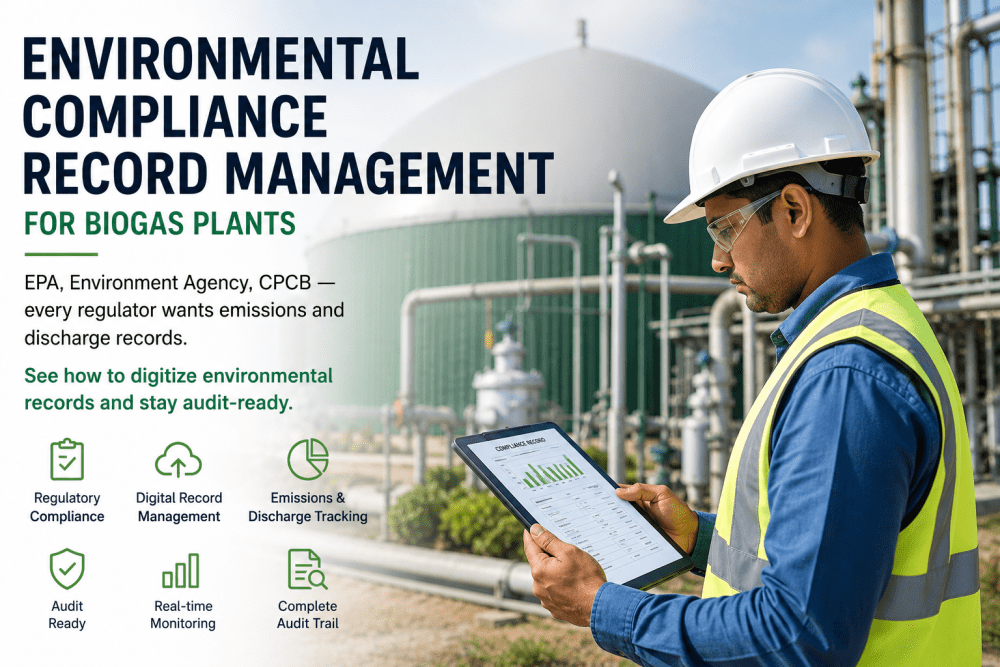
Biogas plants operating across North America and Europe face an expanding web of environmental compliance obligations that span air emissions, water discharge, waste handling, odor control, and greenhouse gas reporting. The EPA's Renewable Fuel Standard, the Clean Air Act, the Clean Water Act, and state-level environmental agencies each impose distinct recordkeeping and reporting requirements that demand systematic documentation management. For anaerobic digestion facilities processing livestock manure, food waste, or municipal biosolids, the compliance burden is compounded by feedstock variability and seasonal operational changes that affect emissions profiles and discharge characteristics. Most biogas plant managers still manage environmental records through spreadsheets, PDF filing systems, and manual logbooks that create audit risk, reporting delays, and operational blind spots. iFactory's environmental compliance platform digitizes the full record lifecycle — from sensor-level emissions data and discharge monitoring to automated report generation and audit-ready documentation — in a single unified system designed for biogas and RNG operations. To see how iFactory automates environmental compliance records for biogas plants, book a demo.with our environmental compliance team today
Environmental Compliance — 2026
Environmental Compliance Record Management for Biogas Plants
Digitize emissions monitoring, discharge records, waste tracking, and regulatory reporting into a single audit-ready compliance platform. No spreadsheets. No missing records. No audit surprises.
Average time biogas plant environmental managers spend manually compiling compliance data from disparate sources — sensors, lab reports, operations logs — before a single report can be submitted to the regulating authority
35% of audits
Share of biogas plant environmental audits that identify at least one recordkeeping deficiency — missing emissions data, incomplete discharge logs, or unreported process changes — that could result in penalty exposure
Multiple regulators
Biogas plants in the U.S. may report to EPA (RFS, CAA, CWA), state environmental agencies, local air districts, and voluntary carbon credit programs — each with different formats, deadlines, and record retention requirements
What Environmental Records Biogas Plants Must Maintain
The environmental compliance record landscape for biogas plants spans six primary regulatory domains, each with specific documentation requirements, retention periods, and reporting cadences. Understanding the full scope of required records is the first step toward building a digitized compliance management framework that eliminates audit gaps and reporting delays. For plant managers evaluating digital compliance platforms, Book a Demo to benchmark your current recordkeeping against iFactory's compliance framework.
01
Air Emissions and Odor Records
Continuous emissions monitoring data for pollutants including hydrogen sulfide, ammonia, volatile organic compounds, and particulate matter. Odor management plans, complaint logs, and dispersion modeling records. Greenhouse gas reporting under EPA's Mandatory Reporting Rule (40 CFR Part 98) for facilities exceeding 25,000 MT CO2e per year, including methane slip quantification.
Regulatory Driver: Clean Air Act, EPA GHGRP, State Air Permits
02
Water Discharge and Groundwater Monitoring
National Pollutant Discharge Elimination System (NPDES) permit compliance records including effluent monitoring reports, pH and temperature logs, biochemical oxygen demand, total suspended solids, and nutrient concentrations. Groundwater monitoring well data for facilities with process water lagoons or digestate storage. Stormwater pollution prevention plan (SWPPP) inspection records and sampling data.
Regulatory Driver: Clean Water Act, NPDES, State Surface Water Standards
03
Feedstock and Digestate Management Records
Feedstock receiving logs with source, quantity, and characterization data. Pathogen reduction and vector attraction reduction documentation for biosolids-derived feedstocks. Digestate quality testing records including nutrient content, heavy metals, and pathogen indicators. Land application records with field location, application rates, and setback distances.
Regulatory Driver: 40 CFR Part 503 (Biosolids), State Nutrient Management Plans
04
Waste and Byproduct Tracking
Hazardous waste determination records, used oil management logs, and non-hazardous solid waste disposal records. Siloxane and other contaminant removal media disposal documentation. Laboratory waste disposal records for on-site testing facilities. All waste manifests and disposal receipts retained per EPA recordkeeping requirements.
Regulatory Driver: RCRA, State Solid Waste Regulations
05
Operational and Process Compliance Records
Digester operating parameter logs — temperature, pH, volatile solids loading rate, hydraulic retention time — that demonstrate consistent process control. Alarm and upset event records with root cause analysis and corrective action documentation. Emergency shutdown and bypass event records. Fugitive methane emissions monitoring data from equipment leak detection and repair programs.
For RNG injection facilities, the compliance record includes RIN generation documentation under EPA's Renewable Fuel Standard — including feedstock supply chain verification, methane concentration data, energy content calculations, and injection point quality verification records. LCFS credit generation documentation under California's Low Carbon Fuel Standard or Oregon's Clean Fuels Program with carbon intensity pathway verification.
Want to evaluate your plant's environmental compliance recordkeeping against regulatory requirements? Book a 30-minute compliance record audit with iFactory's environmental compliance engineering team.
How Environmental Compliance Records Are Collected and Reported
The operational value of a digitized compliance platform is best understood through the specific record types that biogas plants must maintain and the reporting pathways they feed into. The table below maps the major compliance record categories to their collection methods, reporting frequencies, and the consequences of non-compliant recordkeeping for a typical 5,000 SCFM biogas upgrading facility.
Compliance Record Type
Collection Method
Reporting Frequency
Non-Compliance Risk
Continuous Emissions Monitor Data
Online gas analyzers (H2S, NH3, CH4, NOx) with 15-minute averaging
Quarterly emissions reports to state air agency; annual GHGRP to EPA
$15K–$50K per violation; increased inspection frequency
Effluent Discharge Monitoring Reports
Online flow meters and composite samplers at discharge point; weekly grab samples for pH and temperature
Monthly DMR submission to EPA or authorized state agency
$10K–$37.5K per day per violation for NPDES non-compliance
Feedstock and Digestate Records
Weight tickets, lab analysis reports, land application field logs
Annual report to state agency; records retained for minimum 5 years
Permit suspension risk; land application restrictions
RIN and LCFS Documentation
Gas chromatograph data, flow meter totals, feedstock supply chain verification
Quarterly RIN generation reports; annual LCFS pathway verification
RIN invalidation, credit value loss ($50K–$200K per quarter)
Fugitive Emissions LDAR Records
Quarterly or semi-annual leak detection surveys using optical gas imaging
Annual fugitive emissions report; repair records within 30 days of detection
$7.5K–$25K per day for delayed repairs; methane credit value loss
Interested in automating your compliance record collection across all six domains? Book a demo with iFactory's environmental compliance team to see how the platform connects sensors, lab data, and operational records into a single audit-ready system.
Manual Recordkeeping vs. Digital Compliance Management
The choice between manual environmental recordkeeping and a digitized compliance platform is not primarily about software preference — it is about the structural difference between reactive compliance management and proactive compliance assurance. The comparison below makes the operational gap explicit across the dimensions that matter most for biogas plant environmental managers facing multi-regulator reporting obligations.
Manual Recordkeeping
Best For
Small facilities with single permits and limited regulatory exposure
Strength
Low up-front cost; no software investment
Limitation
Data silos between sensors, lab, and operational logs create record gaps; manual report assembly hours per cycle
Staff Time
5–8 hours per week on data compilation and report formatting
Audit Risk
35% audit deficiency rate from missing or inconsistent records
vs
Digital Compliance Platform
Best For
Multi-permit facilities with several regulatory programs and RIN/LCFS obligations
Strength
Continuous data aggregation, automated report generation, always audit-ready
Limitation
Requires initial configuration and sensor integration; ongoing platform subscription
Staff Time
45–60 minutes per week on compliance data review and validation
Audit Risk
Less than 5% deficiency rate with continuous quality monitoring and gap detection
5–8 hrs
Weekly Staff Time Recovered
From manual data compilation and report assembly displaced by automated compliance record aggregation — returned to operational management and process optimization
90%
Faster Report Generation
Average time reduction for quarterly emissions reporting and annual compliance documentation — from days of manual assembly to minutes of automated report generation
85%
Fewer Audit Findings
Share of compliance audits with zero recordkeeping deficiencies after platform deployment — vs. 35% deficiency rate under manual recordkeeping systems
Day 5
Typical First Report Generated
Average time from sensor integration completion to first automated compliance report — no manual data entry required for standard reporting formats
100%
Record Retention Compliance
All records automatically retained for the full regulatory retention period with immutable audit trail — no risk of premature deletion or misplaced documentation
5+
Regulatory Programs Supported
Single platform covering CAA, CWA, RCRA, RFS, LCFS, and state-level environmental programs — eliminating multi-system data management and report duplication
See Your Compliance Records Automatically Assembled in One Dashboard
iFactory's environmental compliance demo walks through real biogas plant scenarios — connecting continuous emissions monitors, discharge sampling data, feedstock records, and RIN documentation into a single audit-ready compliance system.
Expert Review: What Environmental Managers Say About Digital Compliance Record Management
Expert Perspective
I have managed environmental compliance for anaerobic digestion and landfill gas facilities for over fifteen years. For most of that career, the fundamental challenge was not understanding what the regulations required — it was proving to regulators that we met those requirements with records that could survive an audit. The records themselves existed: continuous emissions monitor data in the CEMS data acquisition system, laboratory results in the LIMS, operational parameters in the SCADA historian, feedstock records in the scale house logs, and RIN documentation in the compliance team's file system. But each system had its own data format, its own retention schedule, and its own access method.
The platform's ability to connect directly to continuous emissions monitors and discharge sampling systems determines whether compliance data is truly automated or still requires manual data entry. A platform that requires manual CSV uploads from the CEMS data acquisition system is not an automated compliance system — it is a spreadsheet replacement with a better interface. The integration should read directly from the CEMS via Modbus or OPC-UA, pull lab results from the LIMS through API, and synchronize with the SCADA historian for operational context — all without manual intervention. Before committing to any platform, verify the specific sensor interfaces and data system integrations that are supported for your facility's instrument and software configuration.
Report generation flexibility determines whether the platform actually saves time or just shifts the formatting burden. Every environmental program has a different reporting format — EPA's GHGRP uses e-GGRT, NPDES DMRs use state-specific forms, RIN reports use EPA's Moderated Transaction System, and LCFS credits use CARB's reporting portal. A platform that generates reports in the exact format required by each regulatory system — rather than producing a generic data export that still requires manual reformatting — is the difference between 90% time reduction and only 30%. Verify that your specific reporting formats are supported before deployment.
The most important capability for multi-regulator compliance is automated cross-referencing between related records. When an air emissions report references a process upset event that occurred during the reporting period, the compliance record should automatically link those records so that an auditor can see the emissions data, the upset event log, and the corrective action documentation in a single view. This cross-referencing capability transforms compliance from a collection of disconnected records into a coherent operational narrative — and it is the capability that consistently receives the most positive feedback from regulatory inspectors during audits at facilities using digital compliance platforms.
Environmental Compliance ManagerAnaerobic Digestion and Landfill Gas Operations — U.S. Midwest — 15 Years in Biogas Environmental Compliance — Certified Environmental Manager (CEM)
Conclusion
The environmental compliance record burden for biogas plants is not going to decrease. EPA, state environmental agencies, and voluntary carbon credit programs are all moving toward more frequent reporting, more granular data requirements, and more rigorous audit enforcement. Facilities that manage compliance records through disconnected spreadsheets, manual logbooks, and PDF filing systems face escalating staff time requirements, growing audit risk, and potential penalty exposure that can reach tens of thousands of dollars per violation.
The platform automates report generation for EPA, state, and voluntary program requirements — in the exact format each regulator requires — and maintains an immutable audit trail that survives inspector scrutiny. For biogas plant managers, the return on investment is measured in staff time recovered, audit findings eliminated, and the confidence that every environmental record required by regulation is complete, accurate, and instantly accessible. Book a Demo with iFactory's environmental compliance team to build a digitized compliance roadmap for your biogas facility.
Frequently Asked Questions
Biogas plants must maintain records spanning six primary domains: continuous emissions monitoring data (H2S, NH3, CH4, NOx, CO2e), water discharge and groundwater monitoring records (NPDES DMRs, pH, BOD, TSS, nutrients), feedstock and digestate management records (source documentation, pathogen reduction verification, land application logs), waste tracking documentation (hazardous waste determinations, disposal manifests), operational process records (digester parameters, upset events, LDAR surveys), and RIN/LCFS documentation for RNG injection facilities. Record retention periods vary from 3 years (GHGRP) to 5 years (RFS, NPDES) to permanent (RCRA). iFactory's platform automatically retains all records for the full retention period with immutable audit trail and automated archival notifications when retention periods approach expiry.
iFactory's environmental compliance platform integrates with all major continuous emissions monitoring systems through standard industrial communication protocols — Modbus RTU and TCP, OPC-UA, analog (4-20 mA), and digital outputs. Discharge monitoring system integration covers online analyzers (pH, temperature, flow, turbidity, ammonia) and auto-sampler data through the same protocols. Laboratory information management system (LIMS) integration is available through REST API for facilities using commercial LIMS platforms, and through structured CSV/Excel import for smaller facilities using lab-provided electronic data deliverables. The platform also ingests operational data from SCADA historians and process control systems to provide the operational context required for comprehensive compliance documentation. All data is synchronized to a unified timestamp and automatically quality-checked for out-of-range values, missing data intervals, and instrument status flags before being committed to the compliance record.
Yes. iFactory's compliance platform includes pre-built report templates for EPA's Greenhouse Gas Reporting Program (e-GGRT), NPDES discharge monitoring reports (EPA and state-specific formats), Renewable Fuel Standard RIN generation reports (EPA MTS format), and Clean Air Act emissions inventory reports. For state-specific reporting requirements, the platform's flexible report builder allows environmental managers to configure custom report templates matching any state agency format. All generated reports include quality-checked data with traceability to the original sensor readings or lab results, eliminating the manual data validation step that consumes a significant portion of compliance reporting time. The platform also supports automated report scheduling — quarterly emissions reports, monthly DMRs, annual GHGRP submissions — with email notification to the responsible manager for review before submission.
The platform includes a structured upset event and deviation module that captures the full lifecycle of any event that results in operations outside permitted conditions. When a parameter exceeds its permitted range — for example, an emissions reading above the permitted limit or a discharge parameter outside the NPDES permit range — the platform automatically generates an event record with the affected parameter, duration, magnitude of deviation, and any associated sensor data. The environmental manager adds root cause analysis, corrective actions taken, and regulator notification documentation through a structured interface that ensures complete records for audit review. The module also tracks bypass events — periods when gas is flared rather than upgraded or digestate is diverted to backup storage — with automated duration tracking and regulatory notification deadline counts. All upset and deviation records are cross-linked to the corresponding emissions, discharge, and operational data in the compliance record, providing auditors with a complete event narrative rather than disconnected data points.
A complete environmental compliance digitization deployment — including sensor and data system integration, compliance record configuration, report template setup, and staff training — typically requires 6 to 10 weeks for a single biogas facility. Phase 1 (weeks 1–3) covers integration with continuous emissions monitors, discharge sampling systems, and SCADA historian data with initial data validation. Phase 2 (weeks 4–6) covers configuration of compliance records for each regulatory program — air emissions, water discharge, feedstock, waste, operational, and RIN/LCFS — with automated report template deployment. Phase 3 (weeks 7–10) covers staff onboarding, parallel operation with existing recordkeeping, audit simulation, and full operational transition with ongoing support. For facilities with multiple injection points or complex multi-regulator compliance obligations, the timeline extends to 10–14 weeks. Book a Demo to begin a compliance digitization assessment for your biogas facility.
Give Your Environmental Team 5–8 Hours Back Every Week
iFactory's environmental compliance platform digitizes emissions monitoring, discharge records, feedstock tracking, and RIN documentation into a single audit-ready system — eliminating manual data compilation and report assembly for biogas plants across North America.