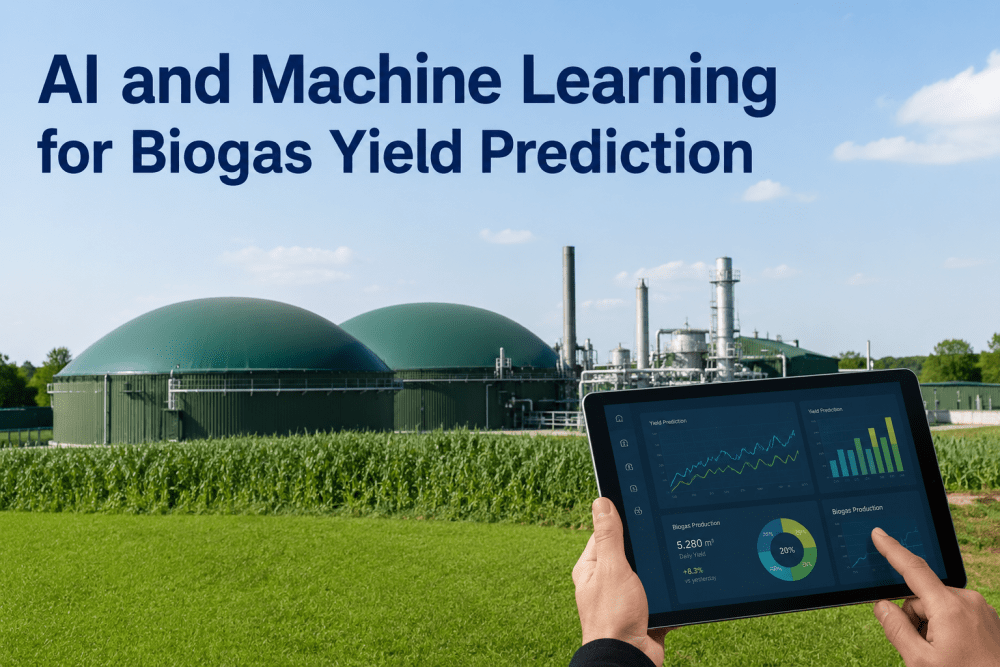
Predicting biogas output from anaerobic digestion has always been a guessing game—until now. Machine learning models trained on historical process data and real-time sensor feeds are replacing reactive monitoring with predictive intelligence, enabling plant operators to forecast methane yield hours or days in advance, catch process anomalies before they spiral into costly shutdowns, and continuously optimize digester performance. Whether you run a municipal wastewater treatment facility or an industrial-scale food waste digester, ML-powered analytics are becoming essential for maximizing energy recovery and maintaining process stability. Schedule a free demo to see how ML-powered prediction can optimize your biogas plant output.
Proven by Research
R² = 0.95
Highest documented prediction accuracy achieved by CatBoost models on industrial-scale anaerobic digesters processing kitchen food waste
24hr
Forecast window for proactive yield management
85%+
Digester upsets detected before yield impact
2,200+
Biogas production sites across the United States
How Anaerobic Digestion Prediction Works with AI
Anaerobic digestion converts organic waste into biogas through a cascade of microbial processes—hydrolysis, acidogenesis, acetogenesis, and methanogenesis. Each stage responds differently to temperature shifts, pH changes, feedstock variability, and organic loading rates. Traditional kinetic models like ADM1 require extensive calibration and detailed substrate composition data that most facilities simply do not have. Machine learning sidesteps this limitation entirely by learning patterns directly from your operational history, capturing the complex nonlinear relationships that mechanistic models miss.
The Problem
Why Traditional Biogas Monitoring Falls Short
Most biogas facilities rely on periodic lab sampling performed two to three times per week, manual spreadsheet tracking, and static operating setpoints that remain unchanged regardless of feedstock quality or seasonal variation. This approach means that by the time operators detect a drop in gas production, the digester may already be acidified—requiring days or weeks of recovery. Research shows that facilities using manual monitoring alone leave 15 to 30 percent of their yield potential unrealized.
The Solution
Data-Driven Prediction in Real Time
ML models ingest continuous streams from SCADA systems, IoT sensors, and lab results to build dynamic baselines that adapt to your specific digester. Instead of waiting for problems to surface, the system forecasts yield 24 hours ahead, flags anomalies within minutes of onset, and recommends optimal feeding schedules and temperature setpoints. Operators move from firefighting to fine-tuning—and the digester rewards them with consistently higher gas output.
Ready to move from reactive monitoring to predictive control? See how ML analytics integrates with your existing SCADA infrastructure.
Best Machine Learning Algorithms for Methane Yield Forecasting
Not all ML algorithms perform equally on biogas data. Peer-reviewed research across dozens of lab-scale and industrial facilities has identified which models deliver the strongest predictive accuracy—and the trade-offs each one carries. Choosing the right algorithm depends on your data volume, feedstock complexity, and whether you need simple forecasting or full real-time anomaly detection.
01
Gradient Boosting (XGBoost / CatBoost / LightGBM)
R² up to 0.95
Best for industrial data
Iteratively builds weak decision trees that correct each other's errors, producing highly accurate ensemble predictions. CatBoost demonstrated the strongest overall performance on full-scale dry anaerobic digesters, while XGBoost excels when combined with SHAP-based feature importance analysis for model interpretability.
02
Artificial Neural Networks (ANN / MLP)
R² up to 0.97
Most widely studied
The most commonly used ML approach in biogas research. Multilayer perceptron architectures capture complex nonlinear relationships between digester inputs and methane output. A neural network model using high-resolution SCADA data achieved a mean absolute percentage error of just 13.4 percent on holdout test data from a municipal co-digestion facility.
03
Random Forest (RF)
R² 0.74–0.92
Robust with noisy data
Ensemble of independently trained decision trees that handles missing values and noisy industrial data gracefully. Provides built-in feature importance rankings so operators can see which process variables matter most. Achieved the best prediction accuracy of R² = 0.92 in one industrial-scale study comparing five different algorithms.
04
LSTM and Deep Recurrent Networks
Time-series specialist
Captures temporal lag
Long short-term memory networks model how yesterday's feeding pattern affects tomorrow's gas production—essential for capturing the biological lag inherent in anaerobic digestion. Ideal when minute-level SCADA data is available and the goal is multi-step forecasting rather than single-point prediction.
05
Support Vector Regression (SVR) and ANFIS
R² 0.83–0.87
Small dataset friendly
SVR finds optimal hyperplanes for regression with limited training samples, while ANFIS combines fuzzy logic with neural learning to handle the inherent uncertainty in biological processes. Both are effective for lab-scale studies or pilot plants where data volumes are modest compared to full-scale industrial operations.
Data Requirements for Accurate Biogas Yield Prediction
The single biggest factor determining whether your ML model succeeds or fails is the quality of input data. Research consistently shows that certain process variables carry far more predictive power than others—and that smarter feature engineering often matters more than choosing a fancier algorithm.
Feedstock Volume / Biomass Amount
Highest feature importance across nearly all published studies. Directly determines the organic load available for microbial conversion.
COD (Chemical Oxygen Demand)
Strong predictor of methane potential. SHAP analysis revealed it as a top-3 driver in multiple industrial deployment studies.
Digester Temperature
Controls microbial activity rate and determines whether the system operates in mesophilic or thermophilic regimes.
Volatile Solids (VS) and Total Solids (TS)
Measures biodegradable organic content. Core denominator for yield calculations and key input for normalization.
pH and VFA/Alkalinity Ratio
Early warning indicators for process instability. VFA/ALK ratio is the primary input for soft-sensor anomaly detection models.
Retention Time and Organic Loading Rate
Operational parameters that affect how thoroughly feedstock is digested. Important for models correlating process health with output.
Feature Engineering Matters More Than Model Choice
In a landmark municipal co-digestion study, 11 out of the 15 most important model features were calculated from raw SCADA outputs—not raw values themselves. Rolling averages, rate-of-change indicators, and time-lagged variables transformed noisy sensor readings into powerful predictors. Before investing in complex deep learning, ensure your data pipeline includes these engineered features.
Get Support now to access automated feature engineering tools built for anaerobic digestion data.
Real-Time Biogas Monitoring with Predictive Analytics
Deploying ML models is not a one-time event—it is a continuous loop of data ingestion, prediction, validation, and retraining that keeps your forecasts accurate as feedstock and conditions evolve over months and years.
Phase 1
Sensor and SCADA Data Integration
Flow meters, temperature probes, pH sensors, and gas analyzers feed data at intervals from sub-second to every few minutes into a centralized data lake. Industrial protocols like Modbus and OPC-UA ensure compatibility with existing metering infrastructure across your entire plant.
Phase 2
Automated Preprocessing and Imputation
Missing values are imputed using KNN-based estimators that achieve R² of 0.91 on validation sets. Outliers are flagged, gaps are filled, and engineered features—rolling averages, lag variables, rate-of-change metrics—are computed automatically before model inference.
Phase 3
Model Inference and Yield Forecasting
Trained ML models generate yield predictions for 24-hour and weekly horizons. Ensemble voting combines multiple algorithms—gradient boosting, neural networks, and random forests—to produce more robust forecasts than any single model alone.
Phase 4
Anomaly Alerts and Operator Dashboards
When actual readings deviate from predicted baselines, the system triggers graduated alerts—informational, caution, and critical—delivered via dashboard, SMS, and email. SHAP-based explanations accompany every alert so operators understand why the model flagged an issue.
Ongoing
Continuous Retraining and Adaptation
Models retrain monthly on accumulated new data, adapting to seasonal feedstock changes, equipment aging, and operational shifts. Performance metrics are tracked continuously to ensure prediction accuracy remains within acceptable bounds.
See real-time biogas prediction in action. Our team will walk you through live dashboards and anomaly detection workflows tailored to your digester type.
Anomaly Detection in Anaerobic Digestion: Early Warning Systems
Beyond yield forecasting, ML models serve as intelligent sentinels that scan every data point for deviations signaling emerging problems—often detecting issues 12 to 72 hours before they become visible through conventional lab testing.
VFA Accumulation and Acidification
Warning: 12–48 hours before pH crash
Soft-sensor models predict VFA/alkalinity ratio from routine monitoring data without waiting for lab results. The CatBoost algorithm achieved R² between 0.62 and 0.77 for VFA/ALK prediction on full-scale digesters, enabling operators to adjust feeding before acidification occurs.
Organic Overloading Events
Warning: 6–24 hours before process upset
When actual gas-to-feed ratio deviates from model predictions, the system flags potential overloading. Pattern recognition across multiple input variables catches the early signatures of foaming and reduced methane content that precede full digester upset.
Ammonia Inhibition from Nitrogen-Rich Feeds
Warning: 24–72 hours before yield decline
Multivariate correlation analysis detects the onset of ammonia-driven methanogen suppression when nitrogen-rich substrates like poultry waste or food waste enter the digester. Early intervention prevents the gradual yield decline that can take weeks to recover from.
Temperature Drift and Thermal Instability
Warning: 2–4 hours after onset detected
Time-series pattern recognition catches subtle temperature drifts that threaten microbial community stability. Even small deviations outside the optimal mesophilic or thermophilic range trigger alerts before microbial community shifts cause extended recovery periods.
From Lab-Scale to Industrial: Scaling ML Models for Biogas Plants
One of the most persistent challenges in biogas ML research is the gap between lab performance and real-world accuracy. Models trained on controlled bench-scale experiments often struggle when deployed on full-scale digesters with variable feedstocks, equipment wear, and imperfect sensor data. Understanding how to bridge this gap is critical for successful industrial deployment.
Data Quality
Clean, controlled, minimal gaps
Noisy, missing values, sensor drift
Feedstock
Single, well-characterized substrate
Variable mix, seasonal composition shifts
Model Accuracy
R² up to 0.999 (controlled conditions)
R² 0.72–0.95 (real operating variability)
Retraining Need
One-time training sufficient
Monthly retraining essential for accuracy
Key Success Factor
Algorithm selection
Feature engineering and data preprocessing
Ensemble Models Close the Gap
Research at a full-scale wastewater treatment plant demonstrated that creating a voting model from three individual ML algorithms outperformed any single model, achieving R² of 0.778 where individual models scored lower. This ensemble approach—combining the strengths of different algorithms—is now considered best practice for industrial biogas prediction.
Schedule a demo to see how ensemble prediction models are configured for your specific digester.
Proven Performance Metrics from Published Research
The numbers speak for themselves. Across peer-reviewed studies conducted on real-world anaerobic digesters—not just laboratory experiments—machine learning models have demonstrated consistent ability to predict biogas output with actionable accuracy.
0.92
R² Score
Gradient Boosting Machine (GBM) searched by H2O AutoML on industrial dry anaerobic digestion data, surpassing most industrial benchmarks
0.95
R² Score
CatBoost algorithm on full-scale kitchen food waste digesters, with strong generalizability across four different digester units
13.4%
MAPE
MLP neural network using minute-level SCADA data for 24-hour biogas flow forecasting at a municipal co-digestion facility
0.78
R² Score
Ensemble voting model combining three ML algorithms on full-scale wastewater AD—achieved without high-quality data inputs
Transform Biogas Production with Predictive ML Intelligence
Your facility generates thousands of data points every day. Our platform turns that raw SCADA and sensor data into accurate yield forecasts, real-time anomaly alerts, and actionable optimization recommendations—so you can maximize methane output, prevent costly digester upsets, and make every ton of feedstock count.
Frequently Asked Questions
What data do I need to start using ML for biogas prediction?
At minimum, you need historical records of feedstock volumes, digester temperature, pH, and biogas output. Even 6 to 12 months of daily data can train a useful baseline model. More granular SCADA data at the minute level and lab analyses including VS, COD, and VFA significantly improve prediction accuracy.
Book a free data-readiness assessment with our biogas analytics team to find out exactly what you need.
Which ML algorithm works best for predicting methane yield?
Gradient boosting models like CatBoost and XGBoost typically deliver the strongest accuracy on industrial-scale data with many features. ANNs excel at capturing complex nonlinear relationships, especially with high-resolution SCADA inputs. For smaller datasets, Random Forest or SVR offer robust performance. Most successful deployments benchmark multiple models and select the best performer for each specific prediction task.
How accurate are ML predictions compared to traditional kinetic models?
ML models consistently outperform traditional approaches on real-world industrial data. Where kinetic models like ADM1 require extensive calibration and detailed substrate composition data, ML models learn directly from your operational history. Published studies show ML achieving R² values of 0.74 to 0.95 on industrial data, while traditional models often struggle with variable feedstocks.
Get Support to run a prediction accuracy benchmark on your own digester data.
Can ML models adapt when feedstock or operating conditions change?
Yes—this is one of ML's core strengths. Models can be retrained on new data as conditions shift, and adaptive algorithms adjust baselines automatically. Ensemble methods are especially robust to feedstock variability because they combine multiple model perspectives. Continuous retraining pipelines running on monthly cycles ensure predictions stay accurate even as your operation evolves seasonally.
How long until we see measurable ROI from ML-based prediction?
Most facilities identify actionable optimization opportunities within the first 30 days. Catching a single digester upset before it happens can justify the investment immediately. Ongoing yield optimization through parameter tuning typically delivers 10 to 18 percent improvement in gas production over the first year.
Schedule a personalized ROI projection session for your biogas facility.