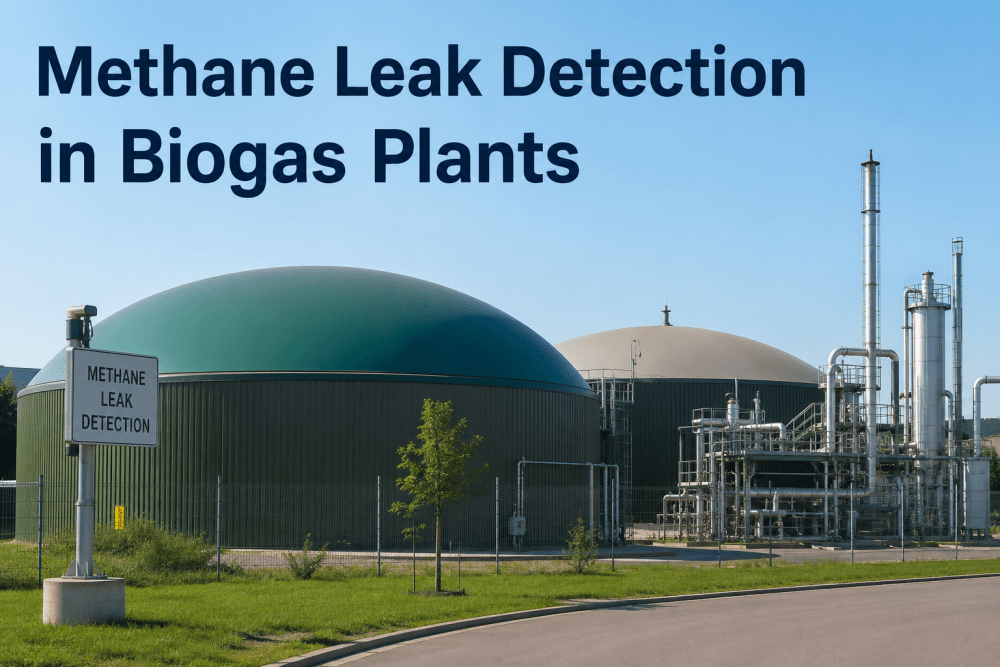
Methane leaks in biogas operations represent more than environmental compliance risk — they are direct losses of revenue-generating gas and potential catastrophic safety hazards. From the digester dome to the CHP unit, every flange, valve, and connection point in a biogas plant is a potential fugitive emission source that demands rigorous detection, continuous monitoring, and a data-driven mitigation strategy.book a demo
Is Your Biogas Plant Leaking Profitable Methane?
Unify continuous gas detection, aerial drone surveys, acoustic monitoring, and compliance reporting into one intelligent platform designed for high-consequence biogas operations.
Why Continuous Methane Detection Is Critical for Biogas Operations
Modern methane analytics platforms bridge this critical gap by aggregating data from fixed-point gas sensors, open-path laser detectors, acoustic emission monitors, and drone-mounted optical gas imaging into a single, unified intelligence layer. When plant managers book a demo, the most common discovery is that their biogas assets are losing measurable methane volumes through undetected fugitive emissions that — once quantified — can justify complete detection infrastructure upgrades within months.
Continuous Leak Surveillance
Deploy fixed-point and open-path gas sensors across all critical zones — digester domes, gas holders, pipe bridges, and CHP inlets — for 24/7 methane concentration monitoring with automated alert thresholds and real-time dashboard visibility.
Aerial Drone Detection
Conduct routine OGI and TDLAS drone surveys across hard-to-reach infrastructure. Identify fugitive emissions at flare stacks, covered lagoons, and elevated piping without plant shutdowns or confined space entry.
Acoustic Leak Localization
Employ ultrasonic acoustic sensors to detect high-pressure gas leaks at valves, flanges, and fittings — pinpointing leak sources even in high-noise environments where conventional sensors struggle to discriminate.
Emissions Accounting Automation
Automatically generate EPA-compliant fugitive emission reports, methane intensity calculations, and leak repair verification records — eliminating manual data entry burdens and reducing regulatory exposure.
Core Detection Technologies for Biogas Methane Monitoring
A purpose-built methane detection architecture for biogas operations must address four foundational requirements unique to high-consequence renewable energy assets: continuous area monitoring, source-level leak identification, repair verification tracking, and long-range emissions trending aligned with regulatory reporting cycles. Operators who book a demo consistently report that connecting their fragmented gas sensor networks, drone survey logs, and LDAR program data into a unified analytics layer is the single most impactful step in their emission reduction journey.
| Detection Technology | Detection Method | Coverage Area | Minimum Sensitivity | Priority Level |
|---|---|---|---|---|
| Fixed-Point IR Sensors | NDIR absorption | Point (2-5m radius) | 1% LEL | Critical |
| Open-Path Laser (TDLAS) | Tunable diode laser | Line path (up to 200m) | 5 ppm·m | Critical |
| Optical Gas Imaging (OGI) | Thermal hyperspectral | Area (visual FOV) | Visual detection | High |
| Acoustic Emission Sensors | Ultrasonic frequency | Point (10m radius) | High-pressure only | High |
| Drone-Based TDLAS | Laser absorption | Routed aerial survey | 10 ppm·m | Standard |
Deploying a Multi-Layer Methane Detection Architecture
Compliance with EPA methane regulations and voluntary reduction targets is a non-negotiable requirement for any operating biogas facility. Yet most plant operators still manage leak detection through quarterly OGI surveys, disconnected spreadsheet logs, and manual LDAR tracking. Plant directors who book a demo early in their emissions reduction cycle consistently achieve stronger compliance outcomes and faster permit approvals.
Facility Risk Assessment and Sensor Placement Planning
Conduct a comprehensive methane source mapping exercise across all digester domes, gas holders, flares, CHP units, and pipe bridges — prioritized by leak probability, safety impact, and regulatory sensitivity.
Multi-Technology Sensor Network Deployment
Install a layered detection network combining fixed-point NDIR sensors, open-path TDLAS monitors, and acoustic emission detectors. Deploy drone survey protocols for elevated and confined infrastructure access.
AI Analytics Platform Integration
Connect all sensor streams, drone survey logs, and compliance records to the central iFactory analytics platform. Configure role-specific dashboards for plant managers, HSE officers, and compliance teams.book a demo
Predictive Leak Signature Modeling
Enable AI-driven leak forecasts that automatically identify pressure or concentration drift before it escalates to a reportable emission event. Prioritize repairs by leak severity and estimated methane loss rate.
Continuous Compliance and Reporting Automation
Leverage historical detection data to generate EPA GHG reports, methane intensity calculations, and LDAR performance dashboards. Build defensible audit trails for every leak event and repair action with automated timestamp records.
"Before deploying iFactory's unified methane detection platform, our LDAR program relied on quarterly OGI surveys that missed intermittent leaks between inspection cycles. By implementing continuous monitoring with AI-driven analytics and multi-technology sensor fusion, we reduced fugitive methane emissions by 72% in the first year and achieved full EPA compliance with zero audit findings. The platform paid for itself in recovered gas value within 14 months."
Top Operational Gaps in Biogas Methane Leak Management
Most biogas facilities pursuing improvements to their methane detection programs encounter a predictable set of operational and documentation challenges. Understanding these gaps before deploying a detection platform dramatically improves implementation success and helps plant managers allocate finite budgets more strategically across complex biogas infrastructure.
Fixed-point gas sensors, drone survey data, and LDAR logs operate in isolation — making it impossible to correlate emission trends across detection technologies or identify recurring leak patterns across different plant zones.
Quarterly OGI surveys leave months-long gaps where undetected leaks can release significant methane volumes. Intermittent leaks that only occur under specific operating conditions are routinely missed entirely.
Most biogas facilities lack integrated alarm management that correlates gas detection readings with plant operating conditions — leading to high nuisance alarm rates that desensitize operators to genuine methane threats.
Without automated LDAR tracking, leak tagging, repair verification, and re-inspection scheduling are managed through spreadsheets — creating documentation gaps that fail EPA audit scrutiny.book a demo
Without continuous flow data integration, most facilities cannot accurately quantify methane loss rates from detected leaks — making it impossible to prioritize repairs by environmental or economic impact.
Integrating modern gas detection networks into legacy biogas control systems without a unified middleware layer creates persistent data silos that undermine the value of both systems.
Closing these gaps requires more than off-the-shelf gas detection equipment — it demands a purpose-built platform designed for the regulatory complexity and operational sensitivity of biogas methane management. HSE officers regularly book a demo to benchmark their gaps against a proven industrial analytics architecture.
Integrating AI Detection Platforms into Legacy Biogas Infrastructure
One of the most technically demanding aspects of methane detection modernization is the responsible integration of digital monitoring systems into existing biogas plant infrastructure.
Key Methane Detection Analytics Capabilities for Modern Biogas Plants
Aggregate readings from NDIR sensors, TDLAS monitors, acoustic detectors, and OGI surveys into a unified methane concentration timeline with cross-correlated leak event detection and automated severity classification.
Centralize before-and-after photographic evidence, repair method specifications, and re-inspection results for every tagged leak in an EPA-ready digital archive with forensic timestamp audit trails.
Deploy machine learning models that distinguish genuine methane releases from environmental interference — humidity spikes, temperature inversions, and cross-gas sensitivity — reducing nuisance alerts by up to 60%.
Automatically generate methane intensity reports, fugitive emission inventories, and LDAR performance metrics aligned with EPA GHG reporting requirements and voluntary sustainability commitments.
Modernize Your Biogas Methane Detection Program Today
Deploy a unified analytics platform that integrates continuous gas monitoring, drone surveys, acoustic detection, and compliance reporting — built specifically for biogas methane management.
Building a Future-Ready Methane Detection Program
The transition from periodic leak hunting to continuous methane stewardship is no longer a competitive advantage — it is an operational necessity for every biogas facility operating under EPA's evolving regulatory framework. Quality directors and HSE officers are encouraged to book a demo to see how AI-powered methane detection can transform their biogas facility's emissions management program.
Biogas Methane Detection — Common Questions Answered
What is the difference between fixed-point and open-path methane detection?
Fixed-point NDIR sensors measure methane concentration at a single location within a 2-5 meter radius, making them ideal for enclosed spaces like digester buildings and gas holder areas. Open-path TDLAS monitors project a laser beam across distances up to 200 meters, providing line-average concentration readings that detect fugitive emissions along pipe bridges and perimeter boundaries.
How often should drone-based OGI surveys be conducted?
For EPA LDAR compliance, quarterly OGI surveys represent the minimum requirement for biogas facilities. However, facilities that deploy continuous fixed monitoring between drone surveys achieve significantly better outcomes — our clients report 60-70% fewer fugitive emission events when combining continuous sensors with quarterly aerial surveys compared to quarterly surveys alone as a standalone strategy.
Can the system detect methane in high-humidity biogas environments?
Yes. Our platform integrates sensor data with humidity and temperature compensation algorithms that correct for water vapor interference in IR-based detection. Additionally, we deploy TDLAS technology that operates at specific absorption wavelengths where water vapor interference is minimal — ensuring accurate readings even in saturated digester gas conditions.book a demo
What is the typical ROI for a biogas methane detection system?
Most facilities recover their detection infrastructure investment within 12-18 months through recovered gas revenues alone — before accounting for avoided EPA penalties, reduced insurance premiums, and improved community relations. Facilities capturing and selling biomethane typically see even faster payback periods since every kilogram of fugitive methane represents direct revenue loss that compounds over time.
Can the platform integrate with our existing biogas SCADA system?
Yes. iFactory provides standard OPC-UA, Modbus, and MQTT interfaces to connect with leading biogas control platforms. Our middleware layer normalizes data from diverse sensor manufacturers and SCADA systems into a unified dashboard, ensuring that your methane detection data enriches rather than replaces your existing operational infrastructure and control workflows.