AI Copilot ROI: Faster Troubleshooting & Better Decisions
By Johnson on August 8, 2026
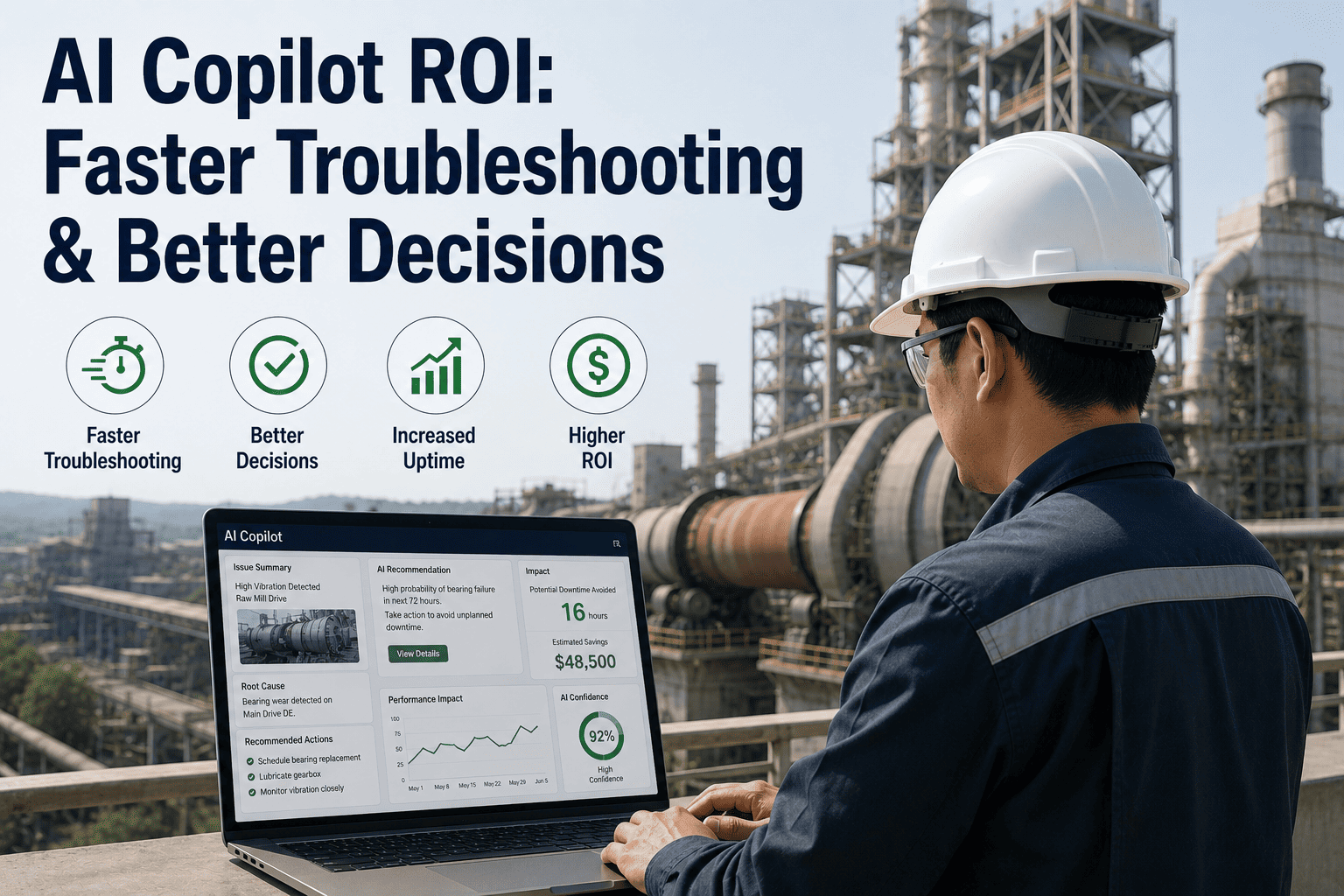
Justifying an AI copilot budget to plant leadership rarely comes down to whether the technology is impressive — it comes down to whether someone can point to a specific number and say this is what it actually saved us. Faster troubleshooting, fewer wrong calls during a kiln upset, and less institutional knowledge lost when an experienced operator retires are all real effects, but they only become a business case once they're measured against a baseline instead of described in general terms. The plants getting funding approved for a second phase are the ones treating ROI as a number to track from day one, not a story to tell after the fact. See how iFactory structures copilot ROI tracking against your plant's own baseline metrics.
AI Copilot · Return on Investment
AI Copilot ROI: Faster Troubleshooting and Better Decisions
Where the return actually comes from — time saved on troubleshooting, fewer costly wrong calls, and knowledge that stays in the plant even after the people who built it move on.
An AI copilot's ROI case usually rests on a small number of value streams rather than one single dramatic number, and understanding each one separately is what makes the eventual business case defensible instead of vague. Plants that only measure one of these — typically time savings, because it's the easiest to notice — tend to significantly undercount the copilot's actual value.
Time Saved on Troubleshooting
An operator diagnosing an unfamiliar alarm pattern or process deviation can query the copilot instead of paging through manuals or waiting for a supervisor, cutting the time between "something's wrong" and "here's the likely cause" from many minutes to a fraction of that.
Fewer Costly Wrong Decisions
A copilot surfacing the relevant historical context — how a similar deviation was handled last time, what the correct response sequence is — reduces the odds of a hesitant or incorrect first response that turns a manageable upset into a production loss or equipment stress event.
Retained Knowledge When Experienced Staff Leave
A copilot trained on years of operator logs and historical interventions keeps that judgment accessible to whoever is on shift, rather than that knowledge walking out the door the day a thirty-year veteran retires.
Stop Guessing at the Value of Your Copilot Program
Track ROI Against a Real Baseline From Day One
iFactory helps cement plants set up before-and-after tracking so the business case for phase two writes itself.
Before-and-After Metrics That Hold Up in a Business Case
A convincing ROI case rests on metrics the plant was already tracking before the copilot arrived, compared honestly against the same metrics after. Metrics invented specifically to flatter the copilot don't survive scrutiny from finance or operations leadership reviewing the investment.
Metric
Before Copilot
What to Track After
Time to Diagnose an Alarm
Manual log/manual search, supervisor page
Time from alarm to confirmed likely cause
Escalations to Senior Staff
Frequency of pages to off-shift experts
Reduction in after-hours escalation calls
Repeat Incident Rate
Same upset mishandled more than once
Whether corrected response is retained
New Hire Independent Response Time
Time until trusted for solo judgment calls
Change in time-to-independent-competence
None of these require a research project to start tracking — most plants already have alarm logs, escalation records, and shift handover notes that contain this data. The work is in defining the baseline clearly enough that the comparison after copilot rollout is credible rather than approximate.
Building the Business Case
Turning Saved Minutes Into a Number Leadership Will Fund
Time savings and fewer wrong calls are real, but they only become a funding argument once translated into terms that connect to production, cost, or risk. These steps are how plants typically build that translation.
01
Establish the Time-Per-Incident Baseline
Pull historical data on how long troubleshooting typically took for common alarm categories before the copilot existed, using shift logs or incident records rather than anecdotal recollection.
02
Track the Same Categories Post-Rollout
Measure the same incident categories after the copilot is in use, capturing not just average time but variance — a copilot that helps most on the hardest cases delivers disproportionate value even if the average shift barely changes.
03
Translate Time Saved Into Avoided Cost
Convert the reduction in diagnosis and escalation time into avoided downtime, avoided overtime for off-shift pages, or avoided production loss from a slower-than-necessary response — whichever the plant's own cost accounting already tracks.
04
Add the Avoided-Mistake Value Separately
Count instances where the copilot's context prevented a documented near-miss or a wrong first response, and estimate the cost that would have resulted, since this value stream is distinct from time savings and tends to be underweighted in a quick ROI estimate.
Common Reporting Pitfalls
Where ROI Numbers Lose Credibility
An ROI figure that looks great in a first presentation can fall apart under scrutiny if it was built on shaky assumptions. These are the mistakes that most often undermine an otherwise legitimate copilot ROI case, and each one is avoidable with a bit of discipline in how the numbers get built.
Comparing Against an Undocumented Baseline
Claiming a percentage improvement without a written record of what the "before" number actually was invites the reasonable question of where that number came from — a credible ROI case always starts with a documented, dated baseline captured before rollout began.
Cherry-Picking the Best Weeks
Reporting only the shifts or weeks where the copilot performed best, rather than an honest average across the full measurement period, produces a number that won't survive a second look and damages trust in every future report from the same program.
Double-Counting Value Across Categories
Time saved on troubleshooting and avoided-mistake value can overlap if the same incident gets counted in both categories — a rigorous ROI case defines each category clearly enough that a single event is only ever counted once.
Ignoring the Cases Where the Copilot Didn't Help
A program that only reports its wins, without acknowledging scenario categories where the copilot's guidance wasn't useful or was ignored, reads as promotional rather than analytical — including the honest gaps actually strengthens the credibility of the wins that are reported.
Field Perspective
The ROI conversations that go well are the ones where someone tracked a real baseline before the copilot showed up. Everyone has a sense that troubleshooting got faster, but "it feels faster" doesn't survive a finance review the way "average diagnosis time dropped from eighteen minutes to six" does. The plants that get funded for phase two are almost always the ones that treated measurement as part of the rollout from day one, not something to reconstruct after the fact when someone finally asks for a number.
Devon Kowalczyk-Reyes
Plant Operations Analyst · 12 years in cement process performance measurement and digital tools ROI reporting
Common Questions
Frequently Asked Questions
How quickly can a cement plant expect to see measurable ROI from an AI copilot?
Time-savings on troubleshooting are usually visible within the first month of active use, since alarm response is a frequent, easily measured activity. Knowledge-retention value takes longer to prove because it depends on comparing performance against a baseline that includes rare events, so a fuller picture often takes a couple of quarters. Book a demo to set a realistic measurement timeline for your plant.
What's the biggest mistake plants make when trying to calculate copilot ROI?
Skipping the baseline is the most common mistake — without a documented "before" number, any post-rollout improvement is a claim rather than a measurement, and it's much harder to defend to finance or operations leadership reviewing whether to continue funding the program. Talk to Solutions Engineering about setting up baseline tracking before rollout.
Does avoided-mistake value actually hold up as a credible ROI category?
Yes, provided it's tied to documented near-misses or incidents rather than speculative claims — a plant that logs the specific instances where a copilot's context changed the operator's response has a defensible record, while a generalized claim about "fewer mistakes" without specific instances tends not to convince a skeptical reviewer. Book a demo to see how avoided-mistake tracking works in practice.
Should ROI be measured per operator or across the whole shift crew?
Both views add value — per-operator data reveals whether newer hires benefit more than veterans, which shapes training decisions, while crew-level aggregates are usually what actually goes into the business case presented to plant leadership for continued investment. Talk to Solutions Engineering about structuring ROI reporting at both levels.
How does knowledge retention get measured when the value only shows up years later?
A practical proxy is tracking whether new hires and less experienced operators resolve the same alarm categories that used to require escalation to a veteran, which shows the knowledge transfer happening in real time rather than waiting years to confirm the effect after a retirement. Book a demo to see how knowledge-retention proxies are tracked.
Turn Copilot Value Into a Number You Can Defend
Baseline Tracking, Time Savings, and Avoided-Mistake Value — Documented Together
iFactory helps cement plants set up ROI tracking from the start of a copilot rollout, so the value case for the next phase is a documented number, not a guess.