AI Training & Operator Simulation for Cement Competency
By Johnson on August 8, 2026
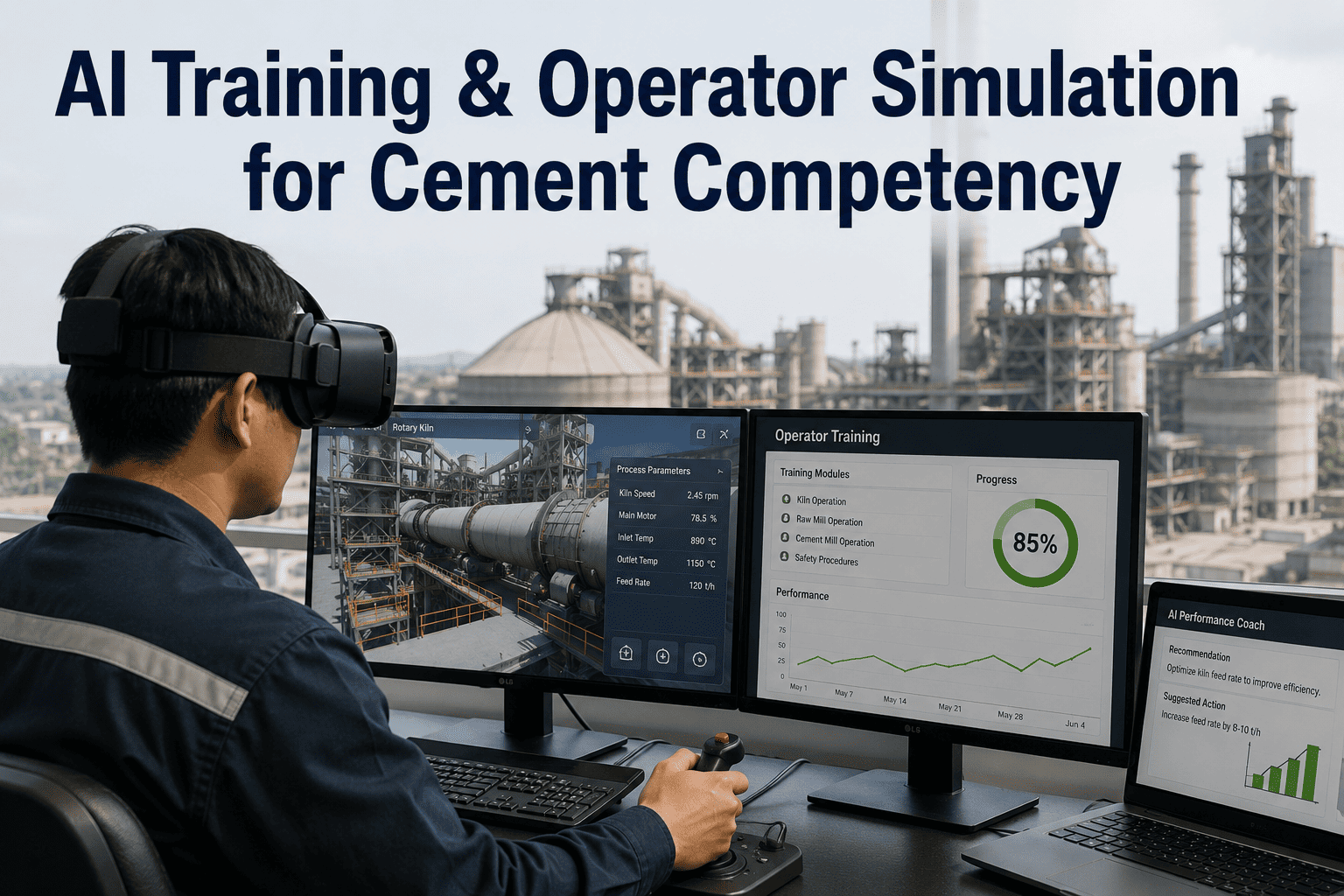
Cement plants are losing their most experienced operators faster than replacements can be trained, and the traditional fix — shadowing a veteran for six to twelve months before being trusted alone on a kiln panel — no longer keeps pace with retirement rates or turnover. A new hire who has never watched a coating collapse or a raw mill surge in real time is being asked to make split-second calls on a process that punishes hesitation as much as it punishes the wrong call. AI-powered training simulation closes that gap by putting new operators through hundreds of realistic upset scenarios before they ever touch a live panel, then scoring exactly how ready they are. See how iFactory structures scenario-based training and competency tracking for plants facing this exact transition.
AI Copilot · Cement Operator Development
AI Training and Operator Simulation for Cement Competency
Scenario-based simulation, automated competency assessment, and personalized learning paths that shorten time-to-proficiency without putting a new hire's first kiln upset in front of a live process.
The cement industry's experienced operator workforce is aging out faster than plants can rebuild it, and the operators leaving are the ones who have personally lived through a coating collapse, a preheater blockage, or a mill vibration trip and know exactly what the panel looked like in the minutes before. That kind of pattern recognition used to transfer through years of shadowing, where a new hire would eventually stand next to a veteran during a real coating fall, watch the exact sequence of corrective actions unfold, and absorb the reasoning behind each one. New hires now often reach solo panel responsibility having witnessed a fraction of the upset conditions their predecessors saw, simply because there is less time and fewer veterans available to walk them through it, and because the specific rare events that build real judgment don't happen on a training schedule — they happen when they happen, whether or not a trainee is on shift to see them.
Shrinking Veteran Bench
Retirements are removing decades of accumulated kiln, mill, and cooler intuition from the floor faster than replacement hiring can offset it, leaving fewer people available to mentor the next generation in real time. Some plants now have entire shift crews where nobody has personally handled the specific upset that defined a veteran's most valuable instincts.
Rare Events, Real Consequences
A refractory-threatening coating fall or a severe kiln ring only happens a handful of times a year at most plants, so a new operator's odds of witnessing one during a normal shadowing period are genuinely low. Waiting for the calendar to eventually serve up that exposure is not a plan a plant can rely on.
Cost of a Wrong First Response
The first time an operator faces a genuine upset should not be the first time they decide how to respond to it — a hesitant or incorrect action on a live kiln carries production, safety, and equipment cost that a simulated one does not, and that cost compounds the longer the wrong action goes uncorrected.
Inconsistent Readiness Signals
Without a structured assessment, "ready for solo shift" often comes down to a supervisor's subjective impression rather than a documented, comparable measure of what that operator has actually demonstrated they can handle, which makes it difficult to defend a readiness decision after the fact if something goes wrong.
How AI Simulation Training Works
Practicing the Upsets Before They Happen for Real
An AI-driven training simulation doesn't just replay a fixed script — it models how the plant's actual process variables would respond to an operator's inputs, so the trainee is reacting to a live, evolving situation rather than clicking through a slideshow. If a trainee delays a fuel rate correction during a simulated coating fall, the simulated burning zone temperature keeps drifting the way the real kiln would, and the consequence of that delay shows up in the next few minutes of the scenario rather than being hand-waved away. The scenario library, the assessment logic, and the way each trainee's path adapts to their own gaps are what separate this from a generic e-learning module that tests recall of a procedure rather than the ability to actually execute it under pressure.
Scenario-Based Training
Trainees work through simulated kiln upsets, mill surges, cooler grate faults, and emergency shutdown sequences built from the plant's own historical process data, so the scenarios reflect this specific kiln's failure signatures rather than a generic industry template that may not resemble anything the trainee will actually encounter on shift.
Competency Assessment
Every simulated response is scored against defined criteria — reaction time, correct sequence of actions, and outcome — producing an objective competency record instead of a supervisor's informal impression of readiness, one that can be reviewed, compared across trainees, and referenced months later.
Personalized Learning Paths
Where a trainee consistently struggles, whether it's coordinating kiln speed and fuel rate changes or diagnosing a false alarm versus a genuine trip, the system weights future scenarios toward that weak spot instead of repeating skills already demonstrated, so training time isn't spent on what the trainee has already proven they can do.
Accelerated Development
Because a trainee can run a compressed version of a rare upset in twenty minutes instead of waiting months for it to occur naturally, exposure to the scenarios that matter most accumulates far faster than shadowing alone allows, compressing what used to take a full onboarding cycle into a fraction of the time.
Stop Waiting for the Real Upset to Be the First Lesson
Build a Documented, Repeatable Path to Solo Panel Readiness
iFactory builds scenario libraries from your plant's own process history and turns readiness into a measured score, not a supervisor's guess.
A useful scenario library isn't a handful of generic drills — it's built to mirror the specific failure modes that actually occur on the plant's own kiln, mills, and coolers, weighted toward the events that carry the highest consequence if handled incorrectly. The table below shows the broad categories most plants prioritize first, though the specific triggers and thresholds within each category should be tuned to what this particular plant's process history actually shows.
Scenario Category
Example Situation
Skill Being Tested
Kiln Thermal Upset
Sudden coating fall changing burning zone temperature profile
Fuel and feed rate coordination under time pressure
Raw Mill Instability
Vibration trending toward trip threshold during a feed change
Early recognition versus reactive shutdown
Cooler Grate Fault
Grate plate obstruction disrupting clinker bed depth
Diagnosing the fault before it cascades to the kiln
Preheater Blockage
Cyclone build-up reducing gas flow and raising pressure drop
Distinguishing a developing blockage from sensor noise
Emergency Shutdown
Multiple correlated alarms requiring an immediate trip decision
Correct shutdown sequence under compressed time
Each scenario in the library carries a defined correct-response envelope built from how the plant's own experienced operators have historically handled the same situation, so the scoring reflects this plant's operating philosophy rather than a generic industry standard that may not match local equipment condition or process constraints.
Why This Matters Now
The Business Case Behind Faster, Better-Documented Training
A training program that shortens time-to-proficiency isn't just a workforce development nicety — it shows up directly in production stability, in the size and cost of upset events, and in how confidently a plant can staff shifts as its most experienced people retire. The value case for simulation-based training rests on a handful of concrete effects that plants running these programs consistently report.
Fewer Costly First-Response Mistakes
An operator who has already practiced the correct sequence for a coating fall or a mill vibration trip in simulation is far less likely to freeze or respond incorrectly the first time it happens for real, which directly reduces the production loss and equipment stress that a mishandled upset causes, and reduces the chance that a small event escalates into a larger one.
Shorter, More Predictable Onboarding Timelines
Because progression is tied to a measured competency score rather than a fixed calendar period, plants gain a far more predictable picture of when a new hire will actually be ready for solo shift, which makes shift-staffing and hiring plans considerably easier to build around instead of guessing at a generic onboarding window.
Retained Institutional Knowledge
Building the scenario library from the plant's own historical process data effectively captures how veteran operators have handled specific failure modes in the past, so that judgment stays accessible to new hires even after the people who built it have retired, rather than leaving the plant with only what happened to get written down.
A Defensible Record for Safety and Insurance Reviews
A documented competency score tied to specific scenario categories gives a plant something concrete to show a safety auditor or insurer about how solo shift readiness is actually determined, rather than relying on an informal supervisor sign-off that's difficult to substantiate after the fact if an incident is later reviewed.
None of these effects require replacing existing DCS operator training entirely — most plants layer simulation-based scenario training and competency scoring on top of the onboarding process they already run, using it to fill the specific gap that shadowing alone can't close: structured, repeatable exposure to rare, high-consequence events, delivered on a schedule the plant controls rather than one dictated by when the next real upset happens to occur.
Measuring Competency
Turning Simulated Performance Into a Documented Record
A training program only earns its keep if the plant can point to a defensible record of what each operator has actually demonstrated — not a vague sense that they "seem ready," but a specific account of which scenario categories they've handled correctly, how consistently, and under what time pressure. These steps are how a simulation program builds that record rather than just running trainees through drills and hoping something sticks.
01
Establish a Baseline Skill Profile
Before any scenario training begins, a short assessment identifies where a new hire's existing knowledge is strong and where the genuine gaps sit, so the learning path starts from an accurate picture rather than a generic assumption about what a new operator does or doesn't already know.
02
Score Every Simulated Response Against Defined Criteria
Reaction time, correct sequencing of actions, and the eventual outcome of the simulated scenario are each recorded, producing a granular score rather than a simple pass or fail that hides exactly where performance broke down and what specifically needs more practice.
03
Route Weak Areas Back Into the Learning Path
A trainee who consistently mishandles cooler grate faults sees more of that scenario type until the score improves, rather than moving on to unrelated content while the actual weak spot goes unaddressed and eventually shows up on a live shift.
04
Set a Documented Readiness Threshold
Solo panel authorization is tied to a defined competency score across the required scenario categories, giving supervisors an objective, auditable basis for sign-off instead of a subjective judgment call.
05
Keep the Record Available for Refresher and Audit Purposes
Because every score is retained, supervisors can identify skill decay over time and schedule refresher scenarios before it shows up as a hesitant response during an actual upset, and the record itself stands up to safety audit review.
Field Perspective
The plants getting real value out of simulation training are the ones treating it as a competency record, not just a nice-to-have onboarding tool. A new operator can watch a hundred hours of video and still freeze the first time the kiln actually surges, because recognition and reaction are different skills. What simulation gives you is repetition on the reaction itself, in a setting where a wrong call costs nothing but a restart. The plants that pair that with an honest, documented threshold for solo readiness are the ones whose new hires are actually ready when the calendar says they are — and the ones still relying on a supervisor's gut feeling are the ones most likely to discover a gap the hard way, on shift, during the exact upset the training was supposed to prepare for.
Marcus Delacroix-Webb
Process Training Manager · 19 years in cement plant operator development and DCS simulation programs
Common Pitfalls
Where Simulation Programs Tend to Fall Short
Not every simulation-based training rollout delivers the readiness improvement it promises. The programs that underperform usually share one of a handful of avoidable mistakes, and knowing what to watch for going in makes the difference between a training investment that pays off and one that becomes a checkbox exercise nobody takes seriously, or worse, one that gives false confidence in readiness that hasn't actually been earned.
Generic Scenarios That Don't Match the Plant's Actual Equipment
A scenario library built from generic industry templates rather than this plant's own historical process data teaches operators to recognize failure patterns that may not match how their specific kiln, mills, and coolers actually behave, which undermines the transfer of skill from simulation to the real panel and can leave a trainee confidently wrong about how their own equipment responds.
Treating Completion as the Same Thing as Competency
A trainee who has clicked through every scenario in the library hasn't necessarily demonstrated they can handle any of them correctly — tracking completion instead of actual scored performance produces a false sense of readiness that only becomes visible during a genuine upset, when it's far too late to do anything about it.
No Refresher Cadence for Experienced Operators
Skills that aren't exercised regularly decay, and an experienced operator who hasn't faced a specific upset type in a year or more can be just as unprepared as a new hire if the training program only ever runs once during initial onboarding rather than continuing on some regular schedule afterward.
Disconnecting the Training Record From Actual Shift Assignment
A documented competency score only creates value if it actually informs who gets assigned to solo shifts and when — a program that generates scores nobody references when making staffing decisions has built a record without building a safeguard, which defeats the purpose of measuring readiness in the first place.
Common Questions
Frequently Asked Questions
How is AI simulation training different from a traditional cement DCS simulator?
A traditional simulator typically runs a fixed set of scenarios that don't change based on who is training. An AI-driven system builds its scenario library from the plant's own historical process data and adapts each trainee's path based on where their scores show genuine weakness, rather than running everyone through the same static curriculum regardless of what they've already demonstrated. Book a demo to see how a scenario library gets built from your plant's own data.
How long does it take to see a reduction in time-to-proficiency?
Most plants running a structured scenario program see measurable improvement within the first few cohorts, since the comparison against prior time-to-solo-shift is direct and the competency scores make the gap visible early rather than only becoming apparent after a costly mistake on the floor. Talk to Solutions Engineering about setting a realistic baseline for your plant's current onboarding timeline.
Can the same simulation platform support refresher training for experienced operators?
Yes — because competency scores are retained over time, the same scenario library can be used to catch skill decay in experienced operators who haven't faced a particular upset type in months, and to requalify anyone returning from extended leave before they're placed back on solo shift. Many plants schedule refresher scenarios on a fixed cadence rather than waiting for a score to drop. Book a demo to see how refresher scheduling works alongside new-hire training.
Does the scenario library need to be rebuilt for every plant, or does it generalize?
A general scenario framework can transfer across plants, but the scoring thresholds and the specific failure signatures — coating behavior, mill vibration patterns, cooler grate faults — need to be tuned to each kiln's own historical data to be genuinely representative rather than generic. Talk to Solutions Engineering about tuning a scenario library to your specific equipment.
Who typically owns the competency records generated by the training program?
Training and operations leadership typically share ownership, since the scores inform both individual readiness sign-off and broader workforce planning decisions, and the record itself is usually retained alongside other formal training documentation for safety audit purposes. Book a demo to see how competency records integrate with your existing training documentation.
Give New Operators a Documented Path to Readiness
Scenario Training, Competency Scoring, and Personalized Learning Paths
iFactory builds AI-driven training simulation around your plant's own process history, so new operators face the upsets your kiln actually produces before they ever face them live.