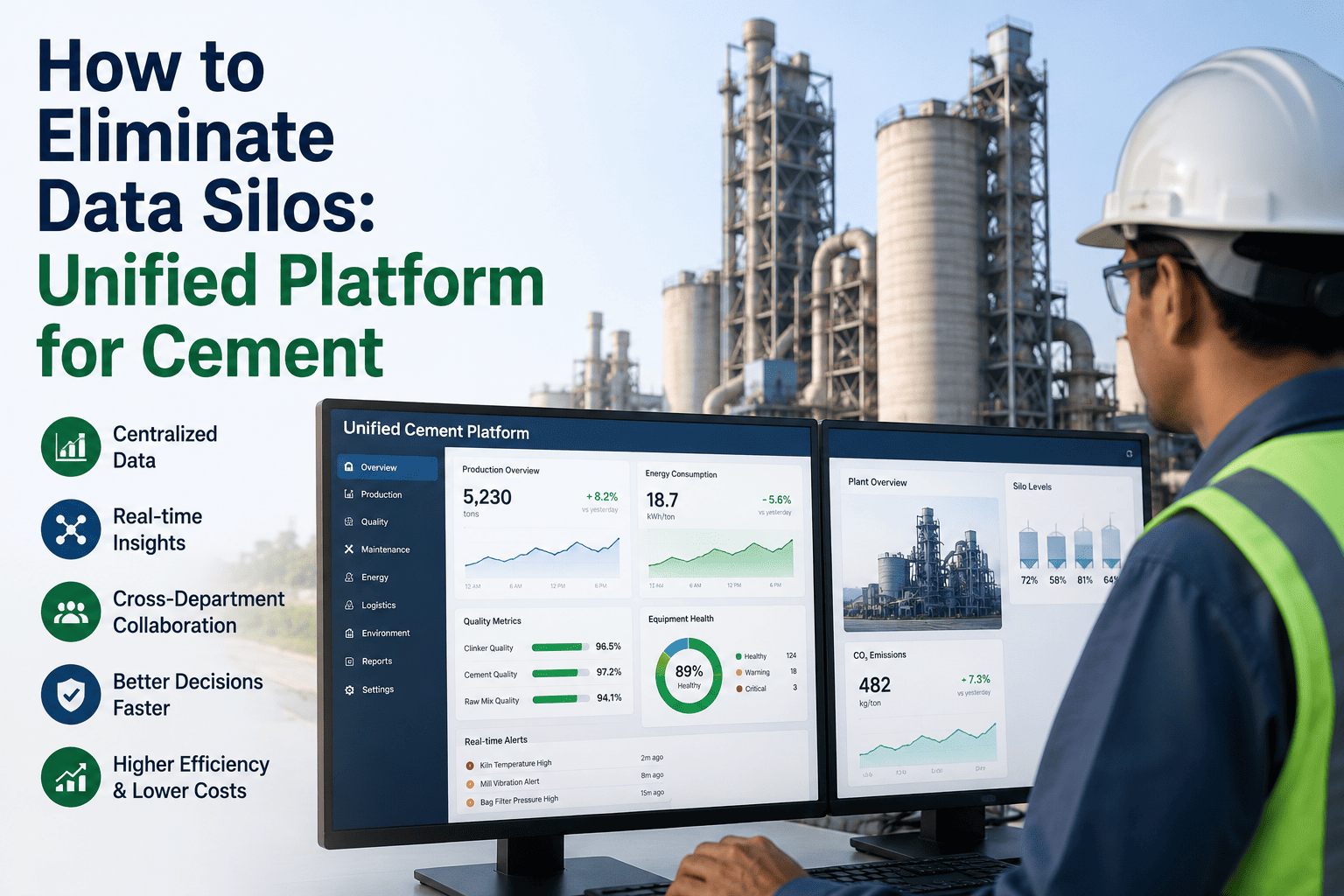
Most cement plants running AI today are running four or five of them at once without realizing it — one tool watching bearing vibration, another flagging free lime drift, a spreadsheet someone updates for maintenance priorities, and a separate dashboard for process trends. Each one works fine in isolation, but none of them talk to each other, so a plant manager still has to be the one connecting equipment health to quality to maintenance scheduling in their head. A unified platform is what happens when those four pieces of intelligence are built to inform each other automatically. Book a free platform assessment to see how your current point solutions could work together.
Quick Answer
A smart cement plant AI platform unifies four capabilities that most plants currently run as separate tools: equipment health monitoring, process optimization, quality prediction, and maintenance intelligence. Built together on shared data rather than as standalone point solutions, these four pieces reinforce each other automatically, so a developing bearing issue can adjust a process optimization recommendation, feed into a quality prediction, and trigger a maintenance priority in one connected flow instead of four disconnected alerts a plant manager has to interpret separately.
Four AI Capabilities, Built to Work as One
iFactory unifies equipment health, process optimization, quality prediction, and maintenance intelligence on one platform, so each capability strengthens the others instead of running in isolation.
Equipment HealthLive Score
Process OptimizationActive
Quality PredictionForecasted
Maintenance IntelligencePrioritized
The Layers Behind a Unified Platform
A unified platform isn't four tools bolted together after the fact. It's built as a stack, where each layer feeds the one above it, so equipment condition, process behavior, quality outcomes, and maintenance priorities stay connected rather than living in separate systems.
Data Ingestion Layer
Pulls live SCADA process data, sensor readings, lab results, and maintenance records into one shared foundation
Equipment Health Layer
Continuously scores bearing, fan, motor, and mechanical condition against vibration, temperature, and load trends
Process Optimization Layer
Adjusts kiln, mill, and cooler recommendations in real time, factoring in current equipment condition from the layer below
Quality Prediction Layer
Forecasts free lime, fineness, and clinker quality ahead of lab results, informed by both process and equipment state
Maintenance Intelligence Layer
Prioritizes work orders based on the combined risk to equipment reliability, process stability, and product quality
What Each Capability Actually Does
Equipment Health Monitoring
Tracks vibration, temperature, and load signatures across rotating and fixed equipment to produce a continuously updated health score, catching degradation trends before they become unplanned failures rather than reacting after a breakdown.
Process Optimization
Analyzes kiln, mill, and cooler operating data to recommend setpoint adjustments that improve fuel efficiency and throughput, updating its recommendations as equipment condition and raw material characteristics shift.
Quality Prediction
Forecasts free lime, fineness, and other clinker quality indicators ahead of the next lab result, using process and equipment trends so a developing deviation can be caught and corrected before it shows up as an out-of-spec batch.
Maintenance Intelligence
Converts equipment health scores and quality risk into ranked maintenance priorities, so planners know not just what needs attention but why it matters relative to everything else competing for the same maintenance window.
Point Solutions vs a Unified Platform
| Factor |
Separate Point Solutions |
Unified Platform |
| Equipment issue reaching quality teams |
Rarely, unless someone manually connects the two alerts |
Automatically factored into the quality prediction the moment it's detected |
| Maintenance prioritization |
Based mainly on equipment condition alone, often disconnected from quality or process risk |
Weighted by combined equipment, process, and quality risk |
| Process optimization recommendations |
Assume equipment is running at full design capability |
Adjust automatically as equipment condition changes |
| Number of dashboards a manager checks daily |
Three or four separate tools, each showing a partial picture |
One unified view showing how the pieces relate to each other |
See What Your Point Solutions Look Like Connected
iFactory brings equipment health, process optimization, quality prediction, and maintenance intelligence onto one platform, so your team stops manually connecting alerts across separate tools.
How the Four Pieces Reinforce Each Other
The real advantage of unification shows up when one capability's finding changes what the others recommend, without anyone having to manually connect the dots. Here's what that chain reaction looks like in practice.
1
Equipment health flags a developing issueA fan bearing shows an early vibration trend shift, still well within normal operating range but drifting from its baseline.
2
Process optimization adjusts its recommendationKnowing the fan's condition is drifting, the optimization layer recommends a more conservative operating setpoint rather than pushing for maximum throughput.
3
Quality prediction factors in the adjusted process stateThe forecasted free lime range updates to reflect the more conservative setpoint, staying within target rather than drifting toward the edge of spec.
4
Maintenance intelligence schedules the repair with contextThe fan bearing repair gets prioritized not just as a mechanical concern but as a task that will restore full process flexibility and remove the quality risk it's currently creating.
What Plants Typically See After Unification
EarlierDetection of quality-relevant equipment issues, since health data feeds prediction directly
FewerRedundant alerts across separate dashboards competing for the same attention
FasterMaintenance prioritization decisions, since risk context arrives with the work order
What Unification Looks Like in Practice
Before
A 3,200 TPD plant ran a vibration monitoring tool, a separate process trending dashboard, and a manual maintenance priority spreadsheet, with a cooler fan bearing issue going unnoticed by the process and quality teams for nearly three weeks until it contributed to a free lime excursion.
After
The same fan bearing trend, now visible to the process optimization and quality prediction layers the moment it started drifting, triggered a conservative setpoint adjustment and a prioritized repair recommendation within the same shift, avoiding both the quality excursion and an unplanned fan failure two weeks later.
Rolling Out a Unified Platform
1
Consolidate Existing Data SourcesBring SCADA, vibration monitoring, lab results, and maintenance records into one shared foundation rather than leaving them in separate tools.
2
Stand Up Equipment Health and Process Layers FirstThese two layers typically have the most mature data already available and form the foundation the quality and maintenance layers build on.
3
Connect Quality Prediction to Live Process and Equipment DataOnce the foundation is stable, quality forecasting can be calibrated against real plant behavior rather than a generic model.
4
Activate Maintenance Intelligence LastWith equipment, process, and quality layers already connected, maintenance prioritization has the full context it needs to rank work orders meaningfully from day one.
Frequently Asked Questions
QDo we need to replace our existing equipment health or process monitoring tools to adopt a unified platform?
Not necessarily. Many plants start by connecting their existing SCADA, vibration monitoring, and lab systems into the platform's data layer rather than replacing them outright, letting the unification happen at the intelligence layer above. Over time, some plants consolidate further as the unified view proves more useful than maintaining separate dashboards, but that's a choice made after seeing the value, not a prerequisite to getting started.
Book a demo to see how it connects to your current tools.
QWhich capability should a plant start with if it can't roll out all four at once?
Equipment health monitoring and process optimization are the two most plants already have some data maturity for, making them the natural starting layers. Quality prediction and maintenance intelligence both benefit significantly from having those two layers already connected, since they draw on equipment and process context to produce more accurate forecasts and priorities.
QHow does a unified platform avoid becoming just another dashboard nobody checks?
The difference is that a unified platform surfaces connected findings rather than raw data, so instead of a plant manager checking four separate screens for four separate numbers, they see one recommendation that already accounts for equipment condition, process state, and quality risk together. That reduces the number of places someone has to look, rather than adding one more place to the list.
Talk to an expert about what a unified view would look like for your team.
QHow accurate is quality prediction when it depends on equipment and process data rather than direct lab measurement?
Quality prediction is designed to forecast ahead of the next lab result, not replace lab testing altogether, and its accuracy improves as it's calibrated against actual lab results over time. Because it draws on equipment health and process data together rather than process trends alone, it tends to catch quality-relevant equipment issues earlier than a quality-only model would, giving teams a head start rather than a final answer.
QDoes unification create a single point of failure if the platform itself has an issue?
The platform is built to read from existing systems rather than replace their core functions, so SCADA, CMMS, and LIMS continue operating independently even if the unified intelligence layer needs attention. Individual capabilities can also be reviewed and validated on their own, which means a plant isn't dependent on the full stack working perfectly to still get value from any one layer.
Stop Running Four AI Tools That Don't Talk to Each Other
iFactory unifies equipment health, process optimization, quality prediction, and maintenance intelligence on one platform built to let each capability strengthen the others.