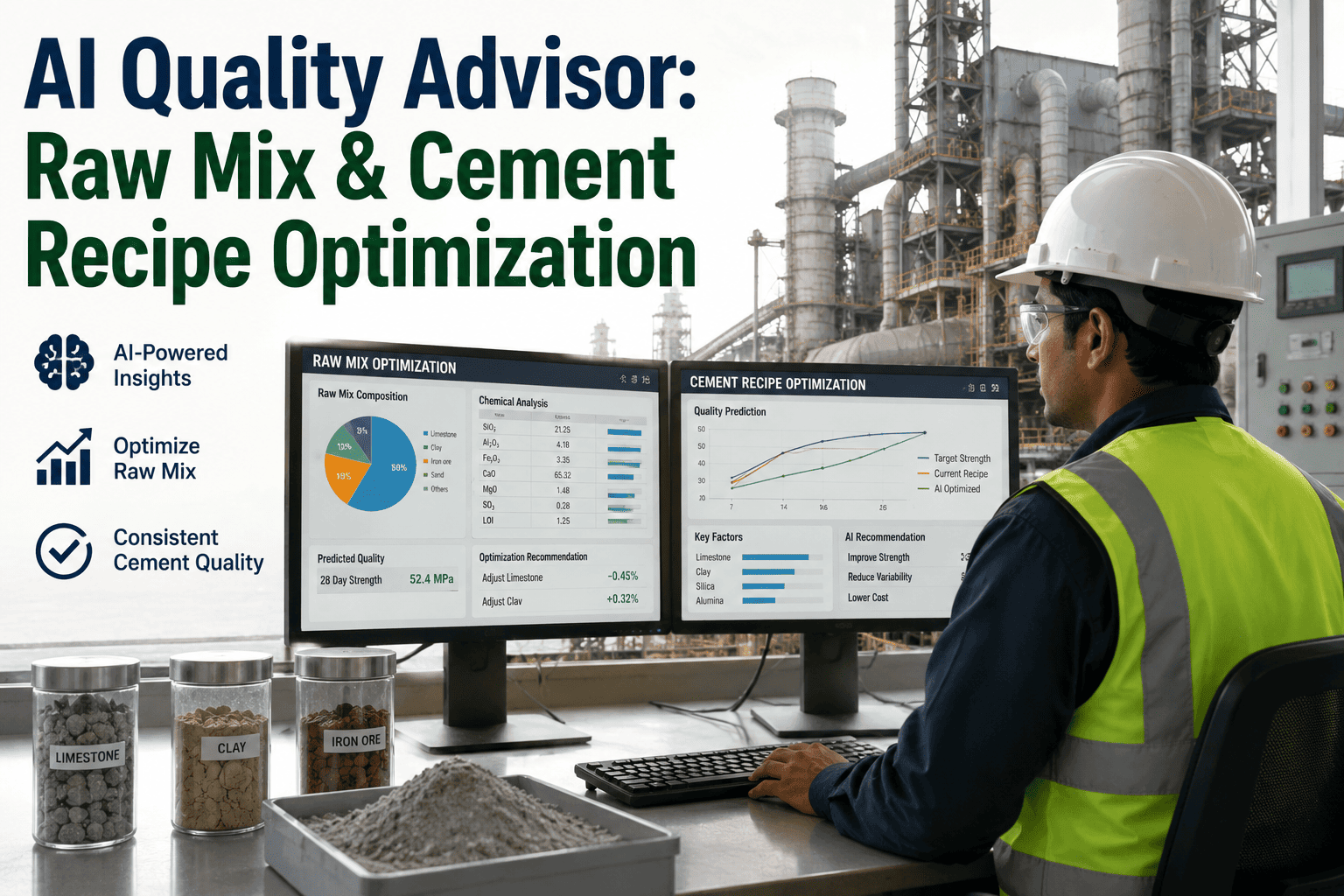
A raw mix that looked correct on paper can still drift out of specification by the time it reaches the kiln, because lime saturation factor, silica ratio, and alumina ratio all respond to raw material variability that a lab technician sampling once a shift simply cannot catch in time. Quality teams end up reacting to an out-of-spec clinker sample after the fact, adjusting the blend for the next batch while the current one is already committed to the kiln. An AI quality advisor changes the timing of that decision entirely, recommending a blend adjustment before the mix leaves the raw mill rather than after the clinker has already formed. See how that shift works in practice at ifactory support.
Catch a Raw Mix Drift Before It Becomes an Off-Spec Clinker Batch
AI that continuously targets lime saturation factor, silica ratio, and alumina ratio, recommends blend adjustments in real time, and predicts clinker quality before the batch is committed.
Why Raw Mix Chemistry Drifts Faster Than Labs Can Catch It
Limestone, clay, and correction materials arriving from a quarry or supplier are never perfectly uniform, and even a modest shift in the composition of one raw material changes lime saturation factor, silica ratio, and alumina ratio simultaneously, since all three depend on the same underlying feed streams. Traditional quality control relies on periodic lab sampling and XRF analysis, which is accurate for the sample it measures but says nothing about what happened to the blend in the hours since that sample was taken. By the time a result comes back showing the mix has drifted, several more batches have already been fed to the kiln with the same underlying problem.
The three chemistry ratios do not move independently, which is part of what makes manual correction difficult even once a drift is detected. Adjusting the proportion of one raw material to fix lime saturation factor almost always shifts silica ratio or alumina ratio at the same time, so a correction aimed at a single number can quietly push another one further from target. This is exactly the kind of multi-variable balancing problem that benefits from a model tracking all three targets together rather than a technician adjusting one dial at a time.
| Factor | Manual Lab-Based Control | AI Quality Advisor |
|---|---|---|
| Detection Timing | After the sample is analyzed, often an hour or more later | Near real time as raw material composition changes |
| Variables Balanced | Adjusted one ratio at a time by technician judgment | LSF, silica ratio, and alumina ratio balanced together |
| Correction Point | Applied to the next batch after the drift is confirmed | Applied before the current batch reaches the kiln feed |
| Quality Outcome Visibility | Known only after clinker is sampled and tested | Predicted ahead of the batch being committed |
Why Historical Recipe Data Makes the Model More Useful Over Time
A quality advisor that only looks at the current blend against a fixed target range is useful, but one that also learns from the plant's own historical relationship between raw mix chemistry and resulting clinker quality becomes considerably more precise over time. Every plant's kiln, fuel, and raw materials interact slightly differently, so a target LSF range that works well as a general guideline may not reflect the specific combination that has historically produced the plant's best free lime and strength results.
Feeding confirmed lab results back into the model after each batch is what allows it to refine its own understanding of the plant's particular chemistry-to-quality relationship, rather than relying solely on generic cement chemistry formulas. Over enough cycles, this turns the advisor from a rule-based calculator into something closer to a model of that specific kiln's behavior, which is part of why the recommendation tends to get more accurate the longer it runs against a given plant's data rather than staying static from day one.
What the Advisor Actually Outputs
The value of a quality advisor is not the underlying chemistry calculation itself, which plants have been able to compute manually for decades, it is turning that calculation into a specific, actionable recommendation delivered while there is still time to act on it. What that looks like in practice varies by what stage of the process is being targeted.
Find Out How Often Your Raw Mix Actually Drifts Between Samples
Bring your current lab sampling frequency and recent chemistry trend data to the call. We will show what an AI quality advisor would have flagged between those samples.
Why Timing the Correction Matters as Much as Getting It Right
Even a perfectly calculated blend correction loses most of its value if it arrives too late to change the outcome, which is why timing deserves as much attention as the accuracy of the recommendation itself. A correction identified from a lab sample taken an hour ago, applied to a blend that has already moved on to a different proportioning state, is solving yesterday's problem rather than the one currently forming in the raw mill.
This is the practical reason continuous monitoring changes outcomes more than a more accurate but still periodic sampling method would. The goal is not simply a better number, it is a number that arrives while the blend it describes is still adjustable, and that timing requirement is what separates a genuinely useful quality advisor from a slightly faster version of the same periodic lab report.
Common Mistakes That Undercut Raw Mix Control
What Consistent Blend Control Actually Looks Like
Where This Fits Alongside the Rest of the Quality Program
A quality advisor working on raw mix chemistry is only one link in a longer chain that runs from quarry material through blending, kiln burning, and finally cement grinding, and it is worth being clear about where its influence starts and stops. Getting lime saturation factor, silica ratio, and alumina ratio close to target before the kiln feed gives the burning zone the best possible starting point, but burning zone temperature control, fuel quality, and residence time still determine how well that raw mix chemistry actually translates into consistent clinker mineralogy. Treating the advisor as a replacement for kiln operating discipline rather than a complement to it tends to lead to disappointment when quality issues that originate downstream of the raw mill get incorrectly attributed to blend chemistry.
The same logic applies on the output side. Free lime and C3S content predicted from raw mix chemistry are useful leading indicators, but final cement quality also depends on grinding fineness, gypsum addition, and any supplementary cementitious materials blended in afterward. A raw mix that hits every chemistry target perfectly can still produce a cement that underperforms if a downstream step introduces its own variability, which is why the advisor's predictions are most useful as an early warning and planning tool rather than as the final word on whether a batch will meet specification.
Signs a Plant Is Ready to Move Beyond Manual Correction
Not every plant needs to make this shift at the same pace, and a few practical signs tend to indicate when manual, lab-interval correction has stopped being sufficient for the variability a plant is actually dealing with. Recognizing these signs early is usually cheaper than waiting for a serious off-spec batch to force the conversation.
None of these signs on their own necessarily means a plant needs to change its entire quality control approach, but together they usually indicate that the gap between lab samples has become the limiting factor in how tightly raw mix chemistry can actually be controlled, which is precisely the gap a continuous quality advisor is designed to close.
Frequently Asked Questions
Get an AI Quality Advisor Tuned to Your Raw Mix
Bring your current chemistry targets and recent lab data to the call. We will show how continuous blend monitoring would have flagged your last drift before the batch reached the kiln.