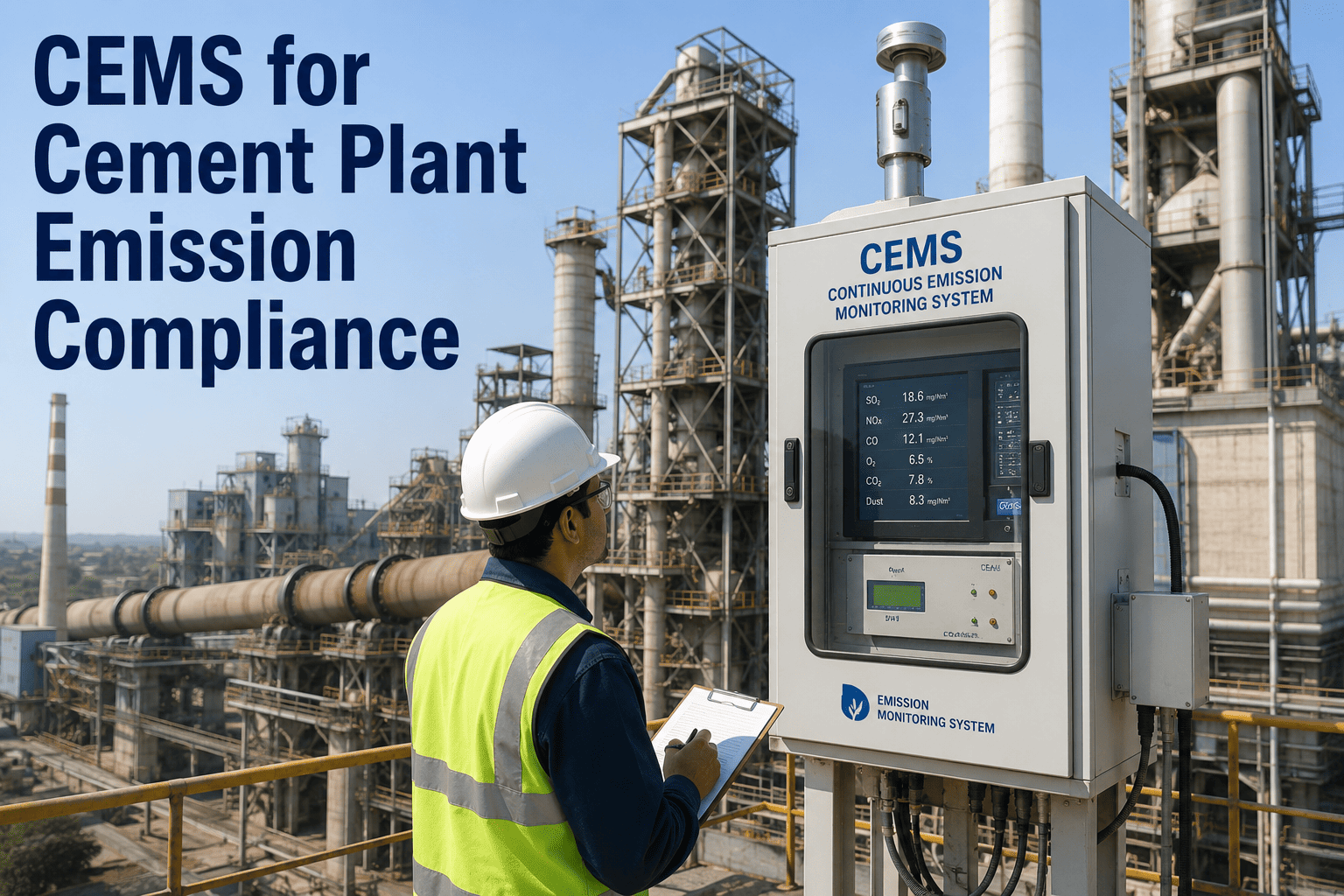
Cement manufacturing produces 2.3 billion tonnes of CO2 annually—7-8% of all global emissions, more than aviation, shipping, and long-distance trucking combined. Every tonne of cement releases 0.6-0.9 tonnes of CO2. With the EU Carbon Border Adjustment Mechanism (CBAM) enforcing carbon tariffs on cement imports from January 2026, carbon prices projected to reach €125/tonne by 2030, and investors conditioning financing on credible ESG metrics, emission monitoring is no longer an environmental nicety—it is a business survival requirement. AI-based emission monitoring transforms this challenge into a competitive advantage: tracking pollutants in real time, optimizing processes to cut emissions at the source, automating regulatory compliance, and generating the verified carbon data that unlocks green financing and market access.
Emission Intelligence
You Cannot Reduce What You Cannot Measure. AI Measures Everything.
AI-based emission monitoring tracks CO2, NOx, SOx, and particulate matter in real time—turning compliance burden into operational savings and market advantage.
2.3 Gt
CO2 emitted by cement annually
€100+
EU carbon price per tonne in 2025
Jan 2026
EU CBAM enforcement begins
Sources: Global Carbon Project, S&P Global Commodities, EU CBAM Regulation
The Regulatory Tsunami Hitting Cement
Cement plants now face six overlapping compliance frameworks simultaneously—and the penalties for non-compliance are escalating from fines to market exclusion. This is not a future threat; it is a present-day operational reality that demands automated, AI-powered emission tracking.
Enforcement: Jan 2026
EU CBAM
Carbon border tariffs on cement imports. Requires verified embedded carbon data or face market exclusion from European markets.
Active
EU Emissions Trading System
Free carbon allowances phasing out. Carbon price at €100+/tonne, projected to reach €150 by 2035. Direct cost per tonne of CO2.
Active
EPA NESHAP / GHG Reporting
Continuous monitoring of HAPs under Subpart LLL. Annual GHG reporting for facilities exceeding 25,000 metric tons CO2e.
Active
ESG & Investor Disclosures
Scope 1/2/3 reporting aligned with TCFD and GHG Protocol. CDP climate scoring. Green financing requires credible emission data.
Active
State & National Air Permits
Local air quality permits with jurisdiction-specific limits on NOx, SOx, particulates, and CO. Violations trigger operational restrictions.
Growing
Green Procurement Mandates
Public buyers specifying low-carbon materials under LEED, BREEAM, and EDGE. Lifecycle carbon data becoming baseline procurement criteria.
Where Cement Emissions Come From—and Where AI Intervenes
To reduce emissions intelligently, you need to understand their sources. About 60% of cement CO2 comes from the chemical transformation of limestone (calcination)—a reaction that cannot be eliminated. The remaining 40% comes from fuel combustion. AI targets both: optimizing combustion to slash fuel-related emissions immediately, while tracking total emissions with the precision regulators demand.
CO2 Emission Sources in Cement Production
60%
Calcination (Chemical Process)
AI Intervention: Calcination Emissions
Reduce clinker ratio by optimizing SCM blending. AI calculates optimal substitution rates for fly ash, slag, and calcined clay while maintaining cement strength.
AI Intervention: Fuel Emissions
Optimize combustion in real time. Increase alternative fuel substitution by 20-40%. Every 1% fuel efficiency gain directly cuts CO2 output.
AI Intervention: Electrical Emissions
Optimize grinding circuits. Shift heavy loads to off-peak and renewable windows. Reduce kWh/tonne across mills and conveyors.
Want to see how AI maps emission reduction opportunities in your specific plant? Book a free emission assessment.
5 Ways AI Transforms Emission Management
AI-based emission monitoring goes far beyond installing sensors and generating reports. It creates an intelligent emission management layer that predicts, prevents, and documents—turning environmental compliance from a cost center into a competitive weapon.
01
Real-Time CEMS Intelligence
AI-powered Continuous Emission Monitoring Systems analyze flue gas data in real time—tracking CO2, NOx, SOx, CO, and particulate matter continuously. When readings approach permit limits, the system triggers alerts and can automatically adjust combustion parameters to bring emissions back within bounds before violations occur.
Instantdeviation detection and corrective action
02
Predictive Emission Forecasting
ML models forecast emission levels based on production schedules, raw material composition, fuel type, and weather conditions—before production even begins. This enables proactive adjustments to minimize emissions during high-output periods rather than reacting after exceedances are recorded.
Hoursof advance warning before emission spikes
03
Combustion & Process Optimization
AI optimizes fuel-air ratios, kiln temperature, and feed rates to minimize emission intensity per tonne of clinker. By stabilizing combustion and preventing overburning, every improvement in thermal efficiency translates directly to lower CO2, NOx, and CO output.
10-15%CO2 reduction through process optimization
04
Automated Compliance Reporting
AI consolidates CEMS data, lab results, and process parameters into audit-ready reports for EPA, EU ETS, CBAM, CDP, and ESG frameworks automatically. Timestamped deviation documentation, root cause analysis, and corrective action records generated without manual data entry.
90 daysto full compliance automation deployment
05
Carbon Footprint Analytics & ESG
AI calculates Scope 1, 2, and 3 emissions across your entire operation with GHG Protocol alignment. Tracks carbon intensity per tonne of cement produced, benchmarks against industry standards, and generates the verified data that unlocks ESG-linked financing and green procurement eligibility.
Scope 1-3complete carbon accounting automated
If EPA Arrived Tomorrow, Could You Produce Complete Documentation in Under One Hour?
iFactory's AI emission platform consolidates CEMS data, automates deviation documentation, and generates regulatory reports instantly from validated data—across all frameworks simultaneously.
The Business Case: Emissions Reduction Pays for Itself
Reducing emissions is not just an environmental obligation—it is a direct financial lever. Carbon pricing, avoided penalties, green financing, and market access create a compelling ROI that makes AI-based emission monitoring one of the highest-return investments a cement plant can make.
Carbon Cost Avoidance
EU ETS + CBAM Exposure
€100+
Per tonne CO2 in 2025
Every tonne of CO2 reduced = €100+ saved. A 10% reduction at a 1.5MT plant saves €9M+ annually at current prices.
Market Access
CBAM + Green Procurement
50%+
Low-carbon concrete target by 2030
Without verified carbon data, cement exports to Europe face border tariffs or exclusion. Green procurement mandates rising globally.
Green Financing
ESG-Linked Capital
Lower
Interest rates with ESG data
Access
Sustainability-linked bonds
Credible emission data unlocks ESG-linked financing, green bonds, and infrastructure lending at preferential rates.
Implementation: 90 Days to Intelligent Emission Monitoring
Modern AI emission platforms deploy without replacing infrastructure. The process integrates with your existing CEMS, SCADA, and control systems in three phases, delivering value from the first month.
Connect & Baseline
Connect CEMS data streams to unified AI platform
Import historical emission records and permit limits
Establish performance baselines across all pollutant categories
Map data flows from DCS, SCADA, and lab systems
Configure & Train
Configure alert thresholds for each regulatory framework
Build automated report templates for EPA, ETS, CBAM, CDP
Train AI models on facility-specific emission patterns
Test automated workflows and compliance documentation
Deploy & Optimize
Deploy live monitoring with real-time dashboards
Complete staff training on AI emission management tools
Generate first automated regulatory reports
Activate predictive emission forecasting and process optimization
Frequently Asked Questions
What pollutants does AI emission monitoring track?
AI-based CEMS systems continuously monitor CO2, NOx (nitrogen oxides), SOx (sulfur oxides), CO (carbon monoxide), particulate matter, and other hazardous air pollutants as required by EPA NESHAP Subpart LLL and local air quality permits. The system tracks all five pollutant categories simultaneously, correlating emission data with process parameters to identify root causes of deviations and optimize reduction strategies.
How does AI help with EU CBAM compliance?
EU CBAM requires verified embedded carbon data for cement exported to European markets starting January 2026. AI platforms calculate the actual CO2 embedded per tonne of cement by integrating kiln process data, fuel consumption, raw material chemistry, and energy sources into a continuous carbon accounting model. The system generates CBAM-compliant documentation automatically, with third-party verification support built in.
Can AI actually reduce emissions, or just monitor them?
Both. AI monitors emissions in real time with precision beyond manual methods, but its real power lies in active reduction. By optimizing combustion parameters, increasing alternative fuel substitution rates by 20-40%, reducing overburning, and enabling lower clinker ratios through intelligent SCM blending, AI-driven process control delivers measurable emission reductions of 10-15% from fuel-related sources without any capital equipment changes.
Do we need to replace our existing CEMS equipment?
No. AI emission monitoring platforms integrate with your existing CEMS hardware, SCADA, and DCS via standard protocols like OPC-UA and MQTT. The system adds intelligence on top of your current sensor infrastructure—processing the data your equipment already generates and turning it into actionable insights, automated reports, and compliance documentation. Deployment typically takes 90 days without infrastructure replacement.
What is the ROI of AI-based emission monitoring?
ROI comes from multiple sources: carbon cost avoidance (every tonne of CO2 reduced saves €100+ under EU ETS), avoided penalties from non-compliance, fuel savings from optimized combustion (6-15%), access to green financing at lower rates, and preserved market access under CBAM and green procurement mandates. For a mid-size plant, the combined savings typically exceed $2-5 million annually, with the monitoring platform paying for itself within the first year.
Turn Your Biggest Liability Into Your Strongest Advantage
iFactory's AI emission platform transforms compliance burden into operational savings—tracking every pollutant, automating every report, and optimizing every process to reduce your carbon footprint while protecting your bottom line.