A carbon figure published two years ago has to survive a question asked today: which emissions factor was used, where did it come from, and would the same calculation reproduce the same number now. Most cement plants cannot answer that cleanly, because factors get updated in spreadsheets with no version history and no record of who approved the change. This guide covers how to build a factor register that survives an audit, with version history, calculation method and approval logged together. Plants ready to see their own factor governance built can book a demo with the iFactory AI team.
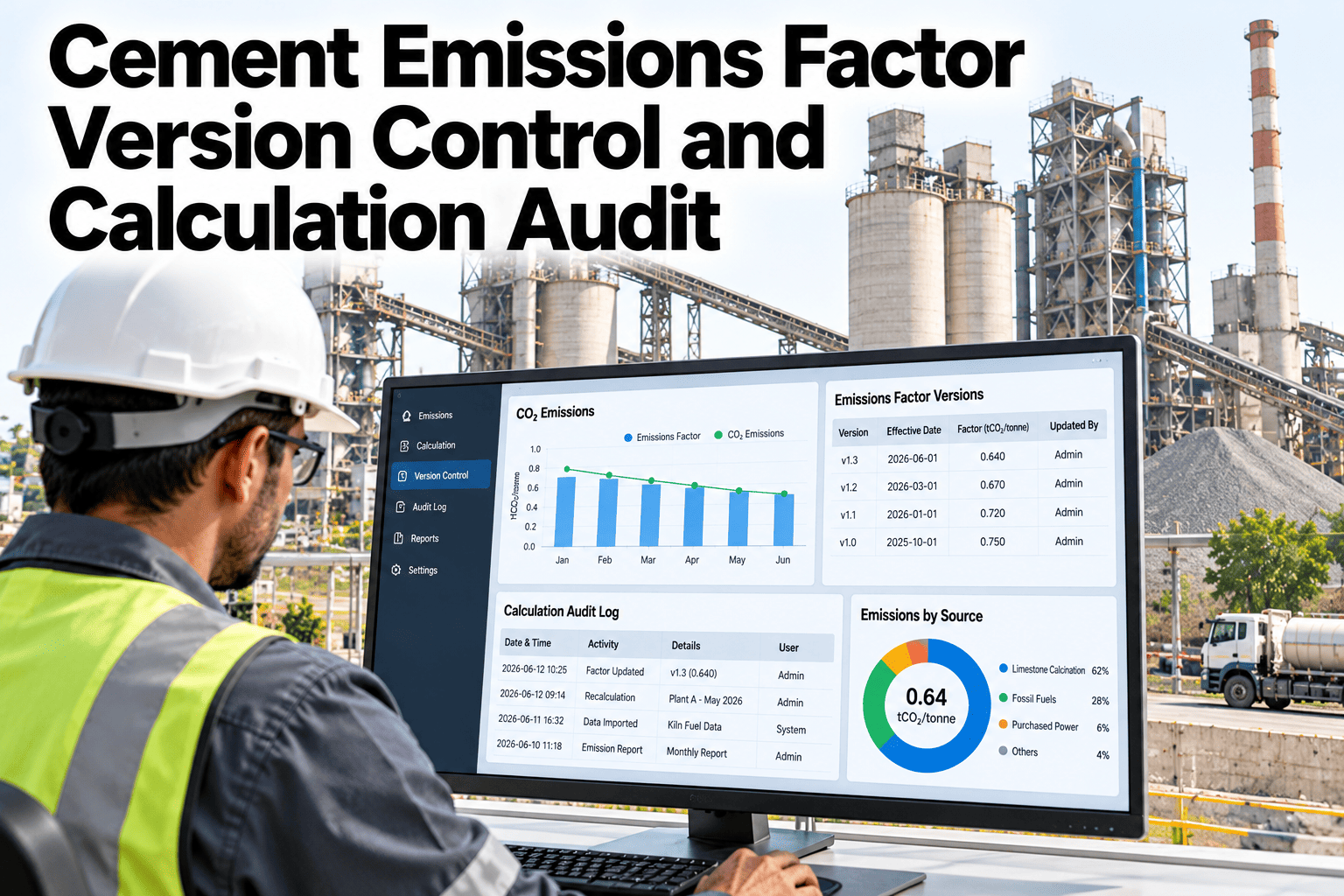
Cement Emissions Factor Version Control and Calculation Audit
Keep a factor source register, version history, calculation method and approval log that any report can be reproduced from.
Why an Old Report Needs to Be Reproducible
A verifier or a customer rarely asks about this year's number alone. They ask why last year's figure was different, and the only honest answer is the factor and method used at the time.
Without version control, the factor behind an old report may already be overwritten, leaving no way to reproduce the original calculation.
Factor Source Register
Every factor in use needs a documented source, so a reviewer can trace it back to where it came from.
| Factor | Source | Basis |
|---|---|---|
| Fuel CO2 | Lab fuel analysis or published factor | Measured or default, clearly labeled |
| Electricity | Grid operator or supplier disclosure | Location or market basis, stated |
| Process CO2 | Raw meal composition analysis | Lab method and sample date |
| Purchased materials | Supplier EPD or database value | Document reference and version |
Version History and Calculation Method
Each factor change needs its own entry, not an overwrite, so the full history stays visible rather than disappearing with the update.
Make Every Carbon Figure Defensible Later
Book a 30-minute walkthrough and see factor version history and approval logs built for your plant.
A Sample Approval Log, Illustrative
The figures below are invented to show the shape of an approval record, not to benchmark your plant.
Common Factor Governance Mistakes
The same gaps repeat across plants building their first factor version control system.
Who Relies on This Register
A well-governed factor register serves more than the team that built it.
A verifier reviewing an EPD traces every number back to its source and approval. A new sustainability hire can pick up last year's report and understand exactly how it was built, without needing the original author in the room.
Frequently Asked Questions
How often should emissions factors be reviewed?
Annually is a common minimum, though factors tied to grid electricity or fuel supply should be checked whenever the underlying source publishes an update, since using a stale factor can meaningfully shift a reported figure. Book a demo to set a review cadence for your own factors.
Can old reports be recalculated automatically?
Yes, when the archived version and method are preserved, a past report's figures can be regenerated on demand, which is exactly what a reproducibility check confirms.
Who should own factor approval?
Typically the sustainability lead approves factor changes, with input from quality or process engineering for plant-specific measured factors like raw meal composition.
Does this replace our existing carbon reporting tool?
No, it strengthens the data governance layer beneath it. iFactory AI can feed version-controlled factors into whatever reporting tool or EPD process your plant already uses. Ask support how this connects to your reporting tool.
Build a Factor Register That Survives an Audit
iFactory AI keeps factor sources, version history and approvals together so every report stays reproducible. Book a walkthrough built around your plant.