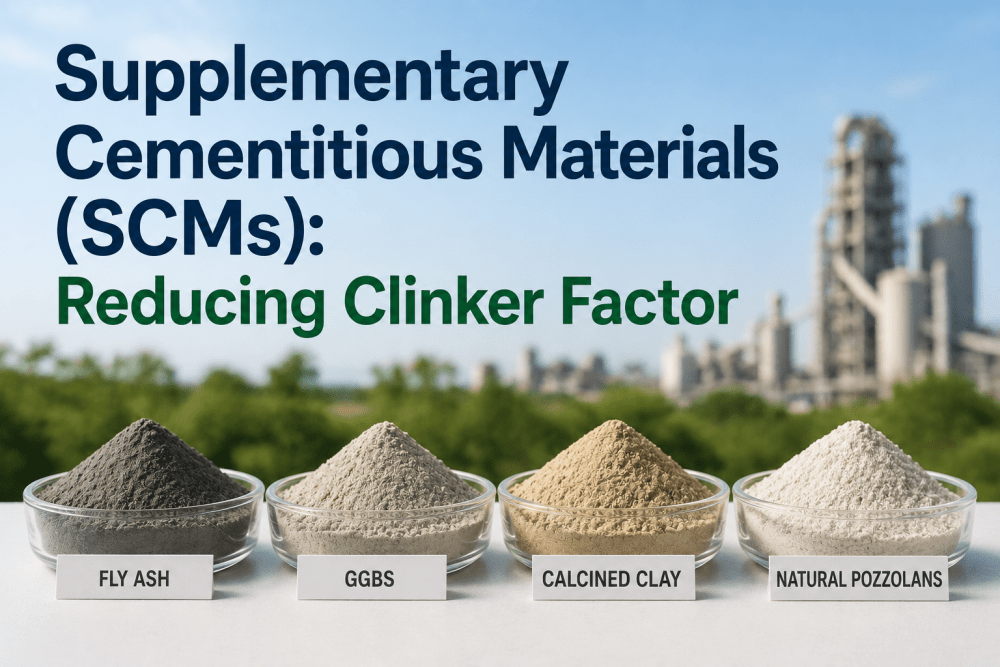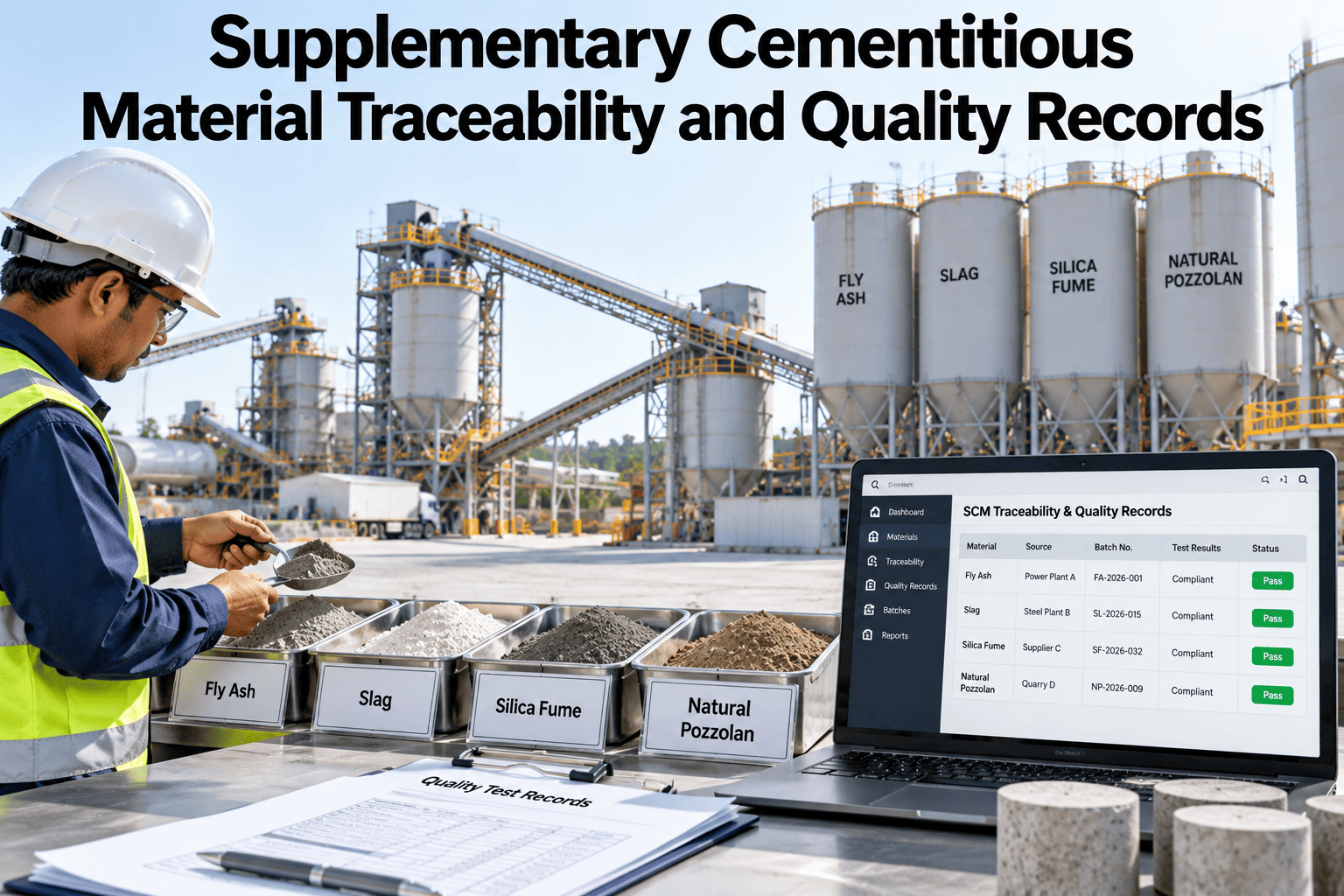
Slag, fly ash, natural pozzolana and ground limestone now make up a large share of what goes into modern cement. Each arrives from a different supplier, in a different lot, with its own test results, and ends up in several grades. When a customer asks what was in a delivery, or a lab result comes back late, the plant needs a clean chain from source to silo to product. This guide lays out that record. Teams that want to see it on live plant data can request a demo of iFactory AI for cement quality records.
Supplementary Cementitious Material Traceability and Quality Records
A workflow for cement plants: record the supplier and source, build batch records, hold test results, track storage and receipt, show usage by product and run a quality review. iFactory AI joins the records.
Why SCM Records Matter More Every Year
Supplementary cementitious materials, often shortened to SCMs, replace part of the clinker in cement. Clinker is the biggest source of carbon in a tonne of cement, so every tonne of SCM used well lowers the footprint. That makes SCMs a quality topic and a carbon topic at once.
Variable inputs
Fly ash, slag and pozzolana are by-products or natural materials. Their chemistry, fineness and carbon content move from lot to lot, and the cement moves with them.
Claims need evidence
A lower clinker factor is only credible if the plant can show how much SCM went into each grade and where it came from.
Product standards such as EN 197-1 define which constituents a cement type may contain. The standard names granulated blast furnace slag, siliceous and calcareous fly ash, natural and calcined pozzolana, limestone and silica fume, each with its own symbol. Concrete-side standards and material standards, such as ASTM C618 for fly ash and natural pozzolan, set the properties each material must meet. Your record should carry the standard each lot was bought and tested against.
The Chain You Are Trying to Build
Think of the record as a chain with six links. Each link is a short set of fields, and each one points to the next. If any link is missing, the chain breaks at that point and the question cannot be answered.
Keep the identifiers simple and consistent. A lot number that appears unchanged on the weighbridge ticket, the sample label, the silo log and the usage report is worth more than any clever scheme. Where two systems use different numbers, store the mapping between them and never rely on someone remembering it. Decide who may change a lot record, and make every change leave a dated note, so the chain can be trusted a year later by someone who was not there.
Record Area 1: Supplier and Source
The supplier record is the start of the chain. It should be a controlled master record, not something re-typed on every delivery.
| Field | Example | Why Keep It |
|---|---|---|
| Supplier and site | Named power station or steelworks | Material from different sites behaves differently |
| Material type | Granulated slag, siliceous fly ash, natural pozzolana, limestone | Maps to constituent symbols in the cement standard |
| Specification | The standard and class the supplier declares | Defines which limits apply on receipt |
| Approval status | Approved, conditional, suspended | Stops unapproved lots entering the process |
| Source change history | Fuel switch at the power station, new coal blend, new blend of slag | Explains a shift in results |
| Transport route | Truck, rail, ship, with distance | Feeds footprint data and delivery planning |
Source changes deserve special attention. A power station that changes fuel or burner settings can change the carbon content of its ash without telling anyone, and a steelworks that changes its slag cooling can change glass content. Ask suppliers to tell you, and record the date when they do.
Record Area 2: Batch Records
A batch record, here meaning a delivery lot, ties together everything known about one consignment. Open the lot record at the gate, before the material goes anywhere.
| Status | Meaning | Allowed Next Step |
|---|---|---|
| Received | Arrived, weighed and sampled, results pending | Quarantine storage or conditional use under written rules |
| Accepted | Meets the specification on all required tests | Move to a silo and use |
| Held | A result is outside limits or missing | Retest, accept with concession, or reject |
| Rejected | Does not meet the specification | Return, dispose or use for another purpose |
| Consumed | Used up, with usage recorded by grade | Close the lot |
See SCM Lots Traced End to End
Book a 30-minute demo and iFactory AI will show a supplier lot followed through storage, mill runs, grades and dispatch for a cement plant.
Record Area 3: Test Results
Test results turn a delivery into an approved material. The plant needs its own results as well as the supplier certificate, because certificates describe production, not the lot in your truck.
The grid below is an illustrative testing plan, not a rule from any standard. Darker cells mean a test is carried out more often or on more lots. Set the frequencies from your standard, your risk and your history.
As one reference point for limits, the 2012 edition of ASTM C618, now marked historical, specified for coal fly ash and natural pozzolan: loss on ignition at most 6.0 percent for classes F and C and 10.0 percent for class N, moisture at most 3.0 percent, fineness no more than 34 percent retained on the 45 micron sieve, and a strength activity index of at least 75 percent at both 7 and 28 days. Always use the current edition and your own purchase specification.
| Result Rule | Requirement | Why It Matters |
|---|---|---|
| Linked to the lot | Every result carries the lot and sample identifier | No orphan numbers |
| Checked on entry | The system compares each value with the limit | Instant flag, no manual look-up |
| Method named | Each result states the test method and edition | Results from different methods are not comparable |
| Slow tests tracked | Strength tests stay open until the last age is read | The lot may be in use before the result arrives |
| Supplier versus plant | Both results are stored side by side | Shows drift between certificate and reality |
Record Area 4: Storage and Receipt
Once a lot is accepted it goes into a silo, a bunker or a covered store. This is where traceability usually breaks, because material from several lots mixes. Decide in advance how the record will handle it.
| Storage Case | Record Approach | Trade-off |
|---|---|---|
| One lot per silo | Silo equals lot, usage tracked by silo | Cleanest record, needs spare silo capacity |
| Several lots in one silo | Silo carries a blended identity, with fill and draw periods | Works for most plants, traces to a group of lots |
| Open stockpile | Pile identity with dated additions and moisture checks | Moisture and contamination risk is higher |
| Bunker with reclaimer | Bay identity and reclaim records | First-in, first-out is not guaranteed |
The bars above show illustrative fill levels in percent for three silos. Level readings are useful for the record because they show when material was added and drawn. Capture level, receipt events and draw events together, and the blended identity of each silo can be rebuilt after the fact.
Record Area 5: Usage by Product
Usage records answer the question every customer and auditor eventually asks: how much of this material is in that product. They come from feeder totals, and they should reconcile with stock.
When feeder totals and stock use disagree, the difference is a finding. It might be a feeder calibration error, a stock count error, or material lost to spillage. Investigate while the month is fresh and record the answer in the same file.
| Usage Field | Source | Use |
|---|---|---|
| SCM per run | Mill feeder totals | Product composition for each run |
| SCM per grade | Run totals grouped by grade | Customer and carbon reporting |
| Lots per run | Silo draw and lot records | Traceability to the source |
| Dosage versus recipe | Setpoint and actual | Shows drift from the intended recipe |
Record Area 6: Quality Review
Review closes the loop. It checks that lots, tests and usage tell one consistent story, and it turns exceptions into decisions.
Lot closure
Each lot is closed only when tests are complete, usage is recorded and the balance is explained.
Trend watch
Supplier results are trended so slow drift in carbon content or fineness is seen early.
Exception follow-up
Holds, concessions and rejections are reviewed for cause and repeat issues.
| KPI | Definition | Use |
|---|---|---|
| Lots accepted first time | Lots accepted without retest, divided by all lots | Supplier quality |
| Held lot age | Days a lot stays held | Process speed and storage pressure |
| Certificate versus plant gap | Difference between the two results for the same property | Trust in supplier data |
| Stock reconciliation error | Gap between feeder totals and stock use, as a percentage | Data quality |
| Trace time | Minutes to list every product that used a lot | Recall readiness |
A Late Result Traced in Minutes
Suppose a fly ash lot is found, after some of it has been used, to have fineness outside the limit. With a complete chain, the plant can scope the issue quickly. Without it, the safe response is to review every product made that week.
The numbers are invented. What matters is the shape: a lot link turns an open-ended review into a finite list of runs and loads, and the held portion in the silo is stopped before it does any harm.
Common SCM Record Mistakes
These problems appear again and again when plants first build SCM records. Each has a plain fix.
Linking SCM Records to Carbon Reporting
The records in this guide are also the raw material for clinker replacement and product footprint claims. Linking them once avoids keeping two sets of books.
Material facts
Supplier, origin, transport route and the specification each lot met give the inputs a footprint model needs.
Product facts
Feeder totals by grade give the real share of SCM in each product, rather than the share written in the recipe.
Treatment of by-products such as slag and fly ash differs between footprint methods, so write down which rule your reports follow. Keep the quantity records separate from the factor, so a change of method changes the factor and leaves the usage history intact.
A practical habit is to review SCM usage and clinker factor on the same page each month. If the recipe says 25 percent but feeders show 22, the plant has either a dosing issue or a stock error, and both are worth knowing about before a customer or verifier asks.
A 90-Day Path to SCM Traceability
iFactory AI is built as a turnkey server that racks in, plugs in and goes live in roughly 6 to 12 weeks, so a traceability pilot on one or two SCMs fits inside a quarter.
What iFactory AI Adds
iFactory AI is smart manufacturing and industrial software. For cement plants it joins weighbridge, lab, silo and feeder records into one traceable chain for each SCM.
Plain-Language Glossary
Shared words keep production, quality and procurement teams aligned.
Frequently Asked Questions
Do we need to test every SCM lot ourselves?
Supplier certificates help, but they describe production and not your delivery. Most plants test key properties on each lot. Book a demo to see plant and supplier results side by side for each lot.
How do we trace when several lots share one silo?
Record fill and draw events and treat the silo as a blend of the lots present during each period. Request a demo to see blended silo identity rebuilt from events.
Which standards apply to our SCMs?
It depends on the material and the market. Cement product standards such as EN 197-1 define allowed constituents, while material standards such as ASTM C618 define properties. Always check the current edition.
Can the same records support carbon reporting?
Yes. Usage by grade gives the clinker replacement behind a footprint, and supplier and transport data feed the factors. Book a demo to see SCM usage feeding footprint data for each grade.
Does iFactory AI replace our lab or weighbridge system?
No. It reads from those systems and joins the records into one chain, so existing equipment stays in place and your people keep working in the tools they already know.
Know Where Every Tonne of SCM Went
iFactory AI joins supplier, lab, storage and usage records into a chain your quality team can trust. Book a walkthrough built around your plant.