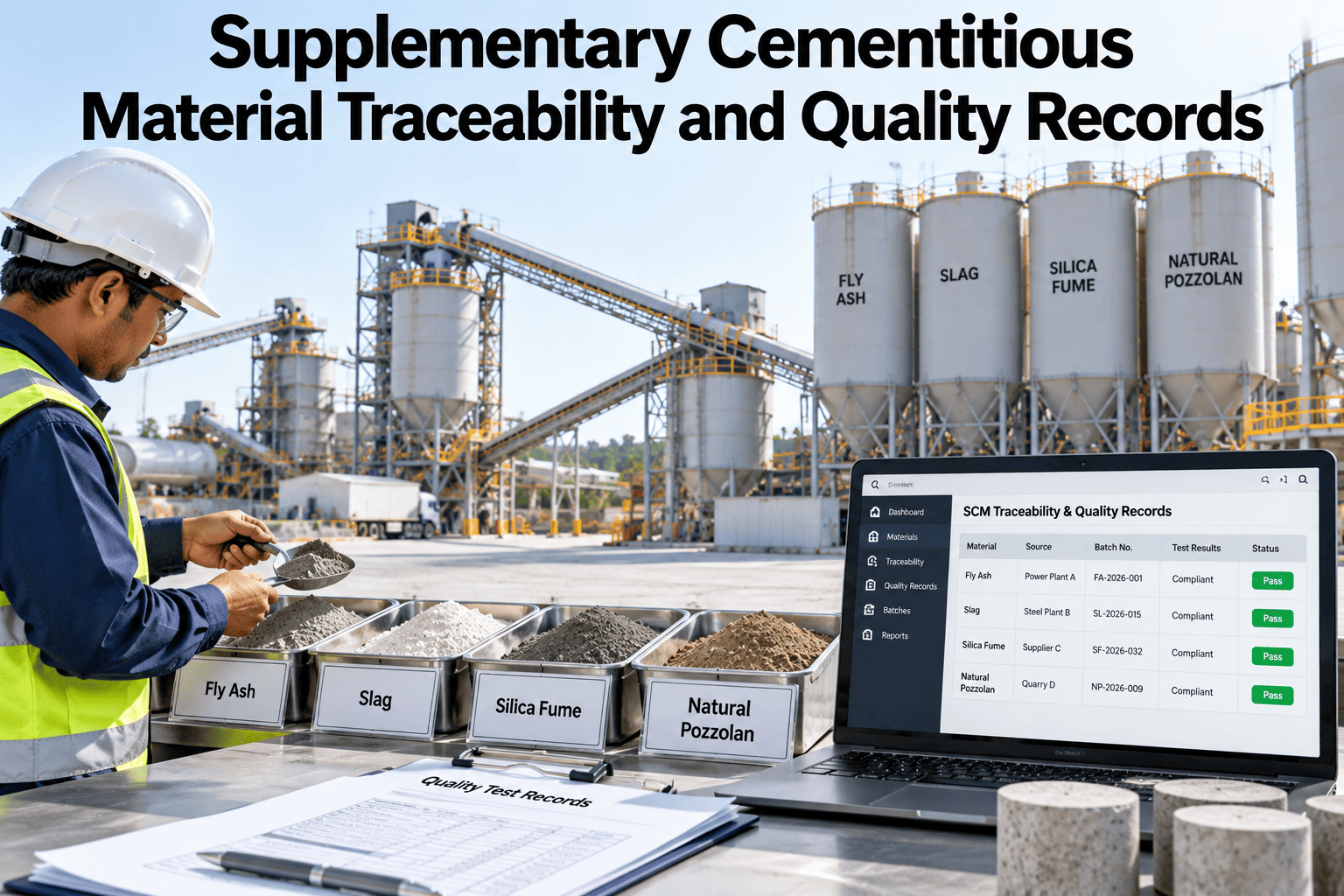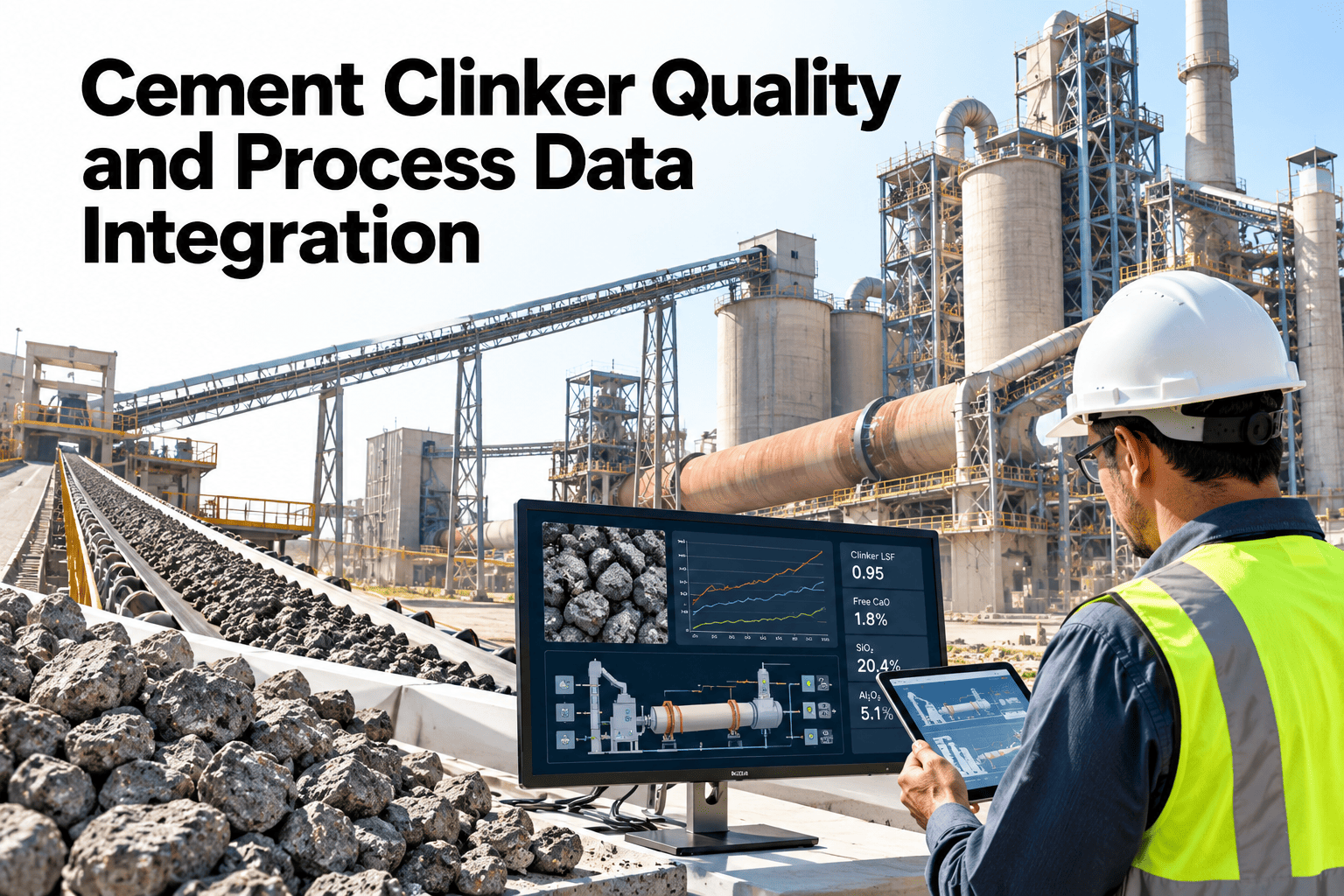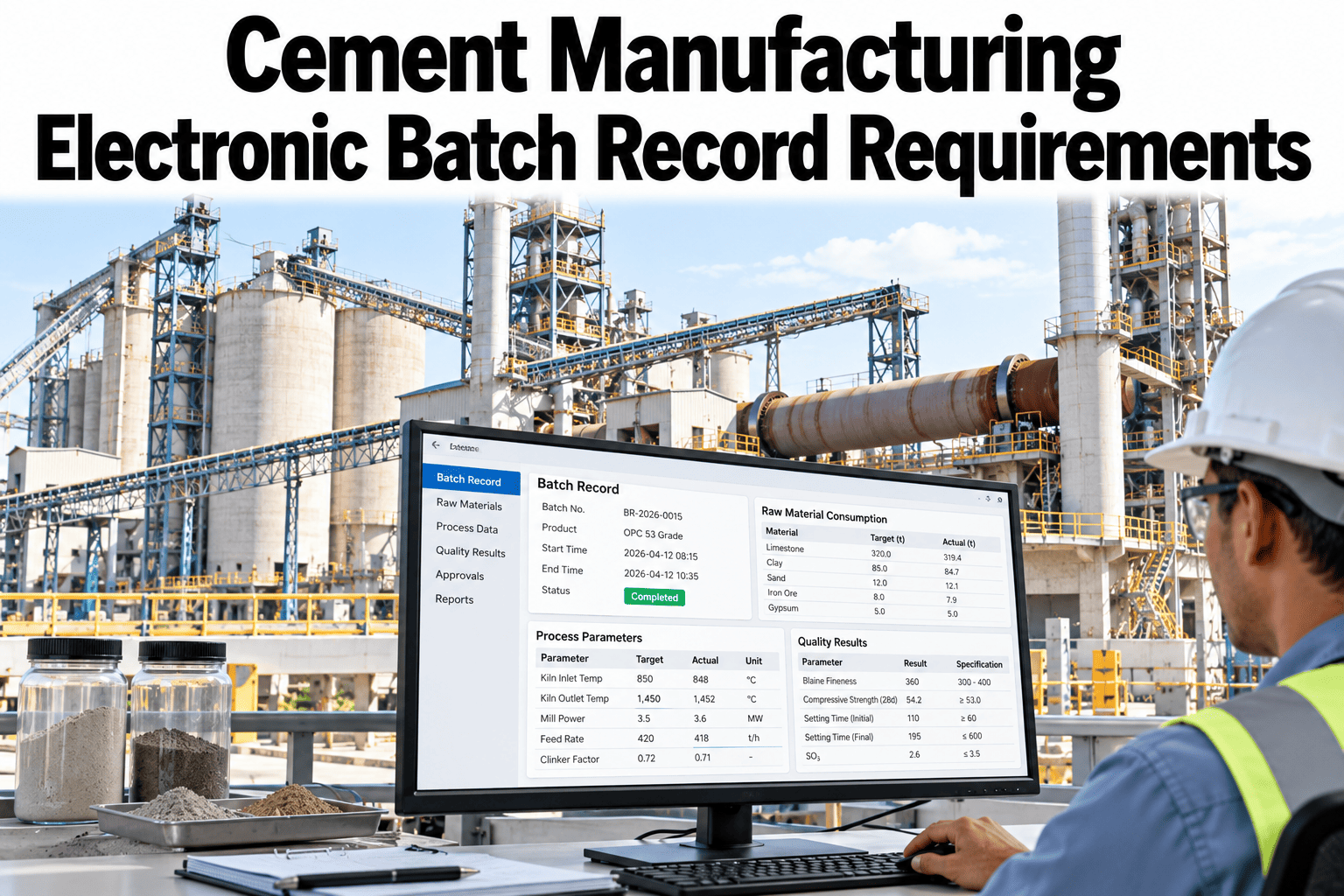
Cement is made continuously, so there is no natural batch to wrap a record around. Quality teams still have to answer batch-style questions: which clinker, which additions, which mill settings and which lab results went into the cement in silo four last Tuesday. An electronic record that answers them in minutes beats a paper chase through logbooks. Plants working out what that record must hold can book a demo to see a cement production record built from live plant data.
Cement Manufacturing Electronic Batch Record Requirements
A requirements guide for cement plant teams: what the record covers, the production, material and lab data it holds, how deviations are handled and how long it is kept. iFactory AI collects the data from plant systems.
What a Batch Means When the Process Never Stops
A pharma plant makes a batch with a start, an end and a signature. A cement plant runs kilns and mills around the clock, and material blends in silos. The first requirement is to decide what unit of cement your record describes. The choice shapes everything that follows.
| Record Unit | What It Covers | Strength | Weakness |
|---|---|---|---|
| Production run | One cement grade through one mill between changes | Matches how operators think | Runs overlap in silos and blur |
| Silo fill | Cement held in one silo between empty and full | Ties well to dispatch | Silos are topped up while draining |
| Fixed time window | A shift or a day of production per mill | Simple and easy to automate | Cuts across grade changes |
| Dispatch lot | Cement shipped to a customer in a load or order | What the customer holds | Needs a link back to production |
Most plants end up with a chain. A production run record per mill, linked to the silos it fed, linked in turn to dispatch lots. The standards do not tell you which unit to use, so write down your choice and apply it the same way everywhere.
Where the Requirements Come From
There is no single rulebook for a cement batch record. The requirements come from several places, and it helps to know which is which before you write a specification.
| Source | What It Asks For | Effect on the Record |
|---|---|---|
| Product standards such as EN 197-1 and ASTM C150 | Composition and performance limits for each cement type | Record must show the grade and the test results against limits |
| EN 197-2 conformity scheme | Factory production control, autocontrol testing and rules after non-conformity | Records of sampling, testing and corrective action |
| Quality system such as ISO 9001 | Documented information and traceability where required | Controlled, retrievable records with clear ownership |
| Customer contracts | Certificates, test frequencies, retained samples | Certificate of analysis tied to the dispatch lot |
| Your own risk view | What you need to defend a claim or fix a process | Extra parameters and longer retention than the minimum |
EN 197-2:2020, as its catalogue entry describes it, sets out the scheme for assessing and verifying constancy of performance, with technical rules for factory production control, autocontrol testing, audit testing and actions after non-conformity. It also covers dispatching centres and depots. Check the current text and your certifier's rules for the exact duties on your site.
Pharma-style rules, such as the FDA's 21 CFR Part 11 on electronic records, are not the usual basis for cement. A vendor page cites them for electronic signatures, but unless your own quality system or a customer asks for them, treat audit trails and signatures as good practice and not as a legal duty.
Requirement Area 1: Record Scope
Scope fixes what the record is about and who owns it. Without it, records drift into whatever the last person typed.
| ID | Requirement | Why It Matters |
|---|---|---|
| S1 | Each record has a unique identifier tied to the chosen record unit | Every later link depends on it |
| S2 | The record states the product: cement type, strength class and standard | Limits differ by grade |
| S3 | Start and end times, mill or line, and silo destination are captured | Defines the boundary of the batch |
| S4 | A named owner is responsible for completing and reviewing it | Prevents orphan records |
| S5 | The record links forward to dispatch lots and backward to inputs | Two-way traceability |
| S6 | Status is explicit: open, awaiting results, reviewed, released or held | Shows what can ship |
See a Cement Record Built Automatically
Book a 30-minute demo and iFactory AI will show how production data, material lots and lab results join into one record for a cement plant.
Requirement Area 2: Production Parameters
Production data explains how the cement was made. For a continuous plant the practical approach is to store averages and extremes for each record window, with the raw trend kept in the historian and referenced from the record.
| Process Area | Typical Parameters | How to Record |
|---|---|---|
| Raw meal and kiln feed | Feed rate, raw meal fineness and chemistry from the blending stage | Average and range for the window |
| Kiln | Burning zone conditions, fuel rate, fuel mix, stoppages | Average, plus flags for excursions and stops |
| Clinker | Source, production period, free lime results | Link to the clinker lot or store |
| Cement mill | Throughput, mill load, outlet temperature, separator settings | Average and range |
| Additions | Gypsum, limestone and other mix proportions | Weigh feeder totals and percentages |
| Silo and dispatch | Silo number, fill start and end, loading times | Event records |
Capture setpoints and actual values separately. A mill that was set for one fineness but ran at another is an important fact in a later investigation, and a record showing only setpoints would hide it.
Requirement Area 3: Material Lots
The record must say what went into the cement. That means tracking each input back to its own lot, and forward to where the finished cement went.
Silos make this harder because cement blends as one run fills on top of another. A practical rule is to record the silo and the fill and draw periods, then treat the contents as a mix of the runs that fed it. Where precision matters, such as a specialised cement, dedicate a silo to a single run.
Requirement Area 4: Lab Results
Lab results prove the cement meets its grade. They arrive at different speeds, and the record has to stay open until the slowest one comes in.
| ID | Requirement | Why It Matters |
|---|---|---|
| L1 | Every sample has a unique identifier, a time, a point of origin and a sampler | Chain of custody |
| L2 | Results link to the record unit sampled, with the method named | Proof of which cement was tested |
| L3 | Each result is checked against the grade limits on entry | Immediate flag for out-of-range values |
| L4 | Instrument and calibration status are visible, with entries blocked when a certificate has expired | Trustworthy numbers |
| L5 | The record stays open until the 28-day result arrives | Final release evidence |
The vendor page quoted here describes sample barcodes, technician IDs and entry blocks for expired calibration. They are marketing claims, but the practices are sound and worth specifying whichever system you use.
Requirement Area 5: Deviations
Deviations are where records earn their keep. A good system makes the response automatic, so no one has to remember what to do when a result is out of range.
| Deviation Type | Example | Likely Disposition Options |
|---|---|---|
| Process excursion | Mill outlet temperature above the set limit for an hour | Review effect on gypsum dehydration, retest, release or hold |
| Material issue | Addition lot fails its incoming test | Trace silos fed, blend or downgrade |
| Lab result out of limit | Fineness below target for a silo sample | Retest, adjust the mill and decide on the silo contents |
| Late strength result | 28-day strength below the grade limit | Trace shipped loads, notify customers per procedure |
| Missing data | Weigh feeder total absent for a window | Reconstruct from the historian or flag as incomplete |
EN 197-2 includes rules for actions after non-conformity. The exact steps depend on your certification body and customer contracts, so build your workflow around your own procedure and use the standard as a check.
Requirement Area 6: Review and Retention
A record is only useful if someone reviews it and it can be found years later. Review by exception keeps the workload sensible, and retention should follow a written rule.
Check the exceptions, sign the rest
The reviewer sees a summary of flags, open deviations and missing results. Records with none can be approved in one pass.
Set the period in writing
Agree a period with legal, your certification body and key customers. The vendor page reviewed here gives none, and there is no universal number to quote.
| ID | Requirement | Why It Matters |
|---|---|---|
| R1 | Records are reviewed and approved by a named person with the right role | Accountability |
| R2 | Reviewed records are locked, and later changes are made as dated corrections | Integrity |
| R3 | An audit trail shows who entered, changed or approved each item and when | Defence in an audit |
| R4 | Records are searchable by silo, date, grade, sample and dispatch lot | Fast retrieval |
| R5 | Retention covers at least the product's expected use period and any contract terms | Claims and warranty |
| R6 | Backups and restore tests are scheduled and logged | Records survive a failure |
What Good Traceability Is Worth
Imagine a customer complaint about low early strength in a cement delivered over several days. Without a lot record, the safe response is to hold or recall everything that could be affected. With one, you can limit it to the silo fill that matches.
The numbers are invented to show the method. Real costs depend on your customers, contracts and the nature of the fault. What does not change is the shape: a precise record turns a broad hold into a narrow one, and a narrow hold costs less and damages fewer relationships.
Common Record Design Mistakes
Plants moving from paper to electronic records tend to trip over the same few problems. Each has a plain fix.
Data Checks to Run Before Go-Live
A record is only as good as the data feeding it. Before anyone relies on an electronic record, test the feeds one by one against what operators and the laboratory already know to be true.
| Feed | Check | Pass Looks Like |
|---|---|---|
| Weigh feeder totals | Compare record totals with stock movements for a full week | Differences explained and within an agreed tolerance |
| Clock alignment | Check that control system, lab system and record share one time source | No sample appears before the run it describes |
| Lab results | Trace ten results from instrument to record | Values, units and sample identifiers match exactly |
| Silo events | Replay a known week of fills and loads | Every dispatch load maps to one silo and one time |
| Limits | Read every configured limit against the product standard and customer terms | Each limit has a named source and an owner |
| Gaps | Pull the plant offline for a test and watch the record | Missing data is flagged and never silently filled |
Run these checks with someone from production, someone from the laboratory and someone from IT in the same room. Disagreements found now are cheap. The same disagreements found during an audit are not.
Treat the checks as repeatable. Keep the test sheet, rerun it after any control system change or lab software upgrade, and file the result with the record design so the next reviewer knows what was proven and when.
A 90-Day Path to Electronic Cement Records
iFactory AI is built as a turnkey server that racks in, plugs in and goes live in roughly 6 to 12 weeks, so a record pilot on one mill and its silos fits inside a quarter.
What iFactory AI Adds
iFactory AI is smart manufacturing and industrial software. For cement plants it gathers production, material and lab data into one traceable record.
Plain-Language Glossary
Shared words keep production, quality and IT on the same page.
Frequently Asked Questions
Do cement plants need an electronic batch record?
No single rule demands one, but standards, quality systems and customers expect traceable production and test records. Book a demo to see what a digital record looks like for a cement plant.
What is a batch in a continuous cement process?
You define it. Common choices are a production run, a silo fill, a time window or a dispatch lot, and many plants link several of them in a chain.
How long do we keep cement production records?
There is no universal period. Agree one with legal, your certification body and customers, based on product use life and contract terms. Book a demo to see retention rules configured per record type.
When can a record be closed?
Only after the last required result arrives, usually the 28-day strength test, and any deviations are closed. Until then, keep the status open and the linked lots visible.
Does iFactory AI replace our lab system?
No. It pulls results from your lab system or instruments into the record. Book a demo to see lab integration in practice and confirm which systems fit.
Make Every Tonne of Cement Traceable
iFactory AI joins production data, material lots and lab results into records your quality team can review in minutes. Book a walkthrough built around your plant.