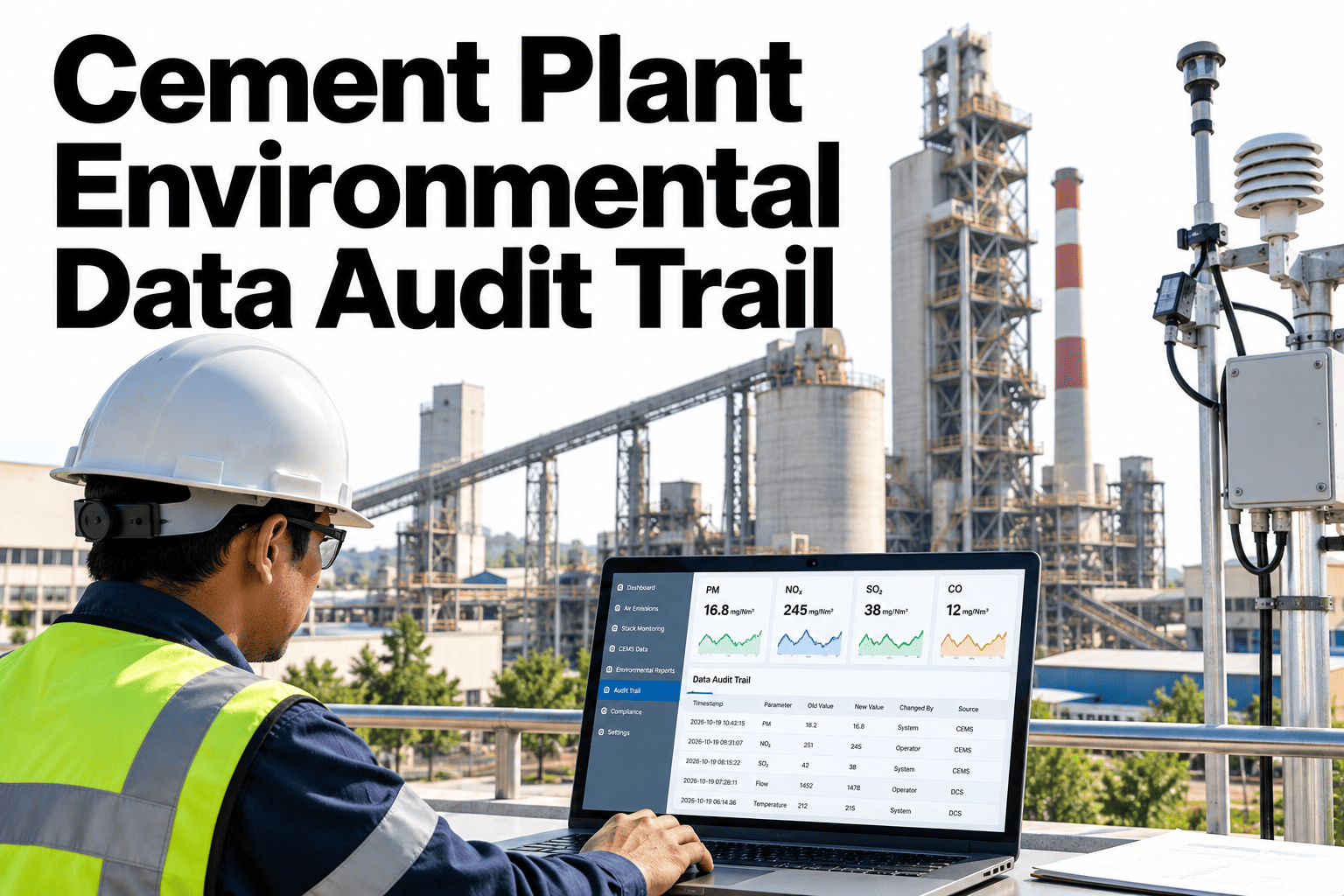
An environmental data audit rarely fails because a number was wrong. It fails because nobody could show how the number was produced: which source record it came from, who owned that data, which version of the calculation was used, and whether anyone reviewed it before it was reported. Without a structured audit trail, every one of those questions turns into a reconstruction exercise under time pressure, often months after the number was first calculated. A governance layer that keeps a source data register, named data owners, versioned calculations and a logged review history turns an audit from a scramble into a lookup. Teams building this governance layer can see an environmental data audit trail built from live plant records before the next external review.
Cement Plant Environmental Data Audit Trail
A source data register, named owners and versioned calculations that turn an audit into a lookup, not a scramble.
Why Audits Turn Into Scrambles
Without a structured trail, three specific questions become hard to answer under time pressure.
A reported figure cannot be traced back to the original meter reading or record it came from.
Nobody is clearly responsible for explaining or correcting a specific data category.
A past report cannot be reproduced because the calculation has since changed.
Each of these is a governance gap, not a data accuracy problem, and each is fixable before the next audit arrives.
Source Data Register and Data Owners
Every environmental data point needs a registered source and a named owner.
Source Data Register
Every data category is registered against its originating system, meter or record.
Data Owners
A named owner is responsible for the accuracy of each registered data category.
Check Your Own Data Register Against This Standard
Book a 30-minute session and bring your current environmental data sources. iFactory AI will show how a structured register would look.
Calculation Versions and Review History
These two pieces make a past report reproducible and a current one accountable.
| Component | What It Preserves |
|---|---|
| Calculation versions | The exact methodology and factors used for a given reporting period |
| Review history | Who reviewed a figure, when, and what changed as a result |
Missing Data Handling and Evidence Export
Gaps need to be handled transparently, and the final record needs to be producible on request.
Missing Data Handling
Gaps are flagged explicitly, with a documented method for any estimate used to fill them.
Evidence Export
The full trail, source to report, exports in a format suitable for an auditor or reviewer.
iFactory AI builds the source register, ownership structure and version history around existing environmental data systems.
Expert Review
The plants that pass an environmental audit smoothly almost always have one thing in common: a named owner for every data category who can answer a question directly rather than needing to track down who originally produced the figure.
Missing data handling is the piece most governance frameworks treat as an afterthought, yet it is often the first thing an auditor asks about. A documented, consistent method for handling a gap is far more defensible than silence on how a gap was filled.
Frequently Asked Questions
How granular does the source data register need to be?
Registering at the level of each distinct data category, such as a specific meter, fuel type or production line, is usually sufficient; it does not need to track every individual reading separately. The goal is tracing a reported figure back to its originating system. See a sample register structure in a working session.
Who typically owns different categories of environmental data?
Ownership commonly splits across process engineering for production and fuel data, energy teams for electricity data, and sustainability or compliance teams for the final calculated figures, though this varies by organization. Ask support about structuring ownership for your organization.
How are calculation versions preserved when a methodology changes?
Each methodology or factor update creates a new version rather than overwriting the previous one, so a historical report can always be reproduced using the version that was actually in effect at the time it was generated. Request a version history example.
What does a documented missing data method actually look like?
It typically specifies how a gap is identified, what substitute data or estimation approach is used, and how the substitution is flagged in the final report, so a reviewer can see exactly where and how a gap was handled. Contact support for a sample missing data policy.
How long before the full audit trail is ready for an external review?
Most plants have the register, ownership structure and version control in place within six to nine weeks, with the evidence export validated against at least one past reporting period before go-live. Book a session to estimate your own timeline.
Make Your Next Audit a Lookup, Not a Scramble
iFactory AI builds a source register, data ownership and version history around your environmental data. Discuss your own setup.