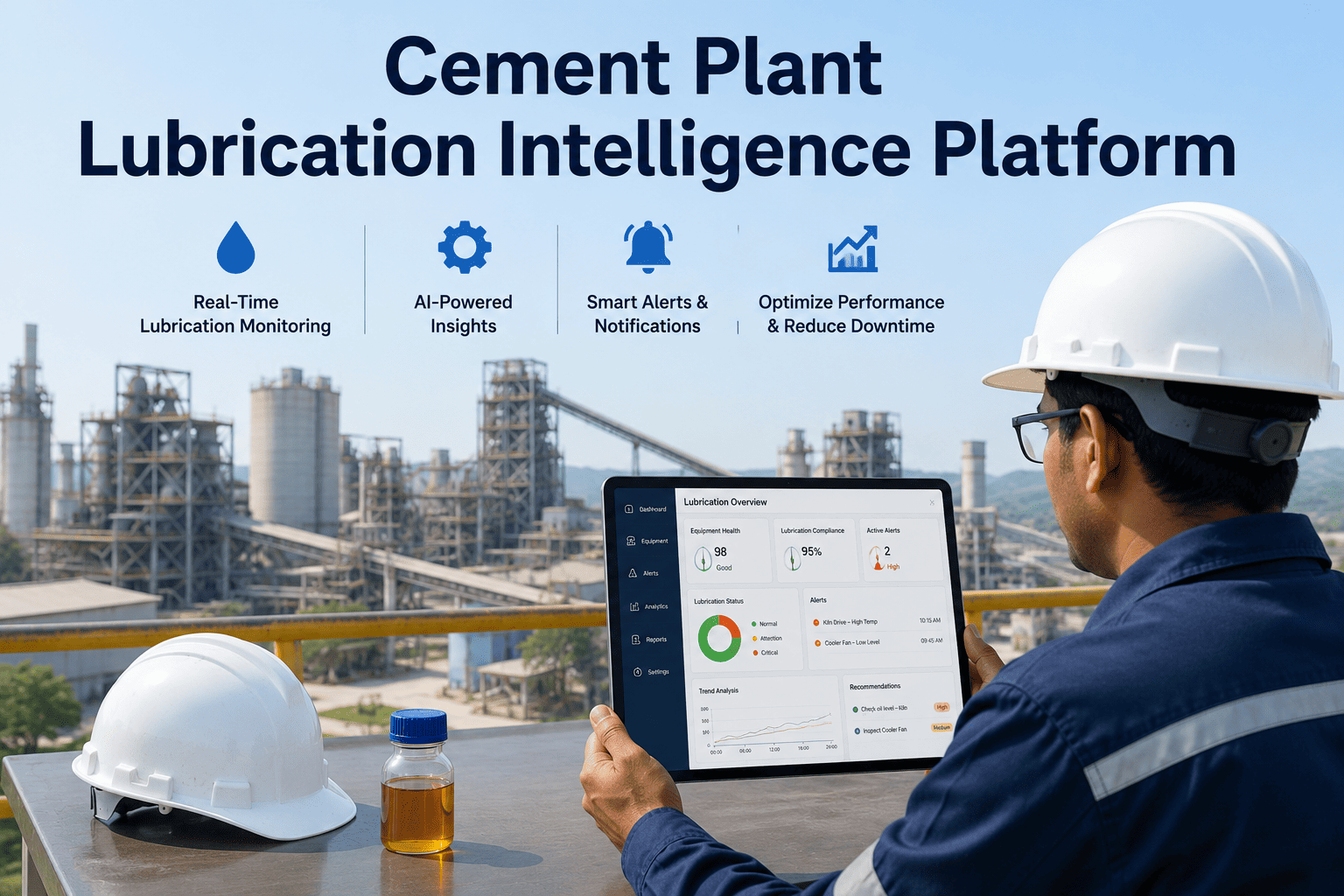
Lubrication failure is the invisible root cause behind a disproportionate share of unplanned cement plant downtime — bearing seizures, gearbox scoring, and premature roller wear on raw mills, kilns, and cement mills can almost always be traced back to a missed relubrication interval, contaminated oil, or a grease that degraded past its service life without anyone noticing. Most plants still run lubrication on a calendar-based schedule that ignores actual operating hours, load, temperature, and contamination trends, which means critical assets are frequently over-greased, under-greased, or lubricated with the wrong interval entirely. iFactory's Lubrication Intelligence platform closes that gap by combining AI-scheduled lubrication routes, automated oil analysis tracking, and real-time bearing health signals into a single system that tells technicians exactly what to lubricate, when, and with how much. Book a Demo to see it mapped to your plant's asset list.
AI LUBRICATION SCHEDULING · OIL ANALYSIS · BEARING HEALTH
Stop Guessing When to Lubricate — Let AI Tell You
iFactory's Lubrication Intelligence platform replaces fixed calendar schedules with condition-based, AI-optimized lubrication routes built from oil analysis trends, bearing temperature data, and equipment duty cycles — cutting bearing failures and gearbox rebuilds across every rotating asset in the plant.
34%
Fewer Bearing Failures
28%
Lower Lubricant Spend
6-10 wks
Earlier Failure Detection
99%
Lubrication Route Compliance
The Hidden Cost of Calendar-Based Lubrication
Cement plants running fixed lubrication intervals face a structural mismatch: a kiln support roller bearing operating at 85% load in a dusty, high-heat environment needs a completely different lubrication cadence than the same bearing type running at 50% load in a cleaner area — yet most CMMS-driven PM schedules treat them identically. The result is a mix of over-lubrication, which itself causes seal damage and heat buildup, and under-lubrication, which accelerates wear and leads to catastrophic bearing failure.
01
Fixed Intervals Ignore Actual Operating Conditions
Duty cycle, ambient temperature, dust loading, and vibration all affect how quickly a lubricant degrades, but calendar-based PMs apply the same interval regardless of these factors.
02
Oil Analysis Results Arrive Too Late to Act
Lab-based oil analysis typically returns results 5 to 10 days after sampling, by which point a developing contamination or additive depletion issue may have already caused wear damage.
03
Manual Lubrication Routes Are Inconsistently Executed
Paper-based or spreadsheet-tracked lubrication rounds depend on technician memory and availability, leading to missed points, especially on hard-to-reach kiln and mill bearings.
04
No Correlation Between Lubrication History and Failures
Without a connected data system, maintenance teams cannot see whether a bearing failure traces back to a missed lubrication point, wrong grease type, or contamination event.
See What Calendar-Based Lubrication Is Costing You
A 30-minute review of your current lubrication schedule and recent bearing failure history reveals where AI-driven, condition-based lubrication would have prevented downtime.
How iFactory's Lubrication Intelligence Platform Works
1
AI-Optimized Lubrication Scheduling
The platform calculates each lubrication point's actual required interval using operating hours, load data from the DCS, ambient conditions, and lubricant type — dynamically shortening or extending intervals as conditions change rather than relying on a static calendar date.
2
Automated Oil Analysis Tracking and Trending
Lab results for viscosity, particle count, water content, and additive depletion are automatically logged against each asset's history, with AI trend analysis flagging deviations before they cross critical thresholds.
3
Mobile-Guided Lubrication Routes
Technicians follow mobile route guidance showing exact lubrication points, grease type, quantity, and method for each stop, with barcode or RFID scan confirmation ensuring every point is serviced correctly.
4
Bearing Temperature and Vibration Correlation
Real-time bearing temperature and vibration signals are cross-referenced with lubrication history to distinguish lubrication-related wear from mechanical defects, improving root cause accuracy.
5
Automated Work Order Generation
When oil analysis or condition data indicates an emerging issue, the platform automatically generates a CMMS work order with the relevant history attached, eliminating manual escalation delays.
6
Lubricant Inventory and Consumption Analytics
Consumption tracking by asset and lubricant type identifies over-lubrication patterns, supports inventory right-sizing, and surfaces opportunities for lubricant consolidation across the plant.
Calendar-Based vs. AI-Driven Lubrication Management
| Capability |
Calendar-Based Approach |
AI-Driven Approach |
| Scheduling Basis |
Fixed calendar interval regardless of condition |
Dynamic interval based on load, temperature, and contamination |
| Oil Analysis Response |
Manual review 5-10 days after sampling |
Automated trend alerts as results are logged |
| Route Execution |
Paper checklist, technician-dependent |
Mobile-guided route with scan confirmation |
| Failure Root Cause |
Difficult to trace to lubrication history |
Correlated automatically across data sources |
| Work Order Trigger |
Manual escalation after inspection |
Automatic generation from condition data |
What Changes After Deployment
34%
Reduction in Bearing Failures Within 12 Months
28%
Lower Lubricant Consumption Through Right-Sizing
6-10 wks
Earlier Detection of Developing Bearing Issues
99%
Lubrication Route Compliance With Scan Confirmation
Deployment Timeline
1
Asset and Lubrication Point Mapping (Weeks 1-2)
Catalog every lubrication point across kilns, mills, and conveyors with grease type, current interval, and criticality ranking.
2
Data Integration and Baseline (Weeks 3-5)
Connect DCS operating data, oil analysis lab feeds, and existing CMMS records to establish per-asset baselines.
3
AI Schedule Go-Live and Mobile Rollout (Weeks 6-8)
Technicians begin following AI-optimized routes on mobile devices with supervised parallel run against the old schedule.
4
Continuous Optimization (Ongoing)
Intervals refine automatically as more operating and analysis data accumulates, with monthly performance reporting.
Bring AI-Driven Lubrication to Your Plant
iFactory's Lubrication Intelligence platform deploys on your existing asset list and lab provider — no new lab contracts required. Book a demo to see your own bearing failure history modeled against condition-based scheduling.
Critical Lubrication Points Across the Plant
Every rotating asset in a cement plant has its own lubrication demands, and treating them all with the same generic schedule is where most reliability problems begin. The platform builds a distinct lubrication profile for each asset class below.
Raw Mill and Cement Mill Bearings
Trunnion bearings and girth gear lubrication points run under heavy cyclic load and high dust exposure, requiring frequent contamination-based interval adjustment rather than a fixed calendar date.
Kiln Support Roller Bearings
Kiln tire and roller bearings operate continuously at high temperature, making oil viscosity breakdown and thermal degradation the dominant factors the AI model tracks for these points.
Fan and Blower Bearings
ID fans, cooler fans, and process blowers run at high RPM, where over-greasing is a common and costly mistake that the platform's consumption analytics are built to catch.
Conveyor and Bucket Elevator Gearboxes
Material handling gearboxes are frequently the most numerous lubrication points in the plant, and route optimization here delivers the largest technician time savings.
Crusher and Screen Bearings
High-shock loading in primary and secondary crushing applications accelerates grease breakdown, making vibration-correlated lubrication timing especially valuable on these assets.
Separator and Classifier Bearings
Dynamic separator bearings run at high speed with tight clearances, where the platform's bearing temperature correlation helps catch early-stage lubrication-related wear.
Frequently Asked Questions
How does AI determine the correct lubrication interval for each bearing?
The platform combines operating hours pulled from the DCS, ambient temperature and dust exposure data, load factors specific to the asset, and historical oil analysis trends to calculate a dynamic interval unique to each lubrication point. As conditions change — for example, a kiln running at higher throughput or a dusty season increasing contamination rates — the recommended interval adjusts automatically rather than staying fixed to a calendar date. This reduces both over-lubrication and under-lubrication across the plant's rotating equipment.
Book a demo to see this modeled against your own asset data.
Does this replace our existing oil analysis lab provider?
No, the platform is designed to work alongside your current lab provider by automatically ingesting analysis results as they arrive and applying trend detection across viscosity, particle count, water content, and additive depletion. There is no need to switch labs or change sampling procedures. The value comes from connecting those existing results to real-time equipment condition data so that emerging issues are flagged immediately instead of sitting in a spreadsheet until the next manual review.
How do technicians follow AI-generated lubrication routes in the field?
Technicians use a mobile app that displays the day's lubrication route in optimized sequence, showing the exact grease or oil type, quantity, and application method for each point. Barcode or RFID scanning at each lubrication point confirms the task was completed and logs the timestamp automatically, removing the need for paper checklists. Supervisors get real-time visibility into route completion and can see immediately if a point was missed or serviced with the wrong lubricant.
What data connections are required to deploy the platform?
The platform connects through read-only data links to the plant DCS or PLC for operating hours and load data, to the CMMS for asset and work order history, and to the oil analysis lab's reporting system or manual upload for lab results. No changes are required to existing control system logic, and the platform does not write commands back to any control system. Deployment typically uses standard protocols already available at most cement plants.
Contact support to review your specific instrumentation.
How quickly can we expect to see a reduction in bearing failures?
Most plants see measurable improvement in lubrication route compliance within the first month of mobile rollout, since scan-confirmed routes immediately close the gap left by inconsistent manual execution. Reductions in bearing failure rates typically become visible within 3 to 6 months as AI-optimized intervals replace fixed calendar schedules, with the full 12-month failure reduction trend depending on the plant's baseline maintenance maturity and asset condition at the time of deployment.

.png)