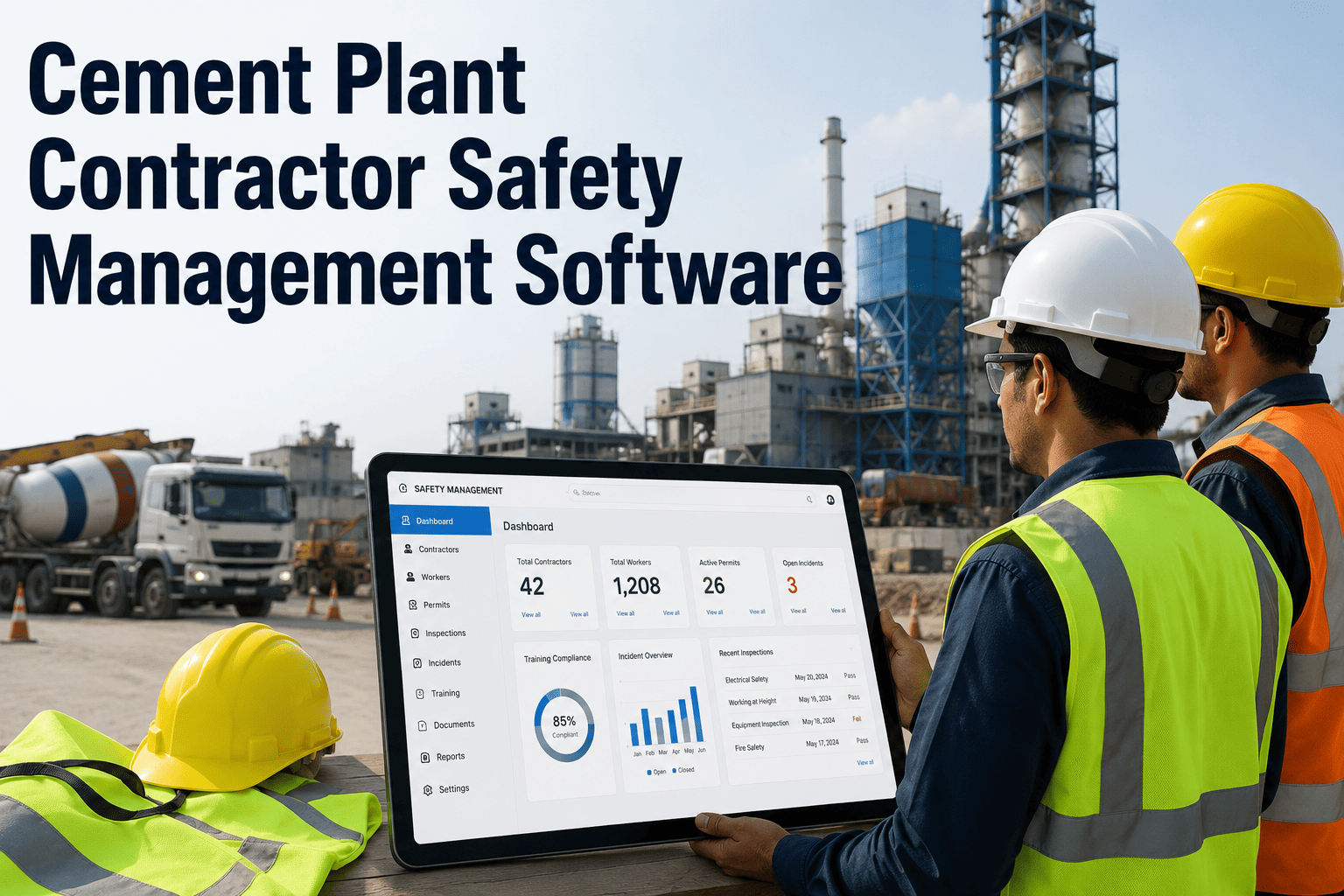
A regulator walks onto a cement plant site and asks for the lockout/tagout procedure book for the raw mill. If the answer is "we have a programme" without the equipment-specific documentation to back it up, that alone is a citation — regardless of how safely the mill has actually been operated for years. Cement plants sit at the intersection of confined spaces, rotating machinery, high-voltage electrical systems, and constant dust exposure, which is exactly why a safety audit here can't be a single annual walkthrough. It has to be four connected disciplines — process, mechanical, electrical, and occupational — checked on a cadence that matches the actual risk. This guide breaks down what a complete audit program covers and how a documented gap gets found before an inspector finds it, which you can see in detail when you book a walkthrough of your current audit process.
SAFETY AUDIT PROGRAM · CEMENT PLANT OPERATIONS
Four audit disciplines, one plant. Miss any one of them and the citation finds you first.
Process safety, mechanical integrity, electrical safety, and occupational health each carry their own checklist, their own inspection cadence, and their own documentation trail — and regulators expect all four to hold up under scrutiny at once.
PROCESS SAFETY
MECHANICAL SAFETY
ELECTRICAL SAFETY
OCCUPATIONAL SAFETY
$16,131
Typical penalty per serious OSHA violation, before willful or repeat multipliers apply.
$161,323
Penalty range for a willful violation — ten times the standard serious citation.
50 µg/m³
Permissible exposure limit for respirable crystalline silica that must be actively monitored.
6 categories
Recurring risk categories that appear across nearly every cement plant citation record.
Six risk categories that show up in almost every citation
These six categories account for the overwhelming majority of citation activity at cement plants, and they cut across all four audit disciplines. An audit program that doesn't explicitly check each one is leaving the most likely source of a violation unaddressed.
R-01
Confined Space Entry
Silos, preheaters, and mill compartments require atmospheric testing, a standby rescue team, and verified ventilation before entry — and each of these must be documented per entry, not assumed from a general programme.
R-02
Lockout/Tagout
Every energy-isolation point on kilns, mills, conveyors, fans, and crushers needs an equipment-specific written procedure. A generic blanket LOTO programme without per-equipment documentation is one of the most common citation triggers.
R-03
Respirable Silica Exposure
Grinding and material handling operations require active exposure monitoring against the permissible exposure limit, with results documented and retained for the length of employment plus decades.
R-04
Fall Protection
Kiln, preheater, and silo structures involve elevated work that requires a documented fall protection plan, inspected anchor points, and equipment registered against inspection and replacement schedules.
R-05
Machine Guarding
Conveyors, mills, and fans need guarding audits that verify physical guards are in place and functioning, not simply present at time of installation years earlier.
R-06
Emergency Action Planning
Fire prevention and emergency response plans need to be current, rehearsed, and matched to the actual layout and hazards on site, not a template document filed away and never revisited.
The four-domain audit framework
A complete safety audit program runs these four domains in parallel, each with its own checklist and its own responsible team, but all four need to reconcile into a single plant-wide compliance picture.
Process Safety
Confined space permits and atmospheric testing records for silos and preheaters
Hazardous material storage, labeling, and handling procedures
Process deviation logs and near-miss investigation follow-through
Kiln and cooler system safety interlocks and bypass logging
Mechanical Safety
Equipment-specific lockout/tagout procedures for every energy-isolation point
Machine guarding condition on conveyors, mills, crushers, and fans
Pressure vessel and compressed gas storage inspection currency
Cranes, hoists, ladders, and scaffold condition and certification
Electrical Safety
Electrical panels, MCC rooms, and substations for arc flash labeling and access clearance
Grounding and bonding verification across process and mobile equipment
Electrical energy sources fully identified within every LOTO procedure
Thermal imaging and preventive testing records for high-load circuits
Occupational Safety
PPE compliance verification across dust, noise, and heat exposure zones
Respirable silica exposure monitoring against the permissible exposure limit
Fall protection equipment registration and inspection countdown tracking
Training records, toolbox talk attendance, and rescue team readiness
Map your current audit program against these four domains
We'll review your existing checklists, permits, and documentation against process, mechanical, electrical, and occupational safety requirements.
How often should each check actually run
Audit frequency should match the speed at which a hazard can develop, not a fixed calendar convenience. Daily checks catch what changes shift to shift; annual audits catch what only shows up over time.
| Cadence | Audit focus | Example checks |
| Daily / per shift |
Occupational and PPE compliance |
PPE at active work zones, housekeeping, active permit status |
| Weekly |
Mechanical guarding and housekeeping |
Guard condition on conveyors and mills, spill and debris checks |
| Monthly |
Electrical and fall protection equipment |
Panel and MCC visual inspection, fall protection gear condition |
| Quarterly |
Confined space and rescue readiness |
Rescue team drill, atmospheric testing equipment calibration |
| Annual |
Full four-domain compliance audit |
LOTO procedure book review, exposure monitoring trend review, EAP rehearsal |
What an inspector actually asks to see
Auditors and regulators rarely take a verbal assurance that a programme exists. They ask for the specific document that proves it was followed on a specific date, for a specific piece of equipment, by a specific trained person.
Equipment-Specific LOTO Books
Not a general policy — a written procedure per kiln, mill, conveyor, fan, and crusher, identifying every electrical, mechanical, hydraulic, and pneumatic energy source for that specific machine.
Confined Space Entry Permits
Atmospheric test readings, ventilation confirmation, rescue team standby time, and entrant training currency, retained per entry rather than summarized after the fact.
Exposure Monitoring Records
Silica and dust exposure results retained for the employment period plus decades, since exposure-related documentation retention requirements extend far beyond standard record schedules.
Training and Toolbox Talk Logs
Attendance and topic records for confined space, LOTO, and emergency response training, ideally time-stamped and tied to the specific worker rather than a general sign-in sheet.
The real cost of a documentation gap
The financial exposure of a failed audit rarely comes from the hazard itself — it comes from the absence of a record proving the hazard was controlled. A plant that runs the exact same safe practice on paper and on the floor can still be cited if the paperwork can't prove it.
SERIOUS VIOLATION
Standard Citation Exposure
A single missing or incomplete LOTO procedure book, confined space permit, or guarding record can trigger a serious violation citation on its own, independent of whether an incident actually occurred.
WILLFUL VIOLATION
Repeat and Willful Exposure
A documented gap that was previously flagged and left unresolved escalates from a serious to a willful violation, multiplying the penalty roughly tenfold and drawing far closer regulatory scrutiny going forward.
FOUND BEFORE ARRIVAL
Proactive Audit Recovery
Plants that run systematic, structured audits internally have identified dozens of deficiencies and corrected them before a regulator ever arrived — turning what would have been a citation into a closed internal action item.
Paper audits versus continuous digital verification
The gap between these two approaches is rarely about how well the safety practice itself is understood on the floor — it's about whether the proof of that practice survives the moment an inspector asks for it.
Paper-Based Audit
Compliance snapshot only as current as the last manual walkthrough
LOTO and permit documentation scattered across binders and shift logs
PPE compliance relies on spot-checks that miss most of the shift
Retrieving a specific record under audit pressure takes hours, not minutes
Continuous Digital Verification
Real-time compliance percentage instead of a point-in-time snapshot
Every lock application, permit, and gas reading logged with timestamp and identity
AI-verified PPE compliance running continuously across every shift
Any specific record retrievable in seconds during an active inspection
Frequently asked questions
How often should a full four-domain safety audit be conducted?
A complete process, mechanical, electrical, and occupational audit is typically run annually as a full review, but each domain has its own shorter internal cadence that feeds into the annual picture — daily PPE checks, weekly guarding inspections, monthly electrical reviews, and quarterly confined space and rescue readiness drills. Running the full audit only once a year without these interim checks means problems can persist for months before anyone notices them.
Book a demo to see a cadence built around your specific equipment list.
What's the difference between a general LOTO programme and what regulators expect?
A general LOTO programme describes the policy and process at a high level, but regulators expect a written procedure specific to each individual piece of equipment — the kiln, the raw mill, each conveyor, each fan — identifying every electrical, mechanical, hydraulic, and pneumatic energy source unique to that machine. Presenting only the general programme without the equipment-specific procedure books is one of the most common citation triggers in cement plant inspections.
Contact our support team for a template structure for equipment-specific procedures.
How long do we need to keep exposure monitoring and training records?
Confined space permits generally need to be retained for at least a year, but exposure-related training and monitoring records — particularly for respirable silica — often need to be kept for the duration of employment plus several decades. This retention requirement catches many plants off guard because it far exceeds standard document retention schedules used for other operational records.
Book a demo to see how digital retention removes the manual tracking burden.
Can AI vision actually help with occupational safety audits?
Yes — cameras positioned across the plant can provide a continuous, timestamped log of PPE usage across every shift, rather than relying on the periodic spot-checks a safety officer can physically manage. During an audit, this produces a verified compliance percentage backed by real footage instead of a self-reported estimate, which holds up far better under regulatory scrutiny than a manual log alone.
Book a demo to see PPE compliance monitoring running against a plant floor similar to yours.
What's the fastest way to find gaps before an inspector does?
Run an internal audit structured exactly like the regulatory audit you expect — same four domains, same documentation standards, same request-for-record process — rather than a general walkthrough. Plants that have done this systematically have found dozens of correctable deficiencies internally before a regulator ever arrived, turning what would have been citations into closed action items with no penalty exposure at all.
Contact our support team to structure a mock audit against your own site.
Move from paper checkbox to real-time, auditable safety compliance
iFactory connects permits, LOTO procedures, PPE monitoring, and exposure records into one verified system built for the audit that's actually coming.