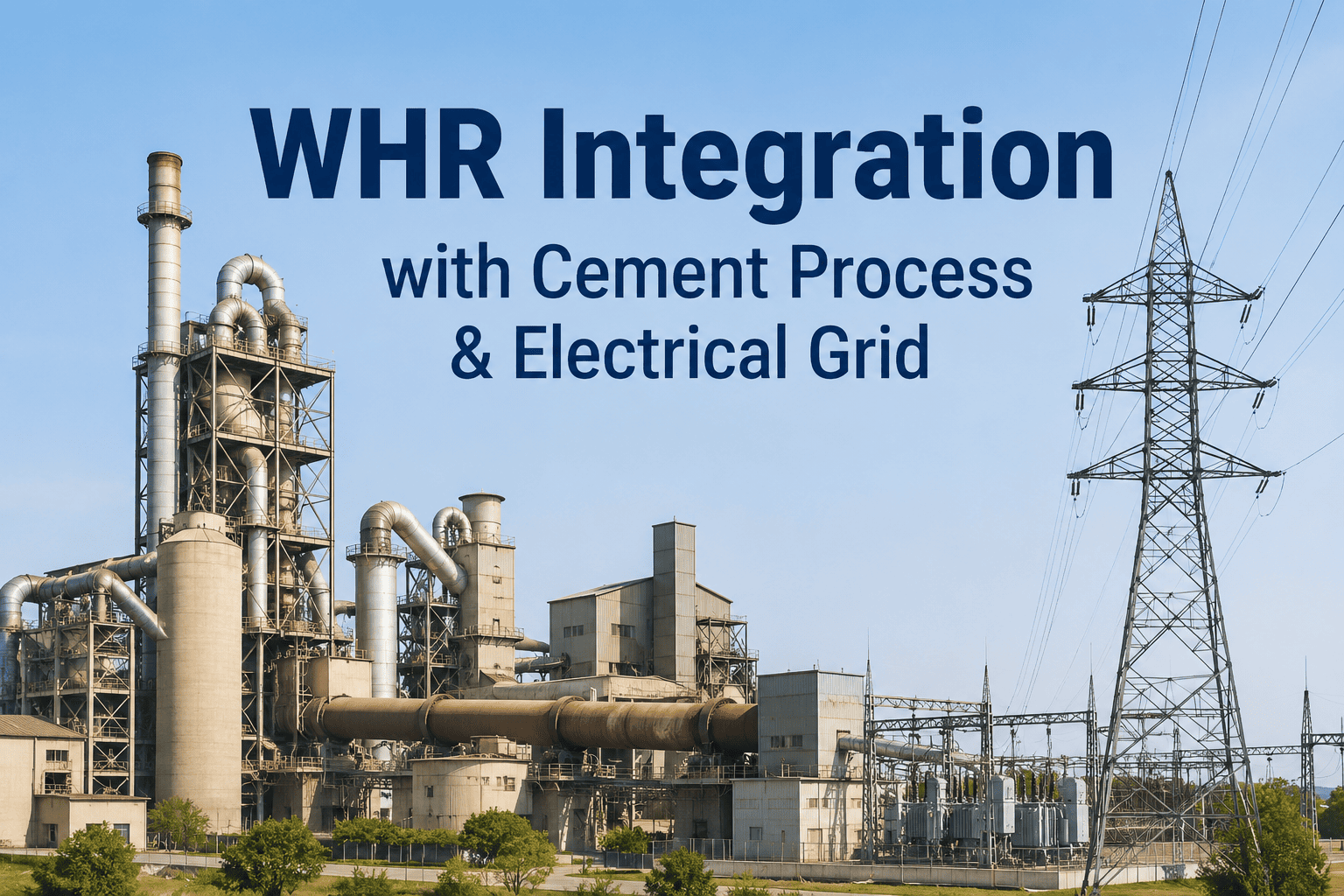
A cement plant commissions its waste heat recovery turbine, and on paper the math is simple: 8 MW of free power, straight off the preheater and cooler exhaust. Six weeks later the breaker trips twice a shift, the plant's frequency dips whenever the kiln draft changes, and the electrical engineer is fielding calls about power quality on the raw mill drives. The turbine works. The heat balance works. What was never fully engineered was the electrical integration — synchronization, protection coordination, and load management between the WHR generator, the plant's internal bus, and the utility grid. Get that wrong and a technically sound WHR project underperforms for years. Book a grid integration review before your next synchronization event.
WHR Power Is Only as Good as the Grid It Feeds
iFactory monitors the electrical side of waste heat recovery in real time — synchronization status, power factor, frequency deviation, and export volume — so the generator that was supposed to cut your power bill doesn't become the reason for an unplanned trip.
Why Electrical Integration Decides WHR's Real ROI
The thermal engineering behind waste heat recovery is well understood. What determines whether a plant actually captures the savings on its electricity bill is the electrical design layered on top of it — the part that gets scoped last and causes the most downtime when it's rushed. Turbine selection, boiler sizing, and heat balance calculations routinely get months of engineering attention, while the switchgear, relay coordination, and synchronizer logic that decide whether the generator stays connected get a fraction of that scrutiny, even though a poorly tuned protection scheme can take a technically sound turbine offline for weeks at a time.
of total plant electricity demand a well-integrated WHR system can offset
typical frequency deviation tolerance before protection relays trip a WHR generator
recoverable generation capacity on a typical large cement production line
window in which a synchronizer must match voltage, frequency, and phase before closing the breaker
Three Layers of Integration, One Generator
A WHR turbine-generator set does not connect to "the grid" as a single event. It connects through three distinct layers, each with its own protection scheme, its own fault current profile, and each capable of causing a trip entirely on its own, regardless of how well the other two layers are engineered.
Generator Bus
The turbine-generator set synchronizes first to its own local bus. Voltage regulation, excitation control, and governor droop settings are tuned here before anything touches plant load.
Internal Plant Distribution
The generator bus parallels with the plant's own medium-voltage network, feeding kiln drives, mills, and fans directly. This is where most cement plants stop, running WHR strictly for self-consumption.
External Utility Grid
Surplus power beyond plant demand can export to the utility grid, but this layer brings in the grid operator's interconnection standards, revenue metering, and export tariff structure.
Self-Consumption, Export, or Hybrid — What Changes Electrically
The strategy a plant picks changes the protection scheme, the metering requirement, and the regulatory paperwork. Most plants start with self-consumption and add export capability once the internal integration is proven stable.
The Synchronization Sequence, Step by Step
Every time the WHR generator comes online after maintenance, a kiln stop, or a grid disturbance, it has to re-synchronize before the breaker closes. This sequence runs the same way whether it is manual or automatic.
Voltage Match
The generator's automatic voltage regulator brings terminal voltage within a narrow band of the bus voltage it is joining, typically within one to two percent.
Frequency Match
The governor adjusts turbine speed until generator frequency tracks the bus frequency, closing the slip between the two to a fraction of a hertz.
Phase Alignment
A synchroscope or digital synchronizer checks that the phase angle between generator and bus is closing toward zero at a controlled rate, not oscillating.
Breaker Close
The synchronizer issues the close signal at the precise moment all three conditions align, avoiding the mechanical and electrical shock of an out-of-phase connection.
Load Ramp
Once paralleled, real and reactive power ramp up gradually under governor and AVR control, avoiding a step change that could disturb sensitive drives on the same bus.
Continuous Monitoring
Power factor, harmonic distortion, and export volume are tracked continuously so any drift toward a protection limit is flagged before it forces an unplanned trip.
Grid Codes Don't Read Your Heat Balance
Interconnection standards, protection settings, and export tariffs vary by region and utility, and they change independently of how well your WHR boiler performs. iFactory's engineers scope the compliance and monitoring layer alongside the thermal system, not after commissioning problems surface.
What Changes Once the Electrical Side Is Actually Engineered
Plants that treat grid integration as a first-class design problem, not an afterthought to the boiler contract, see the difference in three places at once: how often the generator trips, how much of its output the plant actually captures against internal load, and how clean that power looks to the drives sharing the same bus.
Frequently Asked Questions
Do we need utility approval to run WHR for self-consumption only?
In most jurisdictions, a generator that never exports power to the external grid faces a lighter regulatory burden than one that does, but it is rarely zero. Utilities typically still want visibility into any generation source connected behind the meter, since a fault on your internal bus can, in some configurations, back-feed toward their network. Expect to file a basic interconnection notification even for self-consumption-only designs, and confirm the exact threshold with your utility before commissioning. Talk to a specialist about what your specific grid operator requires.
What causes most WHR synchronization trips in practice?
The two most common causes are governor tuning that is too aggressive for the kiln's load swings, and protection relay settings copied from a generic template rather than calculated for the specific bus impedance and fault levels on site. Both are solvable with proper commissioning studies, but both get skipped when the electrical scope is treated as a formality after the thermal design is finalized. A short-circuit and coordination study before commissioning catches the majority of these issues.
How much power quality monitoring does a WHR generator actually need?
At minimum, continuous tracking of voltage, frequency, power factor, and total harmonic distortion at the point of common coupling, since these are the parameters most utility interconnection agreements specify limits for. Plants running variable frequency drives on the same bus as the WHR generator benefit from harmonic monitoring specifically, because drive-generated harmonics and generator response can interact in ways a simple kWh meter will never reveal. Book a demo to see what continuous monitoring looks like on a live bus.
Can WHR power reduce our demand charges even without export?
Yes, and for many plants this is a larger line item than the energy savings themselves. If the WHR system can be dispatched to cover plant load during the utility's peak demand window, it directly reduces the peak kW figure that demand charges are billed against, even if total monthly energy offset stays the same. This requires load forecasting and a control strategy that prioritizes peak shaving over flat baseload generation, which is a scheduling problem as much as an electrical one.
What happens to the WHR generator during a grid outage upstream?
Standard practice is anti-islanding protection that trips the generator offline within a few cycles of detecting loss of the upstream utility connection, unless the plant has specifically designed and certified an intentional island mode with its own load-following controls. Running unintentionally islanded risks damaging plant equipment from uncontrolled frequency and voltage excursions, so this protection is not optional in most interconnection agreements. Plants that want backup power capability during outages need a separate, purpose-built islanding design.
The Bottom Line on WHR Grid Integration
A waste heat recovery system is a thermal project with an electrical dependency that determines whether the savings actually show up on the utility bill. Synchronization discipline, protection coordination, and continuous power quality monitoring are not optional extras bolted on after the turbine is running — they are the difference between a WHR asset that trips through half its operating hours and one that quietly offsets a quarter of the plant's electricity draw, year after year.
See Your WHR Electrical Profile Modeled Before You Commit
Bring your single-line diagram and utility tariff structure to a 30-minute scoping call. iFactory maps the synchronization, protection, and monitoring architecture for your specific plant and grid connection, with a fixed-price integration plan.