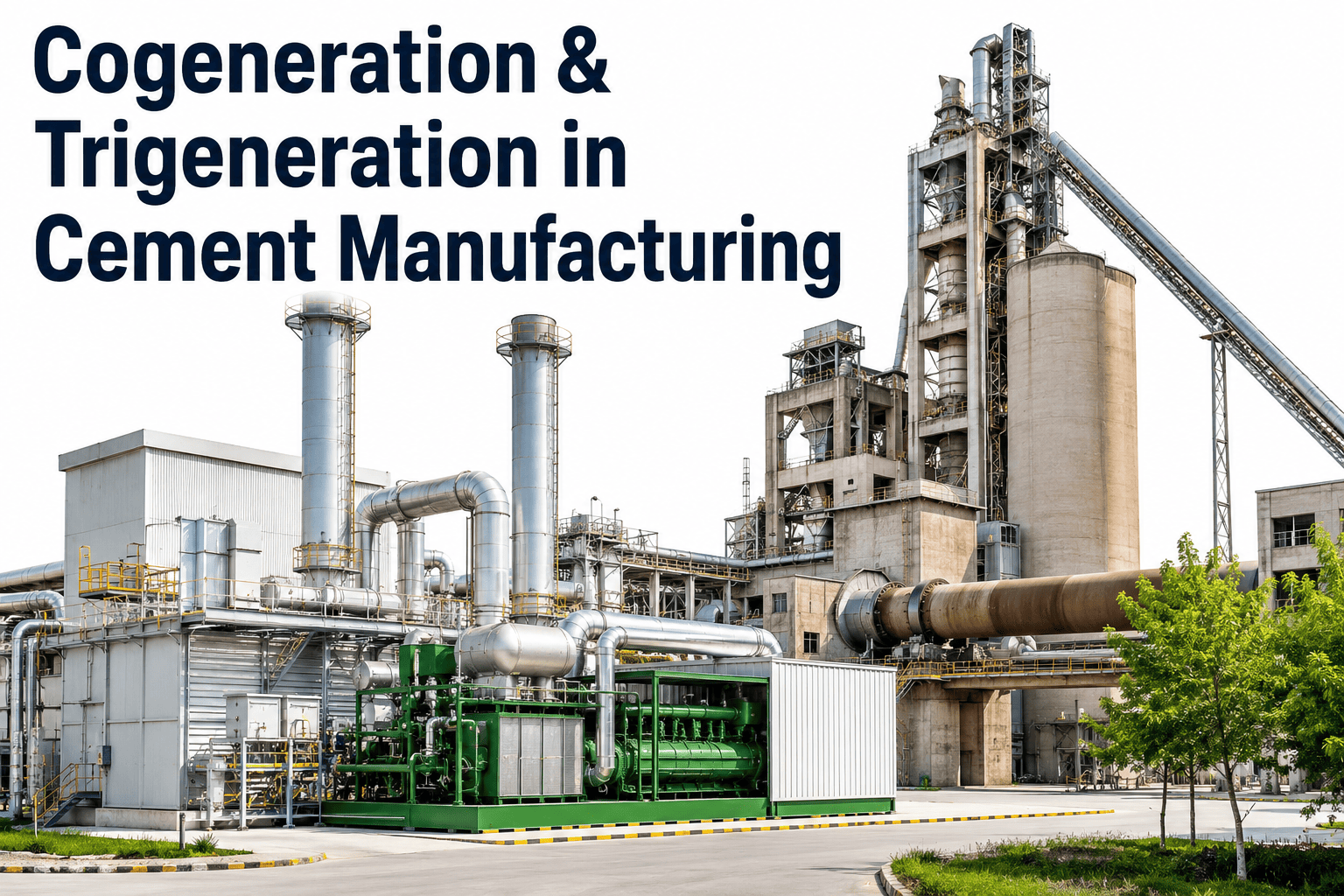
A cement plant running waste heat recovery has already solved half the energy equation — it generates power from heat that would otherwise vent to atmosphere. What most plants have not solved is what happens to the thermal energy left over after that power generation step, the heat that is still too valuable to waste but no longer hot enough to spin a turbine efficiently. That leftover heat can dry raw material, condition combustion air, or in trigeneration configurations even drive absorption chillers for cooling duty. Cogeneration and trigeneration are what turn a single-purpose WHR system into a fully utilized energy asset. book a cogeneration feasibility review to see what your plant's leftover heat is worth.
Power Generation Alone Leaves Value on the Table
iFactory models the full thermal cascade across your plant — power, process heat, and cooling — so cogeneration and trigeneration decisions are based on your actual heat balance, not a generic ratio applied from another industry. Most feasibility proposals stop at electrical output; ours accounts for every stage the heat can still do useful work at.
Cogeneration, Trigeneration, and Where WHR Fits
These terms get used loosely across the industry, but the distinction matters for what equipment a project actually needs and what payback it can realistically deliver. Vendors sometimes use cogeneration and trigeneration interchangeably in early proposals, which makes it harder for a plant to compare quotes on an apples-to-apples basis unless the scope of each output — power, heat, and cooling — is spelled out explicitly before the comparison starts.
Cogeneration
Simultaneous production of electrical power and useful heat from a single fuel or heat source. In cement, this typically pairs a WHR steam or ORC turbine with a process heat offtake for drying or preheating.
Trigeneration
Adds a third output — cooling — usually via an absorption chiller driven by low-grade waste heat that would otherwise be discarded after the power and process heat needs are already met.
WHR Alone
Power generation only, from preheater and cooler exhaust gas, with no structured offtake for the remaining low-grade heat after the turbine extracts what it can for electricity.
The Thermal Cascade: Matching Heat Quality to the Right Job
Not all recovered heat is equally useful for every purpose. High-temperature gas suits power generation, mid-temperature heat suits drying, and low-grade heat below the threshold for efficient power generation still has value for absorption cooling or preheating. Designing the cascade in the right order — extracting power first, then process heat, then cooling — is what separates a system that captures most of the available energy from one that leaves usable heat stranded between stages.
High-Grade Heat — Power Generation
Preheater and cooler exhaust at 300–400°C drives the steam Rankine or ORC turbine, generating the electrical output that offsets grid purchase.
Mid-Grade Heat — Process Drying
Turbine exhaust and bled steam, still well above ambient, routes to raw mill, coal mill, or slag dryer duty where lower temperatures are perfectly adequate.
Low-Grade Heat — Absorption Cooling
Heat too cool for efficient power generation but still well above ambient can drive an absorption chiller, providing cooling for control rooms, MCC rooms, or product cooling without a separate compressor-based chiller load.
Residual Heat — Preheating
What remains after power, drying, and cooling can still preheat combustion air or feedwater, squeezing a final increment of value before the gas finally exits the stack.
WHR-Only vs Cogeneration vs Trigeneration
Adding process heat and cooling offtakes changes the equipment list, the operating complexity, and the total value captured from the same recovered heat source. The table below is a starting comparison, not a final specification — the right configuration for any given plant still depends on its specific drying demand, cooling load, and available space for additional equipment near the WHR turbine.
The Chiller Load You're Already Paying For Twice
Most cement plants run electric compressor chillers for control room and MCC cooling, paid for with grid power, while low-grade waste heat that could drive an absorption chiller vents unused a few hundred meters away. iFactory quantifies that gap for your specific site.
What the Full Cascade Is Worth in Practice
Industry benchmarks on combined heat and power systems consistently show that total energy utilization rises sharply once process heat and cooling offtakes are added to a power-only system. The exact figures vary by plant configuration and climate, but the direction is consistent enough that most feasibility studies now model the full cascade by default rather than evaluating power generation in isolation.
typical electrical efficiency of a standalone WHR power generation system
typical total energy utilization once process heat offtake is added in a cogeneration configuration
additional value commonly captured by adding absorption cooling in a trigeneration configuration
of plant electricity demand a well-integrated combined heat and power system can offset
Signals Your Plant Is Ready to Move Beyond Power-Only WHR
Not every plant should add cogeneration or trigeneration immediately. A few conditions tend to indicate the added complexity is worth the return.
Standing Drying Demand
A raw mill, coal mill, or slag dryer that regularly runs short on drying gas, or relies heavily on an auxiliary fuel-fired hot gas generator, is a strong candidate for a process heat offtake.
Continuous Electric Cooling Load
Control rooms, MCC rooms, or product cooling running on electric compressor chillers year-round represent a load an absorption chiller can offset directly, especially in warmer climates.
WHR Turbine Already Operating Reliably
Adding offtakes to a turbine that is still working through synchronization or reliability issues compounds complexity before the base system is stable. A proven WHR baseline makes the cascade additions far easier to commission.
Frequently Asked Questions
Does adding trigeneration require replacing our existing WHR system?
No, in most cases trigeneration is added as an extension to an existing WHR turbine rather than a replacement. The steam or thermal oil already leaving the turbine at reduced temperature and pressure is exactly what an absorption chiller is designed to use, so the core turbine-generator equipment stays in place while a heat exchanger, absorption chiller, and distribution loop are added downstream. Book a demo to see how a trigeneration retrofit maps onto your existing WHR configuration.
What kind of cooling load actually makes sense for absorption chilling?
Control rooms, motor control centers, and instrumentation rooms are the most common targets, since these areas run continuous cooling loads year-round and are typically served by electric compressor chillers today. Product cooling and some HVAC applications can also work, though the specific temperature requirement of the load needs to be checked against what the absorption chiller's driving heat source can deliver, since colder targets generally require a higher-grade heat input than a basic single-effect absorption cycle provides.
How do we decide the split between process heat and cooling offtake?
The split follows the plant's actual demand profile, not a fixed ratio. A plant with high raw material moisture and aggressive drying needs will prioritize routing more of the mid-grade heat to the mill circuits, while a plant in a hot climate with a large existing electric chiller load may get more value from prioritizing the absorption cooling offtake. Modeling both demand curves against the available thermal cascade is the only reliable way to size the split correctly. Talk to a specialist about modeling your specific demand profile.
Does cogeneration reduce the electrical output of the WHR turbine?
There can be a modest tradeoff, since diverting steam for process heat before it fully expands through the turbine reduces the energy available for electrical generation compared to a condensing-only configuration. The economic case for cogeneration rests on that tradeoff being worthwhile because the diverted heat replaces fuel that would otherwise be burned separately for drying, which is usually a stronger value proposition than the marginal electricity that heat would have generated. The right balance depends on relative fuel and electricity costs at your site.
What operating complexity does trigeneration add compared to WHR alone?
Trigeneration adds real operating complexity, since the absorption chiller, heat distribution loop, and process heat offtake all need to be coordinated with the turbine's load-following behavior as kiln operation varies through a shift. This is exactly the kind of multi-variable coordination that benefits from continuous monitoring and automated control rather than manual damper and valve adjustment, since the number of interacting setpoints grows with each additional offtake added to the system.
The Bottom Line on Cogeneration and Trigeneration
A WHR system that only generates power is capturing a fraction of the value sitting in a cement kiln's exhaust gas. The same heat that spins a turbine still has enough energy left afterward to dry material, preheat combustion air, and in many cases drive absorption cooling, if the plant is engineered to cascade that heat through each use in sequence rather than releasing it after the first extraction. The technology to do this is mature — the limiting factor is almost always whether the plant modeled its full thermal balance before finalizing the WHR scope.
Find Out What Your Leftover Heat Is Worth
Bring your WHR turbine specifications and site cooling load to a 30-minute scoping call. iFactory models the full cogeneration and trigeneration cascade against your actual plant data.