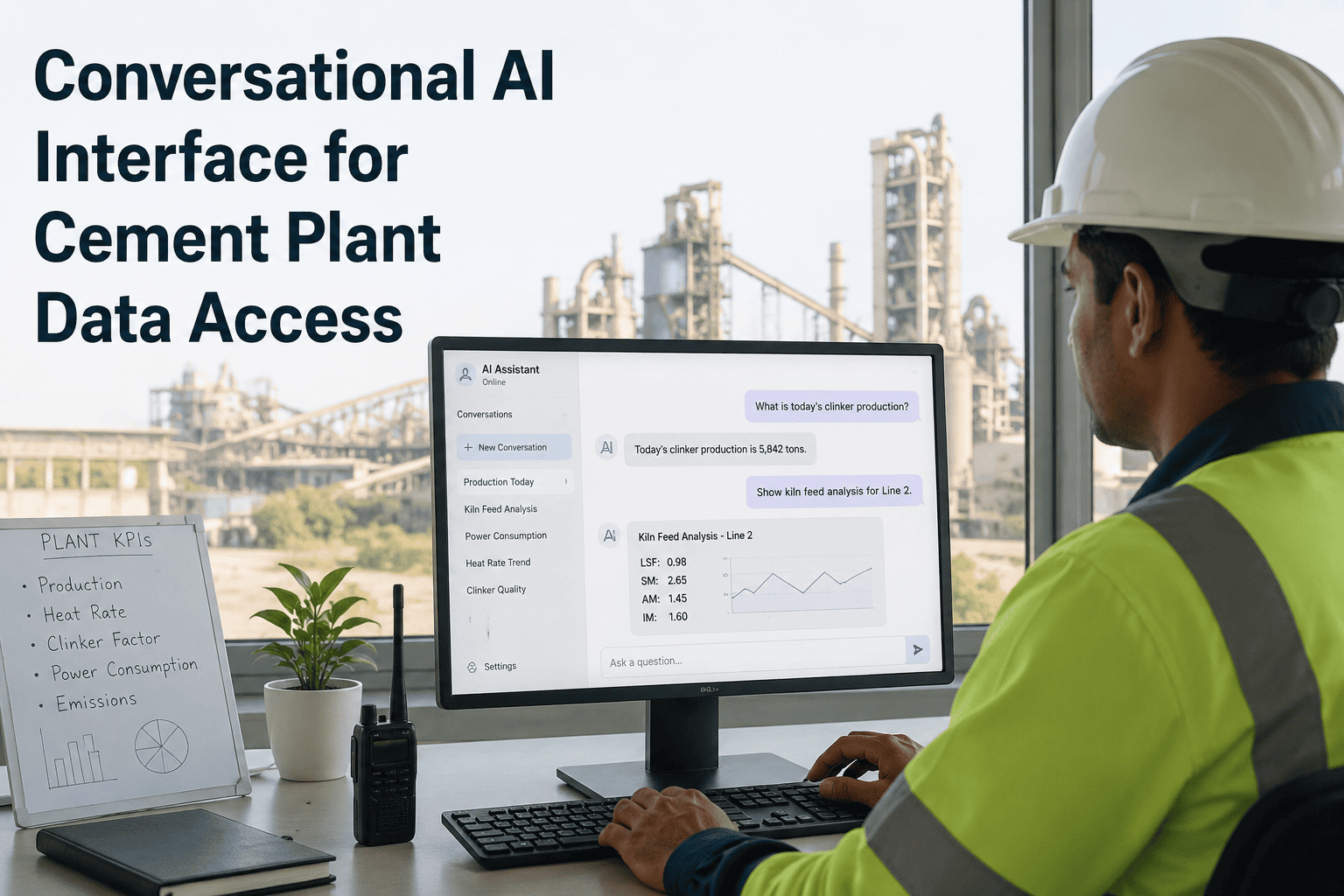
A shift supervisor at a cement plant needs to know why kiln three's specific heat consumption crept up overnight, and the honest answer today is usually a fifteen-minute detour through three different screens, a historian trend that takes a minute to load, and a LIMS report that was last refreshed an hour ago. By the time the numbers are in front of them, the shift has moved on and the moment to act on the answer has often already passed. Conversational AI interfaces close that gap by letting anyone on the floor simply ask the plant a question in plain language and get a grounded, data-backed answer in seconds, the same way they would ask a colleague standing next to the control panel. See how iFactory's support team maps this to your current control room before you commit to anything.
Cement Plant AI Copilot · Data Access
Ask Your Cement Plant a Question, Get a Straight Answer — No Report Required
A conversational AI interface lets kiln operators, shift supervisors, and plant managers query production, quality, and energy data in plain language or by voice, without waiting on a dashboard export or a report that's already an hour stale by the time it lands. It sits on top of the systems you already run — the historian, the LIMS, the energy meters — and turns them into something anyone can simply ask a question of, instead of a set of tools only a handful of trained analysts know how to query properly.
The Real Cost of the Old Way
What Getting an Answer Looks Like Today Versus What It Could Look Like
Cement plants generate an enormous amount of data every single shift, from kiln thermocouples to raw mill vibration to lab quality results, and almost none of that value gets realized in the moment it would actually help someone. The gap usually isn't a data problem — the sensors are logging, the historian is storing, the LIMS is recording every sample. The gap is access: turning a raw pile of readings into a specific answer to a specific question, fast enough that the answer still matters when it arrives. Closing that gap doesn't require a new sensor network or a data science team — it requires a layer that understands both plain language and the plant's own data, and puts the two together on demand.
Without a Conversational Layer
Operator notices a quality flag and opens the LIMS terminal to check free lime.
Realizes the reading is from the last manual sample, not live, and calls the lab.
Switches to the historian to pull kiln temperature trends over the last six hours.
Cross-references a spreadsheet someone built two years ago to make sense of the correlation.
Fifteen to twenty minutes pass before there's an actual answer to act on.
With a Conversational AI Interface
Operator types or speaks: "why is free lime trending high on kiln 2 today."
The system pulls live LIMS, kiln temperature, and feed composition data together.
It responds in plain language with the likely driver and the supporting numbers.
A follow-up question, "how did shift A handle this last time," retrieves the precedent.
Under a minute passes, and the operator is already adjusting rather than researching.
What People Actually Ask
Real Questions a Cement Plant Team Would Type or Speak
"What was our clinker output for the day shift compared to yesterday?"
"Show me energy consumption per ton on kiln 1 for the last seven days."
"Which raw mill had the most downtime this week and why?"
"Is the WHR steam output within the normal range right now?"
"Alert me if blaine fineness on mill 3 drops below spec again."
"Compare refractory life on kiln 2 across the last three campaigns."
None of these require a dashboard to be pre-built for that exact question. The interface interprets the request, finds the right underlying data — process historian, LIMS, energy meters, maintenance logs — and answers in the terms the person actually asked in. That matters more than it sounds, because the questions people actually have on a plant floor rarely line up neatly with the handful of reports that got built months or years ago. A supervisor doesn't think in terms of report names; they think in terms of "what happened, and why," and a conversational layer is built to meet that framing directly instead of asking the person to translate their question into whichever screen might have the answer.
Who Actually Uses It
The Same Interface Answers Very Different Questions Depending on Who's Asking
Kiln Operator
Asks quick, in-the-moment questions about current temperature, feed rate, and fuel mix while standing at the panel, often by voice, since typing isn't always practical mid-shift.
Shift Supervisor
Compares this shift's performance against the last one, checks whether a quality flag needs escalation, and pulls the context needed to hand off cleanly to the next shift.
Quality Engineer
Investigates free lime or blaine fineness trends across multiple mills and campaigns, cross-referencing LIMS results against process conditions without manually joining spreadsheets.
Energy Manager
Checks specific power consumption, thermal substitution rate, and WHR output across kilns to spot where energy efficiency is drifting before it shows up in the monthly report.
Plant Manager
Pulls a cross-shift or cross-week number before a meeting without pulling an analyst off another task, getting a defensible figure in the time it takes to ask the question.
Maintenance Planner
Looks up equipment downtime history and recurring failure patterns to prioritize the next maintenance window around what's actually causing repeat issues, not guesswork.
See It Answer a Real Question
Bring Your Own Kiln Question to the Demo
iFactory's team will walk through the conversational interface live, using a question drawn from your own plant's recent operating history, so you can judge the answer quality against what you already know happened.
Under the Hood
How a Plain-Language Question Turns Into a Grounded Answer
1
Understand the Intent
Natural language processing parses the question — whether typed or spoken — and identifies what's actually being asked: a comparison, a trend, an anomaly check, or a lookup, along with the relevant equipment, time window, and metric. Cement-specific terminology like blaine, clinker, and thermal substitution rate is recognized directly, without the person needing to rephrase into generic terms.
2
Map to the Right Data Source
The system resolves the question against live process data, LIMS quality records, energy meters, and maintenance logs, pulling only from the sources actually relevant to that specific query rather than surfacing an entire dashboard.
3
Ground the Answer in Real Numbers
Rather than generating a plausible-sounding response, the answer is built directly from the retrieved plant data, so every figure quoted back traces to an actual reading, not an inference or an approximation. If the data needed to answer confidently isn't available, the system says so instead of filling the gap with a guess.
4
Respond in Plain Language, With the Option to Dig Deeper
The reply reads like a colleague's explanation, with the option to ask a follow-up, request the underlying trend chart, or export the specific numbers referenced, instead of dumping a full report on the person who just wanted one answer.
Access Method Comparison
Dashboard-First Reporting vs. Conversational Data Access
| What Matters | Dashboard-First Reporting | Conversational AI Interface |
| Time to a specific answer |
Minutes, if the right report already exists |
Seconds, for questions phrased in plain language |
| Coverage of edge-case questions |
Limited to whatever was pre-built |
Open-ended, within the connected data sources |
| Who can use it unassisted |
Usually trained analysts or engineers |
Any operator or supervisor who can type or talk |
| Voice access on the floor |
Rarely supported |
Available for hands-busy environments |
| Follow-up questions |
Requires building or requesting a new view |
Handled conversationally in the same thread |
Dashboards still matter for standing KPIs everyone checks daily. Conversational access covers everything in between — the one-off question that would otherwise never get its own report built for it, and the follow-up question that comes right after the first one, which a static report was never designed to handle in the first place.
What It Actually Plugs Into
The Plant Data a Conversational Interface Needs to Answer Honestly
Kiln and Process Sensors
Live temperature, pressure, feed rate, and fuel data straight from the DCS and historian, so answers about kiln behavior reflect what's happening right now, not a snapshot from the last scheduled report. This is usually the first source connected, since it covers the majority of day-to-day operating questions on its own.
LIMS Quality Records
Free lime, blaine fineness, and clinker composition results tied to the sample time and source, so a question about quality drift can be answered against the actual lab trail, not a remembered number. Pairing this with process data is what lets a quality question and a process question get answered in the same breath.
Energy and WHR Meters
Specific power consumption, thermal substitution rate, and waste heat recovery output, letting energy questions get answered in the exact units the energy manager already thinks in, without a separate energy reporting tool being pulled up just to check one figure.
Maintenance and Downtime Logs
Work order history and downtime causes linked to specific equipment, so a question like "what usually causes this" pulls from documented precedent instead of institutional memory that walks out the door with retiring staff. This is often the source that delivers the most value in a plant's first month of use, simply because that history was rarely searchable before.
The plants that get real value out of conversational interfaces aren't the ones chasing a novelty feature — they're the ones with a genuine bottleneck where the person who needs an answer isn't the person who knows how to pull it. On a cement floor that gap shows up constantly: the shift supervisor who understands the process but not the historian query language, the plant manager who wants a straight number without opening five tabs. Solve that specific gap and the adoption takes care of itself, because people use tools that save them from doing something tedious they were already doing manually. What surprised me on the plants I've worked with is how quickly the questions get more sophisticated once the basic ones are answered fast — teams stop asking "what happened" and start asking "what usually causes this," which is a genuinely different, more useful conversation to be having on a daily basis.
Renata Okafor-Lindqvist
Cement Process Digitalization Consultant · Former Plant Operations Manager, Multi-Site Cement Group
What Changes on the Floor
The Practical Difference a Conversational Layer Makes
Seconds
Typical time from a typed or spoken question to a grounded answer, replacing a multi-screen manual lookup
No Training Wall
Operators and supervisors use it without learning a query language or a historian tool's interface
Every Shift
The same plain-language access works identically across shifts, so answers don't depend on who's on duty
The goal isn't to replace dashboards or the historian — it's to make the data behind them reachable by anyone who has a question, not just the people who already know where to look. Over time, that shift changes how decisions get made on the floor, because the person closest to the problem is also the person asking the question, rather than routing it through someone else first.
Common Questions
Conversational AI for Cement Plant Data — Frequently Asked
Does the AI ever make up numbers if it doesn't have the data?
A properly built conversational interface for plant data is designed to answer only from the sources it's actually connected to, and to say plainly when a question falls outside that scope rather than guessing at a plausible-sounding figure. Every number in a response traces back to a specific sensor reading, LIMS record, or log entry, which is a very different design goal from a general-purpose chatbot built for open conversation. If you want to see this grounding behavior tested against a tricky question from your own plant,
book a demo and bring one.
Can operators use voice commands on a noisy plant floor?
Voice input is built for exactly that environment, using noise-tolerant speech recognition tuned for industrial settings rather than a quiet-office assumption, and it pairs naturally with hands-busy tasks where typing on a tablet isn't practical. Most teams still use typed queries at a control room terminal for longer or more detailed questions, and voice for quick checks while moving around the floor, so both input modes typically get used depending on where the person is standing. Response phrasing stays consistent across both modes, so switching between typing and speaking never feels like using two different tools.
How does this fit with the dashboards and reports we already have?
A conversational interface doesn't replace the standing dashboards your team checks every shift for the KPIs everyone already agrees matter — those stay exactly as they are. What it adds is coverage for the long tail of one-off questions that would otherwise never justify building a dedicated report, plus a faster path to a specific number when someone doesn't want to open a dashboard just to find one figure. Most plants run both side by side rather than choosing one over the other, and teams often find the dashboard usage becomes more focused once the ad hoc questions have somewhere else to go.
What does it take to connect this to our existing systems?
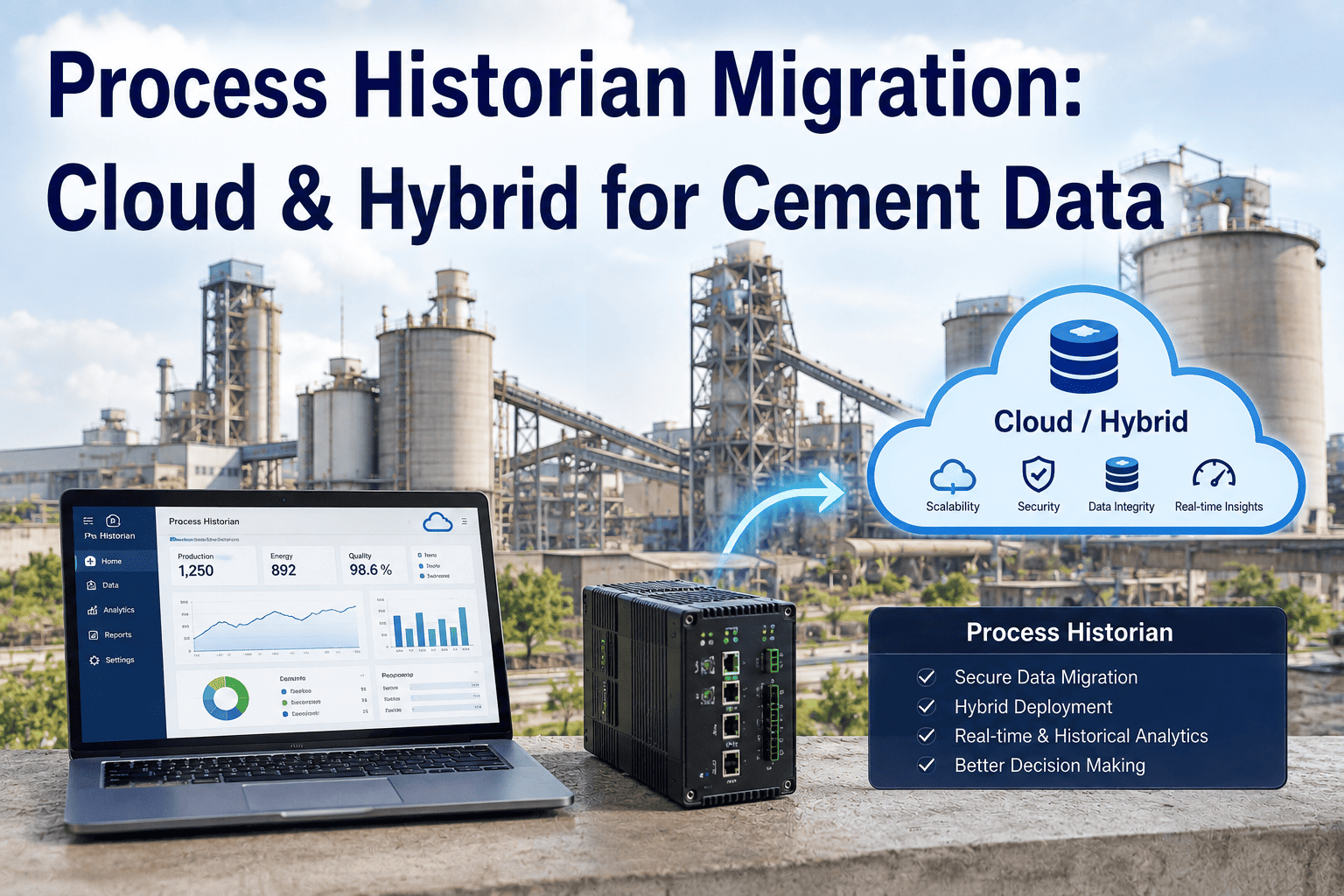
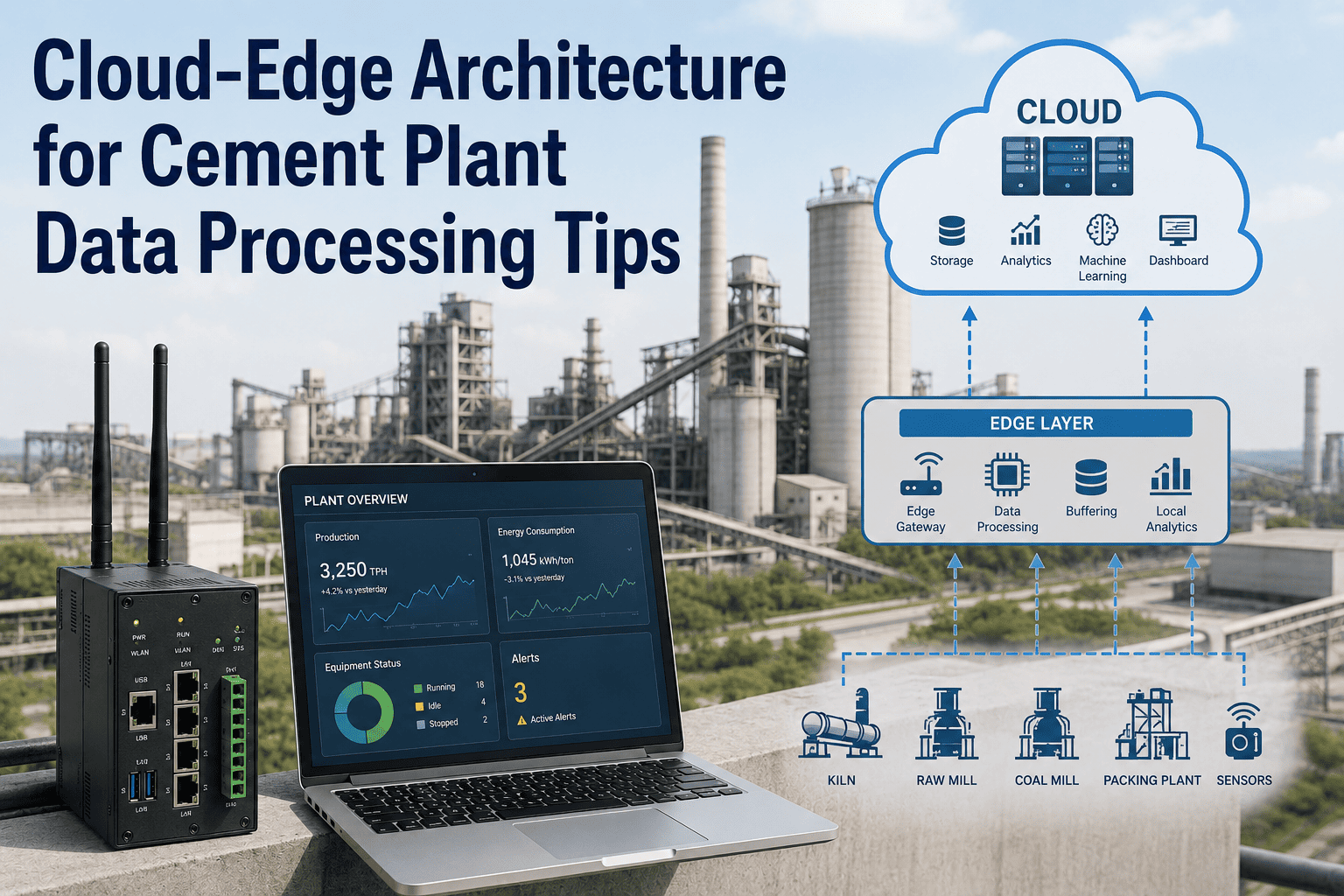
The interface connects to whatever process historian, LIMS, energy metering, and maintenance systems the plant already runs, rather than requiring a rip-and-replace of the underlying infrastructure. The scope of what it can answer grows as more sources get connected, so most plants start with the two or three data sources tied to their most common questions and expand from there as confidence in the answers builds.
Our support team can walk through what your current stack would need for a first connection.
Is this only useful for operators, or does it help plant managers too?
Plant managers and reliability engineers tend to use it just as heavily as floor operators, usually for cross-shift comparisons, multi-day trend questions, or checking a number before a meeting without pulling an analyst off another task to build it. The value shows up wherever someone needs a specific answer faster than the existing reporting cadence delivers one, which in practice covers most roles on a cement plant, not just the control room, from the lab through to the corner office.
Give Your Team a Faster Way to Ask
See a Conversational AI Interface Answer Your Plant's Own Questions
iFactory connects your kiln, LIMS, energy, and maintenance data behind a single plain-language interface, so the answer to "why is this happening" is seconds away instead of a fifteen-minute detour through five different screens. Book a short walkthrough and bring a real question from your own plant floor to test it against.