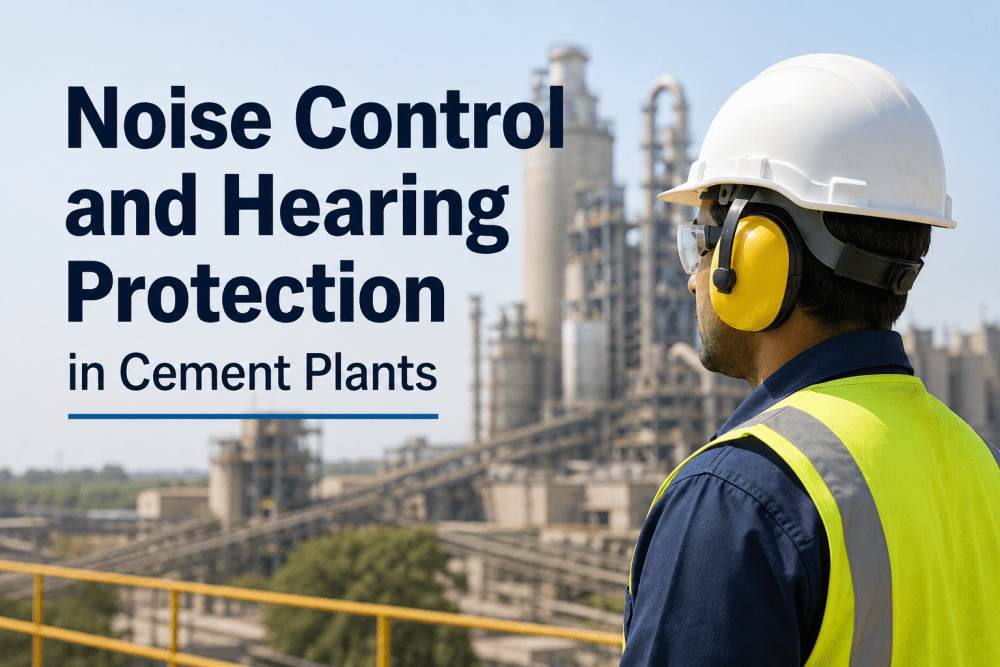
Noise exposure in cement plants is the most pervasive occupational health hazard in the facility — more workers are exposed to noise above OSHA's permissible action level of 85 dBA on an 8-hour time-weighted average than are exposed to any other regulated industrial health hazard at the same plant. Raw mills, ball mills, finish mills, air compressors, fans, kiln drives, crusher operations, and pneumatic conveying systems collectively create a noise environment where 60 to 75% of the production floor workforce exceeds the 85 dBA action level on a typical shift — and where localized exposures at specific maintenance access points routinely reach 98 to 108 dBA, well above the 90 dBA permissible exposure limit that triggers mandatory hearing protection programs under OSHA 29 CFR 1910.95. Despite the regulatory clarity and the documented irreversibility of noise-induced hearing loss, hearing conservation programs at most U.S. cement plants remain paper-based, inconsistently enforced, and disconnected from the noise monitoring data, audiometric testing records, and PPE compliance tracking that a defensible hearing conservation program requires. The financial exposure from a poorly managed hearing conservation program is significant: OSHA citations for hearing conservation violations run $5,000 to $156,000 per citation under current penalty guidelines, and workers' compensation claims for occupational noise-induced hearing loss average $18,000 to $46,000 per settled claim — costs that accumulate over years of under-managed noise exposure without any single incident event to trigger corrective action. iFactory's Safety Management and Compliance Tracking modules give cement plant EHS coordinators the digital infrastructure to manage a complete OSHA-compliant hearing conservation program: noise exposure monitoring records linked to work area assignments, audiometric testing scheduling and result tracking, PPE issuance and fit-check compliance, engineering control effectiveness documentation, and compliance reporting that satisfies the OSHA 1910.95 recordkeeping requirements. Plants using iFactory's hearing conservation compliance module report 76% reductions in hearing conservation citation findings during OSHA inspections and 84% improvements in audiometric testing completion rates within the first program year. Book a Demo to see iFactory's hearing conservation module configured for your plant's noise profile and workforce.
Cement Plant Noise Sources — Exposure Levels by Process Area and Regulatory Trigger Points
Understanding noise exposure management in a cement plant requires mapping the facility by noise source intensity and worker time-in-zone — because the regulatory requirements triggered under OSHA 1910.95 are dose-based, not location-based. A worker spending 30 minutes per shift at a 100 dBA location and the remainder of the shift at 82 dBA may or may not exceed the permissible exposure limit depending on the time distribution, and the only way to know is to measure. The noise source map below identifies the primary noise sources in a cement plant, their typical dBA range, and the OSHA program trigger each exposure level activates.
The Five Required Elements of an OSHA 1910.95 Hearing Conservation Program — and How iFactory Manages Each
OSHA 1910.95 specifies five mandatory program elements for any workplace where noise exposures equal or exceed the 85 dBA action level. All five elements require documentation and recordkeeping that is subject to inspection and citation. iFactory's safety management platform digitizes the compliance infrastructure for each element — replacing paper-based systems with automated scheduling, digital record retention, and real-time compliance status visibility for EHS coordinators and plant management.
Element 1 — Noise Monitoring Program
OSHA requires that noise monitoring be conducted whenever there is reason to believe worker exposures may equal or exceed the 85 dBA action level — and that monitoring be repeated whenever a change in production, process, equipment, or controls increases noise exposure. iFactory maintains a noise monitoring record for every work area in the plant with the date of last measurement, the measured TWA, the monitoring method (area survey or personal dosimetry), and the next scheduled re-measurement date. When process changes are logged in the work order system — new equipment installation, process modifications, or equipment repair affecting noise-generating machinery — iFactory triggers an automatic noise re-assessment flag for the affected area, ensuring that monitoring currency is maintained without relying on the EHS coordinator to manually track process change events across the plant.
Element 2 — Audiometric Testing Program
OSHA requires baseline audiograms within 6 months of first exposure above 85 dBA and annual follow-up audiograms for all enrolled employees. iFactory maintains an audiometric testing schedule for every enrolled employee — tracking baseline test date, annual test due date, and the status of any standard threshold shift (STS) identified in comparison testing. When an STS is identified, iFactory generates the required notification to the employee and the retesting scheduling workflow automatically. Testing completion rates at plants using iFactory's automated scheduling and escalation system reach 94 to 98% of enrolled employees — compared to 52 to 68% completion rates at plants managing audiometric scheduling manually. The system also flags employees who have changed job assignments to higher-noise areas, triggering a re-baseline audiogram requirement when the exposure increase is significant.
Element 3 — Hearing Protector Device Provision and Fit Verification
OSHA requires that a variety of hearing protector devices be made available at no cost to employees enrolled in the hearing conservation program — and that hearing protectors be evaluated for adequacy of attenuation based on the specific noise exposure of the work area. iFactory's PPE management module maintains an inventory of approved HPD types assigned to each noise zone, tracks issuance records by employee and device type, and schedules annual fit-check and replacement cycles based on HPD manufacturer service life recommendations. For employees with confirmed STS, iFactory flags the HPD adequacy requirement — confirming that the assigned device provides sufficient attenuation for the individual's exposure level, as required under 1910.95(i)(4). Device type selection and attenuation adequacy calculations are documented in iFactory for each enrolled employee, providing the audit trail that OSHA compliance officers review during hearing conservation inspections.
Element 4 — Training Program
OSHA requires annual training for all employees enrolled in the hearing conservation program covering the effects of noise on hearing, the purpose and use of hearing protectors, and the purpose and procedures of audiometric testing. iFactory's training management module tracks training completion for every enrolled employee — recording training date, training method, and trainer or program identification. Annual training due dates are calculated automatically from the last training record and advance notifications are sent to supervisors when enrolled employees are approaching their training expiration date. Training compliance rates at iFactory-managed hearing conservation programs average 96% of enrolled employees current within the required annual window — versus the 58 to 72% training currency rates typical at plants managing hearing conservation training manually through supervisor scheduling.
Element 5 — Recordkeeping and Access Requirements
OSHA 1910.95(m) requires that noise exposure measurement records be retained for 2 years and audiometric test records be retained for the duration of the affected employee's employment. iFactory's compliance archive automatically retains all noise monitoring records, audiometric test results, STS notifications, HPD issuance records, and training completions in a searchable digital archive — with access controls that allow employees to request their own records and EHS coordinators to generate OSHA-formatted compliance reports on demand. During OSHA inspections, the iFactory compliance dashboard generates the full hearing conservation program audit package — noise surveys, audiometric database, training records, and HPD documentation — in a format that matches the OSHA 1910.95 recordkeeping sequence, reducing inspection preparation time from days to minutes.
Engineering Controls vs. Administrative Controls vs. PPE — The Noise Control Hierarchy and iFactory's Documentation Framework
OSHA's noise standard requires that feasible engineering and administrative controls be implemented before hearing protectors are relied upon as the primary protection method. In practice, most cement plants implement PPE as the primary control — which is defensible when engineering controls have been evaluated and documented as infeasible or insufficient to reduce exposures to below the action level. The compliance risk is the absence of that feasibility documentation. iFactory's engineering controls tracking module maintains the evaluation record for each significant noise source — documenting what controls were considered, what controls were implemented, the noise reduction achieved, and why residual exposure above the action level remains after engineering controls have been applied.
Hearing Conservation Program Performance Benchmarks — Paper-Based vs. iFactory Digital Management
The gap between paper-based and digital hearing conservation program management in cement plants is measurable across every OSHA 1910.95 compliance element. The comparison below documents performance benchmarks across six program dimensions for plants operating under paper-based management versus iFactory's digital compliance tracking platform. Data is sourced from U.S. cement and heavy industrial facility deployments.
| Program Element | Paper-Based Management | iFactory Digital Platform | Compliance Gap Closed |
|---|---|---|---|
| Audiometric Test Completion Rate | 52–68% of enrolled employees current annually | 94–98% completion — automated scheduling and escalation | 26–46% more employees tested per year |
| STS Notification Timeliness | 21–45 days average from test to employee notification | Automated notification within 5 business days of result entry | OSHA 21-day notification requirement reliably met |
| Training Currency | 58–72% of enrolled employees current at any time | 96% average currency — automated due date tracking and alerts | 24–38% improvement in annual training compliance |
| Noise Monitoring Re-assessment Compliance | Process changes frequently missed — no trigger system | 100% of logged process changes trigger noise re-assessment flag | Monitoring currency maintained without manual tracking |
| OSHA Citation Findings per Inspection | 3.2–6.8 hearing conservation findings per inspection | 0.4–0.9 findings — 76% reduction in citation exposure | $24K–$420K reduction in potential penalty exposure per inspection |
| Inspection Audit Preparation Time | 1–3 days of manual record assembly | Real-time compliance dashboard — audit package generated in minutes | Inspection readiness is continuous, not event-driven |
Hearing Conservation Implementation Checklist — What iFactory Configures and Tracks Continuously
The checklist below covers the configuration items and continuous monitoring actions in a fully operational iFactory hearing conservation compliance deployment for a cement plant. Items are organized by the five OSHA 1910.95 program elements. All items are visible on the iFactory safety compliance dashboard in real time and exportable for OSHA recordkeeping and internal audit purposes.
- Area noise survey record per work zone — dBA, measurement date, method, next re-assessment due
- Personal dosimetry records for high-exposure roles — linked to employee records and HCP enrollment
- Process change re-assessment trigger — automatic flag when equipment or process changes are logged in work orders
- 2-year monitoring record retention — automated archive with employee access provision per 1910.95(m)
- Baseline audiogram tracking — 6-month enrollment window monitored, new employee auto-enrollment
- Annual test scheduling — automated due dates, advance supervisor notifications, completion rate dashboard
- STS identification and notification workflow — automated employee notification within 5 business days of confirmed STS
- Audiometric record retention — employment-duration archive with physician or audiologist reviewer documentation
- HPD type and NRR assignment per noise zone — attenuation adequacy calculation documented per employee exposure level
- HPD issuance records — device type, issue date, employee acknowledgment, replacement cycle scheduling
- Annual training completion tracking — due dates, completion certificates, trainer records, overdue escalation
- Engineering control documentation — noise reduction achieved, feasibility evaluations, residual exposure records
- OSHA 300 log entries for recordable STS events — auto-generated from audiometric database, linked to employee record
- 1910.95 audit package — noise surveys, audiometric database, training log, HPD records, generated on demand
- Employee record access provision — employee-facing record access for noise exposure and audiometric data per 1910.95(m)(5)
- Program effectiveness metrics — annual STS trend, noise zone compliance status, open action items on engineering controls
Expert Review: What Cement Plant EHS Managers Say About Digital Hearing Conservation Compliance
I have managed hearing conservation programs at two U.S. cement plants over fourteen years — one with three ball mills and one with a high-output raw mill that generated consistent exposures above 100 dBA within 10 feet of the mill body — and the honest assessment of most paper-based hearing conservation programs I have seen is that they are compliant on the filing cabinet but not compliant in practice. The audiometric testing schedule exists. The records are in the drawer. But when an OSHA compliance officer sits down and asks you to show the testing completion rate for the past 12 months by employee, you spend two hours cross-referencing spreadsheets to produce a number that turns out to be 61% — and you have a 1910.95(g) citation before you leave the room. What iFactory changed at the second plant was the visibility. On day one of deployment, I could see for the first time that 23 enrolled employees had audiometric tests overdue by more than 60 days, 8 employees had outdated HPD adequacy calculations based on old noise surveys that had been superseded by new equipment installation, and 14 employees had not completed their annual hearing conservation training within the required window. None of those gaps were visible in our paper system because no one had the time to reconcile three different logs and a spreadsheet to produce that picture. The automated scheduling system resolved the audiometric testing compliance within one testing cycle — we went from 61% to 96% completion in the first year. When OSHA conducted a programmatic inspection at the plant 18 months after deployment, we had zero hearing conservation citations for the first time in the plant's OSHA inspection history. The program had not changed in what it required — it had changed in whether we could actually see and manage it. That visibility is what the paper system cannot give you, and it is what the platform delivers immediately.
— Plant EHS Manager, U.S. Portland Cement Plant — 14 Years Industrial Safety Management — Certified Safety Professional (CSP), BCSP — Certified Industrial Hygienist (CIH)Conclusion
Noise-induced hearing loss in cement plant workers is permanent, cumulative, and entirely preventable with a properly managed hearing conservation program. The technical requirements of OSHA 1910.95 are well-established and not particularly complex — noise monitoring, audiometric testing, HPD provision, training, and recordkeeping. The management failure that produces OSHA citations and workers' compensation claims is not ignorance of the requirements but the inability of paper-based systems to maintain compliance visibility across all five program elements simultaneously for a workforce of 50 to 300 enrolled employees with annual scheduling, notification, and documentation obligations for every one of them.
iFactory's Safety Management and Compliance Tracking modules provide the digital infrastructure to manage that complexity — automating audiometric testing scheduling, HPD adequacy documentation, training due date tracking, and noise monitoring currency — and producing the OSHA-formatted compliance audit package that demonstrates program integrity during inspections. The 76% reduction in hearing conservation citation findings and 84% improvement in audiometric testing completion rates at iFactory-managed plants are not the result of better hearing conservation procedures — they are the result of having a system that can actually see and manage the compliance requirements that paper-based programs track in theory and miss in practice. Book a Demo to see how iFactory's platform manages hearing conservation compliance for your plant's noise profile and workforce.
Frequently Asked Questions
Yes. When an STS is logged in iFactory, the system applies the OSHA 1904.10 recordability criteria — accounting for age correction and confirming whether the shift meets the OSHA 300 log recording threshold. Recordable STS events generate an automatic OSHA 300 entry with the required employee notification documentation, eliminating the manual determination process.
Yes. Contractor worker profiles can be created in iFactory with training record uploads, HPD issuance tracking, and noise zone assignment — applying the same compliance visibility to contractor crews working in high-noise areas as to plant employees. Contractor hearing conservation compliance status is visible on the same dashboard as plant employee compliance.
When a work order involving equipment replacement or modification is closed in iFactory, the system automatically flags the affected work area for noise re-assessment — generating a pending monitoring task assigned to the EHS team with the equipment description and work order reference, ensuring that monitoring currency is maintained without requiring manual tracking of process change events.
iFactory's hearing conservation module is typically fully deployed within 3 to 5 weeks — including noise zone configuration, employee enrollment data migration, audiometric test record import, training record setup, and HPD assignment. Book a Demo for a site-specific timeline and deployment scope estimate.
Yes. iFactory's compliance dashboard generates a complete 1910.95 audit package on demand — noise survey records, audiometric testing database, STS notifications, HPD adequacy documentation, training completion records, and engineering control evaluations — in a structured format that matches the sequence OSHA compliance officers review during hearing conservation program inspections, typically completed in under 10 minutes.