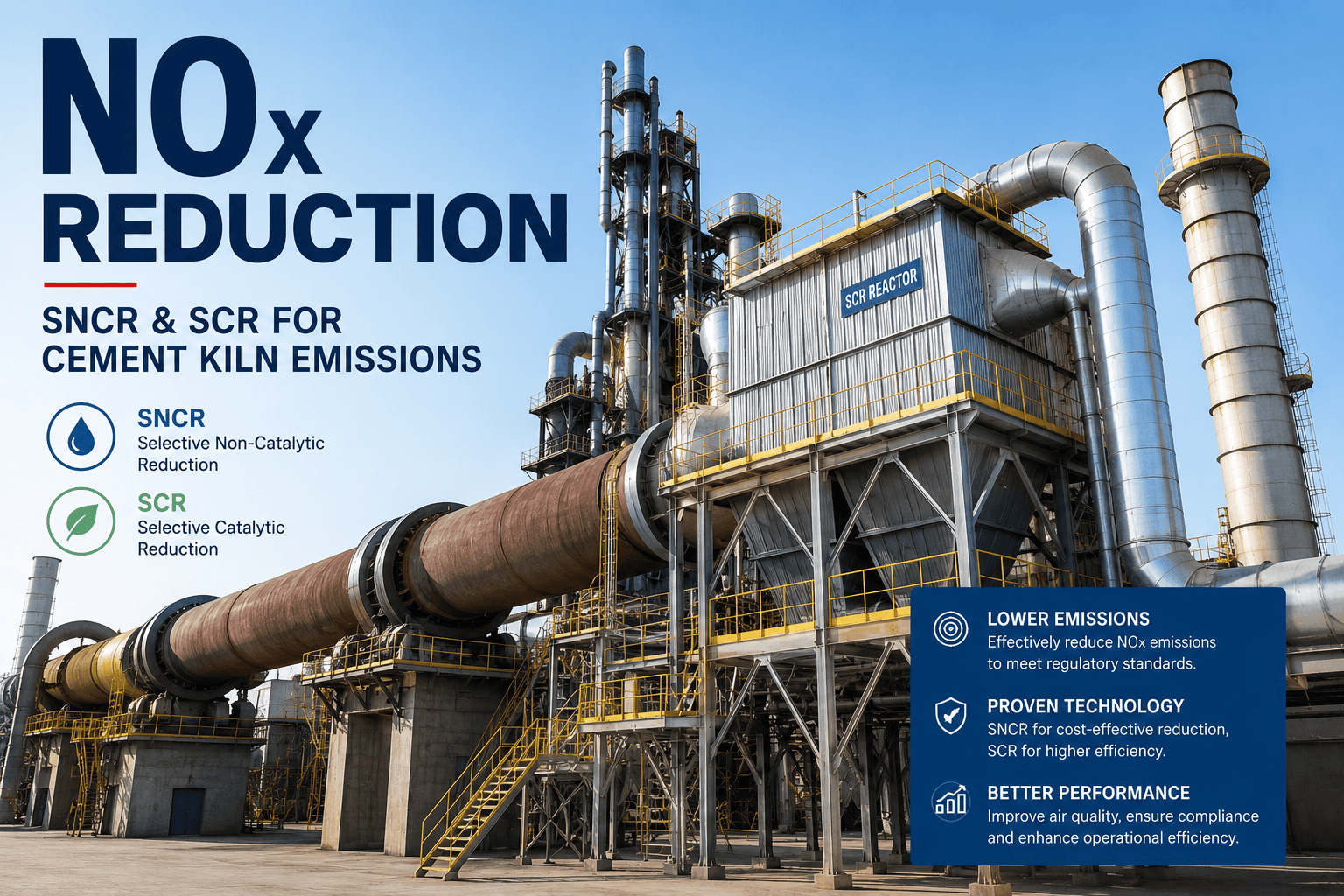
Cement kilns run hot enough to form nitrogen oxides straight out of the combustion air itself, which means NOx is not a byproduct you can engineer away by burning cleaner fuel. It has to be treated after it forms, and the two proven paths for doing that, SNCR and SCR, differ enough in cost, footprint, and reduction ceiling that picking the wrong one locks a plant into a compliance strategy that either overspends or underdelivers. Environmental teams weighing which path fits their kiln can book a demo to see how live emission data supports either system.
EMISSION CONTROL TECHNOLOGY
SNCR vs SCR for Cement Kiln NOx Reduction
Two technologies, two different reduction ceilings, and two very different cost profiles. Here is how to choose the right one for your kiln configuration.
Typical NOx Reduction
SNCR
30-50%
SCR
70-90%
How SNCR Works Inside the Kiln System
Selective non-catalytic reduction injects a reagent, typically urea or aqueous ammonia, directly into the hot gas stream at a point where temperature sits in the 1,600 to 2,000 degree Fahrenheit range. Within that narrow window, the reagent reacts with NOx to produce nitrogen and water without any catalyst needed, which is why the technology is comparatively inexpensive to retrofit onto an existing kiln. The tradeoff is that the reaction only works within that temperature band, so injection point selection has to track exactly where that zone sits as kiln operating conditions shift.
Because SNCR depends entirely on hitting the right temperature window with enough reagent residence time, its reduction ceiling tops out lower than a catalyzed process. Pushing urea dosing higher to chase deeper reduction increases the risk of ammonia slip, unreacted ammonia escaping with the exhaust gas, which creates its own compliance and odor problem downstream.
How SCR Achieves Deeper Reduction
Selective catalytic reduction uses the same basic chemistry, ammonia or urea reacting with NOx, but passes the gas stream through a catalyst bed that allows the reaction to proceed efficiently at lower temperatures and with far less excess reagent. The catalyst effectively does the work that temperature alone does in SNCR, which is why SCR systems consistently reach reduction rates that SNCR cannot approach regardless of dosing.
That performance comes at a real capital cost. SCR requires a catalyst reactor vessel sized into the gas path, a larger equipment footprint, and a periodic catalyst replacement or regeneration cost that SNCR systems simply do not carry. For plants facing the tightest NOx limits, SCR is often the only technology that can close the gap, but it needs to be justified against a facility's actual regulatory exposure rather than installed as a default.
SNCR
Capital Cost
Lower
Footprint
Minimal, injection lances only
Reagent Use
Higher per ton NOx removed
Best Fit
Moderate compliance targets
SCR
Capital Cost
Higher, catalyst reactor required
Footprint
Significant, reactor vessel in gas path
Reagent Use
Lower per ton NOx removed
Best Fit
Strict, near-term compliance limits
AMMONIA SLIP CONTROL
Track Reagent Dosing Against Real Kiln Conditions
Live temperature and NOx data keeps injection rates tuned instead of guessed, on either system.
Managing Ammonia Slip on Either System
Ammonia slip is the operating risk that connects both technologies. Any time reagent dosing runs ahead of the NOx actually available to react with, unreacted ammonia passes through with the exhaust stream. On SNCR systems this typically happens when operators increase urea flow to chase a compliance target during a kiln upset, without accounting for the fact that the injection zone temperature has shifted outside its effective range. On SCR systems, slip usually points to a catalyst that has degraded past its effective activity level, meaning it can no longer convert the ammonia being fed to it.
Continuous monitoring of the relationship between reagent flow, NOx concentration, and exhaust ammonia is the only reliable way to catch slip before it becomes a secondary emissions problem, since the visual and olfactory signs of ammonia slip typically show up well after the underlying dosing imbalance began.
Choosing Between the Two Systems
| Consideration | Favors SNCR | Favors SCR |
|---|---|---|
| Current NOx baseline | Moderate excess above limit | Large gap requiring deep reduction |
| Available footprint | Limited space near kiln riser | Room for a reactor vessel in gas path |
| Capital budget cycle | Near-term retrofit needed quickly | Multi-year capital project already planned |
| Regulatory trajectory | Current limits expected to hold steady | Limits expected to tighten further |
The Reagent Economics Behind Each Technology
Capital cost is only half of the financial comparison between SNCR and SCR, and plants that stop the analysis there often misjudge which system actually costs less over its operating life. SNCR systems consume reagent less efficiently relative to the NOx removed, since a meaningful portion of the urea or ammonia injected never encounters gas at the right temperature to react and simply passes through unreacted or decomposes without contributing to reduction. SCR's catalyst bed pushes reagent utilization much closer to stoichiometric, meaning less reagent is needed per ton of NOx removed even though the absolute reduction achieved is higher.
Over a multi-year operating horizon, the reagent cost gap between the two technologies can close a meaningful portion of the capital cost difference, particularly at plants running high kiln utilization where reagent consumption volume is substantial. This is why a full technology decision should model reagent cost per ton of NOx removed across the expected operating life, not just the upfront installed cost of each option.
Integrating Reduction Systems With Continuous Emissions Monitoring
Whichever technology a plant installs, the value of that investment is only as good as the data confirming it is working as designed. Continuous emissions monitoring systems at the stack provide the regulatory record, but the more useful operational picture comes from pairing that stack data with upstream process variables: kiln riser or preheater temperature for SNCR, and catalyst bed temperature and pressure differential for SCR. Without that upstream context, a NOx excursion at the stack shows up as a compliance problem with no immediately obvious cause, forcing operators to reconstruct what happened after the fact.
Plants that connect reagent flow, injection zone temperature, and stack NOx into one continuous data stream can catch a developing dosing imbalance hours or days before it becomes an exceedance, rather than discovering it during a routine compliance report review. This shift from reactive compliance reporting to proactive process control is increasingly what separates plants that treat emission control as a fixed cost from plants that treat it as an optimized, actively managed system.
Frequently Asked Questions
Can a plant run SNCR and SCR together?
Yes, and combining both is a recognized strategy for kilns that need to reach reduction levels beyond what SNCR alone can deliver but where a full SCR system sized for total NOx load would be oversized and costly. In a combined configuration, SNCR handles the bulk reduction in the high-temperature zone, and a smaller SCR stage polishes the remaining NOx at lower cost than a standalone SCR system designed to do all the work.
How does urea injection compare to aqueous ammonia for SNCR?
Urea is generally easier and safer to store and handle on site, since it does not carry the same handling and permitting requirements as aqueous ammonia, though it requires slightly higher injection temperatures to decompose and react effectively. Aqueous ammonia reacts across a broader temperature window and can offer marginally better reduction performance, but the additional storage and safety infrastructure needs to be weighed against that benefit for each specific site.
What causes catalyst degradation in an SCR system over time?
Catalyst activity declines from a combination of physical masking by dust and alkali deposits, chemical poisoning from trace elements in the kiln feed, and thermal aging from sustained exposure to high gas temperatures. The rate of degradation varies significantly based on raw material chemistry and kiln operating pattern, which is why catalyst life is usually estimated conservatively during initial system design and verified against actual performance data once installed.
Does switching alternative fuels affect NOx reduction system performance?
Yes, alternative fuel blends often burn differently than traditional fuel, shifting flame temperature profiles and the exact location of the effective SNCR injection zone within the kiln riser or preheater tower. Plants increasing alternative fuel substitution rates should expect to revisit injection point placement and dosing logic rather than assuming the original tuning still applies, since the temperature window the reaction depends on can move.
How is NOx reduction system performance verified for compliance reporting?
Most jurisdictions require continuous emissions monitoring at the stack, providing an ongoing record of NOx concentration that regulators can review directly rather than relying on periodic stack testing alone. Pairing that continuous stack data with upstream process data, kiln temperature, reagent flow, and catalyst condition, gives plant teams the ability to explain any excursion rather than simply reporting it. Teams building this out can review their monitoring setup through support.
CEMENT KILN EMISSIONS
Match the Right Technology to Your Compliance Target
See how live kiln and emissions data supports whichever NOx reduction path fits your plant.