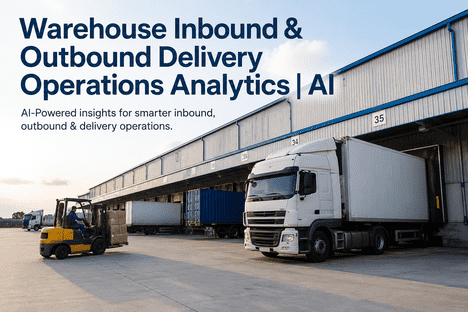
Inbound staging is the chokepoint where delivery schedules are made or broken. Trailers arrive, dock doors open, forklifts move pallets from receiving to staging, staging to put-away, put-away to replenishment, and replenishment to outbound. The forklift fleet is the single layer of equipment touching almost every pallet that enters and leaves the warehouse and when one of those forklifts goes offline mid-shift, the cascading effect hits every outbound order downstream of the staging lane it was working. The operational risk is sharpened by a safety profile the industry has documented for years: OSHA reports forklifts are involved in roughly 85 fatal accidents and nearly 35,000 serious injuries each year in the United States, with serious-violation fines starting at $15,625 per incident and willful violations reaching $156,259 under 29 CFR 1910.178. Most warehouse forklift fleets are still managed on paper pre-shift checklists, calendar-based PM intervals inherited from when the fleet was smaller, and reactive repair cycles that only respond once the truck has already stopped. AI-driven predictive analytics changes the operating model ingesting telematics from the fleet, scoring failure risk per truck, generating CMMS work orders ahead of breakdown, and turning OSHA pre-operation inspections, near-miss events, and operator behavioural data into a compliance-ready record. iFactory AI deploys across warehouse forklift fleets to protect inbound staging throughput, outbound delivery schedules, and operator safety in the same architecture. Book a Demo to see live forklift fleet analytics mapped against your receiving and despatch operations.
85
Annual U.S. fatal forklift incidents OSHA tracks under 29 CFR 1910.178
$156K
Maximum OSHA willful-violation fine per incident for forklift non-compliance
15–25%
Insurance carrier premium discount for warehouses with AI monitoring and predictive maintenance
4–6 wks
Deployment timeline from telematics audit to live predictive forklift analytics
Why Forklift Fleets Drive Inbound Staging Risk and Outbound Delivery Failure
Inbound staging is fundamentally a forklift problem. A single trailer arriving at a dock door requires a forklift cycle for every pallet position, and the trailer cannot release until every pallet has moved to its staging or put-away destination. When a forklift goes offline during the receiving window battery failure during a long shift, hydraulic leak on the mast, drive motor thermal trip during a heavy-load cycle, brake fade on a busy aisle, or a near-miss event that takes the operator off the truck the cascade reaches outbound directly. Staging lanes back up, put-away schedules slip, replenishment falls behind, picking starts running against gaps, sortation receives incomplete loads, and the despatch wave goes out with missing SKUs or misses its carrier cut-off entirely. The forklift fleet is the warehouse's single most operationally connected asset class and the most consistently under-instrumented.
iFactory AI ingests telemetry from the fleet management system engine hours, battery state-of-health, hydraulic pressure, brake actuation, lift cycle count, impact events, operator login, and inspection completion and turns it into a continuous fleet health and compliance view. Failure risk is scored per truck. Work orders push directly into the CMMS before a truck goes offline mid-shift. OSHA pre-operation checklists per 29 CFR 1910.178(q)(7) are completed digitally and stored automatically. Near-miss events, hard-braking incidents, and impact triggers are logged against operator and zone. The maintenance team works against actual condition and the safety team works against actual behaviour, rather than against checklists that nobody can demonstrate were completed honestly. Book a Demo to see what your forklift fleet's current operating profile looks like through live AI analytics.
Battery Health and Charging Analytics
For electric forklifts, AI tracks battery state-of-health, charge-cycle count, opportunity-charging behaviour, voltage drop per cycle, and cell-balance variance. The model flags packs approaching capacity decline weeks ahead of mid-shift failure, protects against deep-discharge events that accelerate degradation, and surfaces operators or zones driving abnormal charging patterns before they shorten pack life across the fleet.
Hydraulic, Mast and Drivetrain Diagnostics
Telematics ingestion across hydraulic pressure trends, mast lift-cycle count, drive motor current and thermal, transmission and brake actuation produces a continuous mechanical health view per truck. Developing hydraulic leaks, mast bushing wear, drive motor degradation, and brake fade signatures are flagged 1 to 3 weeks ahead of operational impact for ICE and electric trucks alike.
Impact Detection and Near-Miss Logging
G-force impact sensors on every truck capture racking strikes, dock-edge contacts, pedestrian-zone incidents, and hard-braking events with timestamp, operator ID, truck ID, and zone. iFactory ties impacts to operator login and routes them automatically into a structured near-miss register feeding both the OSHA-required incident investigation under 29 CFR 1910.178(l)(4) and the re-training trigger workflow.
Digital Pre-Operation Inspection and Operator Lockout
29 CFR 1910.178(q)(7) pre-shift checklists captured digitally at truck start-up. Incomplete or failed checklists block ignition. Operator certification status verified against the digital database before any truck will start. Inspection records, training expiry, and re-training triggers from impact events or near-misses are all retained automatically for OSHA audit production with no paper handling.
Inbound Staging and Dock-Door Throughput Analytics
Forklift cycle time per pallet move, dwell time in each zone, dock-door utilisation, and trailer turnaround visualised against the inbound schedule. Operations leadership sees which staging lanes are throughput-constrained ahead of the receiving wave, which dock doors are queueing, and which forklifts are running off-baseline cycle times that indicate either truck condition or operator-coaching opportunity.
Fleet Telematics, WMS and CMMS Integration
iFactory connects to major forklift telematics platforms (Crown InfoLink, Toyota I_Site, Hyster Tracker, Yale Vision, Raymond iWAREHOUSE, Jungheinrich ISM) plus Manhattan, Blue Yonder, SAP EWM, and Infor WMS, plus IBM Maximo, SAP PM, ServiceMax, and Infor EAM CMMS. Telemetry is normalised across mixed fleets, work orders are auto-generated, and the digital Shift Logbook carries every alert, intervention, and near-miss across handovers.
Paper Checklists and Calendar PM vs Forklift Telematics Analytics: Where the Operating Model Has to Change
Most warehouse forklift fleets are still running on a maintenance and compliance model designed when fleets were smaller, paper inspections were the norm, and OSHA enforcement was lighter. The table maps where that model breaks against the operational and compliance reality warehouses face on inbound staging and outbound delivery today.
| Fleet Management Dimension |
Paper Checklists and Calendar PM |
iFactory AI Forklift Telematics Analytics |
| Pre-Operation Inspection (29 CFR 1910.178) |
Daily pre-shift checklist signed on paper, often retrospectively. Incomplete or missing checklists are routine. OSHA inspectors find gaps that the operations team cannot explain. Fines starting at $15,625 per serious violation are an exposure the operator absorbs. |
Digital checklist completion enforced at truck ignition; the truck will not start without it. Records retained automatically and reproducible on demand. Failed checklist items routed straight into the CMMS as a work order. Compliance posture is structural, not procedural. |
| Maintenance Trigger |
Calendar-based PM at fixed engine-hour or month intervals inherited from the fleet vendor. Heavy-use trucks under-serviced; light-use trucks over-serviced. Unplanned downtime concentrated on the high-utilisation trucks running the inbound staging loop. |
Condition-based maintenance triggered by actual telematics signatures battery SoH, hydraulic pressure trends, drive motor thermal, brake actuation. Highest-utilisation trucks get the maintenance attention they need; lower-utilisation trucks stretch their PM cycles safely. |
| Impact and Near-Miss Capture |
Operators expected to self-report impacts and near-misses. Under-reporting is universal. Patterns across operators, shifts, or zones invisible until an incident produces an OSHA-reportable event and the post-incident review. |
G-force sensors capture every impact and hard-braking event automatically with operator, truck, zone, and timestamp. Patterns surface as fleet-wide trends. Re-training triggers under 29 CFR 1910.178(l)(4) generated automatically when telematics indicate unsafe operation. |
| Operator Certification and Lockout |
Operator certification tracked in spreadsheets or HR systems. Lapsed certifications routinely discovered after an incident. Trucks can be operated by anyone with access to the key, regardless of training status or assignment to truck type. |
Operator login required at truck start; certification status verified in real time against the digital database. Expired certifications, missing truck-type assignments, or re-training triggers block ignition. 100% operator-certification compliance is structurally enforced rather than periodically audited. |
| Inbound Staging Throughput Visibility |
Pallet cycle times and dock-door utilisation tracked in the WMS report layer with 15- to 60-minute lag. Staging-lane bottlenecks identified after they have already impacted the put-away or replenishment schedule downstream. |
Forklift cycle time per pallet, dock-door dwell, and zone throughput visualised in real time. Operations leadership sees the bottleneck developing during the receiving wave with the specific truck, operator, or zone driving it actionable inside the same shift. |
| Insurance Carrier Posture |
Insurance carriers price warehouse forklift liability against incident history alone. Higher premiums on facilities with paper-only compliance and elevated incident rates. No mechanism to demonstrate continuous risk reduction. |
Carriers increasingly offering 15 to 25% premium discounts for facilities with certified AI monitoring and predictive maintenance. Auditable telematics evidence of safe operation, completed inspections, and re-training execution becomes a documented risk-reduction artefact. |
Every Forklift Failure in Inbound Staging Is a Missed Carrier Cut-Off Downstream.
iFactory AI ingests forklift telematics across battery, hydraulic, drivetrain, brake, impact, and operator behaviour data surfacing failures and safety events ahead of operational impact, generating CMMS work orders before mid-shift breakdowns, and delivering OSHA-ready compliance evidence on demand.
Book a Demo to see live forklift analytics running against your inbound and outbound operations.
How iFactory AI Deploys Across a Warehouse Forklift Fleet
The 4 to 6 week deployment sequence is designed to deliver live telematics analytics across Tier 1 trucks in the inbound staging and outbound despatch loops within the first two weeks, condition-based maintenance triggers by week four, and full OSHA-aligned digital inspection and operator-lockout enforcement by week six. Each phase produces a measurable deliverable to the operations, maintenance, and safety teams that will act on the output.
Weeks 1–2
Fleet Telematics Audit, Tier 1 Truck Selection and System Integration
Forklift fleet inventoried by manufacturer, model, age, fuel type, and route assignment. Telematics platform integration scoped Crown InfoLink, Toyota I_Site, Hyster Tracker, Yale Vision, Raymond iWAREHOUSE, Jungheinrich ISM, or the operator's chosen platform. WMS, ERP, and CMMS integration points confirmed. Tier 1 trucks running inbound staging and outbound despatch loops prioritised for first-wave analytics. Per-truck baseline data ingestion begun across battery, hydraulic, drivetrain, brake, impact, and operator behaviour signals.
Weeks 2–4
Baseline Calibration, Anomaly Detection and Inbound Staging Analytics
Machine-learning models calibrated to per-truck healthy baseline under representative load. Anomaly detection activated across battery health, hydraulic and drivetrain condition, brake actuation patterns, and impact events. Inbound staging cycle-time and dock-door analytics live with operations leadership seeing throughput patterns in real time. First-pass anomaly review typically surfaces latent maintenance and safety issues that paper inspections have missed for months.
Weeks 4–6
Digital Inspections, Operator Lockout, CMMS Automation and Shift Logbook
Digital 29 CFR 1910.178(q)(7) pre-operation checklists enforced at ignition. Operator certification lookup and lockout activated against the digital database. Automated CMMS work order generation pushing structured records into IBM Maximo, SAP PM, ServiceMax, or Infor EAM. Re-training trigger workflow active under 29 CFR 1910.178(l)(4) based on impact and near-miss patterns. Shift Logbook integrated so every alert, inspection failure, impact event, and intervention is captured across handovers. Operations, maintenance, and safety leadership trained; full handover with monthly fleet-condition and compliance reporting in place.
DEPLOYMENT OUTCOME: LATENT FORKLIFT FLEET ISSUES SURFACED INSIDE THE FIRST THREE WEEKS
Warehouses completing iFactory's 4–6 week forklift analytics deployment consistently surface latent fleet issues and compliance gaps within the first 3 weeks of telematics integration under-serviced high-utilisation trucks, expired operator certifications still operating equipment, and impact-event patterns that paper near-miss reporting had missed. Programmes typically achieve 1–3 weeks of advance warning per maintenance event, structural OSHA-inspection readiness, and access to insurance carrier discounts of 15 to 25%.
1–3 wks
Advance warning window across hydraulic, drivetrain, and brake degradation signatures
100%
Operator-certification compliance structurally enforced at truck ignition
15–25%
Insurance carrier premium discount achievable with AI-driven safety and maintenance evidence
Forklift Fleet Analytics: Use Cases from Warehouse Inbound and Outbound Operations
The following outcomes are drawn from iFactory forklift analytics deployments at operating warehouse and distribution facilities across e-commerce, 3PL, FMCG, and retail distribution networks. Each use case reflects 9 to 14 month post-deployment performance data against the specific operational or compliance problem the telematics analytics layer was deployed to solve.
A national 3PL operating 34 electric reach trucks and counterbalance trucks across an ambient multi-client DC was missing inbound receiving windows on 12 to 18% of days, with trailer detention charges accumulating and downstream put-away routinely slipping into the second shift. Walk-through analysis pointed at "forklift availability" but provided no underlying diagnosis. iFactory integrated telemetry across the full fleet via the operator's Crown InfoLink feed. Within 3 weeks the analytics layer identified that 9 of the 34 trucks were running 35 to 60% longer pallet cycle times than fleet baseline driven by a combination of battery packs operating below 80% state-of-health, hydraulic pressure decline on three reach masts indicating seal wear, and one fleet of trucks running the wrong tyre compound for the polished floor. Targeted maintenance and equipment changes recovered cycle time within the next month. Inbound miss rate fell from 12–18% to 3.1% across the following six months.
Book a Demo to see how this applies to your inbound staging operation.
3.1%
Inbound miss rate post-deployment vs 12–18% baseline before telematics analytics
9 trucks
Forklifts identified with hidden cycle-time drift driving the staging bottleneck
3 wks
Time from telematics activation to root-cause identification across the affected fleet
A high-velocity e-commerce fulfilment operator had received an OSHA inspection citation for incomplete pre-operation inspection records under 29 CFR 1910.178(q)(7) carrying a five-figure proposed penalty plus an abatement requirement. Paper checklists were inconsistently completed, several operators were found to have lapsed certifications, and the post-incident investigation file did not match the near-miss register. iFactory deployed digital inspections and operator-lockout enforcement across the 47-truck fleet within 4 weeks. Every truck-ignition cycle now requires a completed digital checklist and a verified operator certification. Impact events automatically generate a structured near-miss record. The follow-up OSHA visit closed the abatement with the digital evidence pack reproduced on demand. The operator's insurance broker subsequently negotiated a 19% premium reduction on the forklift liability line citing the documented AI monitoring and predictive maintenance programme.
100%
Pre-operation inspection completion rate enforced at truck ignition
19%
Insurance premium reduction on forklift liability following AI monitoring deployment
47 trucks
Fleet brought under digital inspection and operator-lockout enforcement
An FMCG distribution centre running 28 forklifts across two shifts had logged a stable headline near-miss rate for two years and a simultaneously rising racking damage repair bill that the safety team could not reconcile against the self-reported events. iFactory enabled G-force impact sensing across the full fleet, automatically capturing every impact with operator, truck, and zone context. Within the first 6 weeks the analytics layer surfaced 41 unreported impact events from a single shift handover window concentrated on three operators and one specific aisle intersection where dock-edge clearance was tight. The operators were re-trained under 29 CFR 1910.178(l)(4) using the impact data as the documented trigger; the aisle was re-marked with revised traffic rules. Racking damage repair spend dropped by 62% across the following nine months, and self-reported near-miss accuracy improved materially once operators understood impact events were being recorded automatically.
62%
Reduction in racking damage repair spend over 9 months post-deployment
41 events
Previously unreported impact events captured by G-force sensors in 6 weeks
3 operators
Identified for re-training under 29 CFR 1910.178(l)(4) using the documented impact record
Expert Perspective: Why Forklift Programmes Need to Move Beyond Paper
Industry Perspective Warehouse Safety and Fleet Reliability
"The forklift fleet is usually the highest-touch, highest-utilisation, highest-risk class of equipment in the warehouse and the one running on the most informal management. Paper checklists do not produce auditable evidence under OSHA scrutiny. Calendar PM does not respond to actual operating load. Self-reported near-miss data systematically understates the real frequency of impact events. The operations that have got ahead of this have moved their forklift programme into the same telematics, ML, and CMMS layer they use for the rest of their warehouse stack and they have generally seen the bonus that insurance carriers will reward the move with measurable premium reductions. The fleet that runs your inbound staging is too operationally and legally important to keep managing on a clipboard."
Head of Safety and Compliance European 3PL and Distribution Operator (provided via iFactory deployment reference)
The supporting data is unambiguous. OSHA tracks roughly 85 fatal forklift incidents and nearly 35,000 serious injuries per year in the United States. Serious-violation fines start at $15,625 per incident; willful violations reach $156,259. Insurance carriers are offering 15 to 25% premium discounts for warehouses with certified AI monitoring and predictive maintenance evidence. The technology, the integrations, and the operational case have all matured. The remaining decision for warehouse operators is operational rather than technical which trucks to instrument first and how quickly the safety and maintenance teams can move off paper. Book a Demo to speak with iFactory's forklift analytics team about your warehouse environment.
Conclusion: AI-Driven Forklift Analytics Protects Inbound Staging, Outbound Delivery, and Operator Safety in One Architecture
Forklift fleets sit at the intersection of three problems warehouse leadership cares about: throughput (forklifts run inbound staging and outbound despatch), maintenance cost (forklifts are the highest-utilisation class of equipment in the building), and safety and compliance (forklifts drive OSHA exposure and insurance premiums). Paper checklists and calendar PM cannot solve any of those three problems at the scale and velocity modern warehouse operations now run. AI-driven telematics analytics solves all three in the same architecture and produces the auditable evidence carriers and regulators are asking for.
iFactory AI delivers the capability stack warehouse operators need: battery and charging analytics, hydraulic and drivetrain diagnostics, impact-event capture, digital pre-operation inspections with operator lockout, inbound staging and dock-door throughput analytics, automated CMMS work orders, OSHA 29 CFR 1910.178-aligned compliance evidence, and a Shift Logbook that carries every alert and intervention across shift handovers. Deployment runs 4 to 6 weeks from telematics audit to fully integrated operation. Book a Demo to receive a forklift fleet analytics assessment scoped to your warehouse, inbound profile, and delivery schedule.
Frequently Asked Questions About AI Forklift Fleet Analytics for Warehouse Operations
Which forklift telematics platforms does iFactory AI integrate with?
iFactory integrates with Crown InfoLink, Toyota I_Site, Hyster Tracker, Yale Vision, Raymond iWAREHOUSE, and Jungheinrich ISM, plus the open telematics platforms used on mixed-OEM fleets. Ingestion supports OPC-UA, REST API, and direct telematics feeds. WMS integration covers Manhattan Associates, Blue Yonder, SAP EWM, and Infor; CMMS integration covers IBM Maximo, SAP PM, ServiceMax, and Infor EAM. Integration scope is confirmed during the week 1–2 fleet audit based on the operator's specific OEM mix.
How does iFactory help with OSHA 29 CFR 1910.178 compliance specifically?
Digital pre-operation inspections under 29 CFR 1910.178(q)(7) are enforced at truck ignition the truck will not start until the checklist is completed and any failed items are pushed into the CMMS as a work order. Operator certification status is verified against the digital database under 29 CFR 1910.178(l), blocking ignition for expired certifications, missing truck-type assignments, or pending re-training triggers. Impact events and near-misses are captured automatically and routed into a structured incident register that satisfies the documentation requirement under 29 CFR 1910.178(l)(4). All records are reproducible on demand for OSHA inspection.
What advance warning does the analytics layer typically provide on forklift failures?
For battery state-of-health decline, hydraulic pressure drift, drive motor thermal trending, and brake actuation degradation, telematics signatures typically appear 1 to 3 weeks before functional failure giving the maintenance team enough planning time to schedule the intervention against a low-utilisation window, source parts at standard lead time, and protect the inbound or outbound shift the truck would otherwise have failed in. For battery replacement specifically, the SoH model typically provides 4 to 8 weeks of advance visibility against the operational replacement threshold.
Can iFactory's analytics layer work across a mixed-OEM forklift fleet?
Yes. Telemetry is normalised across OEMs in the iFactory ingestion layer battery state-of-health, hydraulic pressure, drive motor temperature, brake actuation, and impact events are computed against a common per-truck baseline regardless of the underlying brand. Operations and maintenance leadership work against a single fleet-wide health view rather than separate dashboards per OEM. This is the practical requirement for any warehouse that has standardised on more than one forklift platform across deployment phases or truck types.
Do warehouse insurance carriers actually offer discounts for AI monitoring?
Many do, in ranges typically reported between 15 and 25% on the forklift liability line, citing the documented risk-reduction value of AI-driven safety and predictive maintenance programmes. The specific discount depends on the carrier, the operator's existing loss history, and the auditability of the AI evidence pack. iFactory's reporting layer is designed to produce the structured evidence carriers ask for incident-event records, operator certification compliance, completed inspection rates, and predictive maintenance work order history so that the discount conversation has substance behind it.
How does the Shift Logbook integrate with the forklift analytics workflow?
Every forklift alert, impact event, inspection failure, technician response, parts replacement, and operator coaching action is captured in iFactory's digital Shift Logbook against the affected truck, operator, or zone. Incoming shifts see live fleet condition plus full intervention history. Floor observations from supervisors unsafe driving, near-miss reports, equipment concerns are captured and correlated with telemetry so qualitative observation enriches the quantitative analytics. No critical alert, impact event, or compliance lapse is lost between shifts; no operator observation goes unreviewed.
Battery, Hydraulic, Drivetrain, Brake, Impact, Inspection. One Architecture. Live in 4–6 Weeks.
iFactory AI ingests forklift telematics across the full failure-mode and compliance signal set, generates structured CMMS work orders before mid-shift breakdowns, enforces 29 CFR 1910.178 digital inspections at ignition, and produces OSHA-audit-ready evidence on demand protecting inbound staging throughput, outbound delivery schedules, and operator safety in the same deployment.
Stop Running Inbound Staging on a Clipboard. Deploy AI Forklift Analytics in 4–6 Weeks.
iFactory AI delivers forklift-specific predictive analytics, digital OSHA inspections, operator-lockout compliance, impact-event capture, and inbound staging throughput visibility with automated CMMS work orders, OSHA 29 CFR 1910.178 audit evidence, and Shift Logbook continuity. Integrated with your fleet telematics, WMS, CMMS, and ERP from day one.
1–3 weeks advance warning on hydraulic, drivetrain, brake, and battery failure modes
100% operator-certification compliance structurally enforced at truck ignition
15–25% insurance premium discount achievable with documented AI safety evidence
Inbound staging throughput, dock dwell, and pallet cycle time visualised in real time