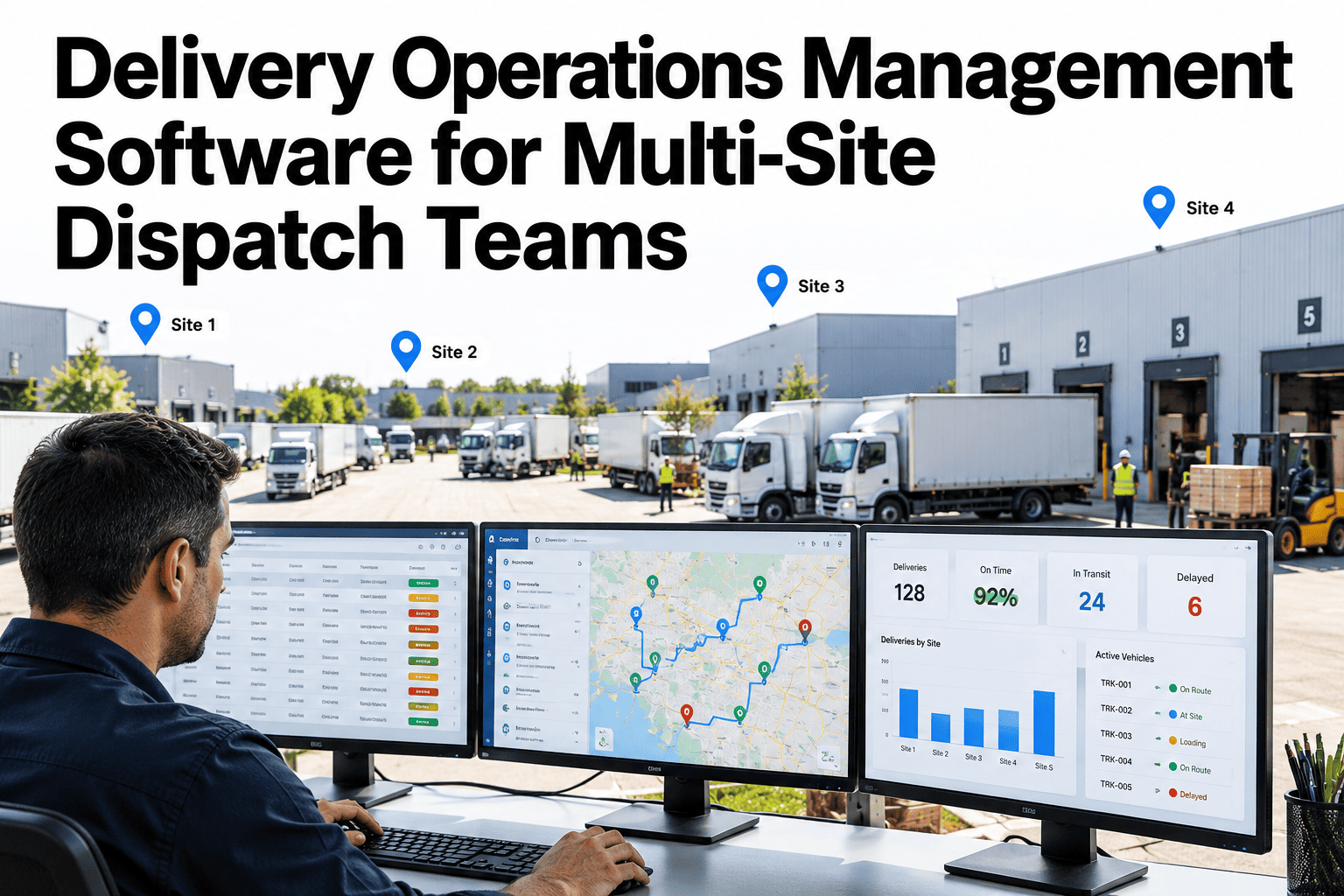
Modern manufacturing plants have invested heavily in production dashboards, OEE tracking, and predictive maintenance — yet the department that physically controls every material entering and leaving the factory still operates on paper gate passes, whiteboard dispatch boards, and phone call coordination. The factory delivery department — spanning gate security, inbound receiving, dispatch sequencing, vehicle inspection, and internal material movement — is the last undigitized function in the modern plant. The consequence is measurable: factories receiving 20 vehicles per day lose 280+ minutes of dock time daily to manual gate processing alone, dispatch errors run at 2–3% under manual sequencing, and 30–40% of production stoppages attributed to material unavailability are actually locating failures — materials that are physically in the building but invisible to the production floor. Collaborative dispatch management systems change this by connecting every participant in the factory delivery department — security staff, receiving teams, dispatch coordinators, drivers, and operations managers — into a single real-time data layer. This guide covers how collaborative dispatch management works inside the factory, what operational problems it solves, and what measurable results iFactory customers achieve within 90 days of go-live. For facility-specific questions, talk to our support team.
iFactory · Factory Delivery Department · Collaborative Dispatch
Improving Factory Delivery Operations Through Collaborative Dispatch Management Systems
Every person in your factory delivery department — gate security, receiving staff, dispatch coordinators, drivers, and floor supervisors — is making decisions based on information that is invisible to everyone else. Collaborative dispatch management systems give all five roles real-time access to the same operational data layer, eliminating the coordination gaps that generate gate delays, dispatch errors, receiving discrepancies, and material location failures across every shift.
87%
Gate pass time reduction
78%
Faster inbound receiving
100%
Audit trail coverage
The Coordination Problem
Why Factory Delivery Departments Fail Without Shared Operational Data
A factory delivery department has five distinct roles operating simultaneously — and in most plants, each role is working from a different data source. Security processes gate passes from paper logs. Receiving teams verify POs from printed documents. Dispatch coordinators sequence vehicles from whiteboards. Drivers communicate ETAs by phone. Production supervisors discover material shortages only when the line stops. The result is a department that is technically functional but operationally invisible — no one has the complete picture until something goes wrong.
GATE SECURITY
Processing vehicles in 15–20 minutes
Without pre-registration data: phone verification, manual log entry, paper pass issuance — every vehicle from scratch
Dock team has zero visibility until security calls them
RECEIVING TEAM
Matching shipments to POs in 45–60 minutes
Paper PO matching, manual quantity counting, handwritten discrepancy notes — no photo documentation, no chain of custody
Production floor has no visibility into what was received, when, or with what discrepancies
DISPATCH COORDINATOR
Sequencing departures from a whiteboard
Manual priority assignment with 2–3% error rate — SLA misses undetected until the customer complaint arrives, sometimes days later
No real-time vehicle status, no automated SLA escalation, no per-vehicle compliance record
DRIVERS & VEHICLES
Communicating by phone with no system record
ETA updates by phone call. Vehicle inspections completed on paper. No auto-block for failed inspection items — non-compliant vehicles dispatched unknowingly
Inspection failures discovered at breakdown, not at inspection — unplanned repairs cost 3–4× more than planned servicing
STORES & PRODUCTION
Requesting materials with no location data
Materials received at dock disappear into the facility with no further digital record — location unknown until a physical search finds them
30–40% of "material unavailability" stoppages are locating failures, not actual stock-outs
OPERATIONS MANAGER
Assembling audit records from paper files
No real-time department performance dashboard — KPIs unknown until manually compiled. Audit preparation requires hours of record assembly from paper binders and spreadsheets
86% of manufacturers track OEE — almost none track gate pass processing time, inbound dwell time, or dispatch SLA compliance
The Data Visibility Gap
What Your Factory Already Tracks — and What Your Delivery Department Cannot See
Data Your Factory Already Generates Digitally
Production OEE — tracked and dashboarded by 86% of manufacturers
Equipment maintenance work orders with timestamps and technician attribution
Outbound shipment documentation and proof of delivery for customers
Employee safety training records and EHS incident reporting
Energy consumption monitoring across production floor operations
ISO audit documentation covering manufacturing process compliance
Finished goods inventory levels and warehouse location records
Supplier qualification records and vendor management documentation
Data Your Delivery Department Cannot Currently Produce
Gate dwell time per vehicle — gate queue backing up with zero measurable record
Inbound receiving cycle time per shipment — no benchmark, no variance detection
Digital chain of custody from supplier to production floor — stops at dock entry
Vehicle inspection results with timestamp and operator attribution per shift
Dispatch SLA compliance rate — misses undetected until customer complaint
Real-time internal material location after dock entry — location unknown
Gate queue length data over time — buildup pattern invisible without digital record
Dispatch error rate by coordinator, shift, vehicle type, and priority tier
8 Operational KPIs
The 8 Delivery Department KPIs That Collaborative Dispatch Management Unlocks — and What Digital Operations Deliver
87%
Gate Pass Processing Time Reduction
Pre-arrival registration allows security to verify vehicle details before the truck arrives — gate clearance completes in under 2 minutes. Every arrival, every shift, every day.
Manual: 15–20 min/vehicleDigital: under 2 min
78%
Faster Inbound Receiving Completion
Mobile PO verification with barcode scanning and photo proof of delivery cuts receiving from 45–60 minutes to under 10 minutes — while simultaneously generating the chain of custody record.
Manual: 45–60 minDigital: under 10 min
90%
Dispatch Error Rate Reduction
SLA-priority automated sequencing replaces whiteboard dispatch — reducing errors from 2–3% to under 0.3% while generating real-time SLA compliance alerts before misses occur.
Manual: 2–3% error rateDigital: under 0.3%
100%
Audit Trail Coverage
Every gate event, receiving transaction, inspection result, internal transfer, and dispatch decision is timestamped and person-attributed — retrievable in under 60 seconds, not hours of manual record assembly.
Manual: incomplete recordsDigital: 100% coverage
40%
Reduction in Inbound Delays
A factory receiving 20 vehicles/day loses 280+ minutes of dock time to manual gate passes alone. Collaborative dispatch systems recover this time by connecting pre-arrival registration to dock assignment before the vehicle reaches the gate.
Manual: 280+ min lost/dayDigital: 40% delay reduction
30–40%
Production Search Time Eliminated
Materials logged at every internal transfer point — dock to stores, stores to staging, staging to production. Location failures that masquerade as stock-outs are resolved in under 10 seconds from the operations dashboard.
Manual: no location recordDigital: real-time location
3–6 mo
Full Platform Payback Period
Recovered dock time, eliminated dispatch errors, reduced compliance overhead, and extended yard vehicle service life combine to deliver full payback within 3–6 months of go-live — with deployment in 7–14 days.
Legacy: 18–24 mo paybackiFactory: 3–6 months
$25.5B
Market Context
The global delivery management software market reaches $25.5B by 2035 (from $11.6B in 2025) — driven by factory digitization mandates and JIT production schedule pressure across every major manufacturing region.
2025: $11.6B market2035: $25.5B projected
iFactory · Factory Delivery Department Module
Your production floor has dashboards. Your delivery department deserves the same visibility.
iFactory digitizes every gate pass, inbound receipt, material transfer, vehicle inspection, dispatch event, and incident report — giving your operations team real-time visibility into the department that controls everything that enters and exits your plant. Deploy in 7–14 days. No IT project. No hardware procurement. Results visible from day one. Talk to our support team for a facility-specific assessment.
87%
Gate pass time reduction
78%
Faster inbound receiving
Book A Demo
How It Works
How iFactory's Collaborative Dispatch Data Layer Connects Every Role in the Factory Delivery Department
iFactory does not require a separate collaboration tool, a new communication platform, or a change management project. It works by making the operational data that every role needs — already generated during their normal daily work — visible to every other role in real time. Five workflows. One shared data layer. Zero coordination gaps.
01
Digital Gate Pass — Pre-Arrival Registration to Exit Timestamp
Suppliers submit vehicle registration, driver credentials, and cargo details via mobile pre-registration link before departure. When the vehicle arrives, the security team's mobile app shows the complete record — vehicle type, driver, cargo, assigned dock, and any compliance flags — before the driver reaches the window. Gate clearance completes in under 2 minutes. The moment clearance is granted, the receiving team and dock coordinator receive an automatic notification with estimated dock arrival time. The dispatch manager's dashboard updates the live gate queue. The operations manager's screen shows real-time dwell time accumulation. Every role sees the same event, simultaneously, without a phone call.
Pre-arrival coordination
Auto dock assignment
Real-time queue visibility
Dwell time tracking
02
Mobile Inbound Receiving — PO Verification, Discrepancy Capture, Chain of Custody
The receiving team's mobile app shows the inbound PO details the moment the vehicle is gate-cleared — no waiting for paper documents from the driver. Staff verify quantities by barcode scan, capture discrepancy photos with a single tap, and flag receiving exceptions that auto-escalate to the procurement team and dispatch coordinator simultaneously. Every inbound shipment generates a digital record linking supplier, carrier, material, quantity received vs. ordered, and timestamp. This record is visible to production scheduling the moment the receiving confirmation is logged — eliminating the information delay between dock completion and production floor awareness that causes unnecessary material search activity.
Auto PO push to mobile
Photo discrepancy capture
Chain of custody record
Auto-escalation on exceptions
03
Yard Vehicle Inspection — Shared Status Dashboard with Auto-Block
Every yard vehicle — forklift, shunter, yard tractor — completes a digital pre-use inspection checklist on mobile at the start of each operational period. Failed inspection items generate an instant notification to the maintenance team and flag the vehicle as unavailable on the dispatch dashboard. The dispatch coordinator cannot assign a failed vehicle to a critical receiving or outbound operation because the platform prevents it — the vehicle status is visible across all roles simultaneously. Maintenance teams can log the repair and close the work order from mobile; the vehicle automatically returns to available status on every screen when the work order is closed. No coordinator needs to check with maintenance to find out which vehicles are ready.
Shared vehicle status dashboard
Auto-block on failed inspection
Maintenance auto-notification
Work order auto-generation
04
SLA-Priority Dispatch Sequencing — Real-Time Deviation Alerts Across All Roles
Dispatch orders are sequenced automatically by SLA priority tier, vehicle type, load capacity, and compliance status — eliminating the manual whiteboard process that generates 2–3% error rates. Every dispatch assignment is visible to the receiving team (so they know which docks are about to be vacated), the gate security team (so they know which vehicles are exiting and in what sequence), and the operations manager (who sees real-time SLA compliance rates by tier). When a vehicle deviates from its assigned schedule or an SLA breach approaches, every relevant role receives an alert simultaneously — enabling coordinated intervention rather than after-the-fact discovery.
SLA-priority auto-sequencing
Cross-role dispatch visibility
Real-time deviation alerts
Per-vehicle dispatch record
05
Internal Material Tracking — Location at Every Transfer Point, Visible to Production
Materials are logged at every internal transfer point — dock to stores, stores to staging, staging to line-side production, production to quality hold, quality hold to dispatch. Each transfer is logged in under 30 seconds on mobile by the person performing the transfer. The production supervisor's dashboard shows real-time material location for every active batch — eliminating the material search activity that currently generates 30–40% of production stoppages incorrectly classified as stock-outs. When a production line requests a component that is sitting in quality hold from a receiving discrepancy three hours earlier, the dashboard shows its location, its hold reason, and the expected release timeline — in under 10 seconds, without a phone call to the stores team.
Real-time location map
Transfer-point digital logging
Production visibility dashboard
Hold status with release timeline
Measurable Results
What iFactory Customers Measure Within 90 Days of Go-Live
87%
Gate Pass Time Reduction
From 15–20 minutes manual to under 2 minutes digital — every vehicle, every day. A 20-vehicle/day factory recovers 280+ minutes of dock time that previously disappeared into manual gate administration.
78%
Faster Receiving Completion
Inbound receiving drops from 45–60 minutes to under 10 minutes per shipment with mobile PO verification and photo POD. The same workflow generates the complete chain of custody record — no separate documentation step.
90%
Fewer Dispatch Errors
Manual dispatch error rates of 2–3% drop to under 0.3% with SLA-priority automated sequencing — and every SLA miss triggers an alert before the breach, not a complaint after it.
100%
Audit Coverage — All Roles
Every gate, receiving, inspection, transfer, and dispatch event is timestamped and person-attributed. Cross-role audit documentation is retrievable in under 60 seconds — not hours of record assembly from paper binders across multiple departments.
3–6 mo
Full Platform Payback
Recovered dock time, eliminated dispatch errors, reduced vehicle inspection downtime, and compliance overhead reduction combine to deliver full payback within 3–6 months. Deployment completes in 7–14 days — no IT infrastructure project required.
14 days
Go-Live Timeline
From decision to fully operational collaborative dispatch system across all five roles — gate, receiving, dispatch, yard vehicles, and internal tracking — in 7–14 days. Cloud-based, mobile-first. No hardware procurement, no server installation.
Before vs. After
Factory Delivery Department — Siloed Manual Operations vs. iFactory Collaborative Platform
| Department Function |
Manual Operations (Current State) |
iFactory Collaborative Platform |
| Gate Pass Processing |
15–20 min/vehicle — security verifies by phone, paper log entry, zero pre-registration, no real-time dock team notification |
Under 2 min — pre-registration verified before arrival, dock auto-notified at clearance, live queue dashboard across all roles |
| Inbound Receiving |
45–60 min/shipment — paper PO matching, handwritten discrepancy notes, no photo documentation, receiving completion invisible to production |
Under 10 min — mobile barcode scan, photo POD, auto-escalation on exceptions, instant production floor notification on completion |
| Vehicle Inspection |
Paper checklists — incomplete, unshared, no auto-block on failures, maintenance unaware of failed items until breakdown occurs |
Shared digital status — timestamped checklists, failed vehicles auto-blocked in dispatch, maintenance auto-notified with work order generated |
| Dispatch Sequencing |
Whiteboard dispatch — 2–3% error rate, SLA misses undetected, vehicle status unknown to receiving and gate teams |
SLA-priority automation — under 0.3% errors, real-time alerts pre-breach, dispatch sequence visible to all roles simultaneously |
| Internal Material Tracking |
No location record after dock — production stoppages from material search, 30–40% of "stock-out" calls are locating failures |
Real-time location at every transfer — production can see material location, hold status, and release timeline in under 10 seconds |
| Incident Management |
Paper report after the fact — timestamp uncertain, attribution disputed, supervisor unaware for hours, insurance chain incomplete |
Real-time photo and location capture — timestamped, person-attributed, auto-escalated to supervisor, linked to vehicle and gate record |
| Operations Visibility |
Zero real-time department KPIs — gate time, receiving rate, dispatch SLA, and vehicle availability unknown until manually compiled |
Live operations dashboard — all five role streams in one view, anomaly alerts auto-generated, audit records retrievable in under 60 seconds |
| Deployment |
Legacy systems: 6–18 months, heavy IT involvement, hardware procurement, high upfront cost, long ROI timeline |
iFactory: 7–14 days — cloud-based, mobile-first, no infrastructure project, results visible from day one |
iFactory · Factory Delivery Department Module
Every Role in Your Delivery Department Needs the Same Real-Time Data. iFactory Makes That Possible in 14 Days.
Collaborative dispatch management connects gate security, receiving teams, dispatch coordinators, yard vehicle operators, and production supervisors into one shared operational data layer — eliminating the coordination gaps that generate gate delays, dispatch errors, receiving discrepancies, and material location failures across every shift. No IT project. No hardware. Deploy in 7–14 days.
87%
Gate pass time reduction
Book A Demo
Frequently Asked Questions
Collaborative Factory Dispatch Management — What Operations Leaders Ask First
Answers for plant managers, dispatch supervisors, and operations directors evaluating collaborative dispatch management for their factory delivery department. For your specific facility, talk to our support team or book a demo.
What exactly is a collaborative dispatch management system in a factory context — and how is it different from a courier logistics platform?
A collaborative dispatch management system for a factory delivery department is a shared operational data platform that connects all five internal roles involved in vehicle and material movement — gate security, receiving teams, dispatch coordinators, yard vehicle operators, and production supervisors — into a single real-time information layer. It is fundamentally different from a courier logistics platform in both scope and purpose. Courier platforms are designed to coordinate third-party delivery service providers dispatching packages to end customers across a geographic network. A factory collaborative dispatch system is designed to coordinate the internal department that manages everything entering and exiting the plant: inbound supplier vehicles, outbound dispatch vehicles, yard vehicle operations, receiving documentation, and internal material movement from dock to production floor. The key operational problems it solves are coordination gaps between roles that currently operate from separate data sources — security from paper gate logs, receiving from printed POs, dispatch from whiteboards, and production from verbal updates. iFactory's platform gives all five roles simultaneous visibility into the same event stream without requiring any of them to change their physical workflow — they simply complete their normal tasks on a mobile device instead of on paper, and the data becomes instantly visible to every other role. For a detailed walkthrough of how this applies to your specific facility layout,
talk to our support team or
book a demo.
How does iFactory's collaborative dispatch system work in a factory where security staff, receiving teams, and drivers have limited technical experience?
iFactory was specifically designed for operational personnel — security staff, receiving teams, and drivers — who are not software users by background and whose primary focus is physical plant operations, not digital tools. The design philosophy is that the platform must fit the work, not require the work to fit the platform. Gate security staff use a mobile app that shows the pre-registration record for each arriving vehicle in a simple verification format — the most complex action required is confirming vehicle details and tapping to grant clearance. Receiving staff use barcode scanning and camera capture to verify POs and document discrepancies — both actions are single-tap workflows on the iFactory mobile app. Drivers interact with the pre-registration form before arrival via a web link — no app download required. Dispatch coordinators use a tablet or desktop dashboard showing vehicle status, SLA priority queue, and real-time alerts. Training for each role group takes 2–4 hours via the mobile app during the deployment week — not a multi-day software training program. iFactory's onboarding team runs training sessions directly with each role group during the days 4–7 configuration phase of deployment, ensuring every staff member is confident before go-live. For questions about role-specific training requirements for your team,
talk to our support team.
What happens to dispatch coordination when a vehicle arrives late, a receiving discrepancy is flagged, or a yard vehicle fails inspection mid-shift?
iFactory's collaborative dispatch architecture is specifically designed to handle mid-shift exceptions — which are the events where siloed manual operations fail most visibly. For a late vehicle arrival: when a supplier vehicle misses its pre-registered arrival window, the gate queue dashboard automatically flags the absence and alerts the dock coordinator, who can immediately reassign the vacant dock slot to another queued vehicle — recovering dock time that manual operations would lose to queue disruption. For a receiving discrepancy: when the receiving team flags a discrepancy on mobile, the exception auto-escalates to the procurement contact for that PO and the dispatch coordinator simultaneously — both are alerted in real time without anyone picking up a phone. The discrepancy record with photo evidence is also visible to the operations manager's dashboard immediately. For a yard vehicle inspection failure: the vehicle is automatically blocked from dispatch assignment the moment the inspection item is failed on the mobile checklist. A work order is auto-generated for the maintenance team, who receives the notification on mobile. The dispatch coordinator's vehicle availability dashboard updates instantly — preventing any attempt to assign the failed vehicle to a critical operation. When the maintenance team closes the work order, the vehicle automatically returns to available status on every screen. No coordination phone calls required at any stage of any exception.
Book a demo to see these exception workflows live.
How does iFactory's real-time material tracking actually eliminate production stoppages that are currently classified as stock-outs?
The production stoppage problem is one of the most impactful — and most misunderstood — issues in factory delivery department management. Industry data consistently shows that 30–40% of production stoppages attributed to material unavailability are locating failures, not genuine stock-outs. The materials are physically present in the facility, but their location after dock entry is unknown to the production floor. iFactory solves this by logging every internal material movement at the point of transfer — dock to stores, stores to staging, staging to line-side production, production to quality hold — using a 15–30 second mobile logging action by the person performing the transfer. The production supervisor's dashboard shows a real-time location map for every active material batch. When a line supervisor calls stores to report a component is unavailable, the stores manager can see in under 10 seconds that the component is in quality hold from a receiving discrepancy flagged 3 hours earlier, with an expected release time of 40 minutes. This resolution — which in a manual plant would require a physical search of stores, staging, quality, and production areas lasting 30–60 minutes during which the line is idle — takes under 10 seconds of dashboard navigation. At typical manufacturing wages and output value, a single avoided 45-minute production stoppage from a location failure easily covers weeks of iFactory subscription cost.
Talk to our support team about configuring internal material tracking for your facility's specific layout and material flow.
What does the iFactory deployment process look like for a factory delivery department, and how disruptive is the go-live transition for daily operations?
iFactory deploys in 7–14 days for a full factory delivery department implementation covering all five collaborative modules: gate pass management, inbound receiving, yard vehicle inspection, dispatch sequencing, and internal material tracking. The deployment is structured to minimize operational disruption because it is explicitly designed to run alongside existing processes during the transition period — staff can complete operations on both paper and digital simultaneously during the first week of go-live, with the digital record becoming the primary source of truth as confidence builds. The deployment has three structured phases. Days 1–3 (data onboarding): your vehicle registry, driver roster, supplier contact list, and PO template library are uploaded by the iFactory onboarding team working directly with your operations or stores manager. No IT department involvement required. Days 4–7 (configuration and training): gate pass workflows, inspection checklists, SLA dispatch rules, and user access are configured to your facility's specific operational requirements. Role-specific training for each group — security, receiving, dispatch, maintenance, and management — takes 2–4 hours via the mobile app. Days 8–14 (go-live and verification): live operations with iFactory support actively monitoring data quality for the first week and resolving any workflow gaps in real time. Because iFactory is cloud-based and mobile-first, there is no server to install, no hardware to procure, and no IT infrastructure project. The platform is accessible from any smartphone, tablet, or desktop browser from day one of go-live.
Book a demo to see the deployment process live, or
talk to our support team for a deployment plan specific to your facility size and operational requirements.
How does iFactory handle multi-site factory delivery department operations — can a single deployment cover multiple plants?
iFactory is built as a multi-depot, multi-site platform from the ground up. A single iFactory deployment can cover all facilities in a manufacturing portfolio under one management dashboard, with site-specific configuration for each plant's gate workflows, vehicle inspection checklists, dispatch SLA rules, and material tracking layouts. At the site level, each plant's operations team sees their own gate queue, receiving dashboard, vehicle status, and dispatch sequence — their operational view is scoped to their facility. At the corporate or regional level, operations managers and supply chain directors see a unified dashboard spanning all sites — with cross-site performance metrics, SLA compliance comparisons, gate processing time benchmarks, and audit trail access across every facility simultaneously. This multi-site architecture is particularly valuable for manufacturers operating JIT production networks across multiple plants that share supplier routes — where a receiving discrepancy or gate delay at one facility has cascade effects on production schedules at another. iFactory's cross-site visibility allows supply chain managers to identify bottlenecks and reallocate receiving capacity across sites in real time, rather than discovering cascade impacts after they have already disrupted production. For multi-site deployment configurations and regional compliance documentation requirements (OSHA/DOT in USA, Schedule M in India, LkSG in Germany, Vision 2030 in UAE),
book a demo or
talk to our support team.
Get Started · iFactory
Your Delivery Department Is Running on Paper. Your Production Floor Runs on Data. Close the Gap in 14 Days.
iFactory's collaborative dispatch management platform connects gate security, receiving teams, dispatch coordinators, yard vehicle operators, and production supervisors into one shared real-time data layer — deployed in 7–14 days with no IT project, no hardware, and results visible from day one.
280+ min
Dock time recovered daily at 20-vehicle/day facility
3–6 mo
Full platform payback period for iFactory customers
90%
Reduction in dispatch errors — 2–3% to under 0.3%
100%
Audit trail — every movement timestamped and retrievable
Book A Demo