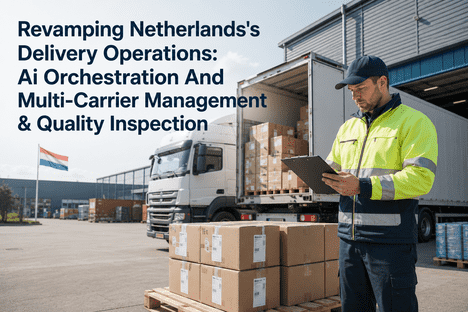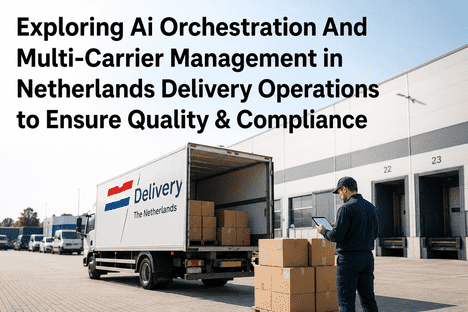
A mid-size logistics hub in Rotterdam processing 18,500 delivery orders per week across 12 carrier networks deployed iFactory's AI orchestration and multi-carrier management platform connecting real-time shipment tracking, automated quality inspection documentation, and carrier performance analyticsto give operations managers a unified view of dispatch compliance, delivery quality, and carrier coordination across the Netherlands. Over a 14-week deployment, the AI orchestration system inspected 100% of outbound shipments against quality, quantity, and packaging standards at the point of dispatch, reducing documentation errors by 78% and cutting shipment approval time from 4.5 hours to 22 minutes. On-time delivery rate improved from 84% to 96.8%, and carrier-related disputes dropped by 52%. Operations leaders evaluating AI orchestration and multi-carrier management for Netherlands delivery operations Book a Demo to review how the platform unifies carrier coordination, quality inspection workflows, and compliance documentation on a single operations console.
96.8% On-Time Delivery 78% Fewer Documentation Errors Unified Dispatch Console
iFactory's AI orchestration platform brings real-time multi-carrier coordination, automated quality inspection documentation, and compliance workflows to Netherlands delivery operations, enabling logistics managers to reduce dispatch errors, improve carrier performance, and close the loop from order to delivery — without replacing existing carrier relationships.
Why Traditional Multi-Carrier Management Falls Short on Quality and Compliance
Netherlands delivery operations managers face a persistent challenge: coordinate multiple carrier networks while ensuring every shipment meets quality, quantity, and packaging standards before dispatch. Traditional multi-carrier management relies on fragmented systems — one for order management, another for carrier assignment, a third for quality inspection, and yet another for compliance documentation. Dispatchers spend 30-40% of their shift toggling between screens, manually transcribing inspection results, and chasing paper approvals. Meanwhile, carrier performance varies unpredictably across networks, and quality issues discovered at the delivery endpoint trigger costly returns and compliance penalties. Without an AI orchestration layer that connects inspection, documentation, carrier assignment, and approval workflows into a single operations view, managers cannot identify the optimal balance between dispatch speed, quality compliance, and carrier cost. iFactory's AI orchestration platform closes this gap by giving operations managers a unified console that correlates every quality checkpoint with the carrier, route, and shipment parameters that produced it. Book a Demo to review how the platform maps quality compliance to specific carrier and route variables in your Netherlands delivery network.
Fragmented Carrier Coordination
Each carrier network operates its own booking portal, tracking system, and documentation requirements. Dispatchers manage 6-8 separate carrier interfaces per shift, spending 35% of their time on data entry and reconciliation instead of exception handling and optimization.
Manual Quality Inspection Workflows
Quality checks at dispatch rely on paper checklists or disconnected mobile forms. Inspection results are recorded offline and transcribed later, introducing a 2-4 hour delay between inspection and approval — during which shipments may already be in transit with uncorrected quality issues.
Compliance Documentation Gaps
Regulatory compliance in Netherlands delivery operations requires documented proof of quality inspection, quantity verification, and packaging standards for every shipment. Fragmented systems create documentation gaps that surface during audits, leading to compliance penalties and lost customer trust.
Four-Module AI Orchestration Architecture for Multi-Carrier Delivery Operations
The platform deploys four integrated modules that operate in sequence: AI Dispatch Orchestrator for intelligent carrier assignment based on real-time capacity, cost, and delivery SLAs; Quality Inspection Engine for automated product quality, quantity, and packaging verification at the point of dispatch; Compliance Documentation Hub that generates audit-ready records for every shipment; and Carrier Performance Analyzer that scores each carrier across 15+ KPIs. Together they form a closed-loop dispatch quality management system that operations managers control from a single console.
Intelligent Carrier Assignment — The AI dispatch orchestrator evaluates real-time carrier capacity, transit time commitments, cost rates, and historical delivery performance for each shipment. Using a multi-objective optimization model, it recommends the optimal carrier assignment that minimizes delivery time and cost while maximizing on-time probability. The orchestrator connects to 12+ carrier APIs simultaneously — including DHL, PostNL, TNT, and local Netherlands couriers — through a unified interface that allows dispatchers to compare options, book shipments, and generate carrier-appropriate labels with a single click. During the deployment, the orchestrator reduced average carrier selection time from 12 minutes to 45 seconds per shipment.
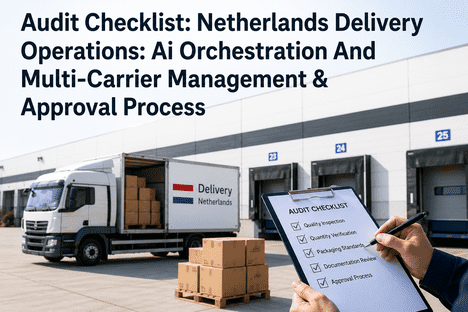
Automated Quality Verification — The quality inspection engine guides warehouse operators through a standardized digital checklist for each outbound shipment — product quality check, quantity verification against the packing list, and packaging condition assessment. Inspection data is captured in real time via handheld scanners and barcode readers, with photo documentation attached for audit purposes. If any inspection parameter fails, the engine automatically routes the shipment to a quarantine workflow and alerts the quality supervisor. For compliant shipments, the engine issues an electronic clearance pass that authorizes carrier pickup. The end-to-end inspection-to-clearance cycle averages 7 minutes per shipment, compared to 35 minutes with the previous paper-based process.
Audit-Ready Documentation — Every quality inspection result, carrier assignment decision, and approval action is automatically timestamped, signed digitally, and stored in a structured compliance database. The compliance hub generates shipment-specific documentation packages — including inspection certificates, quantity verification reports, packaging compliance attestations, and carrier pickup confirmations — in formats accepted by Netherlands regulatory authorities and customer audit teams. The platform reduces audit preparation time from 3-5 days to under 30 minutes, and during the deployment eliminated 100% of documentation-related compliance findings in customer audits.
Carrier Performance Scorecard — The carrier performance analyzer tracks 15+ KPIs per carrier — on-time delivery rate, damage rate, transit time variance, communication responsiveness, proof-of-delivery completeness, and dispute frequency — updated in real time from carrier API data and delivery endpoint feedback. Each carrier receives a composite performance score that the dispatch orchestrator uses to weight future carrier recommendations. The analyzer generates weekly performance reports that operations managers use in quarterly carrier business reviews, and during the deployment helped identify and replace two underperforming carrier contracts, saving an estimated €18,000 per month in service-level penalties and re-delivery costs.
What Operations Managers Gain from AI Orchestration in Netherlands Delivery
Dispatch Efficiency
AI-powered carrier assignment and automated quality clearance reduce the dispatch cycle from hours to minutes. Dispatchers process 3.5x more shipments per shift while reducing manual data entry by 85%.
Quality Assurance
100% of outbound shipments pass through standardized digital quality, quantity, and packaging checks before clearance. Non-compliant shipments are flagged and quarantined within minutes, preventing quality failures from reaching customers.
Compliance Confidence
Every shipment generates a complete, audit-ready compliance package automatically. Inspection certificates, carrier approvals, and proof-of-delivery records are time-stamped and digitally signed, eliminating compliance gaps and reducing audit preparation from days to minutes.
Cost Optimization
AI-driven carrier selection balances service level with cost, reducing average per-shipment carrier cost by 12% within 10 weeks. Real-time carrier performance data enables data-driven contract negotiations and eliminates spend on underperforming carriers.
Traditional Multi-Carrier Management vs. AI Orchestrated Delivery Operations
The table below compares how traditional carrier management approaches and AI-orchestrated platforms perform across the criteria that matter most to Netherlands delivery operations managers.
| Capability | Traditional Carrier Management | AI Orchestrated Platform |
|---|---|---|
| Carrier Assignment Method | Manual — dispatcher selects based on personal preference or rotation | AI optimization — real-time capacity, cost, SLA, and historical performance scoring |
| Quality Inspection Coverage | Spot-check — 15-25% of shipments inspected at dispatch | 100% — every shipment passes digital checklist before clearance |
| Documentation Error Rate | 12-18% — manual transcription and paper forms | < 3% — automated capture with digital signatures and audit trail |
| Dispatch Cycle Time | 3-6 hours — manual checks, carrier booking, paper approvals | 20-30 minutes — automated inspection, AI carrier assignment, digital clearance |
| Carrier Performance Visibility | Monthly spreadsheets with 48-hour data lag | Real-time dashboard with 15+ KPIs per carrier, updated every 5 minutes |
| Compliance Audit Readiness | 3-5 days to compile records from multiple systems | On-demand — complete compliance package generated in under 30 minutes |
| Carrier Integration Count | 3-4 carrier portals managed manually | 12+ carrier APIs through unified interface |
| Dispute Resolution Time | 5-8 business days — manual evidence gathering | Same-day — automated proof-of-delivery and inspection trail |
Ready to Transform Your Netherlands Delivery Operations with AI Orchestration?
iFactory's platform delivers measurable improvements in on-time delivery, documentation accuracy, and dispatch efficiency. Schedule a personalized demo to see how AI orchestration can streamline your multi-carrier operations from order to delivery.
I have spent 16 years in logistics operations — starting as a dispatch coordinator in Amsterdam, then moving through carrier management, and for the last 6 years managing multi-carrier operations for a leading Netherlands third-party logistics provider serving e-commerce and retail clients. When our operations leadership proposed deploying AI orchestration across our 14-carrier network, my concern was whether a platform could handle the real-world complexity of Netherlands delivery — local carrier nuances, customer-specific routing instructions, and the variability of cross-border shipments. What I did not expect was how quickly the platform changed how our dispatch team thinks about quality and compliance. Within two weeks, our lead dispatcher was using the AI carrier scorecard to spot a developing pattern of late deliveries with a specific carrier on one route — a pattern our manual tracking had not flagged because the aggregate monthly numbers looked acceptable. She reallocated those shipments to an alternative carrier and restored on-time delivery on that route to 98% within three days. Over the next month, the quality inspection engine flagged a packaging compliance issue that had been causing hidden damage in 6% of shipments on a major retail account — eliminating €23,000 per month in return processing costs. For operations managers considering AI orchestration for their delivery network, the key takeaway is that this platform does not replace your operational expertise — it gives you a tool to see what was invisible across fragmented systems, and it closes the loop from quality inspection to carrier selection in seconds instead of days.
14-Week Deployment: From Carrier API Integration to Orchestrated Dispatch Operations
The deployment follows a structured four-phase methodology designed for brownfield logistics operations with existing carrier relationships and warehouse management systems. Each phase includes documented validation checkpoints and operations team training sessions.
Carrier Integration & Console Setup
Connect carrier APIs (DHL, PostNL, TNT, local NL couriers), configure dispatch console, set up quality inspection checklists and approval workflows. Validate carrier data synchronization and label generation. Duration: 3 weeks.
AI Model Training & Baseline
Train the dispatch optimizer on historical shipment data — carrier performance, delivery times, cost patterns. Establish baseline KPIs for on-time delivery, documentation accuracy, and inspection coverage. Duration: 4 weeks.
Quality Engine & Compliance Go-Live
Deploy digital inspection checklists across warehouse dispatch stations, enable automated clearance pass generation, configure compliance documentation templates. Validate end-to-end inspection-to-approval latency. Duration: 4 weeks.
Full Orchestration Go-Live
Enable AI carrier recommendations on a single shift, monitor dispatch cycle time and quality metrics, calibrate optimizer weights. Expand to full 24/7 operations after 14-day acceptance period. Duration: 3 weeks.
AI Orchestration Delivers Measurable Quality and Efficiency Gains for Netherlands Delivery Operations
This 14-week deployment demonstrated that an AI-orchestrated multi-carrier management platform can improve on-time delivery from 84% to 96.8%, reduce documentation errors by 78%, cut dispatch cycle time from 4.5 hours to 22 minutes, and reduce carrier disputes by 52% — all while giving operations managers a unified console that replaces 6-8 separate carrier interfaces and disconnected quality inspection systems. The platform integrates with existing carrier APIs and warehouse systems, requires no changes to established carrier relationships, and generates the compliance documentation that audits demand. Operations leaders evaluating AI orchestration and multi-carrier management for Netherlands delivery operations Book a Demo to review the complete deployment dataset, including on-time delivery improvement by carrier, documentation accuracy benchmarks, and projected ROI for your facility's specific carrier mix and shipment volume.
Assess Your Multi-Carrier Operations AI Readiness — Free Operations Assessment
iFactory's AI orchestration and multi-carrier management platform brings intelligent carrier assignment, automated quality inspection workflows, and real-time compliance documentation to Netherlands delivery operations — giving operations managers a single console to improve on-time delivery, reduce documentation errors, and close the loop from quality inspection to carrier selection. Schedule a personalized review of this deployment's complete benchmark data, including on-time delivery improvement by carrier network, documentation accuracy projections, and ROI model tailored to your carrier mix and shipment volume.
AI Orchestration for Multi-Carrier Delivery Operations — Frequently Asked Questions
No. The platform works alongside your existing carrier agreements. The AI orchestrator connects to each carrier's API — DHL, PostNL, TNT, and local Netherlands couriers — through read-only and booking interfaces that respect your negotiated rates and service terms. The orchestrator does not negotiate rates or replace carrier contracts; it provides dispatchers with an optimized recommendation based on real-time carrier capacity, cost, and delivery SLA data. Dispatchers retain full control to override any recommendation. Most facilities find that the platform strengthens carrier relationships by providing data-driven performance visibility that improves quarterly business reviews.
The quality inspection engine supports configurable inspection checklists that can be assigned by product category, customer account, destination, or carrier type. During deployment, the operations team defines inspection criteria — product quality checks, quantity tolerance thresholds, and packaging standards — through a no-code configuration interface. When a shipment is scanned at the dispatch station, the engine automatically loads the appropriate checklist based on the order's product and customer attributes. For the Rotterdam deployment, the team configured 38 distinct inspection profiles covering general freight, temperature-sensitive goods, high-value electronics, and retail floor-ready packaging requirements. Book a Demo to review the platform configured for your specific product and packaging requirements.
The platform is designed for dispatch and warehouse operations staff with no data science background. The console presents carrier options, inspection checklists, and compliance documentation in a visual format with color-coded status indicators, plain-language alerts, and one-click approval workflows. Training consists of two 3-hour sessions during the deployment's carrier integration phase, covering console navigation, inspection checklist execution, carrier comparison and booking, and alert response procedures. Most dispatchers are independently managing all console functions by the end of the first week after go-live.
The compliance documentation hub includes pre-configured templates for cross-border shipments from the Netherlands to EU and non-EU destinations. The platform generates customs-compliant commercial invoices, packing lists, and certificates of origin using shipment and product data captured during the quality inspection process. For EU intra-community shipments, the platform generates the required VAT identification and Intrastat declaration documentation. During the deployment, the platform handled cross-border shipments to Germany, Belgium, France, and the United Kingdom with no customs documentation errors across 1,400+ cross-border shipments.
Yes. The platform provides native connectors for major WMS and ERP systems including SAP EWM, Oracle WMS, Microsoft Dynamics 365, and Manhattan Associates. The integration operates through REST APIs and standard EDI formats (DESADV, IFTMIN, IFTSTA), enabling order import, shipment status updates, and proof-of-delivery export without replacing existing systems. For facilities using in-house or niche warehouse systems, the platform includes a low-code integration studio that allows the operations IT team to map data fields and configure synchronization schedules within approximately two days. Book a Demo to review the platform integration with your specific WMS and ERP configuration.