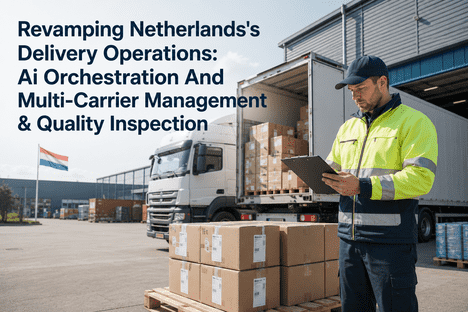
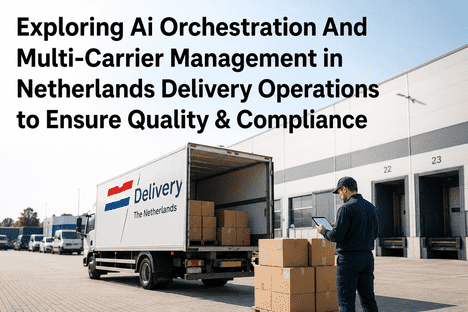
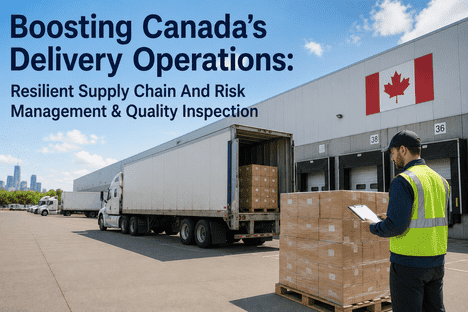
Revamping Netherlands's Delivery Operations Ai Orchestration And Multi-Carrier Management & Quality Inspection
By Arel Dixon on June 15, 2026
Netherlands manufacturers operate at the intersection of European distribution networks, multi-modal transport corridors, and customer expectations that demand both speed and precision. Every shipment leaving a Dutch factory must navigate a logistics landscape where multiple carriers handle different legs of the journey, regulatory documentation varies by destination, and quality expectations differ by customer and market segment. Coordinating these variables manually — matching shipments to carriers, verifying quality across product categories, tracking documentation per destination — creates an operational complexity that scales non-linearly with volume. AI orchestration and multi-carrier management, integrated with AI-powered quality inspection, address this complexity by automating carrier selection, routing, scheduling, and quality verification across the entire dispatch workflow. This blog examines how Netherlands manufacturers are adopting AI-orchestrated delivery operations to achieve zero-defect shipping, reduce carrier costs, and eliminate post-dispatch discrepancies through automated quality inspection at every stage of the outbound process.
Netherlands Manufacturers: Every Outbound Shipment Requires the Right Carrier, the Right Route, and Verified Quality. AI Orchestration Makes All Three Happen Automatically.
iFactory AI Delivery Management orchestrates carrier assignment, route optimisation, and quality inspection across a single platform — AI vision quality checks, automated quantity verification, packaging integrity assessment, multi-carrier coordination, and digital clearance — all connected to a control tower that gives Netherlands manufacturers full visibility and control over every outbound shipment.
Reduction in carrier costs achieved by Netherlands manufacturers using AI-powered carrier matching and dynamic routing across multi-carrier networks
60%
Reduction in post-dispatch discrepancies when AI orchestration automates quality inspection, quantity verification, and documentation validation before carrier assignment
99.5%
Dispatch accuracy rate across Netherlands distribution operations deploying AI-orchestrated inspection and carrier coordination workflows
85%
Reduction in manual dispatch coordination effort when AI orchestration handles carrier selection, route planning, and quality verification automatically
The Four Pillars of AI-Orchestrated Delivery Operations for Netherlands Manufacturers
AI orchestration in delivery operations rests on four interconnected capabilities that together transform dispatch from a manual coordination task into an automated, data-driven workflow. Each pillar addresses a specific operational bottleneck — carrier selection, quality verification, route optimisation, and clearance automation — and each one connects to the others through the control tower platform, creating a unified dispatch operation where decisions are made by AI and executed automatically rather than by dispatchers managing spreadsheets and phone calls.
1
AI Carrier Matching and Multi-Carrier Management
The platform matches every outbound shipment to the optimal carrier based on destination, transit time requirements, cost parameters, carrier capacity, and historical performance data. When a shipment requires multiple carriers — for example, a road leg from Rotterdam to a European hub followed by an air freight leg to an overseas destination — the platform coordinates the handoff automatically, generating transfer documentation and updating the shipment record across both carrier systems. Multi-carrier management eliminates the manual process of phoning carriers, emailing rate requests, and tracking shipments across separate carrier portals.
2
AI-Powered Quality Inspection and Verification
AI vision cameras inspect every unit for surface defects, dimensional accuracy, and labelling correctness at the inspection station. Inline weighing stations and barcode scanners verify quantity against the packing list. Packaging integrity is assessed through AI vision analysis of seal condition, carton integrity, and pallet stability. Every inspection result is recorded in the shipment record automatically — no manual data entry, no paper forms, no transcription errors. The quality orchestration layer ensures that no shipment reaches the carrier without passing every required inspection checkpoint.
3
Dynamic Route and Schedule Optimisation
The route optimisation engine evaluates multiple routing variables simultaneously — carrier availability, transit time commitments, border crossing schedules, port departure windows, and customer delivery time windows — and selects the optimal route for each shipment. When a carrier cancels, a border delay occurs, or a customer changes a delivery window, the engine recalculates the route and reassigns the carrier in real time without dispatcher intervention. The dynamic routing capability is particularly valuable for Netherlands manufacturers who ship to multiple European markets through the Port of Rotterdam and Amsterdam Schiphol, where carrier schedules and capacity fluctuate daily.
4
Digital Clearance and Automated Documentation
When all inspection checkpoints are passed and the carrier is assigned, the platform generates a digital clearance pass that is attached to the shipment record and shared with the carrier automatically. The clearance pass includes the complete inspection record, the carrier assignment confirmation, the shipping labels, and all required documentation — commercial invoice, packing list, certificate of origin, customs declaration. The carrier accesses the clearance pass through the control tower portal at pickup, eliminating paper handoffs and reducing dock waiting time.
How AI Orchestration Transforms Multi-Carrier Coordination for Netherlands Distribution
Multi-carrier coordination is one of the most complex operational challenges in Netherlands delivery operations. A single outbound shipment may require a road carrier to transport goods from a factory in Eindhoven to the Port of Rotterdam, a maritime carrier for an ocean leg to a UK or Scandinavian port, and a final-mile carrier for delivery to the customer's facility. Each carrier uses a different booking system, different documentation requirements, and different tracking portals. Coordinating across these systems manually requires dispatchers to manage multiple logins, re-enter shipment data across systems, and track carrier handoffs through phone calls and emails. AI orchestration eliminates this manual coordination load by connecting to each carrier's system through standard APIs, automating the booking, documentation transfer, and tracking update processes across the entire multi-carrier journey.
Manual Multi-Carrier Coordination vs AI-Orchestrated Multi-Carrier Management — The Operational Difference
Manual Carrier Coordination (Industry Baseline)
Carrier selection: Dispatcher phones or emails 3-5 carriers per shipment, waits for quotes, compares manually. Selection is subjective — based on relationship and recent experience rather than systematic data.
Data entry: Shipment data entered separately into each carrier's booking portal or emailed as a PDF attachment. Data re-entry creates transcription errors and consumes dispatcher time.
Tracking: Shipment tracked across multiple carrier portals. Dispatcher manually polls each carrier's tracking system for status updates. Handoff between carriers requires phone confirmation.
Disruption response: When a carrier cancels or a delay occurs, dispatcher manually searches for alternative carrier, re-books, and re-enters shipment data. Response time measured in hours.
Result: Dispatcher spends 60-70% of time on coordination tasks. Carrier selection is suboptimal. Handoff errors are common.
AI-Orchestrated Carrier Management (iFactory)
Carrier selection: AI matches shipment to optimal carrier based on real-time rates, capacity, transit time, performance score, and customer preferences. Selection decision is data-driven and transparent. Booking made automatically via API.
Data entry: Shipment data pushed from the control tower to the carrier's system through a single API connection. No re-entry. No transcription errors. Data consistency across all carriers.
Tracking: All carrier tracking feeds consolidated into a single control tower view. Handoffs between carriers are tracked automatically. Status updates pushed to customer portal in real time.
Disruption response: When a carrier cancels or a delay occurs, the orchestration engine automatically reassigns to the next-best carrier, re-books, and updates the shipment record. Response time measured in seconds.
Result: Dispatcher focuses on exceptions and optimisation. Carrier selection is optimal. Handoffs are seamless. Costs are lower.
The AI Orchestration Workflow: From Order Intake to Digital Clearance
The orchestration workflow begins when an order is released for dispatch and ends when the digital clearance pass is issued to the carrier. Between these two events, the platform executes a sequence of automated decisions — carrier matching, quality inspection scheduling, documentation validation, route optimisation, and clearance generation — without manual intervention. The dispatcher monitors the workflow from the control tower dashboard and intervenes only when an exception requires human judgment, such as a carrier capacity constraint that no automated alternative can satisfy.
1
Order Released
Order released from ERP to dispatch. Platform receives shipment details — SKUs, quantities, destination, delivery window, customer requirements.
Time: < 1 sec
2
Carrier Matched
AI matches shipment to optimal carrier. Rate confirmed, capacity reserved, booking made via API. Carrier notified through control tower portal.
Time: < 10 sec
3
Inspection Queue
Shipment routed to inspection station. AI vision cameras, weighing stations, and barcode scanners verify quality, quantity, and packaging automatically.
Time: < 2 min
4
Route Optimised
Route engine selects optimal path considering carrier schedule, transit time, border crossings, and cost. Route data pushed to carrier's navigation system.
Time: < 5 sec
5
Clearance Issued
Digital clearance pass generated automatically when all checkpoints passed. Pass includes inspection record, documents, and carrier confirmation. Shared via portal.
Time: < 1 sec
Quality Inspection in the AI-Orchestrated Workflow: What Gets Checked and Why
Quality inspection in an AI-orchestrated delivery operation is not a separate manual task that happens before dispatch. It is an integrated step in the orchestration workflow, triggered automatically when the shipment reaches the inspection station and connected directly to the carrier assignment and clearance generation steps. The inspection results determine whether the shipment advances to clearance or is held for exception resolution. The inspection data flows into the shipment record that the carrier accesses at pickup, creating a seamless link between the quality verification and the physical handoff.
Quality Inspection Criteria in the AI-Orchestrated Dispatch Workflow
Q
Quality
AI vision scans for surface defects, dimensional accuracy, label correctness, and seal integrity. Results written to shipment record automatically. Defects trigger re-inspection or rejection.
N
Quantity
Inline weighing and barcode scanning verify unit count per SKU against packing list. Discrepancies flagged and recorded. Over/under tolerance checked before clearance release.
P
Packaging
AI vision assesses carton condition, seal integrity, pallet stability, and label accuracy. Packaging defects flagged and recorded with timestamped images for carrier and customer reference.
D
Documents
All required documents validated — commercial invoice, packing list, certificate of origin, customs declaration. OCR extracts key fields. Missing or expired documents flagged automatically.
C
Clearance
All prior checkpoints verified. Carrier confirmed. Label applied. Digital clearance pass generated. Pass accessible to carrier at pickup. Complete audit trail documented.
Dynamic Carrier Selection: How the AI Matching Engine Works
The AI carrier matching engine evaluates every outbound shipment against multiple variables simultaneously to select the optimal carrier for each unique shipment. The engine does not apply a simple lowest-cost rule. It evaluates a weighted combination of cost, transit time reliability, carrier capacity, historical performance on similar routes, customer carrier preferences, and sustainability metrics. The weighting is configurable per customer, per destination, and per product type — a perishable food shipment to a UK retailer and a heavy machinery shipment to a German industrial customer require different optimisation priorities, and the engine accommodates both within the same matching framework.
Cost Optimisation Layer
Real-time rate comparison across all contracted carriers for the specific lane, weight class, and equipment type
Consolidation opportunity detection — identifies when multiple shipments to the same region can be consolidated into a full truckload for cost savings
Accessorial charge prediction — estimates likely accessorial costs (waiting time, fuel surcharges, detention) and factors them into the total cost comparison
Performance Optimisation Layer
On-time delivery score per carrier per lane — carriers with higher reliability on the specific route are weighted more favourably even if slightly more expensive
Damage rate tracking — carriers with lower damage rates on similar product types receive priority for fragile or high-value shipments
Customer complaint correlation — carriers with fewer customer complaints per 1,000 shipments are weighted higher for customer-facing deliveries
Constraint Optimisation Layer
Capacity availability — carrier must have available capacity within the required pickup window. Capacity is checked in real time through the carrier's API
Customer carrier preferences — some customers specify preferred carriers or carrier exclusion lists. These constraints are applied automatically
Regulatory compliance — carriers validated for required certifications, insurance levels, and cross-border authorisation for each destination market
Carrier API Integration · Dynamic Routing · Real-Time Optimisation
The Right Carrier for Every Shipment, Selected Automatically in Under 10 Seconds. AI Orchestration Makes Multi-Carrier Management a Single Platform Decision.
iFactory AI Delivery Management connects to every major carrier through standard APIs — road, rail, air, and sea — and orchestrates carrier selection, booking, documentation transfer, and tracking from a single control tower interface.
Signals That Your Netherlands Operation Is Ready for AI Orchestration
Not every delivery operation benefits equally from AI orchestration. The operations that realise the highest return share a set of common characteristics — multi-carrier complexity, high shipment volumes, frequent quality discrepancies, and manual coordination processes that consume disproportionate dispatcher time. The following signals indicate that your operation is ready for the transition from manual coordination to AI-orchestrated delivery management.
You Use 5+ Carriers Regularly
If your dispatch team manages bookings, documentation, and tracking across five or more carriers, the coordination overhead per shipment is high enough that automation delivers immediate time savings. AI orchestration eliminates the need to log into each carrier's separate portal, re-enter shipment data, and manually track status across systems.
Carrier Selection Feels Subjective
If dispatchers select carriers based on relationship, habit, or whichever carrier responds first to a phone call, your carrier costs are likely 15-25% higher than they would be with data-driven selection. AI matching objectively evaluates cost, performance, and capacity for every shipment.
Post-Dispatch Discrepancies Are Common
If customers regularly report missing items, damaged goods, or incorrect documentation, the root cause is often a disconnect between the quality inspection process and the dispatch process. AI orchestration connects the two, preventing discrepancies from reaching the customer.
Manual Coordination Consumes Most of Dispatch Time
If your dispatchers spend more than 50% of their time on coordination tasks — phone calls, emails, data entry, tracking — rather than on optimisation and exception handling, you are overpaying for manual coordination that AI can handle at a fraction of the cost.
"
Our dispatch operation in Rotterdam was managing 23 different carrier relationships across road, rail, and sea freight. Each carrier had a different booking portal, different documentation requirements, and different tracking systems. Our dispatchers were spending their entire shifts entering the same shipment data into multiple systems, calling carriers to confirm bookings, and manually tracking shipments across separate portals. When we implemented AI orchestration, the change was immediate. The platform connected to every carrier through a single API layer. Shipment data entered once was pushed to the correct carrier automatically. Carrier selection went from a subjective decision based on who answered the phone first to a data-driven matching process that considers cost, performance, and capacity for every shipment. Our dispatchers shifted from data entry to exception management. Our carrier costs dropped 28% in the first six months. And our post-dispatch discrepancy rate — which had been running at 1.8% — fell to 0.3% because every shipment was quality-inspected, quantity-verified, and documentation-validated before the carrier was ever assigned.
— Head of Distribution Operations, Netherlands Industrial Products Manufacturer, Rotterdam Distribution Centre, 1,200 Shipments per Week
The Implementation Pathway: From Manual Dispatch to AI-Orchestrated Delivery Operations
Transitioning from manual dispatch coordination to AI-orchestrated delivery operations follows a structured four-phase pathway. Each phase builds on the previous one, and each phase delivers measurable operational improvements that justify the next phase of investment.
PHASE 1
Connect and Digitise
Integrate platform with existing ERP, WMS, and carrier systems. Digitise inspection checklists. Configure carrier matching rules and quality inspection criteria for first product category. Deploy AI vision at inspection station.
Week 1-3
PHASE 2
Validate and Optimise
Run AI orchestration in shadow mode alongside manual dispatch. Compare AI carrier selections against manual decisions. Validate AI inspection results against manual checks. Refine matching rules and inspection models based on site-specific data.
Week 4-6
PHASE 3
Deploy and Scale
Activate AI orchestration for live dispatch operations. Carrier selection, quality inspection, and clearance generation handled automatically. Begin tracking KPIs — carrier cost per shipment, inspection cycle time, discrepancy rate, clearance pass rate.
Week 7-10
PHASE 4
Continuous Improvement
Monitor orchestration performance through control tower dashboard. Update carrier matching rules based on new carrier contracts and performance data. Expand AI inspection to additional product categories. Add new carriers and routes as the operation grows.
Ongoing
Conclusion
Netherlands manufacturers operate in one of Europe's most strategically valuable logistics corridors. The Port of Rotterdam, Amsterdam Schiphol, and the dense road and rail network connecting the Netherlands to every major European market create an environment where delivery operations have the potential to be a competitive advantage rather than a cost centre. Realising that potential requires moving beyond manual coordination — where carrier selection is subjective, quality inspection is disconnected from dispatch, and documentation is tracked across separate systems — to AI-orchestrated delivery management where every decision is data-driven, every inspection is automated, and every clearance is digital.
AI orchestration connects the four pillars of modern delivery operations — carrier matching, quality inspection, route optimisation, and clearance automation — into a single workflow where shipments flow from order intake to digital clearance without manual intervention. The documented outcomes across Netherlands distribution operations that have made this transition are consistent: 35 percent reduction in carrier costs, 60 percent reduction in post-dispatch discrepancies, 99.5 percent dispatch accuracy, and 85 percent reduction in manual coordination effort.
iFactory AI Delivery Management delivers AI-orchestrated delivery operations for Netherlands manufacturers — connecting carrier matching, quality inspection, route optimisation, and clearance automation in a single platform that integrates with your existing systems without infrastructure replacement. Book a Demo to see AI orchestration configured for your multi-carrier network and product categories, or talk to an expert about a free AI orchestration assessment for your Netherlands delivery operations.
Frequently Asked Questions
The platform ingests carrier rate updates through API connections or automated file uploads. When a carrier updates their rates — whether through a contract renewal, a fuel surcharge adjustment, or a promotional discount — the new rates are reflected in the matching engine immediately. The platform maintains rate history for audit and cost analysis purposes. For contract renewals, the platform can be configured to apply new rates from the contract effective date automatically, eliminating the manual process of updating rate tables in separate systems. The matching engine always uses the current effective rate for each carrier and lane combination, ensuring that carrier selection decisions are based on up-to-date cost data. Talk to an expert to see how carrier rate management works in the control tower.
Yes. The platform is designed specifically for multi-leg, multi-carrier shipments. When a shipment requires a road carrier from the factory to the port, a maritime carrier for an ocean leg, and a final-mile carrier for delivery, the orchestration engine coordinates all three segments as a single shipment journey. The platform books each leg with the selected carrier, generates the transfer documentation automatically at each handoff point, and tracks the shipment continuously through all legs from a single control tower view. The handoff between carriers is managed automatically — when the road carrier delivers to the port, the platform updates the shipment status and notifies the maritime carrier that the cargo is ready for loading. The same process repeats at the destination port for the final-mile carrier. Multi-leg coordination is handled through the same API integration layer that connects to each carrier's system, so no manual data re-entry or phone handoff is required at any transfer point. Book a Demo to see multi-leg orchestration configured for your specific carrier network and trade lanes.
The matching engine delivers optimal results from day one because it does not require a learning period. The engine applies the configured rules — carrier rates, performance scores, capacity availability, customer preferences, regulatory constraints — to every shipment at the time of booking. There is no need for the system to 'learn' which carriers perform best because the performance data is either provided as input from the operation's historical carrier performance records or collected during the parallel run phase. During Phase 2, the engine runs in shadow mode alongside manual dispatch, generating carrier recommendations that the dispatch team can compare against their manual decisions. This parallel run phase typically requires 500-1,000 shipments to validate the matching rules against actual operational outcomes. After validation, the engine is promoted to live mode and begins making automated carrier assignments. The engine continues to improve through continuous feedback — each carrier assignment outcome (on-time delivery, damage rate, cost variance) is fed back into the matching model to refine future selections. Talk to an expert to see how the matching engine is configured for your specific carrier network and performance criteria.
The platform applies inspection criteria at the SKU level, not at the shipment level. Each SKU in the shipment record carries its own inspection profile that defines the quality criteria, packaging standards, and documentation requirements for that specific product. When the shipment reaches the inspection station, the platform reads the SKU-level inspection profiles from the shipment record and configures the AI vision models, weighing station tolerances, and document validation rules automatically for each unit in the shipment. This means a multi-SKU shipment containing fragile electronic components, heavy machinery parts, and packaged food products receives different inspection treatment for each product type within the same inspection workflow — without the operator needing to reconfigure the system between units. The platform also supports packaging format-specific inspection — a carton of consumer goods, a pallet of industrial raw materials, and a container of bulk product each have different packaging criteria, and the platform applies the correct criteria based on the SKU and packaging type recorded in the shipment record. Talk to an expert about configuring SKU-level inspection profiles for your specific product portfolio and packaging formats.
Your Netherlands Delivery Operation Runs on Manual Coordination. See What Happens When AI Orchestrates Every Shipment from Order Intake to Digital Clearance.
iFactory AI Delivery Management for Netherlands manufacturers — AI carrier matching and multi-carrier management, AI vision quality inspection, dynamic route optimisation, automated documentation validation, and digital clearance pass generation — all from a single platform that connects to your existing ERP, WMS, and carrier systems without infrastructure replacement.