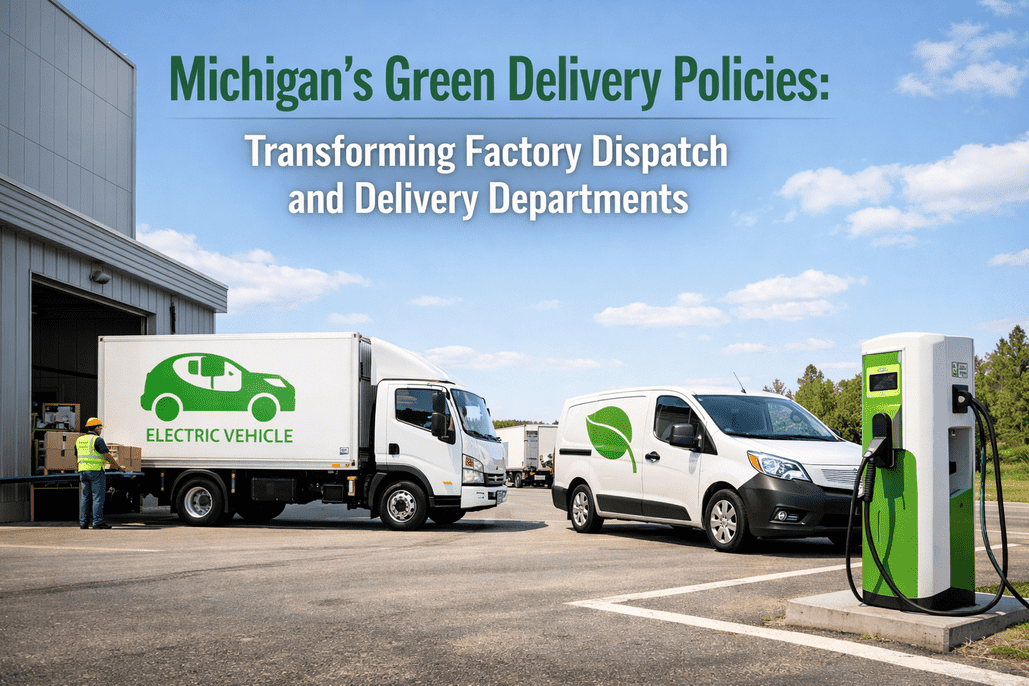
Michigan’s Green Delivery Policies: Transforming Factory Dispatch and Delivery Departments

By Varyn Blue on March 6, 2026

michigan-green-deliveries-policies-logistics

A Detroit-based regional distributor running 28 diesel vehicles across southeastern Michigan received a letter in January 2025 that changed their operational roadmap overnight. Three of their largest commercial customers — all automotive tier-1 suppliers — required documented proof of green logistics compliance within 90 days or face contract review. The distributor had no digital gate pass records, no dispatch fuel data, no vehicle inspection logs. They had paper binders and a spreadsheet. Michigan's green delivery policies are no longer abstract sustainability targets — they are showing up as contractual obligations, regulatory mandates, and operational pressure points directly inside the factory dispatch department. This guide covers what Michigan's green policies actually require from factory delivery operations, where the data gap is, and how iFactory's digital platform closes it. For questions, talk to our support team.

Michigan · Green Logistics · 2026

Michigan's Green Delivery Policies: Transforming Factory Dispatch and Delivery Departments

Michigan's MI Healthy Climate Plan, Executive Directive 2023-5, EGLE emissions standards, and commercial customer ESG requirements are converging on factory delivery departments with real enforcement timelines. The plants that digitize gate pass management, dispatch sequencing, and vehicle inspection records first will have the compliance documentation competitors cannot produce on demand.

Book A Demo
85,000+
EVs registered in Michigan by mid-2025 — up from 20,000 in 2022, creating fleet transition pressure for delivery departments
2033
Michigan state light-duty fleet zero-emission deadline under Executive Directive 2023-5 — cascading into commercial supplier contracts
$26B+
IRA investments in Michigan clean energy projects — funding the EV and green logistics infrastructure factories must now document compliance with
14 days
iFactory go-live timeline from decision to fully operational digital delivery department — before your next compliance deadline
Policy Landscape

Michigan's Green Delivery Mandates: What Factory Delivery Departments Are Actually Facing

Michigan's regulatory and commercial framework for green logistics reaches directly into the factory delivery department — not just the highway fleet. These are the five policy drivers creating the most significant operational changes for plant managers and dispatch supervisors in 2026.

MI Healthy Climate Plan
Statewide Emission Reduction Targets — Commercial Vehicle Reporting
Michigan's Healthy Climate Plan targets a 52% GHG reduction by 2030 and carbon neutrality by 2050. Commercial facilities — including factories — operating diesel yard vehicles and inbound delivery fleets face increasing EGLE scrutiny on facility-level emissions. Plants without digital dispatch and gate records cannot quantify their vehicle-related emission contribution when challenged.
Impact: Factory dispatch departments need digital vehicle and fuel records to respond to EGLE facility emission inquiries.
Executive Directive 2023-5
State Fleet Electrification — Commercial Supplier Cascade
Governor Whitmer's Executive Directive requires Michigan state government vehicles to transition to zero-emission by 2033 (light-duty) and 2040 (heavy-duty). This is cascading into supplier contracts — state agencies and their tier-1 suppliers are requiring vendors to document delivery fleet electrification progress and provide digital records of vehicle compliance status on delivery.
Impact: Every inbound delivery vehicle needs a digital entry record linking vehicle type and compliance status to arrival timestamp.
EGLE Clean Heavy Duty
EPA-Funded EV Truck Replacement — Yard Equipment Compliance
Michigan's EGLE-administered EPA Clean Heavy Duty Vehicles Program (running through December 2026) funds diesel-to-EV truck replacements across southeastern Michigan. Factories receiving these funded replacements must maintain detailed usage, inspection, and fuel comparison records to comply with grant documentation requirements — records that paper logs cannot reliably generate.
Impact: Yard tractors and shunters on grant-funded replacement programs require digital inspection logs with timestamps and operator attribution.
NEVI Charging Network
EV Infrastructure Build-Out — Inbound Fleet Documentation
Michigan's $50M+ NEVI-funded DC fast charger deployment is accelerating inbound fleet electrification on major freight corridors. As delivery carriers transition to EVs on Michigan routes, factory gate pass systems need to capture vehicle type (EV/hybrid/diesel) at entry — both for internal sustainability reporting and to document supply chain decarbonization progress for customer ESG requirements.
Impact: Gate pass records must capture vehicle fuel type and charging status to support supplier sustainability documentation.
Commercial ESG Pressure
Automotive OEM Supplier Sustainability Requirements
Michigan's automotive OEM ecosystem — Ford, GM, Stellantis, and their tier-1 networks — has integrated supplier sustainability scorecards into procurement decisions. Delivery operations data (vehicle emissions, dispatch fuel consumption, idle time records) is increasingly required in annual supplier sustainability reports. Factories with paper-based delivery departments cannot produce this data at audit standard.
Impact: Dispatch fuel type, vehicle idle time, and inbound chain of custody records must be available for OEM sustainability audits.
MI Clean Cars 2030
Air Quality and Community Health Near Industrial Sites
With Detroit ranked #1 for most challenging city for asthma sufferers, Michigan's MI Clean Cars 2030 initiative drives heightened scrutiny of vehicle emissions near industrial facilities. Factory gate queue buildup — a direct result of slow manual gate processing — generates idle emissions that community health advocates and EGLE inspectors are increasingly quantifying against facility records.
Impact: Gate dwell time and queue length are measurable community health metrics — factories need digital records to demonstrate responsible gate management.
The Data Reality

What Michigan's Green Policies Require vs. What Your Delivery Department Can Actually Produce

Compliance Data You Likely Have
Production OEE tracked by 86% of manufacturers
Outbound shipment documentation and POD records
Energy consumption data for production floor equipment
Employee EHS training records and incident logs
ISO and IATF audit documentation for manufacturing
Supplier qualification and vendor qualification records
Compliance Data You Almost Certainly Lack
Per-vehicle gate dwell time — the idle emissions metric EGLE can quantify
Inbound vehicle fuel type at time of entry — needed for OEM sustainability audits
Digital chain of custody from supplier to production floor
Yard vehicle inspection logs with timestamps and operator ID
Dispatch fuel type and mileage per vehicle trip for ESG reporting
Gate queue length data — the community health documentation metric
Operational Impact

5 Ways Michigan's Green Policies Change Your Factory Delivery Department Operations

87%
Gate Processing Time Reduction
Digital pre-registration cuts gate processing from 15–20 min to under 2 min per vehicle — directly reducing idle emissions that Michigan's community health standards target near Detroit-area facilities.
100%
Audit Trail Coverage
Every gate entry, vehicle inspection, material transfer, and dispatch event is timestamped and person-attributed — generating EGLE, OEM ESG, and MI Healthy Climate documentation automatically.
78%
Faster Inbound Receiving
Mobile PO verification and photo POD cuts receiving from 45–60 min to under 10 min per shipment — while generating the supplier chain-of-custody records OEM customers require for sustainability audits.
90%
Dispatch Error Reduction
SLA-priority dispatch automation reduces errors from 2–3% to under 0.3% — capturing per-vehicle fuel type and mileage data required for ESG sustainability reporting on every dispatch event.
3–6 mo
Full Platform Payback
Recovered dock time, reduced compliance overhead, and avoided OEM contract penalties combine to deliver full payback within 3–6 months — with iFactory deploying in 7–14 days.
Before vs. After

Michigan Factory Delivery Department: Manual vs. Digital Platform

Department Function Manual Operations iFactory Digital Platform
Gate Pass Processing 15–20 min/vehicle — paper logs, phone verification, idle queue buildup, zero dwell time data for EGLE reporting Under 2 min — digital pre-registration, mobile verification, automatic dwell time and vehicle fuel type captured
Inbound Receiving 45–60 min/shipment — paper POD, manual PO matching, no chain of custody record for OEM ESG audits Under 10 min — mobile scanning, photo POD, auto-generated supplier traceability record for OEM sustainability audits
Vehicle Inspection Paper checklists — incomplete, no operator attribution, grant-funded EV replacement program records unverifiable Digital checklists — timestamped, person-attributed, failed vehicles auto-blocked, EGLE grant compliance record generated
Dispatch Sequencing Manual sequencing — no fuel type capture, ESG reporting data unavailable, 2–3% error rate undetected until customer complaint SLA-priority automation — fuel type and mileage captured per trip, under 0.3% errors, ESG data generated automatically
Internal Material Tracking No location record after dock entry — production stoppages from material search, not stock-outs, unnecessary yard movements Real-time location at every transfer — 30–40% search time eliminated, unnecessary yard vehicle movements reduced
Compliance Documentation Hours of manual assembly per audit — fragmented across binders, cannot produce OEM ESG or EGLE records on demand Retrievable in under 60 seconds — EGLE, OEM ESG, MI Healthy Climate records auto-generated from daily operations
How It Works

5 Daily Workflows That Generate Michigan Green Compliance Documentation Automatically

Michigan's green delivery requirements do not require a separate compliance program. They require the operational data your factory delivery department should already be capturing digitally. iFactory captures this as a byproduct of 5 core workflows running every day.

01
Digital Gate Pass — Pre-Arrival to Exit with Vehicle Compliance Capture
Drivers pre-register via mobile before arrival. Security verifies vehicle compliance status, driver credentials, and cargo manifest at the gate using a mobile checklist. Gate processing completes in under 2 minutes. The system records vehicle fuel type (EV/hybrid/diesel), exact arrival and exit timestamps, and dwell time per vehicle — generating the idle emissions documentation and inbound fleet electrification records Michigan's OEM sustainability audits require.
EGLE idle emissions record OEM ESG vehicle data Community health queue data
02
Mobile Inbound Receiving — PO Verification and Supplier Chain of Custody
Receiving staff verify inbound materials against purchase orders on mobile — scanning barcodes, capturing discrepancy photos, and logging receiving exceptions in real time. Every inbound shipment generates a digital record linking supplier, carrier, material description, quantity received vs. ordered, and timestamp — creating the supply chain traceability record from supplier to factory floor that Michigan's automotive OEM customers require in sustainability audits without any additional documentation step.
OEM supplier traceability Discrepancy documentation Photo POD record
03
Yard Vehicle Inspection — Digital Checklists for EV and Diesel Fleet
Yard tractors, forklifts, and shunters — including grant-funded EV replacements under Michigan's EGLE Clean Heavy Duty program — complete digital pre-use inspection checklists on mobile. Failed inspection items are logged with timestamp, operator ID, and photo evidence. Vehicles with failed inspections are automatically blocked from dispatch until a verified repair work order is completed. This generates the continuous, timestamped inspection log that EGLE grant compliance and IATF supplier audits require for yard equipment verification.
EGLE grant compliance log Inspection audit trail Failed vehicle auto-block
04
SLA-Priority Dispatch — Fuel Type and Mileage Capture for ESG Reporting
Dispatch orders are sequenced automatically by SLA priority tier, vehicle type, load capacity, and compliance status. Each dispatch event records vehicle ID, fuel type (EV/alternative/diesel), assigned route, departure timestamp, and return mileage. This data set directly supports Michigan OEM sustainability scorecard requirements and Scope 3 emissions reporting — providing the per-vehicle, per-trip fuel consumption record that ESG documentation requires without any separate reporting workflow.
OEM ESG Scope 3 data SLA compliance record Per-vehicle fuel capture
05
Internal Material Tracking — Location at Every Transfer Point
Materials are logged at every internal transfer — dock to stores, stores to production, production to quality, quality to dispatch. Each transfer generates a timestamped, person-attributed record that extends the traceability chain from the factory gate all the way to production floor usage. This eliminates the material location failures that generate unnecessary yard vehicle movements — reducing internal transport emissions that increasingly appear in Michigan facility emission assessments and supplier sustainability reviews.
Full internal chain of custody Reduced yard movements Production stoppage prevention
Michigan's Green Delivery Policies Require Digital Factory Delivery Records. iFactory Generates Them Automatically.
Gate dwell time, inbound vehicle fuel type, supplier chain of custody, yard vehicle inspection logs, dispatch ESG data — all captured as a byproduct of daily operations. Audit-ready on demand. Live in 14 days. Talk to our support team for a compliance gap assessment specific to your Michigan facility.
Measurable Results

What Michigan Factory Delivery Departments Measure Within 90 Days of iFactory Go-Live

87%
Gate Pass Time Reduction
From 15–20 minutes manual processing to under 2 minutes digital — across every inbound vehicle, every day. A 20-vehicle/day factory recovers 280+ minutes of dock time daily that previously disappeared into idle queues generating the emissions Michigan's community health standards scrutinize.
78%
Faster Receiving Completion
Inbound receiving drops from 45–60 minutes to under 10 minutes per shipment with mobile PO verification and photo POD. The same workflow generates the supplier traceability record Michigan's OEM customers require in sustainability audits — at zero additional operational cost.
90%
Fewer Dispatch Errors
Manual dispatch error rates of 2–3% drop to under 0.3% with SLA-priority automated sequencing. Each dispatch event simultaneously generates fuel type and mileage data required for Michigan OEM ESG reporting — without any separate documentation step.
100%
Audit Coverage
Every gate event, receiving transaction, inspection result, material transfer, and dispatch decision is timestamped and person-attributed. EGLE, OEM sustainability, and MI Healthy Climate documentation is retrievable in under 60 seconds — not hours of manual assembly across paper binders.
3–6 mo
Full Platform Payback
Recovered dock time, eliminated dispatch errors, reduced compliance overhead, and avoided OEM contract penalties combine to deliver full platform payback within 3–6 months. iFactory deploys in 7–14 days — no heavy implementation fees, no IT infrastructure project.
14 days
Go-Live Timeline
From decision to fully operational digital delivery department in 7–14 days. Cloud-based deployment with mobile apps for drivers, security staff, and receiving teams. No hardware procurement, no server installation, no IT department involvement required for initial deployment.
Frequently Asked Questions

Michigan Green Delivery Policies and Factory Delivery Departments — What Operations Leaders Ask First

How do Michigan's green delivery policies specifically affect a factory's internal delivery department — not just the highway fleet?
Michigan's green logistics framework reaches factory delivery operations through four distinct pathways. First, the MI Healthy Climate Plan creates EGLE scrutiny on facility-level vehicle emissions — including yard tractors, shunters, and inbound delivery vehicles queuing at your gate. Second, EGLE's EPA-funded Clean Heavy Duty Vehicles Program (active through December 2026) requires factories receiving grant-funded EV replacements to maintain detailed usage and inspection records that paper logs cannot produce at audit standard. Third, Michigan's automotive OEM ecosystem has integrated supplier sustainability scorecards into procurement decisions — your dispatch fuel consumption and inbound vehicle fuel type data appear in annual supplier reviews. Fourth, MI Clean Cars 2030's air quality focus creates scrutiny for factories near residential communities, where gate queue buildup from slow manual processing generates documentable idle emissions. The factories most exposed are those processing gate passes on paper — they have no dwell time data to defend against enforcement actions or satisfy OEM audit requests. Talk to our support team for a facility-specific compliance gap review.
What green compliance documentation does iFactory automatically generate from daily factory delivery operations in Michigan?
iFactory generates five categories of compliance-relevant documentation automatically from daily delivery department workflows — without any separate reporting step. Gate pass records capture vehicle fuel type (EV/hybrid/diesel), exact arrival and exit timestamps, and dwell time per vehicle — satisfying EGLE idle emissions documentation and OEM inbound fleet electrification audit requirements. Inbound receiving records capture supplier, carrier, material, quantity, and timestamp for every shipment — satisfying OEM supply chain traceability and sustainability scorecard requirements. Vehicle inspection logs capture timestamped, person-attributed inspection results with failed item documentation and repair verification — satisfying EGLE grant compliance records for funded EV replacements. Dispatch records capture vehicle ID, fuel type, route, and mileage per trip — supporting Scope 3 emissions calculations for OEM sustainability reporting. Incident records capture event timestamp, vehicle, operator, and resolution timeline — satisfying EGLE and OSHA incident documentation requirements. All five categories are retrievable in under 60 seconds through iFactory's audit dashboard. Book a demo to see the audit documentation interface live.
How do Michigan's automotive OEM sustainability requirements translate into factory delivery department data obligations?
Michigan's Ford, GM, and Stellantis OEM networks — and their tier-1 supplier base — have been integrating Scope 3 supply chain emissions into annual supplier sustainability evaluations since 2022. This means your factory delivery department's data is now part of your customer's carbon accounting. Specifically, OEM sustainability audits now request inbound delivery fleet composition (percentage EV/hybrid/diesel) to document Scope 3 supplier logistics emissions, dispatch fuel consumption data to calculate per-unit delivery carbon intensity, supplier chain of custody records to trace material origin and transport method, and yard vehicle inspection records as evidence of responsible equipment fleet management. A factory delivery department still running on paper gate passes and manual dispatch logs cannot produce any of these records in audit-ready format — and increasingly, this failure appears in supplier sustainability scorecards that directly influence contract renewal decisions. iFactory's digital platform captures all of this data as a byproduct of daily operations with zero additional reporting workload.
How quickly does iFactory deploy and what does implementation look like for a Michigan factory delivery department?
iFactory goes live in 7–14 days for a standard factory delivery department deployment covering gate pass management, inbound receiving, vehicle inspection, dispatch sequencing, and internal material tracking simultaneously. The deployment process has three phases. Days 1–3: data onboarding — uploading vehicle registry, driver roster, supplier list, and PO templates. iFactory's onboarding team handles this with your operations team directly. Days 4–7: configuration and training — setting up inspection checklists, dispatch SLA rules, gate pre-registration workflows, and user access permissions. Training for security staff, receiving teams, and drivers takes 2–4 hours via the mobile app. Days 8–14: go-live and verification — live operations with iFactory support monitoring data quality. Because iFactory is cloud-based and mobile-first, there is no server infrastructure to install, no IT department project, and no hardware procurement required. For Michigan regulatory documentation requirements specifically, iFactory configures compliance record templates during setup to ensure every relevant data field — including vehicle fuel type for OEM ESG reporting — is captured from day one. Talk to our support team about your specific deployment timeline.
What is the measurable ROI of digitizing a factory delivery department under Michigan's green delivery requirements?
The ROI calculation for Michigan factory delivery department digitization has five independent components. Recovered dock time: a factory processing 20 vehicles/day at 15–20 minutes manual gate time recovers 280+ minutes of dock time daily by moving to under 2-minute digital processing — equivalent to 1.5–2 full-time equivalent labor hours per day. OEM contract protection: with Michigan automotive OEM customers increasingly requiring sustainability documentation from suppliers, a single avoided contract downgrade or non-renewal can represent $500,000 to $2M+ in revenue protection for a mid-size Michigan supplier. EGLE grant compliance: factories operating EGLE-funded EV replacements that fail to maintain required inspection and usage records risk grant clawback provisions — iFactory's inspection module generates all required records automatically. Dispatch error elimination: reducing dispatch errors from 2–3% to under 0.3% eliminates re-dispatch costs and SLA penalty exposure — typically $50,000–$200,000 annually for a mid-size factory. Compliance overhead reduction: manual documentation assembly for EGLE and OEM audits typically requires 4–8 hours per audit event; iFactory reduces this to under 30 minutes. Full platform payback is typically achieved within 3–6 months of go-live when all components are included. Talk to our support team for an ROI calculation specific to your facility.
Does iFactory support factory delivery departments outside Michigan facing similar green logistics requirements?
iFactory is built as a multi-depot, multi-site platform — a single deployment covers all facilities under one dashboard with site-specific configuration. Michigan's green delivery policy framework is part of a broader national and international pattern: California's CARB mandates, Ohio's EPA requirements, Illinois IEPA standards, and international frameworks in the EU, UK, and India are all converging on the same operational data needs — digital gate records, vehicle fuel type capture, dispatch emissions data, and supplier chain of custody documentation. The underlying iFactory data model — timestamped, person-attributed records for every gate, receiving, inspection, dispatch, and transfer event — satisfies all of these frameworks from the same operational dataset. For Michigan specifically, iFactory is configured for EGLE grant documentation, OEM sustainability scorecard requirements, and MI Healthy Climate Plan facility reporting. For multi-state or global operations, iFactory supports CARB, FMCSA, EPA, OSHA, Schedule M GMP, and LkSG supply chain traceability requirements from the same platform. Book a demo to see multi-site configuration live.

Michigan's Green Delivery Deadlines Are Arriving. Your Factory Delivery Department Needs Digital Records Now.

iFactory digitalizes every function of your factory delivery department — gate pass management, inbound receiving, vehicle inspection, dispatch sequencing, and internal material tracking — and generates the EGLE, OEM ESG, and MI Healthy Climate documentation your auditors require as a byproduct of daily operations. Live in 14 days. No heavy implementation fees. Book a demo to see iFactory running in a live factory delivery environment.

Book A Demo
Share This Story, Choose Your Platform!