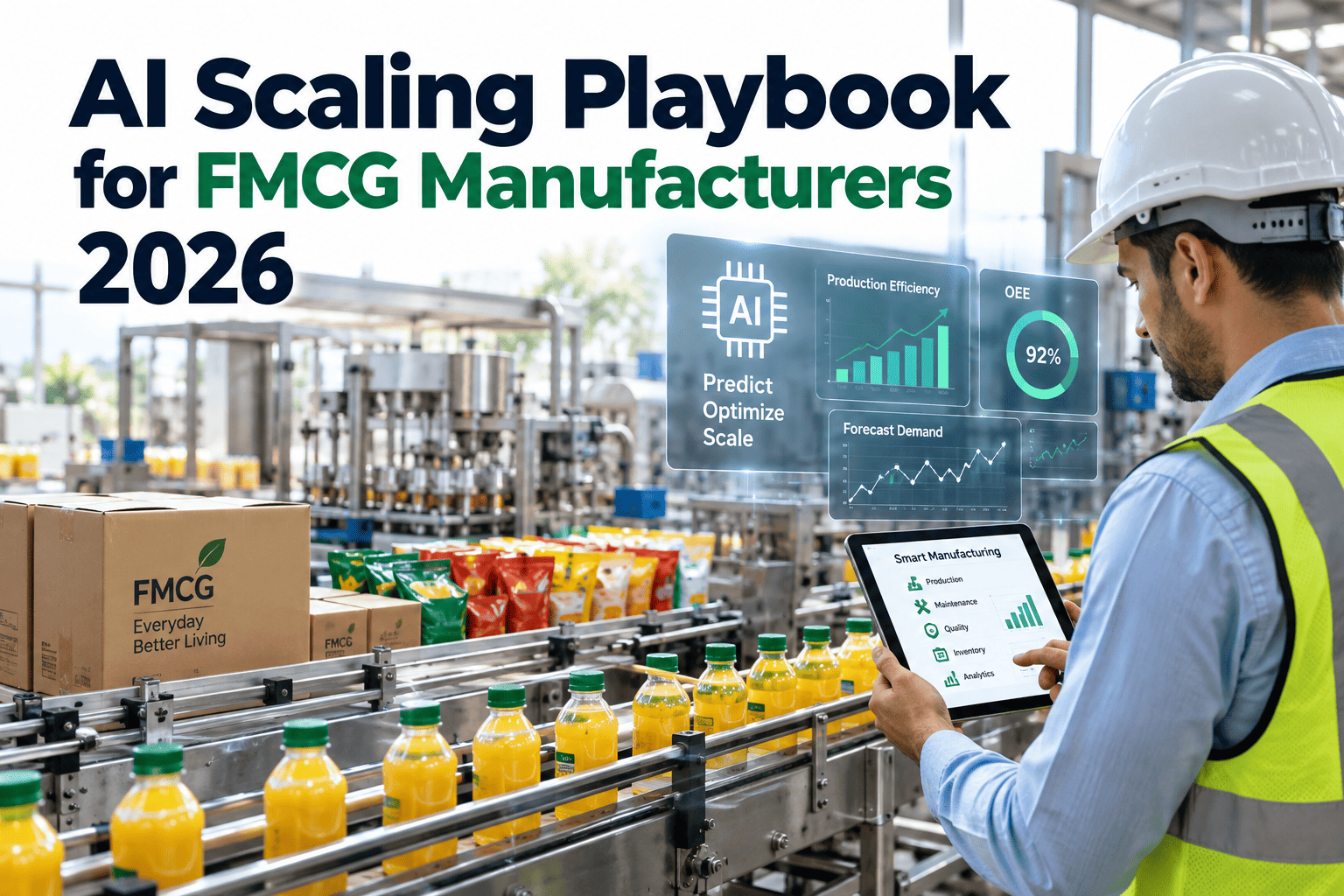
Most FMCG manufacturers do not fail at AI because the algorithms do not work — they fail because the algorithm was deployed on top of a data foundation, an IT/OT architecture, and a KPI framework that were never built to support it, so a promising pilot delivers a great demo and then stalls the moment someone tries to scale it past the one line it was built on. Scaling AI across a manufacturing enterprise is fundamentally a sequencing problem: data foundation work has to happen before model deployment, IT/OT convergence has to happen before enterprise-wide rollout, and KPI alignment has to happen before anyone can agree the AI initiative actually worked. Manufacturers building this sequence deliberately rather than backing into it can start with a conversation with iFactory's support team about what a realistic scaling roadmap looks like for their specific plant landscape.
Every Stalled AI Pilot Skipped a Rung on the Same Ladder
Data foundation, IT/OT convergence, and KPI alignment are not optional steps before scaling AI — they are the ladder, and skipping a rung is why most pilots never make it past one plant.
Why Pilots Work and Enterprise Rollouts Stall
A pilot succeeds on one line because a small, dedicated team can work around data gaps manually, patch together a one-off integration, and define success criteria informally as they go. None of those workarounds scale, and the same shortcuts that got a pilot across the finish line become the exact obstacles that stop a broader rollout, since a hundred lines cannot each have a dedicated team manually cleaning data and improvising an integration.
The Four Rungs of the Scaling Ladder
Each rung depends on the one below it, and organizations that try to build a rung out of order typically end up rebuilding it later once the gap becomes unavoidable.
Data Foundation
Consistent, accessible, quality-checked data across plants is the prerequisite every later stage depends on, since a model trained or deployed against inconsistent data will not generalize across sites.
IT/OT Convergence
A structured, secure architecture connecting plant floor systems to enterprise IT replaces the one-off integrations a pilot relied on, giving a scalable path for any future AI application to plug into.
KPI Alignment
Agreed, standardized success metrics defined before rollout begins are what let an organization actually determine whether scaling delivered value, rather than debating it after the fact.
Enterprise Scale
Only once the first three rungs are in place does a rollout across dozens or hundreds of lines become operationally realistic rather than a repeated series of custom pilot projects.
Build the Sequence, Not Just Another Pilot
Book a 30-minute walkthrough of how iFactory sequences data foundation, IT/OT convergence, and KPI alignment for enterprise-wide AI scaling.
Integration Patterns Compared
How a plant connects its floor-level systems into the broader AI initiative determines whether the integration work done for one pilot can be reused for the next one.
| Pattern | Reusability Across Plants | Typical Use Case |
|---|---|---|
| One-Off Point Integration | Low, custom-built per pilot | A single proof-of-concept project |
| Standardized Connector Library | Moderate, reusable across similar equipment | Rollout across plants with similar equipment mix |
| Unified Data Platform | High, consistent across the enterprise | Enterprise-wide AI scaling across diverse plants |
What Changes at Each Stage of the Rollout
As an AI initiative moves from a single pilot toward enterprise scale, the nature of the work changes substantially, and organizations that expect the later stages to feel like the first one are usually the ones caught off guard by the effort required.
A Composite Scenario: The Predictive Maintenance Pilot That Never Left One Line
An FMCG manufacturer ran a successful predictive maintenance pilot on a single packaging line, correctly identifying an impending bearing failure weeks before it would have caused unplanned downtime. Leadership approved funding to expand the approach across the plant's other lines, expecting a straightforward replication of the pilot's success.
The expansion stalled almost immediately: the pilot line had unusually clean sensor data because of a recent equipment upgrade, while most other lines ran older equipment with inconsistent data quality and no standardized connector to pull sensor data into the AI platform at all. Rather than replicating a model, the team ended up having to build a data foundation and connector library retroactively, work that should have happened before the pilot rather than after leadership had already been promised a quick expansion. The eventual rollout succeeded, but on a timeline more than triple what was originally communicated.
Mistakes That Stall AI Scaling Efforts
Piloting on the Cleanest Available Data
A pilot run on the best-case equipment and data, as in the scenario above, produces a misleadingly optimistic scaling timeline that ignores the data foundation gap waiting at every other plant.
Treating Integration as a One-Time Pilot Cost
A custom integration built for a single pilot rarely transfers to the next plant without significant rework, and budgeting for scaling should assume this rework rather than a simple copy-paste deployment.
Committing to a Rollout Timeline Before Assessing Data Readiness
Promising a specific expansion timeline before understanding the data and integration gap at other sites is exactly what produced the threefold timeline overrun in the scenario above.
Defining Success Metrics After the Rollout Instead of Before
Without KPIs agreed in advance, an organization ends up debating whether a rollout succeeded rather than measuring it against a standard set before the work began.
Is Your Organization Ready to Scale Past the Pilot Stage
Data quality has been assessed across all target plants, not just the pilot site
The gap between pilot-site data quality and the rest of the plant landscape is exactly what derailed the timeline in the scenario above, and it needs to be understood before committing to a schedule.
A reusable connector or integration pattern exists, not a one-off build
Integration work built to be reused across similar equipment saves the rework that a custom, pilot-specific integration would otherwise require at every new site.
Success KPIs are defined and agreed before rollout begins
Metrics agreed in advance remove the ambiguity that would otherwise surface only after the rollout is complete and results are already being questioned.
Frequently Asked Questions
Why does a successful AI pilot so often fail to scale across an enterprise?
A pilot typically succeeds because a dedicated team manually works around data and integration gaps that do not scale to dozens or hundreds of lines, and the pilot's success metrics are rarely re-examined against the very different data quality and equipment landscape found elsewhere in the organization, exactly the gap that stalled the expansion in the scenario above. Recognizing that a pilot proves the concept but not the scaling path is the first step toward avoiding this trap.
Should data foundation work happen before or after the first AI pilot?
A minimal data foundation is usually necessary even for a single pilot to produce a meaningful result, but the deeper, enterprise-wide data foundation work is best sequenced immediately after a successful pilot and before committing to a full rollout timeline, since assessing data readiness across all target plants at that point avoids the kind of retroactive scramble seen in the scenario above.
What does IT/OT convergence actually mean in the context of AI scaling?
IT/OT convergence refers to building a structured, secure architecture that connects plant floor operational technology systems to enterprise IT systems, replacing the ad hoc, one-off integrations that a pilot typically relies on with a reusable pattern that any future AI application can plug into without custom engineering work for every new site.
How should an organization set a realistic timeline for AI scaling across multiple plants?
A realistic timeline accounts for data foundation and integration work at each target site individually, rather than assuming the pilot site's timeline applies uniformly, since the threefold overrun in the scenario above happened specifically because that assumption was made without first assessing the other sites. Building in a data and integration readiness assessment for each site before committing to a schedule is what keeps the eventual timeline credible. Book a demo to see how iFactory assesses scaling readiness across a plant landscape.
What KPIs should be agreed before an AI rollout begins?
KPIs should be tied directly to the business outcome the AI initiative is meant to deliver, whether that is reduced unplanned downtime, improved forecast accuracy, or lower cost-to-serve, and they need to be defined consistently across every site included in the rollout so results can be compared fairly. Defining these metrics after the rollout, rather than before, is what leaves an organization debating success rather than measuring it. Organizations working through this KPI definition process can reach iFactory support for guidance.
Build the Foundation That Lets AI Actually Scale
iFactory sequences data foundation, IT/OT convergence, and KPI alignment so an AI rollout across dozens of plants does not repeat the pilot's manual workarounds. Book a walkthrough to see it running on a real plant landscape.