A pilot running cleanly on one line, in one plant, with a data science team watching it closely is a completely different engineering problem than the same model running unattended across twelve plants with no one dedicated to monitoring it. That jump — from pilot to production — is where the majority of AI initiatives that survive their first phase still quietly stall, not because the model stopped working but because nobody built the operational scaffolding to run it without a data scientist standing by. The iFactory team treats scale-up as its own distinct project phase, with its own checklist, rather than an assumed continuation of the pilot.
SCALE-UP PLAYBOOK
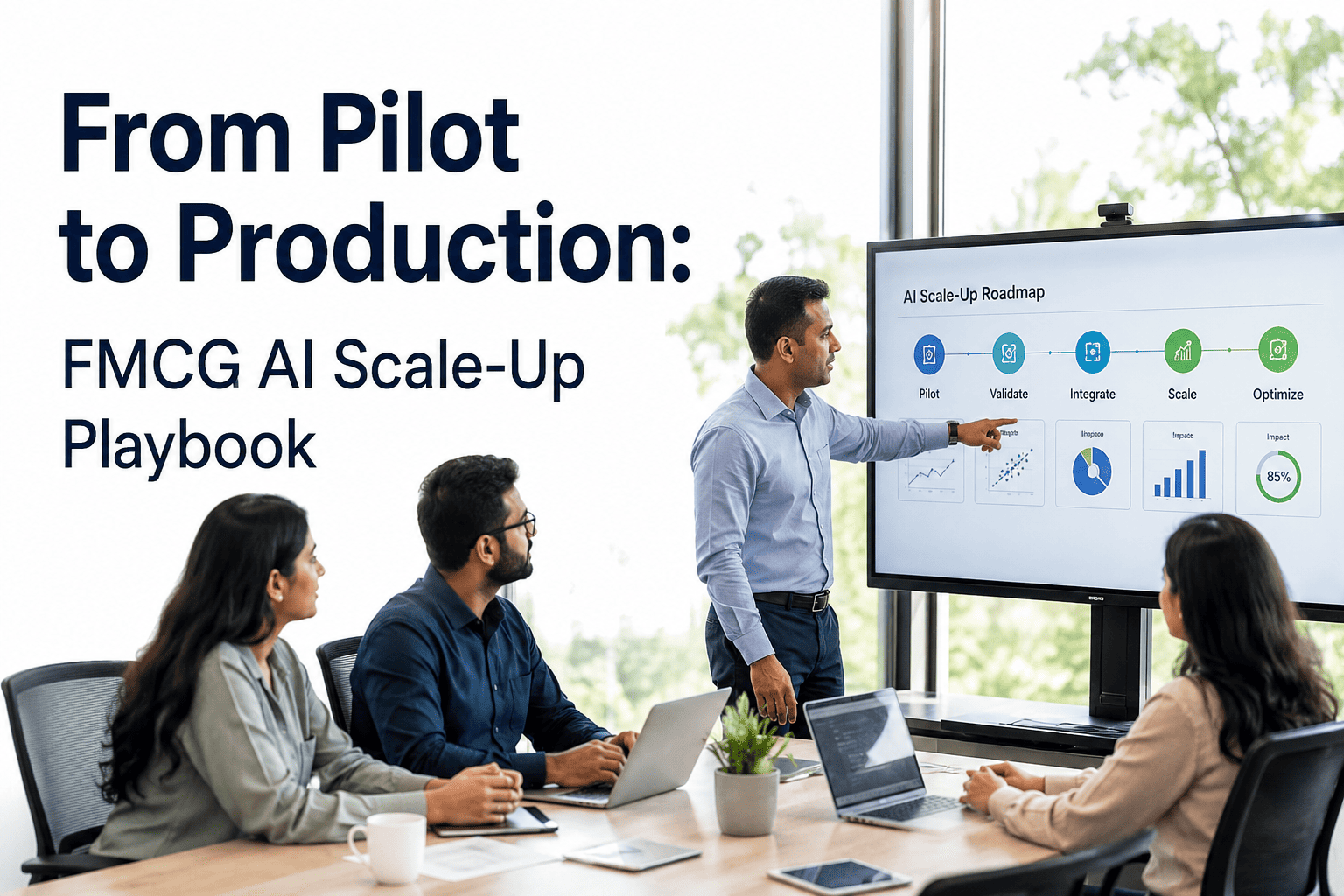
From Pilot to Production: FMCG AI Scale-Up Playbook
Architecture hardening, MLOps, model monitoring, and ownership handoff — the four workstreams that move an AI system off the data science team's laptop and onto the plant floor for good.
Why "It Worked in the Pilot" Is Not the Same as "It's Ready to Scale"
A pilot is, by design, a controlled environment: a small number of lines, close data science attention, and a team of early adopters who will forgive rough edges because they helped build the thing. Production is the opposite — dozens of lines with no one watching the model day to day, operators who never met the data science team, and zero tolerance for a system that behaves unpredictably during a shift. Treating scale-up as "more of the same, just bigger" is the single most common reason a pilot that worked beautifully for three months collapses within weeks of a full rollout.
The Four Scale-Up Workstreams
A
Architecture Hardening
Rebuilding the pilot's infrastructure to handle production load, multiple sites, and failure scenarios that a single-line pilot never had to face.
B
MLOps & Deployment Pipeline
Automating model versioning, retraining, and rollout so updates do not require a data scientist to manually push changes to every site.
C
Model Monitoring
Continuous tracking of prediction drift, data quality, and system health so degradation is caught automatically instead of by a customer complaint.
D
Ownership Handoff
Transferring day-to-day responsibility from the data science pilot team to a defined operations or IT owner with a clear support model.
Pilot Architecture vs Production Architecture
The technical decisions that were perfectly reasonable for a single-line pilot often become liabilities at scale. The comparison below highlights where architecture typically needs to change as a system moves from proof of concept to a network-wide deployment.
| Architecture Element | Typical Pilot Setup | Production Requirement |
|---|
| Model hosting | Single server, manually managed | Redundant, auto-scaling infrastructure across sites |
| Data pipeline | Manually triggered or scheduled batch jobs | Automated, monitored pipelines with failure alerts |
| Model updates | Manually retrained and deployed by a data scientist | Versioned, automated retraining and rollout pipeline |
| Error handling | Data scientist investigates issues as they arise | Automated fallback behavior and defined escalation path |
| Integration scope | Connected to one line's local systems | Standardized integration pattern replicable across sites |
Get a Scale-Up Readiness Assessment for Your Pilot
iFactory reviews your current pilot architecture against production requirements before rollout begins, so the gaps get addressed in weeks rather than discovered mid-deployment across a dozen plants.
The MLOps Foundation Most Pilots Skip
MLOps — the operational discipline of deploying, monitoring, and retraining models reliably — is rarely built during a pilot, because a small team watching one model closely does not need the automation yet. At scale, that manual attention becomes impossible to sustain, and without an MLOps foundation, every model update becomes a risky, manual event across every site running the system.
Version Control for Models
Every model version is tracked, so a problematic update can be rolled back instantly across all sites without manual intervention at each location.
Automated Retraining Triggers
Models retrain automatically on a schedule or when performance drift is detected, rather than waiting for a data scientist to notice degradation.
Staged Rollout Process
New model versions deploy to a small subset of sites first, with performance validated before wider rollout, limiting the blast radius of any issue.
Standardized Integration Templates
A repeatable connection pattern to common plant systems means each new site deployment takes days, not the weeks a custom pilot integration required.
The Monitoring Signals That Catch Problems Before Operators Do
The most dangerous production failure mode for an AI system is not a crash — it is silent degradation, where predictions slowly become less accurate without anyone noticing until the business impact is already significant. Production-grade monitoring watches for the specific signals below, continuously, across every deployed site.
01
Prediction Drift
Gradual change in the distribution of model outputs over time, often the earliest sign a model is no longer well-matched to current plant conditions.
02
Input Data Quality
Missing sensor readings, camera feed interruptions, or schema changes upstream that silently degrade the data a model depends on.
03
Alert Response Time
How long it takes a floor team to acknowledge and act on a model-generated alert, a direct proxy for whether the system is actually being used.
04
System Uptime and Latency
Basic infrastructure health that, at production scale, needs its own automated alerting rather than manual checking by whoever remembers to look.
An IT Director on Handing Off a Pilot Successfully
"
Our predictive maintenance pilot ran beautifully for four months on two lines in our largest plant, and the data science team that built it knew every quirk of the system by heart. The mistake we almost made was assuming that same team could just keep supporting it informally as we rolled it out to eleven more plants. It became clear within the first two site rollouts that this was not sustainable — every new site needed hand-holding, every model update was a manual, nerve-wracking event, and the data science team was spending more time on operational support than on the next project they were supposed to be working on. We stopped the rollout for six weeks specifically to build the monitoring and deployment automation that should have been part of the pilot from the start, and to formally hand ownership to our operations technology team with a real support model behind it. Those six weeks felt expensive at the time. They were nothing compared to what it would have cost us to keep scaling without that foundation.
— IT Director, Multi-Plant FMCG Manufacturer · Managed Scale-Up Across 13 Facilities
The Ownership Handoff Checklist
A pilot that never formally transfers ownership from the data science team to an operations or IT owner tends to stay fragile indefinitely, dependent on the specific individuals who built it. The checklist below is what a clean handoff looks like in practice.
✓
A named operations or IT owner is assigned responsibility for day-to-day system health, separate from the original pilot data science team.
✓
Runbooks exist documenting common issues, escalation paths, and who to contact for each category of problem.
✓
Monitoring dashboards are accessible to the new owning team, not locked inside the original pilot team's personal tooling.
✓
A defined support tier structure exists for issues that exceed what the operations team can resolve on its own.
✓
The original data science team's ongoing role, if any, is explicitly scoped rather than left as an open-ended informal support arrangement.
Frequently Asked Questions
How long does the pilot-to-production transition typically take?
For a well-scoped pilot with reasonably clean data foundations, the architecture hardening and MLOps buildout typically takes four to eight weeks before the first additional site goes live, followed by a rolling deployment schedule across remaining sites. Pilots with more complex integration requirements or less mature data infrastructure can take longer for this initial hardening phase, but the investment consistently pays off in a faster, more predictable rollout to subsequent sites once the foundation is in place.
Do we need a dedicated MLOps engineer, or can existing IT staff manage this?
This depends heavily on the scale of the deployment and existing team skill sets. Smaller deployments across a handful of sites can often be managed by existing IT or data engineering staff with some additional training, particularly when the deployment partner provides standardized tooling and templates. Larger, network-wide rollouts across dozens of plants generally benefit from at least one dedicated MLOps-focused role, since the operational overhead of managing model versioning, monitoring, and retraining at that scale becomes a full-time responsibility on its own.
What happens if a model's performance degrades after scale-up?
This is precisely what production monitoring is designed to catch early, through prediction drift tracking and data quality checks that flag degradation before it becomes visible as a business problem. When degradation is detected, a properly built MLOps pipeline allows the team to roll back to a previous stable model version quickly while investigating the root cause, rather than needing to diagnose and fix the issue live in production under pressure. This is one of the clearest arguments for building the monitoring and versioning infrastructure before scale-up rather than after a problem has already occurred.
Should every new site get an identical deployment, or does each site need custom work?
The goal of a standardized integration template is to make each new site deployment as close to identical as possible, which is exactly what makes scale-up feasible and fast. In practice, most FMCG manufacturers still encounter some site-specific variation — different equipment vendors, plant layouts, or legacy systems — that requires modest customization. The key distinction from a pilot is that this customization should be a smaller, well-understood adjustment to a proven template, not a from-scratch rebuild of the entire integration each time.
How does iFactory support the transition from pilot to production specifically?
iFactory runs a structured scale-up readiness assessment against your existing pilot, covering architecture, MLOps maturity, monitoring coverage, and ownership clarity, then builds the specific gaps needed before a wider rollout begins. Our team works alongside your IT and operations staff during the handoff process so the system is genuinely owned internally rather than remaining dependent on an external team indefinitely. To discuss a scale-up assessment for your own pilot,
book a demo, or
contact our support team with specific questions.
Move Your AI Pilot to Production Without the Growing Pains
The gap between a pilot that works and a system that scales is architecture, automation, monitoring, and clear ownership. iFactory builds all four into your rollout plan before the first additional site goes live.