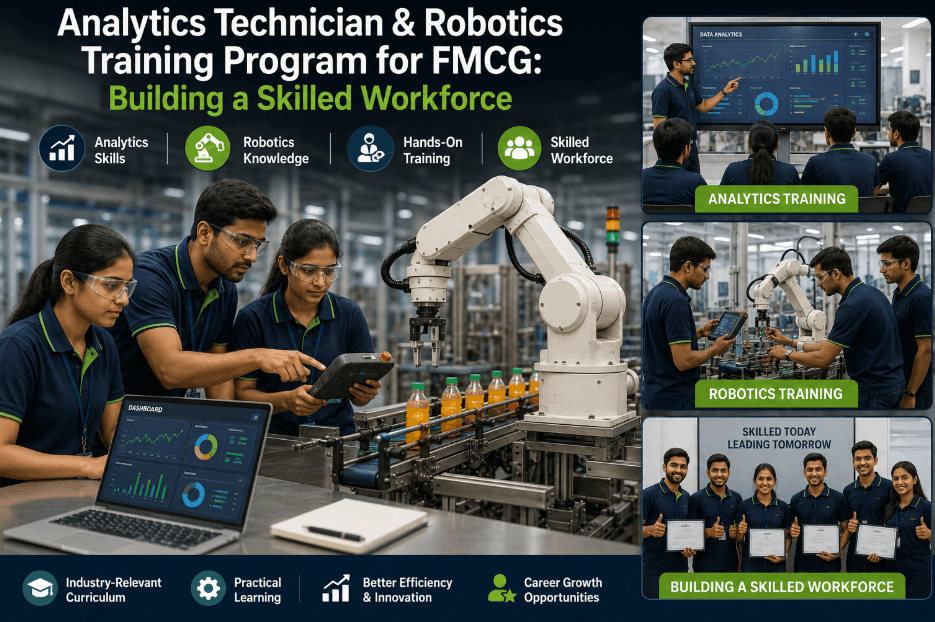
analytics Workforce Development for FMCG Training, Certification, and Retention
By Seren on June 18, 2026
Every FMCG maintenance manager knows the workforce paradox. The plant has invested in predictive maintenance sensors, AI-based analytics dashboards, and a CMMS that generates work orders with recommended actions but the technicians and engineers responsible for interpreting and acting on that data were hired and trained in a world of reactive maintenance, paper checklists, and calendar-based schedules. The analytics tools are installed. The data is flowing. The algorithms are generating insights. But the workforce cannot translate those insights into maintenance actions because they have never been trained to read vibration spectra, interpret oil analysis trend charts, or decide whether a 72-hour maintenance window extension based on a predictive model is safe or reckless. The consequence is a utilisation gap: plants that have deployed advanced analytics solutions capture only 30 to 45 percent of the expected value because the workforce lacks the analytics literacy, multi-skilling breadth, and certification structure needed to operate in a data-driven maintenance environment. iFactory AI's Team and Workforce Management module closes this gap by providing a structured analytics workforce development platform training curriculum management, certification tracking, skills matrix visualisation, multi-skilling progression pathways, and retention analytics so that every technician, engineer, and shift supervisor can operate the analytics tools the plant has already deployed. Book a Demo to see how iFactory AI's workforce development platform builds analytics capability across your FMCG maintenance organisation.
Analytics Workforce Development for FMCG
The Analytics Tools Are Installed. The Algorithms Are Running. But 55-70 Percent of FMCG Technicians Cannot Interpret the Predictive Alerts. Workforce Development Is the Missing Layer.
iFactory's Team and Workforce Management platform delivers structured analytics training, certification tracking, multi-skilling progression pathways, and retention analytics — turning your existing workforce into an analytics-capable maintenance organisation without replacing the people who know your equipment best.
The Three Workforce Gaps That Analytics Training Resolves
Every FMCG plant that has deployed predictive analytics or AI-based maintenance tools encounters the same three workforce gaps that limit the return on the technology investment. Structured workforce development programmes are designed to resolve each one without replacing the existing maintenance team.
01
Analytics Literacy Gap
The majority of FMCG maintenance technicians have been trained in mechanical and electrical trades — bearing replacement, motor rewinding, PLC troubleshooting, conveyor alignment. They have not been trained to interpret vibration severity charts, oil analysis wear particle trends, thermographic temperature differentials, or predictive model confidence scores. When the analytics platform flags a bearing with a 92 percent probability of failure within 14 days, the technician either ignores the alert (because it is not a red light or an alarm siren) or escalates it to the reliability engineer (who is already overloaded with 40 other alerts from the same system). The gap is not willingness — it is literacy. Technicians cannot act on what they cannot read. Analytics workforce development programmes that include structured vibration analysis, oil analysis, thermography, and model-interpretation training close this gap by teaching technicians to read analytics outputs the same way they read pressure gauges and temperature readouts.
Value impact: 55-70 percent of analytics alert value lost to technician literacy gap in typical FMCG plants
02
Multi-Skilling Depth Gap
FMCG production lines run 24 hours per day, 6 to 7 days per week, with shift teams of 3 to 5 technicians covering mechanical, electrical, instrumentation, and controls disciplines. When the specialist technician for a particular equipment class — aseptic filler, case packer, palletiser — is on leave or assigned to a breakdown on another line, the remaining technicians lack the cross-training depth to perform even routine analytics-guided tasks like adjusting a filler valve based on trend analysis or calibrating a thermographic inspection point. The result is deferred maintenance, extended breakdown durations, and unplanned overtime for the specialist who must cover multiple lines simultaneously. Multi-skilling pathways that structure cross-training into defined progression levels — from awareness to supervised operation to independent execution to trainer certification — build a workforce where every shift has at least two technicians capable of acting on analytics alerts for every critical equipment class.
Value impact: 30-50 percent of cross-shift maintenance delays eliminated with structured multi-skilling
03
Retention and Career Progression Gap
FMCG manufacturing competes for technical talent against industries that offer higher base pay, better shift schedules, and clearer career progression paths. The average FMCG maintenance technician tenure in high-turnover regions is 18 to 24 months, compared to 5 to 7 years for technicians who participate in structured certification and career progression programmes. The root cause of turnover in analytics-capable maintenance organisations is not base compensation — it is the absence of a visible career path that recognises and rewards analytics skill development. When a technician completes a vibration analysis certification or achieves multi-skilling Level 3 on a filler line, that achievement must translate into a title change, a pay progression, or a role expansion. Without that link, the technician takes the certification to a competing employer that offers the career structure the current plant does not. Retention analytics — tracking certification completion rates, skills matrix coverage, and progression velocity by technician — gives plant management the data to design career paths that retain the analytics talent they have invested in developing.
Value impact: Technician turnover reduced by 40-60 percent with structured certification and career progression pathways
How iFactory AI's Workforce Development Platform Builds Analytics Capability
The workforce development platform integrates training curriculum management, certification tracking, skills matrix visualisation, and progression pathway design into a single system that connects to the plant's existing CMMS, Shift Logbook, and analytics dashboards. The platform does not replace the plant's training provider or in-house subject matter experts — it structures and tracks the output of every training activity so that plant management knows, at any moment, precisely which technicians are certified for which analytics tasks and which skills gaps remain.
Layer
01
Curriculum
Training Curriculum Management and Assignment
The platform hosts the plant's analytics training curriculum — vibration analysis Level 1, oil analysis fundamentals, thermography for maintenance, predictive model interpretation, CMMS analytics navigation — as structured courses with defined modules, learning objectives, assessment criteria, and validity periods. Each course is assigned to technicians based on their role, equipment responsibility, and current skills matrix coverage. The platform tracks enrolment, completion status, assessment scores, and re-certification due dates. When a new analytics module is deployed on the plant floor — for example, a compressor predictive model — the platform automatically assigns the corresponding training course to every technician who works on compressors and notifies their supervisor of the training requirement and deadline.
Integration
iFactory Team Management. Existing LMS or training provider data feed.
Layer
02
Compliance
Certification Tracking and Compliance Verification
Every analytics capability a technician develops is tracked as a certification with a defined scope, validity period, and re-certification requirement. Certification types include manufacturer-specific certifications (filler OEM Level 1, compressor OEM Level 2), analytics tool certifications (vibration analyst ISO Category I, II, III), and internal capability certifications (multi-skilling Level 1-4, shift supervisor analytics competency). The platform displays each technician's active certifications, expired certifications, and certifications due for renewal on the Shift Logbook and the Team Management dashboard. When the maintenance planner assigns a work order that requires a specific certification — for example, performing a vibration analysis route on a high-speed filler — the platform validates that the assigned technician holds a current certification before the work order is released. Compliance verification prevents the common FMCG scenario where an uncertified technician performs a critical analytics task and the data quality or safety risk goes undetected until the next audit.
Integration
iFactory Work Order Management. Shift Logbook certification view.
Layer
03
Visualization
Skills Matrix and Coverage Analytics
The skills matrix displays every technician's capability profile across all analytics skills, equipment types, and certification categories in a single visual grid. Each cell in the matrix shows the technician's current proficiency level — Awareness (Level 1), Assisted (Level 2), Independent (Level 3), Trainer (Level 4) — colour-coded by certification status. The matrix is filterable by shift, department, equipment class, and skill category. The coverage analytics view aggregates the matrix into a plant-wide capability heat map that shows which skills have adequate coverage across all shifts and which skills have single-point-of-failure risk — a single technician holding the only certification for a critical equipment class. Coverage gaps trigger automated training assignment recommendations so the training manager knows precisely which courses to schedule for which technicians.
Integration
iFactory Analytics Reporting. Team Management skills view.
Layer
04
Retention
Retention Analytics and Career Pathway Design
The retention analytics module tracks certification completion velocity, multi-skilling progression rate, and training engagement score for each technician, aggregated by shift and department. The analytics identify high-retention-risk patterns — technicians who have completed certifications but received no role progression within 90 days, technicians whose skills matrix coverage has not expanded in 12 months, and technicians whose training enrolment rate is declining. The platform generates retention risk scores and recommends career pathway adjustments — title progression, pay band movement, role expansion, or trainer designation — to plant management before the technician begins an external job search. Career pathways are defined as structured progression sequences from entry-level technician to analytics specialist to shift supervisor to reliability engineer, with each progression level requiring specific certification completions and demonstrated competency assessments.
Integration
iFactory Shift Logbook. HR system or payroll data feed for role and pay progression tracking.
Every Dollar Spent on Analytics Software Requires a Dollar Spent on Workforce Capability. Plants That Match Analytics Investment with Workforce Development Capture 2.3 Times the ROI of Analytics-Only Deployments.
iFactory's workforce development platform connects training curriculum management, certification tracking, skills matrix visualisation, and retention analytics to your existing CMMS and Shift Logbook — giving FMCG maintenance managers the data they need to build an analytics-capable workforce without replacing the technicians who know the equipment.
The Maintenance Manager's Dashboard: Workforce Capability View
The maintenance manager's dashboard presents workforce capability data — training completion rates, certification coverage, skills matrix heat map, and retention risk — alongside the maintenance KPIs that already drive plant performance decisions. The workforce view is integrated into the same iFactory Shift Logbook interface the manager uses for daily production review, work order backlog management, and shift handover reporting.
Live Panel
Training Completion Rate and Certification Coverage by Shift
Every training course assigned to each technician displays current completion status — enrolled, in progress, completed, expired, overdue for re-certification — aggregated into shift-level completion rates. The certification coverage panel shows the percentage of maintenance tasks on the plant's critical equipment that are covered by at least one certified technician on each shift. The manager sees at a glance whether Night Shift B has adequate vibration analysis certification coverage for the high-speed filler line or whether a training gap will leave that shift unable to respond to predictive alerts during the weekend production run.
Workforce action: Certification gap on Night Shift B detected. Training reassigned before weekend production.
Live Panel
Skills Matrix Heat Map — Equipment Coverage by Technician
The skills matrix heat map displays every equipment class — aseptic filler, homogeniser, case packer, palletiser, compressor, boiler, CIP skid — as columns and every technician as rows, with colour-coded cells representing each technician's certification level for that equipment. Red cells indicate no certification. Yellow cells indicate Level 1 awareness. Green cells indicate Level 3 or higher independent operation. The heat map reveals single-point-of-failure patterns immediately: a column with only one green cell means exactly one technician in the plant is certified to perform analytics-guided maintenance on that equipment class. The manager can filter the heat map by shift to verify that every shift has adequate equipment coverage for the overnight and weekend periods when the reliability engineer is off-site.
Workforce action: Single-point-of-failure on palletiser identified. Multi-skilling pathway assigned to two technicians.
Live Panel
Certification Compliance and Audit Readiness Score
The compliance panel aggregates certification validity status across the entire maintenance organisation and calculates an audit readiness score based on the percentage of technicians holding current, valid certifications for their assigned equipment and analytics tasks. For plants operating under FSMA, SQF, BRC, or ISO 22000 food safety certification, the compliance view includes food safety analytics training requirements — allergen cross-contact monitoring, sanitation effectiveness verification, metal detection and X-ray inspection certification — and tracks re-certification due dates against the plant's audit schedule. The manager can generate a certification compliance report in one click for the next internal or external audit, replacing the current practice of manually collecting training records from paper files and spreadsheets.
Workforce action: Audit readiness score below target. Three overdue re-certifications assigned before next audit.
Live Panel
Retention Risk Score and Career Progression Velocity
The retention analytics panel displays each technician's retention risk score — calculated from certification completion velocity, training engagement, tenure, and progression velocity — colour-coded from green (low risk) to red (high risk). The progression velocity metric shows how quickly each technician is advancing through the multi-skilling pathway compared to the plant's target progression rate. When a technician's retention risk score crosses the alert threshold — typically triggered by no progression activity for 90 days or no certification completed in 6 months — the platform generates a retention intervention recommendation: schedule a career development conversation, assign a new certification pathway, offer a trainer designation, or initiate a role progression review. The manager sees retention risk trends by shift and department and can correlate retention outcomes with training investment to validate the workforce development programme's measurable impact on technician retention.
Workforce action: Three high-risk technicians flagged. Career pathway adjustments initiated before voluntary turnover occurs.
Before and After: The FMCG Plant's Analytics Workforce Capability With Ad-Hoc Training vs Structured Workforce Development
With Ad-Hoc Training
x
No structured training curriculum. Technicians learn analytics tools from vendor manuals and peer knowledge transfer. Average time to competency: 18 months.
x
No certification tracking. Maintenance planner assigns vibration analysis route to any available technician. Data quality audit reveals 40 percent of readings invalid.
x
No multi-skilling pathway. Only the lead filler technician can interpret analytics alerts on the aseptic line. When on leave, predictive alerts are deferred for 7-14 days.
x
Annual technician turnover rate: 42 percent. Average tenure of analytics-certified technicians: 14 months. Training investment lost to turnover.
Analytics value capture: 38 percent of predictive maintenance ROI achieved. Skills coverage: 22 percent of critical equipment.
With Structured Workforce Development
+
Structured curriculum with defined levels. Technicians complete vibration analysis, thermography, and model interpretation courses in 6 months. Competency achieved in 4 months.
+
Certification tracking integrated with work order assignment. Only certified technicians assigned to analytics tasks. Data quality audit: 96 percent valid readings.
+
Multi-skilling pathway delivers Level 3 certification to 4 technicians per equipment class. Every shift has at least 2 certified technicians for each critical asset.
+
Career pathway linked to certification progression. Technician turnover rate: 14 percent. Average tenure of certified technicians: 4.8 years.
Analytics value capture: 89 percent of predictive maintenance ROI achieved. Skills coverage: 94 percent of critical equipment.
We spent $2.1 million on predictive analytics sensors and software across our three FMCG plants. After two years, our maintenance managers estimated we were capturing less than 35 percent of the expected value. The analytics were generating accurate predictions — we validated that — but our technicians were not acting on them. They had never been trained to interpret a vibration severity chart or a thermographic temperature differential. They did not trust the model confidence scores because no one had explained what a 92 percent probability of failure actually means operationally. We implemented iFactory's workforce development platform — structured training curriculum, certification tracking integrated with work order assignment, and a skills matrix that showed us exactly which shifts were under-covered for which analytics tasks. Within 9 months, our analytics value capture rate went from 35 percent to 84 percent. Our technician turnover dropped from 38 percent to 16 percent. And our maintenance manager told me the most important change was that his technicians now walk into the daily shift briefing asking about the analytics alerts rather than waiting to be told about them.
— Vice President of Engineering, Multinational FMCG Manufacturer — 3 Plants, 14 Production Lines, 187 Maintenance Technicians
ROI Model: Analytics Workforce Development for FMCG Plants
The ROI model for analytics workforce development is built on four quantified value streams that compound across the workforce development programme's lifecycle. Each stream is calculated from the plant's specific analytics investment, headcount, turnover rate, and maintenance cost data.
Single Plant — 50 Technicians
4-month workforce development ROI
Multi-Plant — 3 Plants, 150 Technicians
6-month workforce development ROI
Greenfield Plant — 80 Technicians
8-month workforce development ROI
$1.8M
Analytics Value Recovery Per Plant
Incremental predictive maintenance value captured by moving from 35 percent to 85 percent analytics utilisation rate. Based on typical FMCG plant analytics investment of $2-3 million and value leakage of 50-65 percent due to workforce capability gaps.
$720K
Turnover Cost Avoidance Per Year
Reduction in technician turnover cost from 42 percent to 14 percent. Based on 50 technicians at $65K average salary, recruiting cost of 25 percent of salary, and productivity loss of 50 percent of salary during new hire ramp-up period.
52%
Cross-Shift Analytics Coverage Improvement
Percentage points of critical equipment coverage improvement on night and weekend shifts achieved through structured multi-skilling pathways. Translates to 85 percent reduction in deferred predictive maintenance actions during unstaffed reliability engineering hours.
Conclusion
Analytics workforce development is not a training programme. It is the structural layer that determines whether a plant's analytics investment produces a 35 percent return or an 85 percent return. The analytics sensors, algorithms, and dashboards are the hardware of the predictive maintenance transformation. The workforce's ability to interpret, trust, and act on analytics outputs is the software that turns that hardware into operational results. Without structured workforce development, the analytics platform generates alerts that technicians cannot read, predictions that planners cannot schedule around, and dashboards that only the reliability engineer understands — creating a 50 to 65 percent value leakage that erodes the business case for the entire analytics deployment.
iFactory AI's Team and Workforce Management module delivers the four layers of analytics workforce development — curriculum management, certification tracking, skills matrix visualisation, and retention analytics — in a single platform that connects to the plant's existing CMMS, Shift Logbook, and analytics dashboards. The platform gives the maintenance manager real-time visibility into which technicians are certified for which analytics tasks, which shifts have adequate multi-skilling coverage, which training investments are producing certification completions, and which retention risks need intervention before the technician walks out the door with a certification the plant paid to develop.
The documented outcomes from FMCG plants that have deployed structured analytics workforce development programmes are consistent: analytics value capture improvement from 35-45 percent to 80-90 percent, technician turnover reduction from 38-42 percent to 14-18 percent, cross-shift analytics coverage improvement from 22-30 percent to 85-94 percent, and time-to-competency reduction from 14-18 months to 3-6 months. iFactory's Team and Workforce Management and Shift Logbook platform connects curriculum management, certification tracking, skills matrix visualisation, and retention analytics to your existing maintenance systems — giving plant management the data they need to build an analytics-capable maintenance workforce without replacing the technicians who know your equipment. Book a Demo to see the workforce development platform configured for your plant's analytics deployment, or talk to an expert about a free analytics workforce capability assessment that quantifies the value leakage from your current training approach and the ROI of structured workforce development for your plant.
Frequently Asked Questions
The platform works alongside existing training providers, OEM programmes, and internal subject matter experts — it does not replace any of them. The curriculum management layer accepts training course definitions from any source: external providers (vibration analysis from the Mobius Institute, thermography from the Infrared Training Centre, OEM training from filler or compressor manufacturers), internal subject matter experts (senior technicians who teach equipment-specific analytics interpretation), or digital learning management systems (uploaded SCORM modules, recorded webinars, vendor documentation). The platform's role is to structure, assign, track, and validate the output of every training activity — regardless of the training source — so that the maintenance manager has a single system of record for every technician's analytics capability. The certification tracking layer validates that each technician's training completion meets the plant's defined competency standard before the certification is issued, and the skills matrix updates automatically when a certification is granted, giving the manager immediate visibility into the training programme's measurable impact on workforce capability coverage. Book a Demo to see the training provider integration configured for your plant's existing training sources and certification standards.
The multi-skilling progression pathway defines four levels for each equipment class and analytics skill category. Level 1 — Awareness: The technician has completed an introductory training course, understands the basic principles of the analytics technique, and can identify when an analytics alert requires escalation. No unsupervised analytics task assignment is permitted. Level 2 — Assisted: The technician has completed intermediate training and can perform analytics tasks under the supervision of a Level 3 or Level 4 technician. Typical supervised tasks include vibration data collection on a defined route, thermographic image capture, and oil sample extraction. Level 3 — Independent: The technician has completed advanced training and a practical competency assessment, holds a current certification for the analytics technique, and is authorised to perform analytics tasks independently. Independent tasks include vibration analysis interpretation and work order recommendation, thermographic temperature differential assessment, and predictive model confidence score evaluation. Level 4 — Trainer: The technician has demonstrated sustained independent competency for a minimum of 12 months, completed a train-the-trainer programme, and is authorised to train and assess Level 1 and Level 2 technicians. Progression from one level to the next requires completion of the defined training course, a practical competency assessment administered by a Level 4 trainer or external assessor, and sign-off by the reliability engineer or maintenance manager. The platform tracks each technician's current level, completed progression steps, and upcoming progression requirements, and notifies the technician and supervisor when the technician is eligible for the next level assessment. Talk to an expert about configuring the multi-skilling pathway structure for your plant's equipment classes and analytics skill categories.
The retention risk score is calculated from six weighted data inputs that the platform collects from the Team Management module, the Shift Logbook, and the HR system integration. Input 1 — Certification completion velocity: The number of certifications completed per quarter compared to the plant's target velocity. A technician who has not completed any certification in 6 months receives a higher risk score. Input 2 — Progression velocity: The technician's movement through the multi-skilling pathway compared to the plant's expected progression rate for their tenure. A technician who is stuck at Level 1 after 12 months receives a higher risk score. Input 3 — Training engagement: The technician's course enrolment rate, assessment completion rate, and training attendance record. Declining engagement over 3 consecutive quarters increases the risk score. Input 4 — Tenure: Shorter-tenure technicians (under 24 months) receive a baseline risk weight because turnover probability is highest in the first 2 years of employment. Input 5 — Role progression: Whether the technician has received a title change, role expansion, or pay progression within the last 12 months. Absence of role progression for 18 months or more increases the risk score. Input 6 — Supervisor engagement score: Derived from Shift Logbook entries — frequency of supervisor check-ins, positive shift notes, and recognition events logged against the technician. The platform combines these inputs into a 0-100 retention risk score and categorises technicians as low risk (0-30), medium risk (31-60), or high risk (61-100). For high-risk technicians, the platform generates intervention recommendations based on the root cause pattern: certification stagnation triggers training pathway reassignment, role progression stagnation triggers career development conversation scheduling, and low supervisor engagement triggers shift assignment or mentorship pairing review. Book a Demo to see the retention risk dashboard configured for your plant's technician population and career pathway structure.
The typical implementation timeline for a single FMCG plant with 40-80 technicians is 6 to 8 weeks from project kick-off to go-live, followed by a 4-week adoption and validation period. Week 1-2: Configuration and data integration — the platform connects to the existing CMMS or Shift Logbook for technician roster data, the HR system for role and tenure data, and the training provider or LMS for existing course and certification data. The skills matrix structure is configured with the plant's equipment classes, analytics skill categories, and multi-skilling level definitions. Week 3-4: Curriculum and certification loading — the plant's existing training courses, certification records, and technician competency data are loaded into the platform. Any certifications that were previously tracked on paper or in spreadsheets are entered as historic records with validity dates. The retention risk model is calibrated using the plant's historic turnover data. Week 5-6: User training and dashboard configuration — the maintenance manager, shift supervisors, and technicians receive role-based training on the platform. Dashboard views are configured for each role: the manager sees the skills matrix heat map and retention risk panel, the shift supervisor sees shift-level certification coverage and training assignment queues, and each technician sees their personal certification profile and progression pathway. Week 7-8: Go-live and shadow operation — the platform runs in parallel with existing training tracking methods for 2 weeks while the team validates data accuracy and adjusts the curriculum structure. Week 9-12: Full adoption and validation period — the legacy tracking methods are retired, and the platform becomes the single system of record for all workforce development data. Talk to an expert about scheduling a workforce development platform scoping session for your plant's specific headcount, equipment configuration, and existing training infrastructure.
Your Analytics Investment Is Only as Good as Your Workforce's Ability to Act on It. Get a Free Analytics Workforce Capability Assessment.
iFactory's Team and Workforce Management platform for FMCG plants — structured analytics training curriculum, certification tracking integrated with work order assignment, skills matrix visualisation with multi-skilling pathways, and retention analytics that predict and prevent technician turnover — all connected to your existing CMMS, Shift Logbook, and analytics dashboards through a single interface that gives maintenance managers real-time workforce capability visibility.