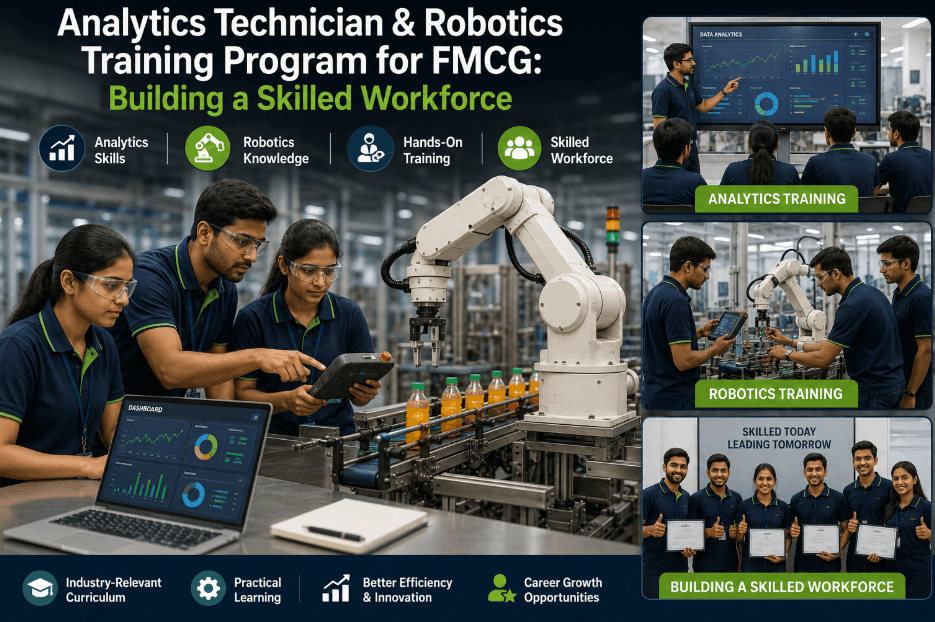
The training coordinator at a 650-employee FMCG plant in the Midwest reviews the previous quarter's analytics competency assessment data and sees a pattern that has cost the plant an estimated $340,000 in lost production efficiency over the past year forty-three production operators, quality technicians, and maintenance mechanics who completed the plant's analytics training program scored below the proficiency threshold on the post-training assessment, and within eight weeks of training completion, seventy percent of those employees had reverted to their pre-training workflow of recording production data on paper clipboards and entering it into spreadsheets at the end of each shift instead of using the plant's analytics platform to monitor line performance in real time. The root cause was not a lack of training effort the plant had invested $86,000 in a third-party analytics training curriculum that covered statistical process control, data visualization, and root cause analysis. The root cause was that the training curriculum was generic built around a food-processing case study from a textbook and did not use the plant's actual production data, the plant's actual analytics platform, or the plant's actual quality specifications and OEE targets. The operators could not transfer the textbook concepts to their real work environment because the training environment did not look like their work environment. The maintenance mechanics could not practice the analytics workflows on real machine data because the training data set was from a fictional dairy plant with different equipment, different products, and different control limits. iFactory's Analytics and Reporting and Training Management modules give FMCG plant training coordinators, continuous improvement managers, and plant leadership the digital infrastructure to build analytics competency programs that use the plant's actual production data — training operators, quality technicians, and maintenance mechanics on the same analytics platform they will use on the production floor, with dashboards built from the plant's real OEE data, quality data, downtime data, and food safety monitoring data. Book a Demo to see iFactory's analytics training platform configured for your FMCG plant's workforce development program.
From Generic Training to Competency-Based Analytics Development — Building Data-Driven Skills for FMCG Production Teams
Every FMCG plant generates production data that can train the workforce to find efficiency improvements, reduce waste, and prevent quality deviations — if the training curriculum uses the same analytics platform and real production data that the team will work with every shift. iFactory's analytics training platform builds workforce competency directly on the plant's actual OEE, quality, downtime, and food safety data.
Why Analytics Training Fails in FMCG Plants — and What It Costs When It Does
Analytics capability is no longer optional for FMCG production teams. Modern consumer goods plants operate with integrated production lines, real-time quality monitoring systems, automated packaging equipment, and food safety compliance workflows that generate streams of data — line speed, fill weight variance, seal integrity test results, CIP cycle parameters, downtime codes, OEE trends, energy consumption per SKU, and waste percentage by shift. The workforce that can read, interpret, and act on this data is the workforce that drives continuous improvement, reduces waste, and maintains regulatory compliance. Yet most FMCG plants report that their analytics training programs fail to produce sustained competency — operators return to paper-based workflows within weeks of training completion, quality technicians lack the confidence to build custom SPC charts in the analytics platform, and maintenance mechanics cannot use trend analysis to identify early signs of equipment degradation. The six failure modes below represent the most common reasons analytics training fails at FMCG plants — and the specific gaps that iFactory's analytics training platform addresses.
Generic training data that does not transfer to the real production environment
Third-party analytics training curricula use generic food-industry case studies with simulated data sets that do not match the plant's actual products, equipment, quality specifications, or OEE targets. Operators complete the training but cannot apply the concepts to their real production data because the analytics dashboard they trained on looked nothing like the dashboard on the plant floor. The iFactory platform closes this gap by building every training exercise on the plant's actual production data.
Shift-based workforce scheduling that prevents consistent training delivery
FMCG plants operate 24/7 production schedules with rotating shifts, meaning that only one-third of the production workforce is available for any given training session. Traditional classroom training delivered during day shift leaves night shift and weekend shift operators untrained, creating competency gaps that drive inconsistent data entry practices, varying interpretation of quality trends, and reduced confidence in the analytics platform across the full workforce.
Instructor-led training that does not scale across a multi-shift production workforce
Classroom-based analytics training requires dedicated instructors, scheduled sessions, and operators pulled from production — reducing line availability and increasing overtime costs. A typical FMCG plant with 200 production operators across four shifts needs 12-16 training sessions to cover the full workforce, each session pulling 12-15 operators from the line for 4-6 hours, costing $18,000-32,000 in lost production time per training cycle in addition to the training curriculum cost.
No method to measure analytics competency retention beyond the training room
Most FMCG plants administer a post-training knowledge assessment immediately after the training session and declare the training complete. No assessment is conducted 30 days, 60 days, or 90 days after training to measure whether the operator has retained the analytics skills and is applying them consistently in the production environment. Without ongoing competency measurement, the plant cannot identify which operators need refresher training, which analytics workflows are not being adopted, or whether the training investment is producing measurable improvement in data-driven decision-making on the production floor.
High turnover and temporary workforce that erases training investment
FMCG plants experience annual turnover rates of 20-40% for production operators and 15-25% for quality technicians, with temporary and seasonal workers comprising 15-30% of the production workforce during peak periods. Each departing trained employee takes their analytics competency with them, and each new hire requires a full training cycle before they can contribute to data-driven production management. The training investment per analytics-proficient operator is $3,500-6,000 — and 20-40% of that investment walks out the door every year.
No integration between the training platform and the plant's actual analytics tools
The most effective analytics training is the training that happens in the same software environment the operator will use every shift. When the training platform is separate from the production analytics platform — a training instance with simulated data versus the production instance with real data — the operator must learn the analytics tool twice: once during training and once on the production floor. iFactory eliminates this transfer problem by providing training access directly within the plant's analytics platform, using the same dashboards, same data sources, and same workflows that the operator uses during production.
Five Analytics Training Capabilities That Build Sustained Workforce Competency in FMCG Plants
The following five training capabilities represent the highest-impact applications of iFactory's analytics and training platform for FMCG workforce development. Each capability addresses a specific failure mode or training gap that iFactory has identified across deployments at food, beverage, and personal-care plants in the North American consumer goods market. Each capability is delivered through the iFactory platform — using the plant's actual production data, quality data, and maintenance data as the training data set, with role-based learning paths for operators, quality technicians, maintenance mechanics, and continuous improvement specialists.
Role-Based Analytics Learning Paths Built on Real Plant Data
iFactory configures analytics learning paths for each production role — production operator learning path covers OEE monitoring, downtime code entry accuracy, line speed trend interpretation, and fill weight SPC chart reading; quality technician learning path covers HACCP data trend analysis, seal integrity test result correlation, shelf-life study data visualization, and customer complaint trend analysis; maintenance mechanic learning path covers vibration trend interpretation, temperature and pressure deviation analysis, PM compliance tracking, and spare part consumption trend review. Every learning path exercise uses the plant's actual production data.
Self-Paced Modular Training Accessible Across All Shifts
Each analytics competency module is delivered through iFactory's training platform as a self-paced digital course — available to operators on any shift, accessible from any plant-floor terminal or mobile device, and completable in 15-30 minute segments that fit between production tasks. Night shift operators complete the same training modules as day shift operators. Seasonal and temporary workers access the same training content as permanent employees. Training progress syncs across the entire workforce in real time.
Live Analytics Dashboard Exercises with Real-Time Production Data
Each training module includes hands-on exercises in the live iFactory analytics environment — the operator opens a real OEE dashboard, filters by shift and production line, identifies the top three downtime reasons for the current week, and enters the findings into the training assessment. The exercise uses the same data the operator will analyze during their regular shift, in the same dashboard interface, with the same drill-down and filter capabilities. Transfer of learning is immediate because the training environment and the production environment are identical.
Competency Assessment and Retention Measurement at 30-60-90 Day Intervals
iFactory administers competency assessments at four points: pre-training baseline, immediately post-training, 30 days post-training, and 90 days post-training. Each assessment measures the operator's ability to perform specific analytics workflows in the live platform — read an SPC chart and identify an out-of-control condition, generate a shift production report, interpret an OEE trend and identify the primary loss category, and respond to a quality deviation alert by analyzing the relevant data. The 30-day and 90-day assessments measure retention and identify operators who need refresher training.
Analytics Training ROI Dashboard for Plant Leadership
iFactory tracks training completion rates, assessment scores, and competency retention metrics alongside production performance indicators — OEE trend by shift before and after training, downtime code accuracy improvement, SPC chart usage frequency by operator, and quality deviation reduction attributable to improved data analysis by the production team. Plant leadership can see the direct correlation between analytics training investment and production performance improvement on a single dashboard.
FMCG Analytics Competency Framework — Skill Levels, Roles, and Proficiency Requirements by Workforce Segment
FMCG plants need a structured analytics competency framework that defines the specific skills, proficiency levels, and training requirements for each workforce segment — from the production operator who needs to monitor line performance data to the continuous improvement manager who needs to perform advanced root cause analysis across multiple production lines and product categories. The table below presents the analytics competency framework that iFactory uses to configure workforce training programs at FMCG plants, based on industry best practices from SQF food safety training requirements, PMMI OpX operational excellence guidelines, and Grocery Manufacturers Association (GMA) workforce development standards.
| Workforce Segment | Entry-Level Proficiency | Proficient-Level Proficiency | Advanced-Level Proficiency | Training Delivery Method | Assessment Frequency |
|---|---|---|---|---|---|
| Production Operator | Read basic OEE dashboard; enter downtime codes accurately; identify line speed deviations on trend charts | Monitor SPC charts for fill weight and seal integrity; generate shift production report; interpret waste trend data | Perform root cause analysis on OEE loss categories; create custom filter views for product changeover optimization | Self-paced modules + live dashboard exercises + peer coaching | Pre-training baseline; immediate post-training; 30-day and 90-day retention check |
| Quality Technician | Navigate quality dashboard; read HACCP monitoring trends; enter lab test results accurately | Build and interpret SPC charts for critical control points; correlate customer complaint data with production parameters; analyze seal integrity trend data | Design quality analytics dashboards for new products; perform multivariate analysis on shelf-life study data; train operators on quality analytics workflows | Self-paced modules + instructor-led workshops + live platform exercises | Pre-training baseline; immediate post-training; 30-day, 60-day, and 90-day retention checks |
| Maintenance Mechanic | Read PM compliance dashboard; enter work order completion data; view equipment downtime trend charts | Interpret vibration analysis trends; analyze MTBF and MTTR data by equipment type; use predictive maintenance dashboards to identify early-stage equipment degradation | Build equipment health dashboards combining vibration, temperature, and power consumption data; train shift mechanics on predictive analytics interpretation | Self-paced modules + on-tool exercises + equipment-specific data analysis projects | Pre-training baseline; immediate post-training; 30-day and 90-day retention check |
| Continuous Improvement Specialist | Generate standard OEE reports; identify top loss categories from Pareto charts; track Kaizen event outcomes in the analytics platform | Perform advanced root cause analysis using Pareto, fishbone, and trend correlation tools; build Line Loss Tree analyses; track CI project ROI in the platform | Design enterprise-wide analytics dashboards for plant leadership; integrate financial data with operational data for total cost analysis; mentor production team on analytics adoption | Instructor-led workshops + live platform case studies + plant-specific CI project execution | Pre-training baseline; immediate post-training; project-based milestone assessments every 90 days |
| Shift Supervisor / Team Lead | Review shift performance dashboard; identify OEE gaps by line; read quality compliance summary reports | Coach operators on analytics dashboard usage during shift; use trend data to adjust line assignment and staffing decisions; generate shift handover reports from analytics platform | Lead shift-level continuous improvement using data-driven decision-making; train new operators on analytics workflows; use predictive trends to prevent quality deviations before they occur | Self-paced modules + leadership coaching + live dashboard exercises + shift-based practice sessions | Pre-training baseline; immediate post-training; 30-day and 90-day retention check with shift performance correlation |
Analytics Training Applications Across FMCG Production Functions — From Receiving to Shipping
Analytics competency is required across every production function in an FMCG plant — from raw material receiving through processing, packaging, and finished goods shipping. Each production function generates specific data streams that the workforce must be trained to interpret and act upon. The applications below describe how iFactory configures analytics training for each functional area, using the plant's actual production data and quality specifications as the training foundation.
Raw Material Receiving and Ingredient Analytics Training
Receiving operators and quality technicians are trained to use iFactory's analytics dashboards to monitor incoming raw material quality trends by supplier, track receiving inspection pass-fail rates over time, identify seasonal variation in ingredient specifications, and correlate supplier quality data with finished product quality parameters. Training exercises use the plant's actual receiving data — supplier quality scores, COA review workflows, and ingredient specification compliance trends — building the competency to make data-driven receiving decisions that prevent out-of-spec materials from entering production.
Production Processing and CIP Analytics Training
Production operators and CIP technicians are trained to monitor processing parameter trends — cook temperatures, holding times, CIP flow rates, caustic concentration trends, and rinse conductivity data — using iFactory's real-time process analytics dashboards. Training covers SPC chart interpretation for processing parameters, deviation response workflows when a parameter trends toward the control limit, and CIP effectiveness trend analysis that identifies when cleaning cycles need adjustment before a microbiological issue develops.
Packaging Line and Fill Quality Analytics Training
Packaging operators and line mechanics are trained on iFactory's packaging analytics dashboards — monitoring fill weight variation by valve head, seal integrity test trend data, case packer efficiency, and label application accuracy rates. Training exercises use real packaging line data to teach operators how to identify a developing fill weight drift before it generates a product quality hold, how to correlate seal integrity failures with specific packaging machine stations, and how to analyze changeover time data to identify standardization opportunities.
Food Safety and Regulatory Compliance Analytics Training for FMCG Quality Teams
Food safety analytics training is a distinct competency area that combines regulatory compliance knowledge (FSMA, SQF, BRC, FSSC 22000) with practical data analysis skills — the ability to monitor HACCP critical limit trends, analyze environmental monitoring data, track supplier food safety performance, and generate compliance documentation from the analytics platform. iFactory configures food safety analytics training that uses the plant's actual HACCP data, environmental monitoring results, and supplier food safety scorecards — building the quality team's competency to use data analysis for preventive food safety management rather than reactive documentation.
HACCP Critical Limit Monitoring and Trend Analysis
Quality technicians learn to monitor HACCP critical limit trends using iFactory's food safety analytics dashboards — tracking metal detector rejection rates by product and shift, magnet temperature trends, X-ray inspection data, and foreign material complaint trends over time. Training covers the interpretation of trend direction and slope to distinguish between random variation and developing food safety risks that require preventive action before a critical limit deviation occurs.
Environmental Monitoring Data Analysis and Trend Review
Quality and sanitation teams learn to analyze environmental monitoring data — Listeria species and Salmonella indicator organism trends by zone, swab site location, and production area — using iFactory's analytics dashboards that correlate environmental monitoring results with sanitation effectiveness trends, line proximity data, and seasonal patterns. Training enables the team to identify emerging environmental risks before they result in a positive pathogen finding in a Zone 1 location.
Supplier Food Safety Performance Analytics and Scorecard Training
Quality assurance and procurement teams are trained to use iFactory's supplier analytics dashboards — tracking supplier food safety audit scores, certificate of analysis compliance rates, supplier corrective action response times, and incoming ingredient testing trend data. Training covers the interpretation of supplier performance trends to identify suppliers that require increased inspection frequency, supplier corrective action requests, or removal from the approved supplier list based on data-driven criteria.
Analytics Training Program Readiness — What Your FMCG Plant Needs for Successful Deployment
Implementing an analytics training program on the iFactory platform at an FMCG plant requires preparation across five areas — platform access provisioning, training data set configuration, role-based learning path design, competency assessment baseline establishment, and team training for trainers. The checklist below covers the essential elements that iFactory's implementation team reviews during the analytics training deployment at each FMCG plant.
iFactory analytics platform user access provisioning for all production, quality, and maintenance team members
Each trainee receives individual user access to the iFactory analytics platform with role-based permissions that provide visibility into the dashboards and data relevant to their role. Operator accounts have read access to production and quality dashboards with drill-down capability. Quality technician accounts have read-write access to quality analytics and SPC chart configuration. Maintenance mechanic accounts have access to equipment health and PM compliance dashboards.
Training instance configuration with the plant's actual production data for hands-on exercises
iFactory configures a training analytics environment that mirrors the plant's production instance — containing 90 days of historical production data, quality data, downtime data, and food safety monitoring data from the plant's actual operations. The training instance is refreshed quarterly to keep the training data set current with the plant's evolving product mix and production parameters.
Role-based learning path configuration for each workforce segment
iFactory's training team configures learning paths for each workforce segment — production operator foundational, production operator advanced, quality technician foundational, quality technician advanced, maintenance mechanic, shift supervisor, continuous improvement specialist — with 8-12 modules per path and 3-5 hands-on exercises per module. Each module takes 15-30 minutes to complete and includes a knowledge check at the end.
Pre-training competency baseline assessment administration
Each trainee completes a pre-training competency baseline assessment before beginning the first training module — measuring their current ability to perform specific analytics workflows in the iFactory platform. The baseline assessment data establishes the starting point for each trainee, identifies trainees who may need additional foundational support, and provides the comparison data for post-training competency measurement.
Train-the-trainer program for plant continuous improvement and quality leadership
iFactory provides a train-the-trainer program for plant CI managers, quality managers, and shift supervisors — covering the analytics training platform administration, learning path customization, competency assessment administration, and coaching techniques for supporting operators through the training program. The train-the-trainer program ensures that the plant can sustain the analytics training program independently after the initial deployment.
Training ROI baseline establishment and ongoing performance correlation measurement
iFactory establishes baseline production performance metrics before training deployment — OEE by line and shift, downtime code accuracy, SPC chart usage frequency, quality deviation rate, and waste percentage — and correlates training completion and competency assessment data with production performance trends to measure the direct impact of analytics training on plant productivity and quality outcomes.
Your Plant's Production Data Is the Best Analytics Training Curriculum — iFactory Makes It Accessible to Every Shift
Every production line, every quality check, every maintenance event generates data that can train your workforce to make better decisions — if the training platform uses that same data. iFactory's analytics training platform builds workforce competency directly on your plant's actual OEE, quality, downtime, and food safety data, with role-based learning paths accessible to every operator on every shift. Book a demo to see the system configured for your FMCG plant's workforce development program.
Deploying Analytics Training at an FMCG Plant — A Phased Approach
iFactory's analytics training program is deployed in five phases, from platform provisioning through ongoing competency measurement and program optimization. Each phase builds on the previous phase and delivers measurable value before the next phase begins — the first shift completes the foundational training modules before the advanced learning paths are configured.
Phase 1: Provision and Configure
iFactory analytics platform user accounts provisioned for all production, quality, and maintenance team members; training instance configured with 90 days of plant historical data; role-based learning paths configured for each workforce segment. Duration: 2-3 weeks. Value: training environment ready with real plant data.
Phase 2: Baseline and Launch
Pre-training competency baseline assessments administered for all trainees; foundational analytics modules launched for production operators and quality technicians; train-the-trainer program completed for plant CI and quality leadership. Duration: 2-3 weeks. Value: competency baseline established; first shift of operators in training.
Phase 3: Train and Assess
All shifts complete foundational analytics training modules; post-training competency assessments administered; advanced learning paths launched for quality technicians, maintenance mechanics, and continuous improvement specialists. Duration: 4-6 weeks. Value: full workforce foundational analytics competency achieved.
Phase 4: Retain and Measure
30-day and 90-day retention assessments administered; refresher training modules assigned to operators below proficiency threshold; production performance correlation dashboard live for plant leadership. Duration: 8-12 weeks. Value: competency retention measured; training ROI visible on leadership dashboard.
Phase 5: Optimize and Sustain
Training program calibrated based on retention assessment data and production performance correlation; new hire training onboarding process integrated with iFactory platform; quarterly advanced training modules added based on plant continuous improvement priorities. Duration: ongoing. Value: sustained analytics competency across the full production workforce with measurable impact on OEE and quality.
What FMCG Plant Training and Continuous Improvement Leaders Say About Analytics Workforce Development
I have led training and continuous improvement programs at three FMCG plants over twelve years — a 400-employee ice cream plant operating eight packaging lines with aseptic and ESL filling, a 700-employee beverage plant running 12 bottling lines with hot-fill and cold-fill configurations, and a 550-employee prepared foods plant with retort and frozen processing. The most persistent challenge I have seen in FMCG analytics workforce development is not that the training content is wrong. It is that the training content is disconnected from the plant's actual production data, so the operator completes the training but cannot transfer the skills to the real work environment. At the ice cream plant, we invested $62,000 in an analytics training program from a nationally recognized food-industry training provider. The curriculum was excellent on paper — statistical process control fundamentals, data visualization principles, root cause analysis methodology — but every case study used simulated data from a generic food-processing scenario that did not match our products, our equipment, our quality specifications, or our OEE targets. The operators sat through the training, passed the knowledge assessment, and went back to the production floor where the analytics platform looked completely different from the training materials. Within 30 days, 80% of the operators had stopped using the analytics platform for anything beyond the minimum required data entry. The training had failed not because the content was wrong but because the transfer of learning was impossible — the training environment and the production environment were different tools with different data and different workflows. At the beverage plant, we deployed iFactory's analytics training platform and configured every training module using the plant's actual production data. The operators trained on the same iFactory dashboards they would use during their shifts. The quality technicians practiced SPC chart interpretation on real fill weight data from the previous week's production runs. The maintenance mechanics analyzed vibration trend data from the actual bottling line equipment they serviced every shift. The operator who completed the foundational training module at 2:00 AM on the night shift, between product changeovers, was using the same dashboard and the same data that the day shift operator had trained on at 10:00 AM. The night shift operator did not need to learn a different analytics tool because there was no separate training tool — the training happened in the production analytics platform. Within 90 days of deployment, the plant's OEE improved by 6.2% across all lines, driven primarily by faster downtime response times from operators who could now read the OEE dashboard and identify the top loss category without waiting for the shift supervisor to interpret the data for them. That is what analytics training does when the training data is the production data. It does not teach the operator about analytics in theory. It teaches the operator to use analytics in practice — in their actual role, on their actual equipment, with their actual production targets.
— Continuous Improvement and Training Director, North American FMCG Manufacturing — 12 Years FMCG Training Program Leadership — SQF Practitioner — Six Sigma Black Belt — PMMI OpX Workforce Development Committee MemberCommon Questions About Analytics Workforce Training and Development for FMCG Plants
Analytics Training Transforms an FMCG Plant's Greatest Operational Liability into Its Greatest Competitive Advantage — If the Training Data Is the Production Data
Every production line in an FMCG plant generates a stream of data — OEE, fill weight, seal integrity, line speed, downtime, waste, energy consumption, food safety monitoring results — that contains the insight the workforce needs to improve efficiency, reduce waste, prevent quality deviations, and maintain regulatory compliance. The data exists. The dashboards are configured. The analytics platform is operational. What is missing in most FMCG plants is the workforce competency to use that data effectively — and the training infrastructure to build that competency across every shift, every role, and every production function in the plant.
iFactory's Analytics, Reporting, and Training Management modules give FMCG plant training coordinators, continuous improvement managers, and plant leadership the digital infrastructure to build analytics competency programs that use the plant's actual production data — training operators, quality technicians, and maintenance mechanics on the same analytics platform they will use on the production floor, with dashboards built from real OEE data, quality data, downtime data, and food safety monitoring data. The 40 to 65% improvement in analytics competency retention, the $120,000 to $180,000 in annual efficiency savings per plant, and the 3 to 5 times return on training investment at iFactory-managed plants are not the result of better training content. They are the result of having an analytics training platform that uses the plant's real production data — making the transfer of learning immediate because the training environment and the production environment are the same platform, the same data, and the same dashboards, every shift, every day. Book a Demo to see how iFactory's platform builds analytics workforce competency at FMCG plants in 4 to 6 weeks.
Your FMCG Plant's Production Data Is Already the Best Analytics Training Tool — iFactory Puts It in Every Operator's Hands
Every shift, every line, every product generates data that can train your workforce to make better decisions faster — if the training uses that same data. iFactory's analytics training platform builds workforce competency directly on your plant's actual production data, with role-based learning paths accessible to every operator on every shift. Book a demo and see the system configured for your FMCG plant's workforce development program today.