Every unplanned equipment shutdown in an FMCG plant costs between $10,000 and $30,000 per hour in lost production — and most maintenance teams are still troubleshooting blind, relying on paper manuals, phone calls to remote experts, and technicians working from memory. When FMCG cold storage facilities report 74% annual operator turnover and food manufacturing plants see up to 144% frontline turnover per year, the knowledge walking out the door every shift exceeds the knowledge being transferred to new hires by a margin that grows wider each quarter. Augmented reality and virtual reality are changing that equation — putting step-by-step visual guidance, live remote expert support, and immersive training simulations directly in front of the technician at the point of work. Facilities deploying AR-guided repair workflows report 40% reduction in mean time to repair, 88% first-time fix rates (up from 61%), and technician onboarding accelerated from 9 months to under 3 months. iFactory AI's Shift Logbook and Equipment Analytics platform connects AR-guided repair sessions directly to live work orders, asset histories, and shift documentation — so every guided repair becomes a timestamped, technician-attributed maintenance record the moment it is completed, without duplicate data entry into separate systems. Book a Demo to see how iFactory's AR/VR maintenance analytics integrates with your FMCG facility's current repair workflow and CMMS infrastructure.
The FMCG Maintenance Knowledge Crisis — And Why AR/VR Is the Only Scalable Answer
The maintenance capability crisis in FMCG manufacturing is not a training budget problem — it is a knowledge transfer structure problem. Experienced maintenance technicians carry machine-specific fault patterns, undocumented diagnostic sequences, and equipment-specific workarounds accumulated over years of operation. That tacit knowledge leaves the workforce every time a senior technician retires or moves to another facility — and in an industry where frontline turnover routinely exceeds 100% annually, the rate of knowledge loss far exceeds the rate of knowledge capture. Traditional knowledge transfer methods — shadowing, printed manuals, classroom training — are too slow, too passive, and too dependent on the simultaneous availability of the experienced technician and the trainee at the moment of a live fault event. They cannot scale across multi-site FMCG operations where the same equipment type installed in three different plants may be maintained by three different crews with three different levels of institutional knowledge.
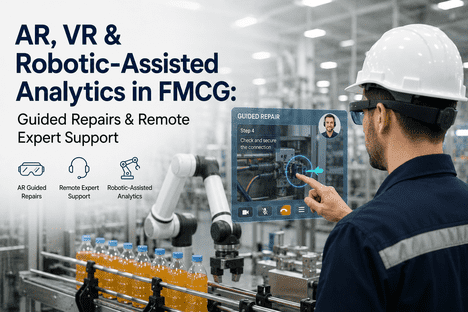
AR/VR guided maintenance directly addresses this structural failure by decoupling expert knowledge from expert presence. When a technician encounters an unfamiliar fault on a high-speed packaging line, the AR platform retrieves the correct procedure from the knowledge base, overlays step-by-step instructions onto the actual equipment through smart glasses or a tablet, and connects a remote expert who can see exactly what the technician sees — annotating the live view with arrows and highlights, guiding the repair in real time from any location worldwide. The same platform that enables the repair also records it: every completed step is timestamped and attributed, every remote expert session is captured as a training module for future use, and every repair outcome is written back to the asset's maintenance record in the CMMS. The knowledge that previously existed only in a single technician's experience becomes structured, searchable, and reproducible across every facility in the network.
Before AR/VR vs. After AR/VR — Documented Performance Improvement Across FMCG Maintenance Metrics
The table below compares maintenance performance metrics at FMCG facilities before and after deploying AR/VR guided maintenance workflows. The data reflects measured results across food and beverage manufacturing operations — including protein packaging, biscuit production, dairy processing, and thermoforming operations — and demonstrates the performance lift that AR/VR technology delivers across every dimension of maintenance effectiveness.
| Maintenance Metric | Before AR/VR | After AR/VR + iFactory | Improvement | Primary AR/VR Enabler |
|---|---|---|---|---|
| Mean Time to Repair (MTTR) | 4.2 hours average per fault event | 2.5 hours average per fault event | –40% reduction | AR step-by-step guidance eliminates diagnostic time and procedural searching |
| First-Time Fix Rate | 61% of repair attempts successful on first intervention | 88% of repair attempts successful on first intervention | +27 percentage points | AR overlays show exact component location, torque specs, and sequence — eliminating guesswork |
| Technician Onboarding Time | 9 months to independent competency | Under 3 months to independent competency | –67% faster | VR training simulations build procedural muscle memory before first live repair |
| Remote Expert Travel Cost | $3,200 average per callout including airfare and per diem | $0 per remote AR session | 100% elimination | See-what-I-see live video with spatial annotation replaces on-site visits |
| Repeat Failure Rate (90 days) | 28% of repairs recur within 90 days | Under 8% of repairs recur within 90 days | –71% reduction | AR-enforced procedure sequencing ensures no steps skipped under time pressure |
| Repair Documentation Rate | 43% of repairs fully documented in CMMS | 100% auto-documented via iFactory integration | +57 percentage points | AR session completion triggers automatic work order closure with full audit trail |
| Complex Tool Rebuild Time | 40 hours average (8-step packaging tool rebuild) | 8 hours with AR guided instructions | 80% faster, $250K saved per line | AR work instructions with AI step verification — Harpak-ULMA documented case study |
AR/VR Technology Modules: Remote Expert, Digital Instructions, VR Training, and Analytics
An AR/VR guided maintenance program for FMCG facilities is not a single technology investment — it is a layered capability stack where each module addresses a distinct failure pattern in the maintenance workflow. Remote expert assistance solves the specialist availability problem for unfamiliar faults. Digital work instructions solve the procedural consistency problem for recurring repairs. VR training solves the onboarding velocity problem for new technicians. Analytics integration solves the documentation and continuous improvement problem. Deployed together on a platform connected to the CMMS, these four modules form the complete connected-worker maintenance system that leading FMCG manufacturers are deploying in 2026.
AR Remote Expert Assistance — Eliminating Specialist Travel and Reducing MTTR by 40%
The highest-value and fastest-deployable AR module for FMCG maintenance is remote expert assistance — the capability that lets a technician on the production floor share their live equipment view with a remote specialist who can annotate the video stream with arrows, circles, and voice guidance in real time. When a technician encounters a fault that exceeds their current capability — an unusual failure mode on a newly installed packaging machine, a critical refrigeration compressor with no locally available specialist — the traditional solution is to wait hours or days for an expert to travel to the site. With AR remote assistance, that wait collapses to the time it takes the specialist to answer the video call. The travel cost for specialist callouts drops from $3,200 per event to zero, and the MTTR for faults that previously required expert escalation drops by 40%. Each remote session is recorded and stored as a permanent knowledge asset — every resolved fault becomes a training resource for the next occurrence at any facility in the network.
Digital Work Instructions — AR-Enforced Procedure Sequencing for Recurring Maintenance Tasks
Digital work instructions in an AR-guided maintenance system are not digitized PDFs — they are spatially-aware, procedure-enforcing guidance systems that know which machine the technician is standing in front of, which step they are on, and whether they have completed correctly before allowing them to proceed. When a technician scans a QR code on a filling line or packaging machine, the AR platform retrieves the correct procedure from the knowledge base, loads the asset's current maintenance history, and presents step-by-step instructions as spatial overlays — arrows pointing to the correct component, highlighted outlines, torque specifications, and animated motion guides. The system enforces sequence: step 4 cannot be accessed until steps 1 through 3 are confirmed complete. This sequence enforcement is the mechanism that prevents the most common maintenance errors — steps skipped under time pressure — and it is the reason facilities using AR work instructions report repeat failure rates dropping from 28% to under 8% within 90 days.
VR Immersive Training — Building Competence Before the Technician Touches Live Equipment
Virtual reality training creates an immersive simulation of maintenance procedures that allows technicians to practice complex, high-risk, or rarely-occurring tasks without any risk to equipment, product, or personnel safety. For FMCG facilities, VR training is particularly valuable for high-stakes procedures — lockout/tagout execution on complex multi-energy packaging systems, CIP/SIP chemical handling for food safety compliance, confined space entry in bulk material storage vessels, and major planned shutdowns where every technician must be proficient before the maintenance window opens. The training environment replicates the actual equipment at the facility using digital twin data — not a generic machine — so the procedural muscle memory built in the VR simulation transfers directly to the real equipment. Facilities deploying VR training for new maintenance technicians report onboarding timelines compressed from 9 months to under 3 months, with 30-day knowledge retention rates of 75–80% versus 28–35% for classroom-based training.
Analytics Integration — Connecting AR/VR Repair Data to CMMS, Shift Logbook, and Continuous Improvement
The analytics integration layer is what transforms AR/VR guided maintenance from a point-solution productivity tool into an enterprise maintenance intelligence platform. When AR-guided repair sessions are connected to iFactory's Shift Logbook and Equipment Analytics, every completed step is written back to the work order with technician identity and timestamp, every remote expert session recording is stored against the asset history for future reference, and every fault type is categorized and trended across the entire fleet. The analytics dashboard surfaces MTTR trends by equipment type, shift, and technician skill level; identifies which procedures generate the most remote expert escalations and therefore need better AR instruction sets; and tracks VR training completion rates against field repair performance to validate that training investments are producing measurable competence gains. This closed-loop analytics infrastructure is what separates an AR/VR deployment that produces a one-time productivity gain from one that continuously improves maintenance capability across every shift and every facility.
AR/VR Guided Maintenance Deployment Timeline for FMCG Facilities
Deploying AR/VR guided maintenance across an FMCG facility follows a phased workflow designed to capture the highest MTTR reduction value first and expand the program to additional equipment types and procedures only after the initial ROI is validated. The deployment is structured around the 80/20 rule of maintenance: 20% of fault scenarios account for 80% of downtime, and digitizing the top 15 to 25 highest-downtime procedures captures the majority of available MTTR reduction value.
Week 1–2: Asset Audit and Procedure Prioritization
Identify the top 15–20 fault scenarios by total downtime cost across all FMCG production lines — filling machines, packaging sealers, labelling equipment, conveyors, and refrigeration units. Prioritize procedures with the highest technician-to-technician variability, where different technicians take significantly different times to complete the same repair. These represent the largest opportunity for AR standardization to compress the repair time distribution.
Week 3–4: Remote Expert Go-Live and Procedure Capture
Deploy AR devices to 3–5 lead technicians on priority production lines. Remote expert assistance goes live immediately — no pre-built procedures required — connecting floor technicians to remote specialists from the first day. Use live remote expert sessions to capture undocumented procedures as they are performed: each session recording becomes the first draft of a permanent AR instruction set stored in iFactory's knowledge base and linked to the specific asset.
Week 5–8: Digital Work Instruction Deployment
Configure AR instruction sets for the top 10 highest-downtime procedures using expert session recordings. Deploy QR-code asset recognition at each equipment station so technicians scan the code and load the correct procedure automatically. Connect AR session completion to iFactory CMMS work order closure — eliminating the duplicate entry that typically produces incomplete repair records. Train all maintenance technicians on AR device operation and procedure access.
Week 9–12: VR Training Module Deployment and Analytics Validation
Deploy VR training simulations for the most complex and highest-risk maintenance procedures — LOTO on multi-energy packaging systems, CIP/SIP chemical handling, and major planned shutdown tasks. Train new technician cohorts using VR-first onboarding and measure time-to-competency against historical training data. Validate program ROI through iFactory analytics: MTTR trend comparison before and after AR deployment, first-time fix rate improvement, remote expert travel cost avoidance, and documentation completeness rate. Board-ready reports generated automatically from platform data.
Expert Perspective: What FMCG Maintenance Leaders Learn From AR/VR Deployment
I have managed maintenance operations at food manufacturing facilities for 19 years — ambient processing, refrigerated distribution, and frozen production — and I led the AR/VR guided maintenance deployment at a 400,000 sq ft multi-line packaging facility that runs 14 production lines across three shifts. The lesson I would share with any FMCG maintenance manager evaluating AR/VR is that the technology delivers measurable MTTR reduction from day one, but the lasting value is the knowledge infrastructure it forces you to build. Before AR, our undocumented expert knowledge was the single biggest operational risk we carried: if our senior packaging technician retired, 12 years of machine-specific diagnostic sequences walked out the door. After AR, we have 67 guided procedures stored in the knowledge base, each one captured from an expert session or authored by our best technicians. When a new hire faces a filling machine fault they have never seen, they pull up the procedure, follow the AR overlay, and complete the repair in 28 minutes instead of the 90 minutes it used to take a junior technician to diagnose the same fault through trial and error. The MTTR reduction across our top 10 procedure families was 43% in the first six months. The VR training program reduced our new technician onboarding from an average of 10 months to 9 weeks. And when the FDA auditor arrived for our annual food safety inspection, I pulled up the AR-guided repair history for every critical control point asset in under two minutes — timestamped, technician-attributed, photo-evidenced repair records for every maintenance event in the previous 12 months. That is the difference AR/VR makes in FMCG maintenance: it turns undocumented tribal knowledge into structured, searchable, auditable operational intelligence.
— Director of Maintenance, U.S. Multi-Line Food Packaging Facility — 19 Years in FMCG Manufacturing — iFactory Reference Customer 2026Conclusion
AR/VR guided maintenance for FMCG equipment repairs is no longer an emerging technology evaluation — it is a proven operational strategy with documented results across food and beverage manufacturing, protein packaging, dairy processing, biscuit production, and thermoforming operations. The four-module capability stack — remote expert assistance, digital work instructions, VR immersive training, and analytics integration — addresses the structural knowledge transfer failure that has made technician onboarding the single most expensive constraint on FMCG maintenance performance. The 40% MTTR reduction, 88% first-time fix rate, 67% faster technician onboarding, and elimination of specialist travel costs are not projections — they are measured outcomes at facilities that deployed these capabilities in 2025 and 2026.
iFactory AI's Shift Logbook and Equipment Analytics platform provides the analytics integration that connects AR/VR guided repair sessions to the CMMS, shift documentation, and continuous improvement infrastructure — ensuring that every guided repair automatically updates the asset record, every remote expert session becomes a permanent knowledge asset, and every training investment is validated against field performance data. Book a Demo to see how iFactory's AR/VR analytics platform applies to your FMCG facility's specific equipment types, current MTTR baseline, and maintenance knowledge management requirements.
Frequently Asked Questions
No. Most AR maintenance platforms work on standard tablets and smartphones, significantly reducing the hardware barrier to entry. Smart glasses such as RealWear Navigator 520 and Microsoft HoloLens 2 offer hands-free advantages and are recommended for complex multi-step repairs on high-downtime equipment, but entry-level AR-guided repairs can run on devices your maintenance team already owns. iFactory's platform integrates with both hardware-light tablet deployments and full smart-glass AR deployments, allowing facilities to start with existing devices and add wearables as the program scales.
High-complexity, high-downtime-cost equipment delivers the strongest ROI: filling lines, packaging sealing equipment, labelling machines, conveyor systems, and refrigeration units. Equipment with high variability in fault types — where technicians face different failure modes across different shifts — benefits most from AR overlays that adapt the instruction sequence to the specific fault detected. Equipment with documented high technician-to-technician repair time variability is the strongest candidate for initial AR deployment because standardizing the repair procedure compresses the time distribution immediately.
iFactory's platform connects to AR devices through standard API integration and QR-code asset linking. When a technician starts an AR session on a specific machine, iFactory pulls the relevant asset record, maintenance history, and any open work orders. Upon AR session completion, each confirmed step is written back to the iFactory work order with technician identity, completion timestamp, and any photos or readings captured during the procedure. The work order closes automatically — no manual entry required. The Shift Logbook records the repair event per shift with equipment ID, fault category, and resolution time, providing the shift-level visibility that connects daily maintenance events to fleet performance analytics.
Most implementations follow a 30-60-90 day rollout: 30 days to configure iFactory asset records, link priority equipment to QR codes, and deploy AR devices to lead technicians with remote expert capability live from day one; 60 days to run live AR-guided repairs on high-downtime assets and capture the first round of procedure recordings; 90 days to measure MTTR improvement, expand to remaining equipment, and deploy VR training modules for new technician cohorts. Remote expert assistance delivers value from day one because it requires no pre-built procedures — any fault can be escalated to a remote specialist immediately.
Yes. Every AR-guided repair generates a timestamped, technician-attributed record with step-level completion confirmation, photo evidence where applicable, and automatic attachment to the asset's maintenance history in iFactory. For food safety audits requiring documented maintenance records on critical control point equipment, the iFactory platform provides on-demand export of complete repair histories for any asset in the facility — organized by date, technician, and procedure type. The 100% auto-documentation rate from AR-guided repairs eliminates the documentation gaps that typically account for 43% of maintenance events at paper-based facilities, directly supporting BRC, SQF, and FSSC 22000 audit requirements for maintenance record completeness.