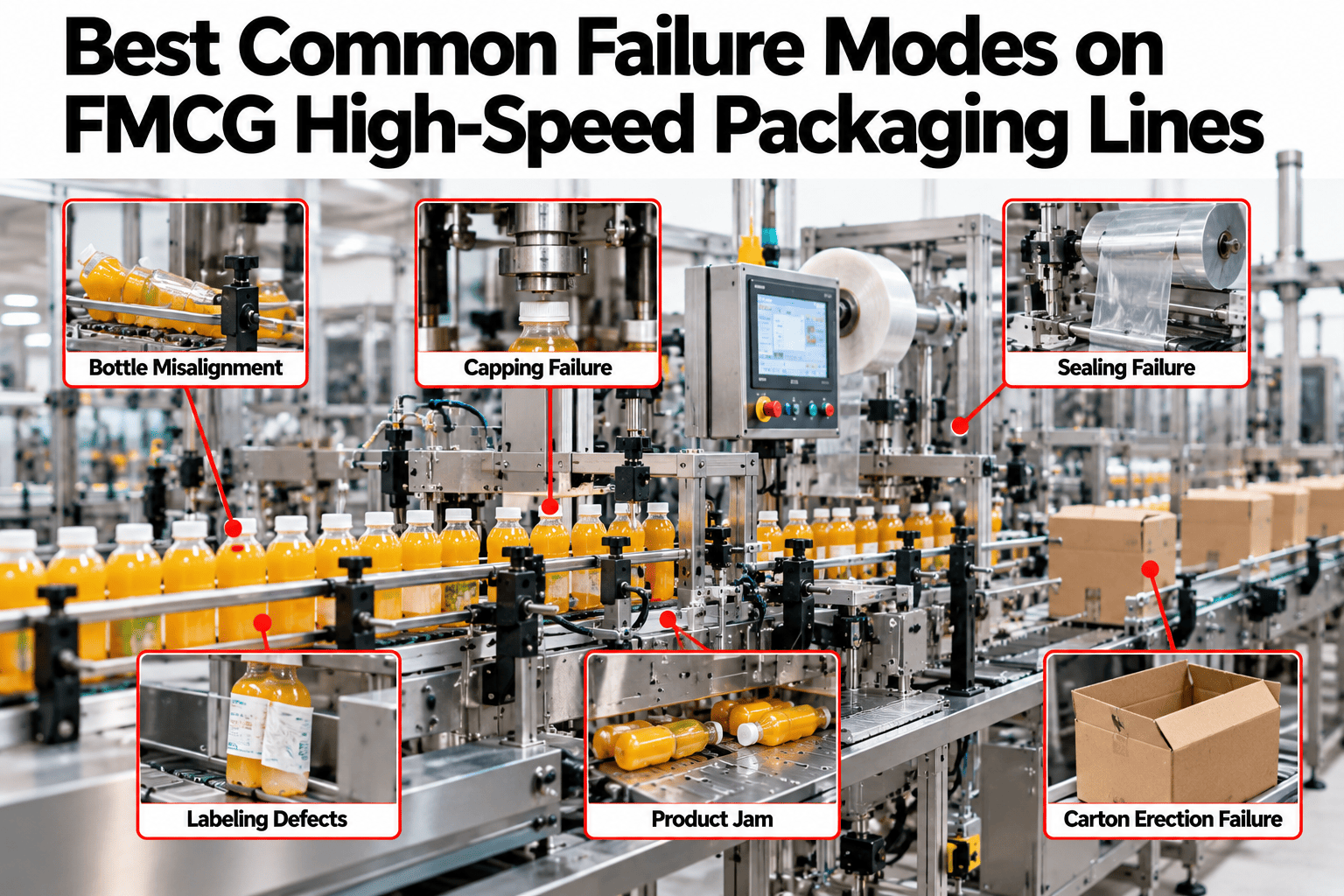
High-speed packaging lines fail in a fairly small number of recurring ways, which is actually good news: bearings, seals, sensors, servo drift, and vacuum losses account for most unplanned stops across FMCG lines, and each one leaves a different early signature before it causes a full failure. The plants that catch these signatures early run noticeably less unplanned downtime than those that wait for the fault alarm. See your own line's failure mode frequency ranked in a short session.
Five Failure Modes Cause Most High-Speed Line Downtime
iFactory AI tracks the early signatures of bearing wear, seal degradation, sensor drift, servo misalignment, and vacuum loss before they stop the line.
Ranked by Frequency Across Lines
A composite breakdown of unplanned stop causes across high-speed FMCG packaging lines.
Each Failure Mode Has an Early Signature
None of these five failures happen without warning. The warning just rarely gets caught before the stop.
| Failure Mode | Early Signature | Typical Lead Time |
|---|---|---|
| Bearing wear | Rising vibration amplitude | Days to weeks |
| Seal degradation | Slow pressure or fluid loss trend | Days |
| Sensor drift | Reading variance from baseline | Hours to days |
| Servo misalignment | Positioning error creeping upward | Hours to days |
| Vacuum loss | Declining hold pressure under load | Hours |
See Your Own Line's Early Failure Signatures
Book a 30-minute session and iFactory AI will walk through live failure signature tracking on your own line.
Bearings: The Largest Single Category
Bearing failures account for the largest share of unplanned stops, and nearly all of them show a detectable vibration trend before failure.
The challenge is rarely detection, it is prioritization: a plant with vibration sensors on every motor still needs a way to know which rising trend matters most this week.
Prevention Tactics by Failure Mode
Each failure mode responds to a different prevention approach.
Bearings
Vibration trend monitoring with alerts ranked by proximity to failure threshold.
Seals
Pressure and fluid loss trending to catch slow degradation before a full breach.
Sensors
Cross-validation against redundant readings to catch drift before false faults occur.
Servo Drift
Positioning error tracking against tolerance, flagged before product quality is affected.
Vacuum Loss
Continuous hold-pressure monitoring under load, not just at shift-start checks.
A Composite Line Comparison
Failure mode frequency tracked across three packaging lines. Darker cells show a higher share of that line's unplanned stops.
Rolling It Out on the Line
iFactory AI arrives turnkey, built to connect to existing vibration, pressure, and positioning sensors.
Frequently Asked Questions
Do we need new sensors to track all five failure modes?
Most high-speed lines already have vibration, pressure, and positioning sensors in some form, so the first step checks what is already available before recommending additions. Support can review your current sensor coverage during rollout.
How are alerts prioritized when several machines show rising trends at once?
Alerts are ranked by proximity to failure threshold and estimated downtime impact, so maintenance teams see which trend needs attention first rather than a flat list of warnings. See the ranked alert view in a walkthrough.
Does this replace our existing vibration monitoring program?
No, it builds on existing vibration and condition monitoring data, adding cross-machine ranking and the other four failure categories alongside it rather than duplicating what is already in place.
How accurate is the failure signature baseline when first installed?
Accuracy builds over the first several weeks as the system learns your specific machines' normal operating range, with accuracy improving as more failure history is captured.
How does this connect to our spare parts planning?
Early warnings on a specific failure mode can trigger a check against spare parts availability for that component, connecting directly to criticality-based stocking decisions. Ask support how this links to spare parts planning.
Catch the Signature Before the Stop
iFactory AI tracks the early signatures of the five most common high-speed line failures. Book a walkthrough to see it on your own line.