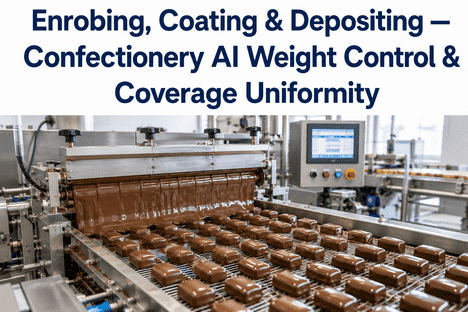
The global confectionery enrobing, coating, and depositing equipment market was valued at USD 3.8 billion in 2025 and is projected to exceed USD 5.6 billion by 2034, driven by rising demand for premium chocolate products, clean-label confectionery, and automated production lines with precise weight and coverage control. In chocolate and confectionery manufacturing, enrobing and coating operations directly determine product appearance, mouthfeel, and compliance with declared net weight yet most facilities still rely on periodic manual weight checks and operator-adjusted coating parameters that miss the real-time variations in chocolate temper, coating viscosity, enrober curtain flow, and depositor nozzle performance. Process engineers responsible for enrobing machines, coating drums, and depositing systems face a persistent challenge: how to maintain consistent coating weight and coverage uniformity across millions of pieces per shift while managing the complex interplay of chocolate tempering curves, product temperature, coating viscosity, enrober blower speed, and depositor shot weight variables that shift with ambient conditions, recipe changes, and gradual mechanical wear. AI-driven enrobing, coating, and depositing optimisation has emerged as the most effective response, converting the confectionery production line from a weight-check-and-adjust process into a continuously optimised weight control and coverage uniformity platform that ensures every piece meets specification.
Why Enrobing, Coating & Depositing Lines Need AI Weight Control and Coverage Uniformity Monitoring
From chocolate tempering curves to depositor shot weights — every variable that affects piece weight and coverage depends on data you cannot capture with periodic manual sampling.
Traditional enrobing and coating line management relies on operator-adjustable parameters based on periodic weight checks, visual coverage inspection, and temper meter readings taken every 30 to 60 minutes. The problem is that these approaches miss the rapid micro-variations that occur between sampling intervals — the subtle drift in chocolate temper as the tempering unit transitions between production runs, the gradual increase in coating viscosity as enrober chocolate ages, the fluctuation in enrober curtain uniformity caused by pump pulsation or nozzle blockage, and the shift in depositor shot weight as piston seals wear or product temperature changes. Process engineers operating enrobing, coating, and depositing equipment face particularly high stakes: an undetected tempering curve deviation can produce a full production shift of bloom-prone product, while a depositor weight drift during a high-speed run can result in thousands of out-of-specification pieces before the next scheduled weight check. AI enrobing and coating performance monitoring addresses these challenges by creating a continuous digital model of the entire coating line, learning the normal operating patterns for each parameter, and detecting anomalies at the earliest possible moment — typically 15 to 45 seconds before a significant deviation would be detectable by conventional weight sampling.
The Science of AI Enrobing, Coating & Depositing Optimisation
How machine learning transforms confectionery coating lines from reactive weight-check operations into continuously optimised precision coating platforms.
AI enrobing, coating, and depositing optimisation operates at the intersection of food rheology, heat transfer, fluid dynamics, and data science. Every enrobing and coating process generates characteristic sensor signatures during normal operation — specific relationships between chocolate temper index, coating viscosity, enrober pump speed, curtain height, blower pressure, depositor nozzle pressure, and product temperature. When a parameter begins to drift out of the optimal range, these signatures shift in measurable ways, often within seconds of the deviation starting. The AI model learns the normal operating envelope for each coating parameter across all product types, recipe variants, and production conditions — different chocolate types, coating formulations, product centre temperatures, line speeds, and ambient conditions — and continuously evaluates current readings against the expected range. When a measurement falls outside the predicted envelope, the system generates an immediate warning with the specific parameter identified and the probable root cause indicated. This real-time precision control capability transforms the process engineer's relationship with the enrobing line: instead of reacting to out-of-specification weight check results and visual coverage defects, the team can make micro-adjustments continuously, maintaining consistent coating weight and coverage uniformity across every piece produced.
1. Chocolate Tempering Curve Optimisation — AI-Controlled Crystal Formation
Chocolate tempering is the most critical process parameter in enrobing operations. Even a 0.5°C deviation from the optimal tempering curve can shift the crystal distribution toward unstable forms, producing a coating that blooms within weeks. AI tempering curve monitoring continuously tracks the temper index and compares it against the optimal curve for the current chocolate type and production conditions. The model predicts the temper index 5 to 15 minutes into the future, enabling proactive adjustment before the chocolate reaches the enrober in an out-of-temper condition. Result: 60 to 80 percent reduction in bloom-related coating defects.
2. Enrober Curtain Flow and Coverage Uniformity — Real-Time Coating Distribution Control
The enrober curtain must provide uniform coverage across the full width of the product bed. AI enrober monitoring uses an array of load cells across the curtain width to create a real-time curtain profile map. When the profile shows uneven distribution, the AI identifies the cause — pump cavitation, nozzle blockage, temperature gradients — and dynamically adjusts pump speed, curtain height, and blower pressure to restore uniform flow within 2 to 5 seconds. For multi-product lines, the AI stores the optimal curtain profile for each product and automatically adjusts during changeovers.
3. Coating Viscosity and Temperature Management — AI-Predicted Rheological Control
Coating viscosity directly determines coating thickness and weight per piece. AI viscosity monitoring estimates real-time viscosity from temperature, pump motor current, curtain flow rate, and product contact time — eliminating manual flow-cup measurements. The AI predicts viscosity evolution over the next 15 to 30 minutes, enabling proactive temperature adjustment and chocolate replenishment scheduling. Result: 25 to 35 percent reduction in chocolate ageing waste and consistent coating weight across extended runs.
4. Depositor Shot Weight and Fill Volume Control — AI-Precision for Molded Confectionery
Depositor shot weight accuracy depends on piston seal condition, product viscosity, and nozzle pressure. AI depositor monitoring evaluates shot weight consistency across each nozzle station using pressure transducers, position encoders, and machine vision. The AI detects the earliest signs of piston seal degradation or valve timing drift — typically 200 to 500 cycles before the deviation produces a measurable violation. Result: 50 to 70 percent reduction in shot weight variability and 2 to 4 percent reduction in giveaway.
5. Enrober Blower and Air Knife Optimisation — AI-Controlled Excess Coating Removal
Blowers and air knives remove excess coating after the curtain. AI blower optimisation evaluates the relationship between blower pressure, product temperature, coating viscosity, and achieved coating weight — adjusting blower pressure and air knife position in real time as conditions change. For bottom-coated or striped products, the AI coordinates multiple blowers for precise coating distribution patterns, eliminating manual trial-and-error adjustment.
6. Coating Weight Prediction and Giveaway Reduction — Real-Time Weight Estimation
AI coating weight prediction combines enrober curtain flow, blower pressure, product temperature, and line speed to estimate coating weight on every piece — achieving accuracy within 0.1 to 0.3 grams. This enables a fundamental shift from targeting average weight 2-4 percent above declared (pure giveaway) to targeting minimum acceptable weight with confidence. Typical giveaway reduction: 1.5 to 3.5 percent of total coating weight, representing USD 150,000 to 350,000 in annual savings.
7. Changeover Optimisation and Recipe Management — AI-Accelerated Product Transitions
AI changeover optimisation stores optimal parameters for every product and automatically executes transitions at the optimal moment. The AI recommends the optimal product sequence to minimise changeover impact. Result: 40 to 60 percent reduction in changeover time and 50 to 70 percent reduction in transition waste.
8. Predictive Maintenance for Enrobing, Coating & Depositing Equipment
AI predictive maintenance monitors vibration signatures, motor current patterns, pump pressure profiles, and nozzle temperature distribution to detect the earliest signs of component degradation. For depositor systems, the AI tracks each piston's force profile — detecting seal wear 2 to 5 days before failure. For enrober pumps, the AI monitors pressure ripple patterns indicating cavitation or seal wear. Result: 45 to 60 percent reduction in unplanned coating line downtime.