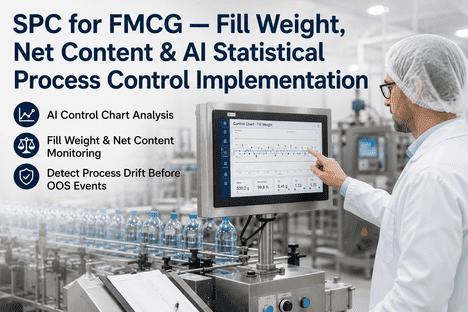
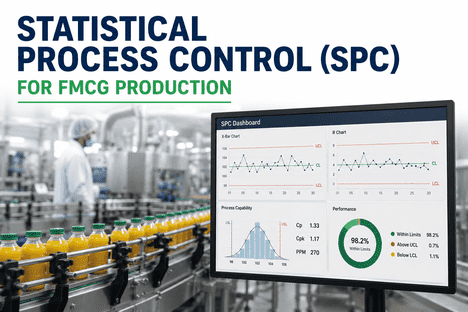
A process engineer starts the morning shift review and sees the same pattern on the fill weight control chart: the running average has drifted 1.8 grams above the target since the last product changeover three hours ago. The line is still within specification limits, but the drift is costing the facility an estimated $14,000 per shift in product give-awa product that is shipped to customers at no additional revenue. Meanwhile, on line 4, a gradual decline in fill weight caused by pump wear went undetected through six hourly samples before a final check-weight station caught an underfill at 92% of declared net content, triggering a 2-hour line stop and a batch segregation that consumed three quality technicians for the remainder of the shift. The gap between traditional SPC periodic manual samples plotted on static control charts and AI-powered SPC that monitors every fill event in real time, detects drift at inception, and adjusts process parameters before the deviation reaches the control limit, is the difference between a facility that loses 3-5% of revenue to give-away and OOS events and one that operates at target fill weight with zero OOS incidents. iFactory's AI SPC platform closes that gap. Book a Demo to see how AI SPC transforms your fill weight control process.
AI SPC · FILL WEIGHT CONTROL · NET CONTENT COMPLIANCE · FMCG
Eliminate Fill Weight Give-Away and Out-of-Spec Events with AI-Powered Statistical Process Control.
iFactory's AI SPC platform monitors every fill event in real time, detects process drift at inception, and adjusts parameters before deviation reaches control limits — delivering target fill weight accuracy with zero OOS incidents across every production line.
3-5%
Average revenue lost to product give-away — fill weight above declared net content that is shipped at no additional revenue per unit
60%+
Of FMCG facilities still rely on manual SPC with periodic sample weighing — creating detection gaps between measurements that allow drift to go unnoticed for hours
30%+
Reduction in OOS events with AI-powered SPC — real-time detection and correction before products fall below declared net content
12%+
Reduction in give-away with real-time fill weight adjustment — AI detects drift at inception and corrects before cumulative loss exceeds 0.1% of target
The Fill Weight Control Problem — Why Traditional SPC Costs FMCG Facilities Millions in Give-Away and OOS Penalties
Process engineers running FMCG filling lines manage two competing constraints: the regulatory requirement to never ship product below declared net content, and the commercial pressure to minimise give-away above the declared fill weight. Traditional SPC — periodic manual samples plotted on X-bar and R charts with fixed control limits calculated from historical data — cannot optimise both constraints simultaneously. The sampling interval creates detection gaps during which fill weight drift goes unnoticed, and the fixed control limits cannot distinguish between normal process variation and developing drift. The result is that process engineers default to running fill weights 2-5% above the declared target — a safety margin that costs mid-sized FMCG facilities $500,000 to $2 million per year in unrecoverable product give-away. AI-powered SPC eliminates this compromise by monitoring every fill event, detecting drift at the moment it begins, and enabling real-time process adjustment that keeps fill weight at the declared target with zero OOS risk.
Product Density Variation
Raw material properties shift between batches, changing the volumetric fill weight relationship
Ingredient temperature, viscosity, particle size distribution, and moisture content vary between raw material deliveries and production batches. For volumetric fillers — which represent 70%+ of FMCG filling lines — these density variations translate directly into fill weight shifts that static SPC cannot anticipate. A 2% density shift between ingredient lots can cause a 1.5 gram fill weight shift on a 500 gram product — enough to push the process from target to the control limit edge without any mechanical change to the filler.
Equipment Wear & Calibration Drift
Pump wear, nozzle deposits, and seal degradation cause gradual fill weight drift that manual sampling detects too late
Filler components degrade progressively — piston seals wear, nozzle orifices enlarge from abrasive product flow, and check-weigher load cells drift from thermal cycling. The drift is typically 0.1-0.3 grams per week on a 500 gram fill — imperceptible in hourly manual samples but cumulative over a production run. By the time a manual sample detects the drift, the line may have produced 30-60 minutes of off-target product. AI SPC detects the drift trend within 3-5 fill events and alerts the process engineer before cumulative deviation exceeds 0.1% of target.
Environmental Factors
Ambient temperature shifts and humidity changes alter product density and filler performance across production hours
A morning production start at 18 degrees C versus afternoon production at 32 degrees C changes product viscosity by 15-25% for many liquid and semi-liquid FMCG products — directly affecting the volumetric fill weight relationship. Facilities without HVAC-controlled production environments experience fill weight cycles that track the daily temperature curve, with give-away peaking during the coolest hours and OOS risk peaking during the warmest hours. AI SPC models these environmental correlations and adjusts fill parameter targets proactively rather than reacting to the weight deviation after it appears on the control chart.
Book a Demo to see how iFactory's AI models eliminate environmental fill weight variation.
What Traditional SPC Misses — The Hidden Cost of Sampling Intervals and Static Control Limits
Give-away from safety margin padding
Process engineers set target fill weight 2-5% above declared net content to avoid OOS risk — cost is pure product loss at $0.50-$2.00 per 1000 units per gram of give-away.
OOS detection latency
Manual SPC samples at 30-minute intervals create detection windows where 300-6000 units can be produced below declared net content before the next sample identifies the deviation.
Control limit irrelevance
Static control limits calculated during process qualification assume the process remains stationary indefinitely — in reality, every filling line experiences continuous drift from wear, material variation, and environmental change.
Regulatory penalty exposure
FDA 21 CFR Part 101, EU FIC Regulation 1169/2011, and NMI Trade Measurement requirements impose penalties for net content violations that can reach $10,000 per violation per SKU per jurisdiction.
What AI-Powered SPC for Fill Weight Control Actually Delivers
iFactory's AI SPC platform is not a software licence with a control chart template. It is an operational intelligence layer that monitors every fill event, correlates fill weight with every upstream process variable, and enables real-time process adjustment that keeps the filling line operating at target with zero OOS incidents.
Capability 01
Real-Time Fill Weight Monitoring — Every Fill Event, Every Nozzle, Every Second
Continuous Surveillance
iFactory's AI SPC platform connects to in-line check-weighers, flow meters, and filler control systems to capture fill weight data for every individual unit produced — not a sample every 30 minutes. For a multi-nozzle filler running 600 units per minute across 24 nozzles, this means 600 individual fill weight data points per minute, per filler head — enabling per-nozzle control charts that identify a single worn nozzle within seconds of drift onset. The platform compares each fill weight against the declared target, the regulatory lower tolerance limit, and the dynamically calculated upper control limit — flagging any unit that approaches within 95% of the OOS threshold for immediate corrective action. Process engineers see live fill weight distributions per line, per nozzle, per product SKU on unified dashboards that update with every fill event.
600+ data points per minute per line
Per-nozzle control charts
Live fill weight dashboards per SKU
Capability 02
AI Control Chart Analysis — Trend Detection at Inception, Not After the Sixth Consecutive Point Beyond the Limit
Predictive Drift Detection
Traditional SPC control charts use Western Electric or Nelson rules to detect out-of-control conditions — rules that require 6-8 consecutive points beyond a control limit before signalling a process shift. By the time these rules trigger, the process has been off-target for 6-12 minutes in a manual sampling regime or 30-60 seconds in a continuous monitoring regime. iFactory's AI control chart analysis uses multivariate drift detection models that identify the onset of fill weight drift within 3-5 fill events — before the trend produces a single point beyond the control limit. The AI model correlates fill weight trends with upstream variables — product temperature, filler pressure, nozzle wear index, line speed — to distinguish between random variation and developing drift, eliminating false alarms while detecting real shifts at the earliest possible moment.
Drift detected within 3-5 fill events
Multivariate correlation engine
False alarm elimination vs static rules
Capability 03
Automated Process Adjustment — Corrective Action Without Operator Intervention
Closed-Loop Control
When the AI control chart analysis identifies fill weight drift below the actionable threshold, the platform can issue automated adjustment commands to the filler control system — adjusting fill time, nozzle pressure, or volumetric displacement to bring the running average back to target. The adjustment is calculated to compensate for the measured drift magnitude and is executed within the same production cycle, eliminating the 3-7 minute delay between drift detection and manual operator intervention. For process engineers managing 6-12 filling lines simultaneously, this automated adjustment capability is the difference between a line that operates continuously at target fill weight and one that cycles between give-away and OOS risk across every production hour.
Automated filler parameter adjustment
Same-cycle drift correction
Multi-line closed-loop control
Capability 04
OOS Prediction and Prevention — Regulatory Compliance Without the Safety Margin
Zero OOS Operations
The platform's prediction models forecast fill weight trends 5-15 minutes into the future based on current drift velocity, upstream parameter trends, and historical correlation patterns. When the forecast predicts that the running average will breach the regulatory lower tolerance limit within the forecast window, the system alerts the process engineer and, where configured, initiates corrective adjustment before any actual unit falls below declared net content. This predictive capability is what enables facilities to reduce the fill weight safety margin from 2-5% to under 0.5% while maintaining zero OOS incidents — converting give-away that represented 3% of shipped product value into recovered revenue at effectively zero marginal cost. For a facility shipping $100 million in product annually, closing a 3% give-away gap to 0.5% recovers $2.5 million per year in otherwise lost product value.
5-15 minute drift forecasting
Safety margin reduction from 3% to 0.5%
Proactive OOS prevention, not detection
Stop Losing 3-5% of Revenue to Fill Weight Give-Away. AI SPC Delivers Target Fill Weight with Zero OOS Events.
Real-time fill weight monitoring, AI control chart analysis, automated process adjustment, and predictive OOS prevention — deployed across every filling line with per-nozzle granularity.
Traditional SPC vs. AI SPC — How the Models Compare Across What Process Engineers Actually Measure
Process engineers evaluating SPC solutions for fill weight control need to understand how each approach performs on the dimensions that determine give-away reduction, OOS prevention, and regulatory compliance outcomes.
SPC Comparison — Traditional Manual SPC vs. iFactory AI SPC Across Key Fill Weight Dimensions
Dimension
iFactory AI SPC
Traditional Manual SPC
Data collection frequency
Every fill event — 600+ data points per minute per line
Periodic samples — 2-4 data points per hour per line
Control limit calculation
Dynamic — recalculated continuously based on real-time process behaviour and upstream variable correlation
Static — calculated from historical data, rarely updated between requalification cycles
Drift detection speed
Within 3-5 fill events — drift detected at inception
After 6-8 consecutive points beyond control limits — 30-60 min delay typical
Give-away level
Under 0.5% above declared target — predictive control eliminates safety margin
2-5% above declared target — safety margin required to buffer detection latency
OOS incident rate
Zero — predictive OOS prevention adjusts before any unit falls below declared net content
1-3 events per month per line — detection latency and static limits miss developing drift
Process adjustment method
Automated — AI issues adjustment commands to filler control system within same production cycle
Manual — operator identifies drift, calculates adjustment, implements corrective action — 3-7 min delay
Regulatory compliance
Continuous documented compliance — every fill event recorded with full traceability for FDA, EU FIC, NMI audits
Sample-based compliance — gaps in recorded data create audit exposure for net content declaration verification
"
We were running our fill weight target at 3.2% above declared net content to keep the regulators comfortable. Our annual give-away across six filling lines was running at $1.8 million — product we made, packaged, and shipped at zero revenue. The process engineers knew the safety margin was too high, but every time we tried to tighten it, an OOS event would hit during a temperature swing or material changeover and the margin would go right back up. iFactory's AI SPC platform gave us the real-time visibility and predictive control to drop the margin to 0.4% in the first 90 days — and we have not had a single net content violation since deployment. The platform paid for itself in give-away reduction within the first four months.
— Process Engineering Director, Multi-Site FMCG Manufacturer — 14 Filling Lines Across 3 Facilities
Who AI SPC for Fill Weight Control Is Built For — and What Production Profiles It Fits Best
AI SPC for fill weight control is not the right solution for every FMCG facility. It is the right solution for specific operational profiles — and the fit is strong enough in those profiles to make AI SPC the definitive improvement over traditional manual SPC methods.
Strong Fit — AI SPC Definitively Wins
Facilities running 4+ filling lines with in-line check-weighers where manual SPC sampling creates detection gaps that lead to OOS events or excessive give-away safety margins
Process engineers managing products with tight net content tolerance limits (under 2% margin above declared weight) where the cost of give-away compounds across high-volume production runs
Multi-nozzle filler operations where individual nozzle wear creates asymmetric fill weight distribution that aggregate sampling cannot detect until one nozzle has drifted significantly
Regulated product categories where net content compliance documentation must demonstrate every-unit traceability rather than sample-based statistical inference
Growing Fit — AI SPC Accelerates What Manual SPC Cannot Achieve
Facilities with manual check-weighing processes transitioning to in-line check-weighers — where the hardware investment has been made but the statistical process control methodology has not been updated to leverage continuous data
Process engineers who have implemented traditional SPC software but find that static control limits and manual sampling intervals still leave fill weight variation unmanaged between samples
High-speed filling lines operating above 400 units per minute where the sampling ratio (samples per 1000 units produced) is too low to provide statistical confidence in fill weight control
Facilities where regulatory audit findings related to net content declaration accuracy have identified SPC methodology gaps that require continuous monitoring capability to close
Conclusion — From Safety Margin to Target Fill Weight: The AI SPC Transition
For the process engineer responsible for fill weight control across multiple FMCG filling lines, the choice between traditional manual SPC and AI-powered SPC is a choice between accepting 3-5% give-away as an unavoidable cost of regulatory compliance and recovering that product value as revenue with zero OOS risk. iFactory's AI SPC platform delivers the real-time monitoring, predictive drift detection, and automated process adjustment required to operate every filling line at target fill weight — not at a safety margin that costs the facility millions per year in unrecoverable product loss.
The under-0.5% give-away level is a revenue recovery outcome. The zero OOS incident rate is a regulatory compliance outcome. The per-nozzle control chart visibility is a maintenance optimisation outcome that compounds in value as the filling equipment ages. For process engineers and quality leaders seeking to eliminate the hidden cost of fill weight safety margins and transform SPC from a periodic documentation exercise into a continuous profit protection capability, Book a Demo with iFactory's AI SPC engineering team.
Frequently Asked Questions — AI SPC for Fill Weight Control in FMCG Manufacturing
Every Fill Event Is a Data Point. iFactory AI SPC Turns Them Into Profit Protection.
Real-time fill weight monitoring across every nozzle, AI control chart analysis that detects drift at inception, automated process adjustment that maintains target fill weight, and predictive OOS prevention that eliminates the safety margin — all deployed on your existing filling lines without equipment modification.