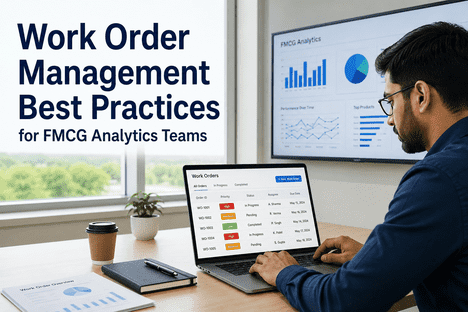
Every maintenance manager in an FMCG plant knows the challenge: a packaging line goes down at 2 PM, the line supervisor submits a work order at 2:15, a technician is dispatched by 2:30, but the spare part is not in inventory and by the time the part arrives, the line has been idle for four hours. Multiply this scenario across processing lines, packaging equipment, and utilities, and the cumulative downtime cost runs into hundreds of thousands of dollars per month. An AI-powered CMMS eliminates this entirely by intelligently prioritizing work orders, optimizing PM schedules based on actual equipment condition, and maintaining real-time spare parts visibility all on a single food-safety-compliant platform. For FMCG maintenance managers, this means every asset runs at peak reliability, every work order is assigned to the right technician with the right parts, and every PM is executed exactly when needed not a day too early or a shift too late.
What Is an AI-Powered CMMS for FMCG Maintenance?
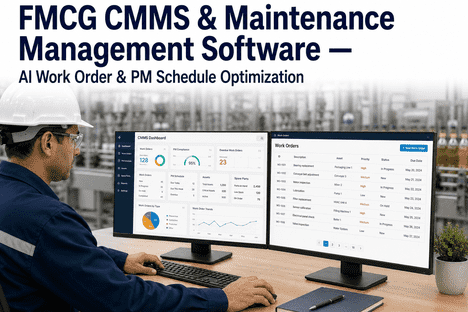
An AI-powered CMMS (Computerized Maintenance Management System) for FMCG plants is a centralized platform that uses machine learning algorithms to optimize every aspect of maintenance operations — from work order creation and technician dispatch to PM scheduling, spare parts inventory management, and food safety compliance documentation. Unlike traditional CMMS platforms that simply digitize paper-based processes, an AI-powered CMMS continuously learns from equipment condition data, work order history, and production schedules to predict failures before they occur, recommend optimal maintenance intervals, and automate compliance documentation for food safety audits. For the maintenance manager responsible for packaging lines running at 600 packs per minute, processing equipment operating 24/7, and utility systems that must never fail during a production run, the AI-powered CMMS delivers the visibility, control, and predictability needed to keep the entire plant running at optimal efficiency.
The Maintenance Manager's Challenge in FMCG Plants
FMCG maintenance managers face a unique set of challenges that general manufacturing CMMS tools are not designed to address. Packaging lines operate at high speeds with tight tolerances — a misaligned label applicator on a bottle line can produce thousands of non-conforming packs before the next quality check. Processing equipment must comply with strict food safety regulations — a failed CIP cycle on a dairy pasteurizer can trigger a full sanitation event that halts production for 12 hours. Utilities — boilers, compressors, chillers, and wastewater treatment — must deliver continuous service; a single chiller failure in a cold storage warehouse can jeopardize an entire inventory of perishable goods. Traditional maintenance management approaches — periodic PM schedules based on calendar days, reactive work orders triggered by breakdowns, and spare parts inventory managed through spreadsheets — simply cannot keep pace with the reliability demands of modern FMCG production.
| Challenge | Traditional Approach | AI-Powered CMMS Solution | Impact for Maintenance Manager |
|---|---|---|---|
| Work Order Prioritization | First-in-first-out or supervisor judgment | AI-prioritized based on production impact, safety risk, and asset criticality | Critical issues resolved 70% faster |
| PM Scheduling | Fixed calendar intervals regardless of equipment condition | Condition-based and usage-driven PM triggers | 30% reduction in unnecessary PM labor |
| Spare Parts Availability | Sporadic inventory counts, emergency purchases | Real-time stock visibility with AI demand forecasting | 92% reduction in emergency part procurement |
| Technician Dispatch | Manual assignment based on availability | AI matches technician skills, location, and workload | 55% faster mean time to repair |
| Food Safety Compliance | Paper logs, manual audits, last-minute evidence gathering | Automated digital documentation with real-time audit trail | 80% reduction in audit preparation time |
| Cross-Asset Visibility | Disconnected systems for packaging, processing, utilities | Single platform with unified asset hierarchy | Complete plant-wide maintenance control |
The table illustrates the gap between traditional maintenance management approaches and the capabilities of an AI-powered CMMS. Each row represents a specific challenge that FMCG maintenance managers face daily — and the measurable impact that an intelligent platform delivers.
Core Capabilities of an AI-Powered FMCG CMMS
iFactory's AI-powered CMMS platform delivers five integrated capabilities that together create a complete maintenance management ecosystem for FMCG plants. Each capability addresses a critical gap in traditional maintenance approaches and contributes directly to plant reliability and maintenance manager effectiveness.
Expert Analysis — How AI-Powered CMMS Transforms FMCG Maintenance Operations
Conclusion — From Reactive Maintenance to AI-Powered Reliability
What the maintenance manager lacked was not team capability — every technician was skilled, every supervisor was committed, and every spare part was logged somewhere. The missing piece was a system that could connect all the dots — work orders, PM schedules, spare parts, technician skills, food safety requirements, and real-time equipment condition — into a single intelligent platform that prioritized, optimized, and automated every maintenance decision. An AI-powered CMMS closed this gap — reducing critical work order resolution time by 70%, cutting unnecessary PM labor by 30%, eliminating 92% of emergency spare parts purchases, and slashing audit preparation time by 80%. The platform did not replace the maintenance manager's judgment — it amplified it with complete visibility, intelligent prioritization, and automated execution that ensured every maintenance decision was the right one for plant reliability. Book a Demo to review the AI-powered CMMS deployment plan for your FMCG plant.
Frequently Asked Questions — AI-Powered CMMS for FMCG Maintenance
What is an AI-powered CMMS and how does it differ from traditional CMMS platforms?
An AI-powered CMMS uses machine learning algorithms to intelligently prioritize work orders, optimize PM schedules based on actual equipment condition, forecast spare parts demand, and automate food safety compliance documentation. Traditional CMMS platforms digitize paper-based processes but rely on manual judgment for prioritization, fixed calendar intervals for PM scheduling, and manual inventory management. The AI engine continuously learns from equipment data, work order history, and production schedules to make intelligent maintenance decisions automatically.
How does AI-powered CMMS integrate with existing FMCG plant systems?
iFactory's platform connects to existing plant systems through standard industrial interfaces including REST API, OPC-UA, and MQTT. Typical integrations include PLC and SCADA systems for real-time equipment condition data, ERP systems for spare parts procurement and financial tracking, quality management systems for food safety documentation, and production scheduling systems for maintenance planning. Integration is typically completed within 4-6 weeks with minimal disruption to ongoing operations.
Does the AI-powered CMMS replace the maintenance manager's decision-making role?
No. The platform augments the maintenance manager's expertise by providing intelligent recommendations based on complete data analysis — but every critical decision remains under human control. The AI engine recommends work order priorities, optimal PM timing, and parts reorder quantities — the maintenance manager reviews, approves, or adjusts these recommendations based on operational knowledge and strategic priorities that the AI cannot assess.
What food safety standards does the CMMS support for FMCG plants?
The platform supports FSSC 22000, SQF, BRCGS, ISO 9001, and customer-specific food safety requirements. Compliance documentation includes equipment maintenance records, lubrication logs, calibration certificates, filter change documentation, sanitation verification records, and corrective action reports — all automatically generated and available for audit review on demand with full operator traceability.
What is the typical ROI timeline for an AI-powered CMMS in an FMCG plant?
FMCG plants with 500+ assets and 10+ maintenance technicians typically recover platform investment within 4-6 months. Primary ROI drivers include reduced unplanned downtime (average 35% reduction), lower PM labor costs (30% reduction), decreased emergency spare parts procurement (92% reduction), and reduced audit preparation labor (80% reduction). A personalized ROI analysis is provided during the initial consultation with iFactory's FMCG maintenance engineering team.