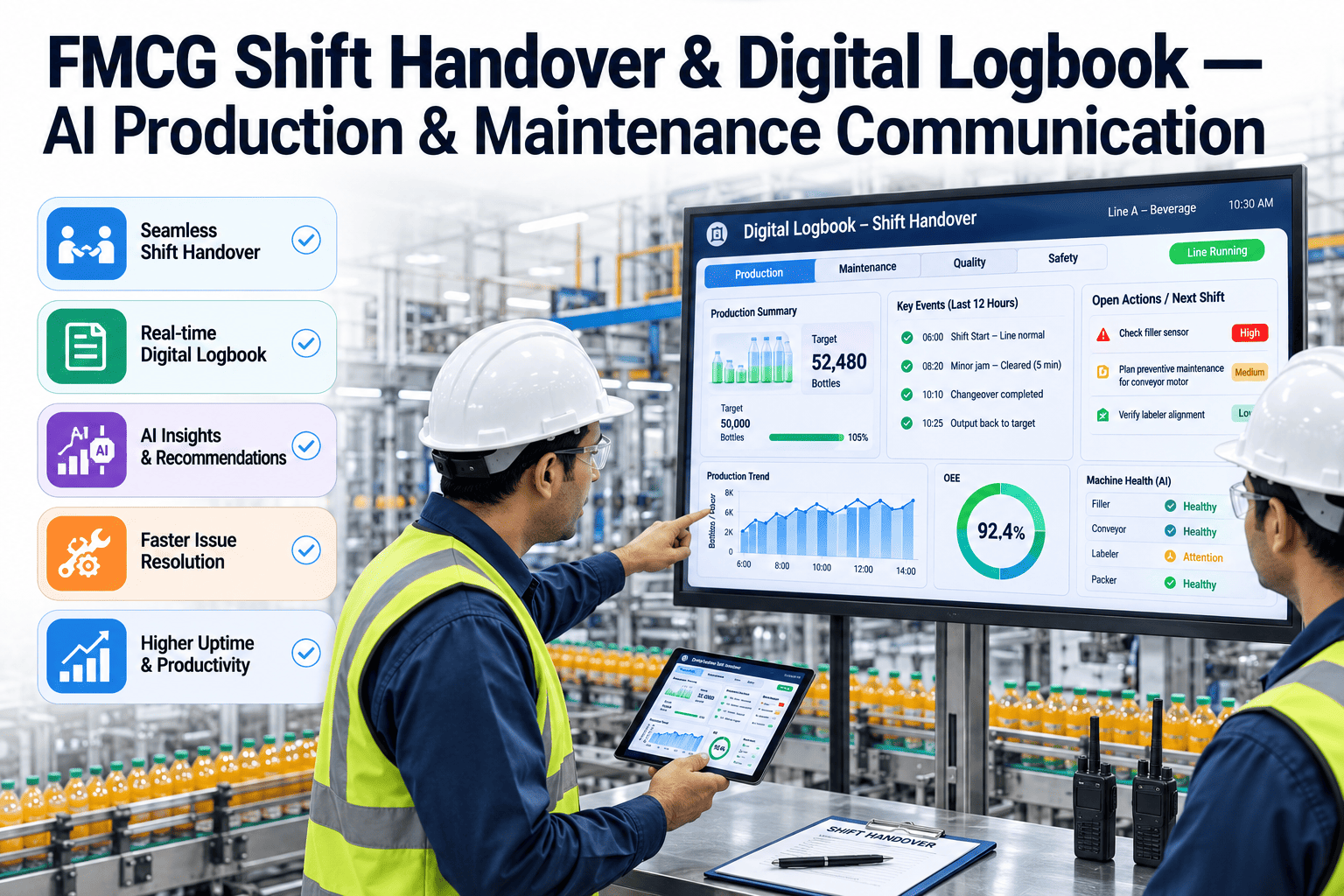
FMCG Shift Handover & Digital Logbook — AI Production & Maintenance Communication

By James Smith on August 25, 2026

fmcg-shift-handover-digital-logbook-ai-production

The night shift catches a quality hold on a batch at 5:40 in the morning, scribbles a note on a clipboard, and goes home twenty minutes later when the shift ends. The day shift supervisor arrives, skims a logbook full of similar handwritten notes from the past week, and misses it entirely because nothing flagged it as unresolved. Three hours later that same batch gets released by mistake, and the plant spends the rest of the day untangling a problem that a five-minute structured handover would have prevented. This exact scenario repeats across FMCG plants constantly, not because people are careless, but because a paper logbook has no way to guarantee that what matters actually survives the handoff, which is the gap ifactory support helps close with digital shift handover.

iFactory Digital Shift Handover

Make Sure What Matters Actually Survives the Handoff

AI-structured shift handover and digital logbooks that carry changeover status, quality holds, equipment issues, and safety observations forward automatically, instead of hoping the next shift reads every line of a paper notebook.

Why Handover Is the Weakest Link in Continuous FMCG Production

FMCG lines rarely stop, which means every shift change is a moment where critical context has to transfer between two teams who may never actually speak to each other face to face. A rushed five-minute verbal handover, backed by a paper logbook nobody has time to fully read, is expected to carry forward everything from an in-progress changeover to an unresolved safety observation. When that transfer fails, the cost rarely shows up immediately. It shows up hours later as a quality escape, a repeated troubleshooting effort on an issue the previous shift already diagnosed, or a safety hazard that never got flagged to the team now working near it.

A 24-Hour Production Cycle, Three Handover Points
6 AM Handover 2 PM Handover 10 PM Handover Day Shift Evening Shift Night Shift

What a Structured Digital Handover Actually Enforces

The problem with a paper logbook is not the paper itself, it is that nothing requires an entry to be complete, specific, or actually read by the next shift. A structured digital process fixes each of those gaps by design rather than relying on discipline alone.

Mandatory Fields
Changeover status, open quality holds, and equipment issues cannot be skipped, unlike a free-text paper entry that can leave a section blank.
Read Confirmation
The incoming supervisor must actively acknowledge each open item rather than simply signing a logbook page without reading it closely.
Auto-Carried Open Items
An unresolved issue automatically carries forward to the next handover until it is formally closed, instead of disappearing after one shift.
Searchable History
Past handover records are searchable by line, SKU, or issue type, so a recurring problem becomes visible across weeks, not just one shift.
See a Real Handover Gap

Walk Us Through a Recent Miscommunication Between Shifts

We will show you how a structured digital handover would have surfaced that same issue before it became a problem.

What Belongs in Every Shift Handover

A good handover is not a summary of everything that happened, it is a focused transfer of exactly what the next shift needs to know to avoid repeating work or missing something critical. The four categories below cover the vast majority of what actually matters at a handoff.

Core Handover Categories
Category What Gets Captured Why It Matters
Changeover Status Current SKU, remaining steps, any deviation from plan Prevents the next shift from restarting a changeover already underway
Quality Holds Any batch or material currently on hold and why Prevents an accidental release of held product
Equipment Issues Faults, workarounds in use, and pending maintenance Stops the next shift from re-diagnosing an already-known issue
Safety Observations Any hazard, near-miss, or condition flagged during the shift Ensures the incoming team is aware of risks before they start

Rolling Out Digital Handover Without Disrupting the Shift Rhythm

Shift teams are understandably resistant to any process that slows down an already tight changeover window, so a digital handover process has to be faster than paper, not just more thorough, or it will not stick.

Phase 1
Define the Core Fields
Agree on the specific categories every handover must cover, based on what has historically caused miscommunication.
Phase 2
Pilot on One Line
Run the structured digital process on a single line for a few weeks to refine the fields and confirm it is actually faster than paper.
Phase 3
Add Read Confirmation
Introduce the acknowledgment step once the team is comfortable with the basic entry process.
Phase 4
Expand Site-Wide
Roll the validated process out across remaining lines and shifts using the pilot as the proven template.

Want to see how a recent handover would have looked in a structured digital format? Send us an example and we will show you.

Frequently Asked Questions

Won't a structured digital process take longer than a quick verbal handover?
In practice it tends to be faster once a team is used to it, because structured fields guide the outgoing supervisor through exactly what to report rather than leaving them to recall everything unprompted, which is often what makes verbal handovers run long and still miss things. The pilot phase is specifically designed to confirm the digital process saves time before it expands beyond one line. Talk to our team about typical handover time after the transition period.
How does this work for a plant running three shifts with limited overlap time between them?
Digital handover is actually most valuable in exactly this scenario, since a written, structured record does not depend on both supervisors being physically present at the same time the way a verbal handover does. The incoming supervisor can review and acknowledge the digital handover the moment they arrive, even if the outgoing supervisor has already left. Book a walkthrough to see how this fits a limited-overlap shift pattern.
Does this integrate with our existing quality hold and maintenance systems?
Yes, the handover process is designed to pull relevant status directly from existing quality and maintenance systems where possible, rather than asking a supervisor to manually re-enter information that already exists elsewhere, which reduces both the time required and the risk of a transcription error. Reach out to our team to confirm integration with your specific systems.
What happens to the handover history over time — does it just accumulate unused?
No, the searchable history is one of the most valuable parts of the system, since it lets a plant manager spot a recurring issue across weeks of handovers that would be nearly impossible to notice by flipping through individual paper logbook pages. Many plants use this history directly in root-cause investigations when the same problem keeps reappearing across different shifts. Book a scoping call to see how this history could support your existing improvement process.
How do you get shift teams to actually adopt a new handover process instead of reverting to old habits?
Adoption improves significantly when the pilot phase genuinely proves the process is faster and catches things paper missed, since shift teams are pragmatic and will stick with a tool once they see it prevent a problem they would otherwise have inherited. Involving shift supervisors in defining the core fields during the pilot also builds ownership that a top-down mandate rarely achieves on its own. Contact our team for guidance on running an adoption-friendly pilot.
Close the Handover Gap.

Give Every Shift a Handover That Actually Carries What Matters

Bring a recent handover breakdown to the call. We will show you how a structured digital process would have caught it.
Share This Story, Choose Your Platform!