Most FMCG risk programs stop at the supplier they actually pay, which means the raw material grower, the sub-component molder, and the label printer three tiers back stay completely invisible until a shortage, a scandal, or a sanction forces the question of where the input really came from. A single tier-1 co-packer can look financially sound and still sit on top of a tier-3 palm oil estate with a labor violation or a tier-2 packaging mill exposed to a currency collapse, and none of that shows up in a standard vendor scorecard. Brands that only monitor the names on their purchase orders are, in practice, monitoring less than a third of the risk that actually sits inside their supply base. Mapping risk signals across every tier, not just the first, is what closes that gap, and booking a demo is the fastest way to see your own network mapped this way.
SUPPLY RISK · N-TIER MAPPING · FMCG
See the Risk Sitting Three Tiers Behind Your Tier-1 Supplier
iFactory maps financial, geopolitical, ESG, and cyber risk signals across your entire supplier network, tier by tier, so a problem at a sub-supplier surfaces as an early warning instead of a surprise shortage.
70%+
of supply disruptions in recent industry surveys originate below tier-1, outside the reach of standard vendor monitoring
4
distinct risk signal categories that need separate tracking logic to be caught reliably
24×7
continuous signal monitoring instead of a quarterly or annual supplier review cycle
THE VISIBILITY PROBLEM
Why Tier-1 Monitoring Misses Most of the Actual Risk
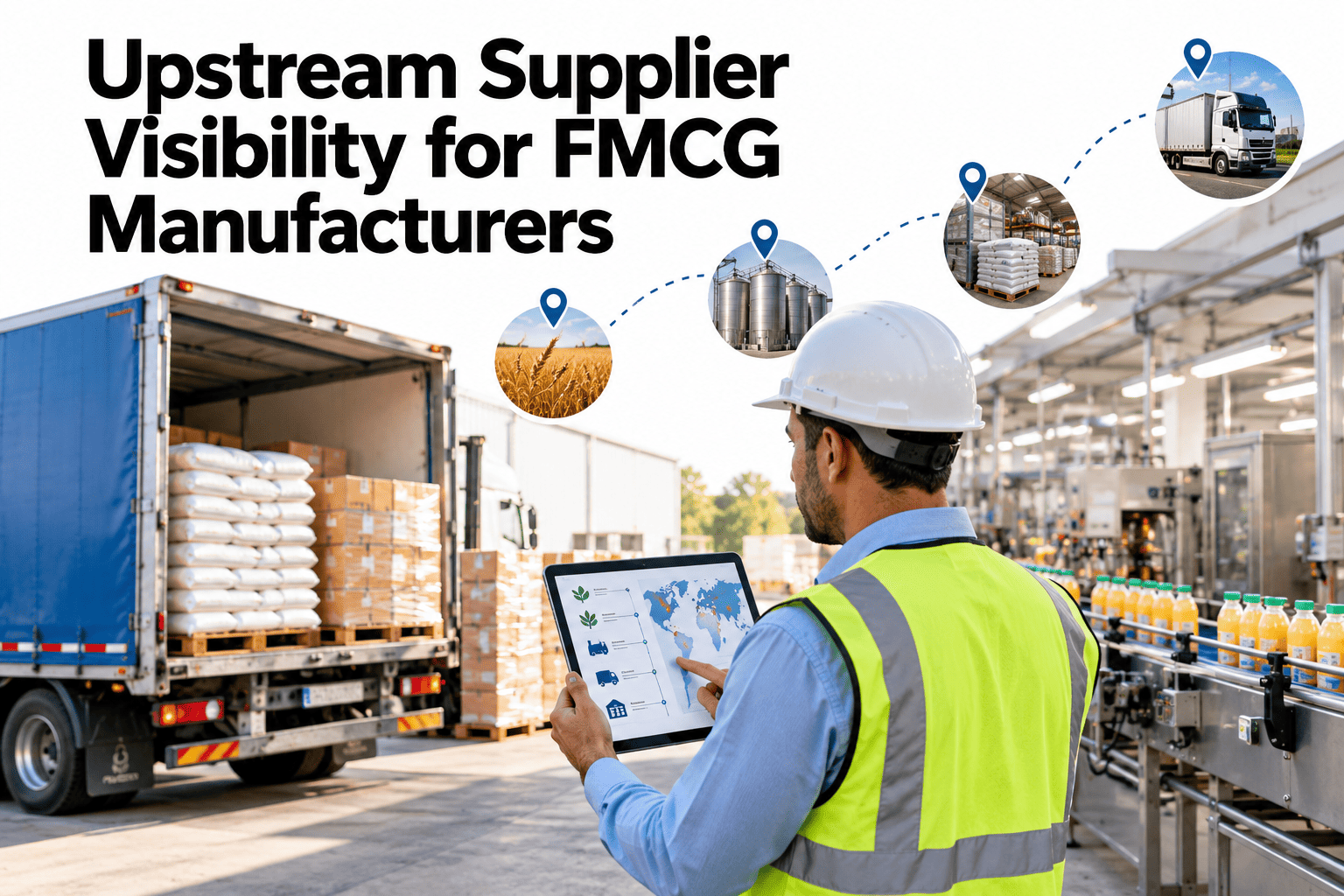
A finished goods brand typically has a direct commercial relationship, a contract, and a scorecard for its tier-1 co-packers and primary ingredient suppliers. Everything behind that first tier, the flavor house's raw material source, the packaging supplier's resin vendor, the ingredient broker's actual growing region, is contracted by someone else, invoiced by someone else, and therefore invisible to the brand's own procurement systems by default.
TIER 1
Direct Supplier
The co-packer or ingredient supplier you contract with directly, the only tier most scorecards actually reach.
TIER 2
Their Suppliers
The resin, flavor, or packaging vendor feeding your tier-1 partner, usually undisclosed unless specifically requested.
TIER 3
Raw Origin
The farm, mine, or mill where the underlying material actually originates, and where most ESG and geopolitical exposure lives.
By the time a risk event at tier 3 becomes visible to a brand, it has already traveled through two layers of suppliers with no obligation and often no ability to flag it upstream, which is why the disruption usually arrives as a shortage notice rather than an early warning.
FOUR SIGNAL TYPES
The Risk Categories a Real N-Tier Program Has to Track
Treating "supplier risk" as one score flattens four very different kinds of exposure that each need their own data sources and thresholds. A supplier can be financially perfect and still sit in a flood zone, or ESG-clean and one ransomware attack away from missing a shipment.
Financial Risk
Credit rating shifts, payment delinquency patterns, and liquidity signals across every tier, not just the supplier you invoice, since a tier-1 co-packer's own supplier going insolvent can stop your line just as fast as the co-packer's own default.
Geopolitical Risk
Trade restrictions, port congestion, sanctions exposure, and regional instability mapped against the actual origin points in your network, which are frequently several tiers removed from the country listed on your purchase order.
ESG Risk
Labor practice violations, deforestation exposure, and environmental compliance gaps that overwhelmingly concentrate at the raw material tier, the part of the network most brands have the least direct visibility into today.
Cyber Risk
Ransomware exposure and IT security posture across suppliers whose production systems, order management, or logistics scheduling could halt shipments without a single physical disruption ever occurring.
Find out what's sitting in your tier-2 and tier-3 network right now
iFactory can run an initial n-tier exposure scan against your current supplier list to show what's currently invisible before you commit to anything.
HOW MAPPING WORKS
Building the Tier Map From Your Existing Supplier Data
Getting to n-tier visibility doesn't require re-contracting every supplier relationship in your network, it requires connecting data you and your direct suppliers already have and layering external risk signals against it in a structure that actually reflects how the network is built.
1
Ingest Tier-1 Data
Pull existing procurement, contract, and shipment records for every direct supplier as the anchor point of the map.
2
Request Sub-Tier Disclosure
Structured disclosure requests to tier-1 partners surface their own supplier relationships without requiring new contracts on your side.
3
Overlay Risk Signals
Financial, geopolitical, ESG, and cyber data sources are matched against every identified node in the map, tier by tier.
4
Score and Monitor
Each node gets a live risk score that updates continuously rather than at the next scheduled supplier review.
TIER-1 ONLY VS N-TIER
What Changes When the Map Goes Deeper
The gap between tier-1 monitoring and n-tier monitoring isn't a matter of degree, it's a difference in what kinds of disruption a brand can see coming at all versus what it only learns about after the fact.
| Factor |
Tier-1 Only Monitoring |
N-Tier Monitoring |
| Network Coverage |
Direct suppliers only, typically under a third of total supply base exposure |
Full network depth including raw material and sub-component origin points |
| Disruption Warning |
Arrives as a shortage notice once the problem has already reached tier-1 |
Flagged at the origin tier, often weeks before it would surface upstream |
| ESG Accountability |
Limited to self-reported disclosures from direct suppliers |
Independently sourced signals matched against actual raw material origin |
| Review Frequency |
Quarterly or annual scorecard cycles |
Continuous monitoring with real-time alerting on new signals |
TURNKEY DELIVERY
How iFactory Builds the N-Tier Program
iFactory connects to your existing procurement systems, structures the sub-tier disclosure process with your tier-1 partners, and layers continuous risk monitoring on top so your team sees a live map rather than a one-time snapshot.
What Gets Built
Full network map connecting tier-1 through tier-3 and beyond where data allows
Separate scoring models for financial, geopolitical, ESG, and cyber risk
Real-time alerts when a node's risk score crosses your defined threshold
Dashboard access for procurement, quality, and risk teams in one place
Deployment Timeline
Weeks 1-3: Data ingestion from existing procurement and contract systems
Weeks 4-7: Sub-tier disclosure process and risk signal integration
Weeks 8-10: Dashboard go-live and alert threshold calibration
FREQUENTLY ASKED QUESTIONS
What FMCG Risk Teams Ask Before Going N-Tier
How do you get visibility into suppliers we don't have a direct contract with?
The map is built primarily through structured disclosure requests to your existing tier-1 partners, who already know their own suppliers even though that information rarely flows upstream in a standard vendor relationship. Combined with commercially available trade, customs, and shipping data, this fills in most sub-tier nodes without requiring new contracts on your side. Where disclosure is incomplete, the model flags the gap explicitly rather than presenting an assumed or estimated node as verified.
Book a demo to see how much of your current network can be mapped from existing data.
Will our tier-1 suppliers push back on disclosing their own sub-suppliers?
Some resistance is common the first time a disclosure request goes out, since suppliers are naturally protective of their own sourcing relationships, but most FMCG brands find compliance improves once the request is framed as risk continuity rather than competitive intelligence gathering. The disclosure process is structured to request risk-relevant categories, such as origin region and financial standing, rather than commercially sensitive pricing or contract terms, which reduces the friction considerably.
Contact our support team to see the disclosure request template used in similar programs.
How is this different from a standard supplier risk scorecard we already use?
A standard scorecard almost always stops at tier-1 and refreshes on a quarterly or annual cycle, which means it can only ever reflect risk that has already reached your direct supplier relationship. An n-tier program extends that same discipline several layers deeper and shifts from a periodic snapshot to continuous monitoring, so a financial or ESG signal at the raw material tier surfaces while there's still time to act rather than after a shipment has already been missed.
Book a demo to compare it directly against your current scorecard process.
Can this be scoped to just our highest-risk categories first instead of the whole network?
Yes, most programs start with a focused scope, often the ingredient categories with the highest geographic concentration or the packaging suppliers with known sub-tier ESG exposure, and expand from there once the initial mapping proves out. This keeps the first phase manageable and gives your team a concrete result to evaluate before committing to a full network rollout.
Contact our support team to scope a starting category list for your business.
What happens when the system flags a high-risk node several tiers deep?
The alert routes to your risk or procurement team with the specific signal driving the flag, whether that's a financial distress indicator, a geopolitical event near the origin region, an ESG violation report, or a cyber exposure at that node, along with the tier depth and the path connecting it back to your tier-1 relationship. From there, your team decides on the response, whether that's engaging the tier-1 partner directly, qualifying an alternate source, or simply monitoring the situation more closely.
Book a demo to see a sample alert and response workflow.
EVERY TIER, EVERY SIGNAL, CONTINUOUSLY
Stop Finding Out About Sub-Tier Risk After It's Already a Shortage
iFactory maps financial, geopolitical, ESG, and cyber risk signals across your full supplier network, tier by tier, so the next disruption shows up as an early warning instead of a surprise.