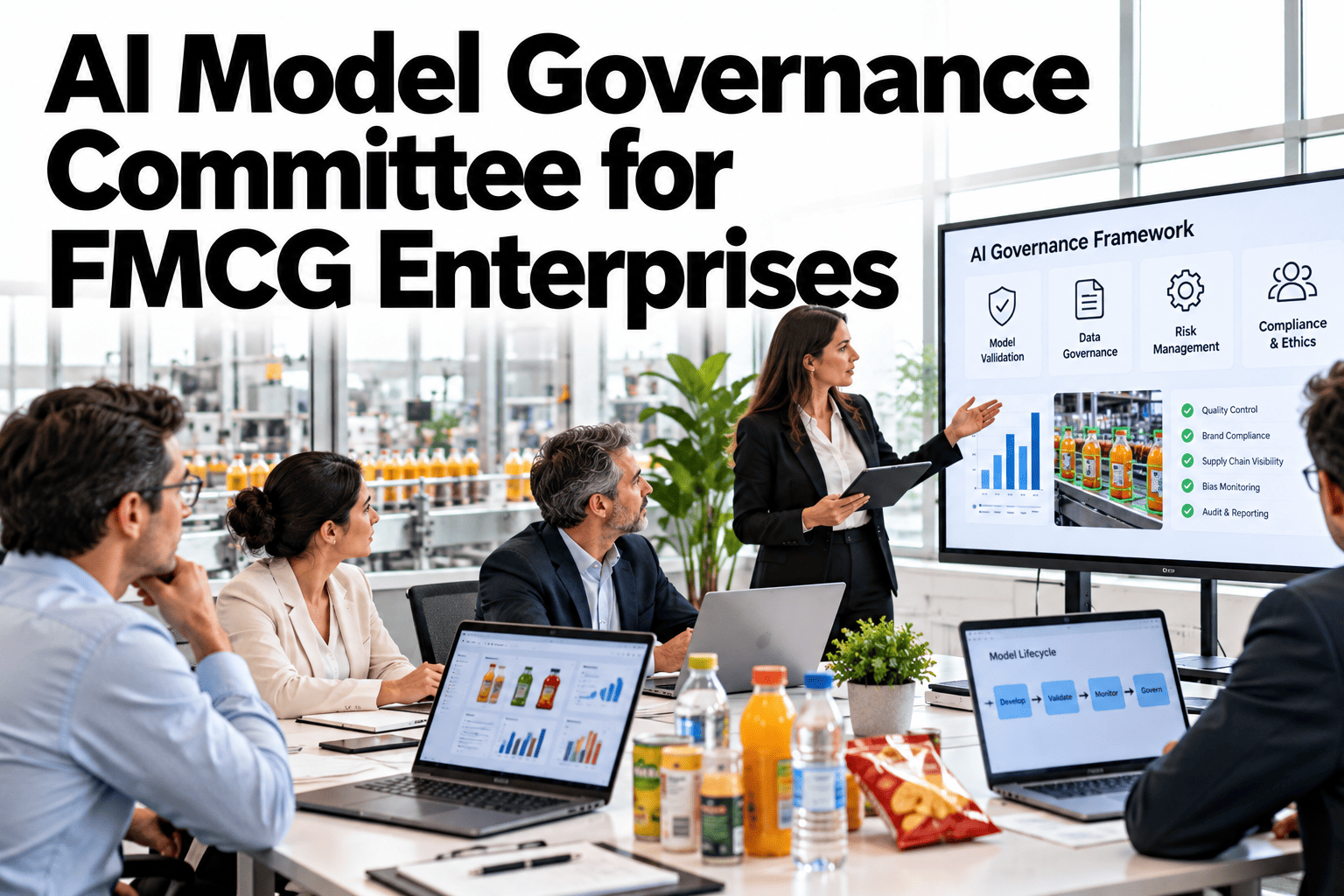
A predictive maintenance model that misses a failure is an inconvenience. A quality inspection model that misses a contamination risk is a recall. As FMCG enterprises move AI systems from a single pilot line to dozens of production decisions running daily across a network of plants, the question shifts from "does the model work" to "what happens when it doesn't, and who is watching for that moment." Governance is the answer to that question, and it is a structural requirement the iFactory team builds into every production deployment, not an afterthought bolted on once something goes wrong.
RISK & OVERSIGHT
AI Governance & Model Risk for FMCG Enterprises
Model inventory, risk tiering, monitoring cadence, and human-in-the-loop rules — the governance structure that keeps production AI systems accountable as they scale across your plant network.
Why Governance Becomes Unavoidable Past a Certain Scale
A single pilot model, watched closely by the team that built it, does not urgently need a formal governance structure — informal oversight is sufficient at that scale. The moment an FMCG enterprise has five, ten, or twenty models running in production across multiple plants, informal oversight breaks down completely: nobody can hold the full picture of every model's purpose, risk level, and current performance in their head. Governance is what replaces individual memory with a structure the whole organization can rely on.
Building a Model Inventory
The starting point for any governance program is deceptively simple and frequently skipped: a single, maintained record of every AI model in production, what it does, what data it depends on, and who owns it. Without this inventory, an enterprise cannot answer basic risk questions — including, in some cases, not knowing the full list of models currently running across its own plant network.
Model Purpose & Scope
What business decision or action the model informs, and which lines, plants, or product categories it applies to.
Data Dependencies
Which source systems and data feeds the model relies on, and what happens to its output if that data becomes unavailable.
Ownership & Contacts
The named individual or team responsible for the model's ongoing performance, and the escalation path if something goes wrong.
Last Validation Date
When the model's performance was last formally reviewed against its risk tier's required cadence, and by whom.
Risk Tiering — Not Every Model Needs the Same Level of Oversight
Treating every AI model with identical governance intensity wastes resources on low-risk systems while potentially under-scrutinizing high-risk ones. A risk tiering structure sorts models by the consequence of a wrong prediction, and assigns oversight intensity accordingly.
TIER 3 — HIGH RISK
Models where a wrong output directly affects food safety, regulatory compliance, or consumer health — such as contamination or allergen detection systems. Require the most frequent validation and mandatory human review of flagged cases.
TIER 2 — MODERATE RISK
Models affecting production efficiency, quality grading, or inventory decisions where errors are costly but not safety-critical, such as demand forecasting or predictive maintenance. Require regular monitoring with periodic human validation.
TIER 1 — LOW RISK
Models supporting operational convenience with limited downside from an occasional error, such as internal dashboard automation or low-stakes routing suggestions. Require lighter, less frequent oversight.
Build a Risk Tiering Framework for Your Model Portfolio
iFactory helps FMCG enterprises inventory existing AI systems, assign risk tiers, and design a monitoring cadence appropriate to each tier — so oversight effort is focused where consequences are highest.
Recommended Monitoring Cadence by Risk Tier
Once a model is tiered, the required monitoring and validation frequency follows directly from that classification. The table below shows a typical cadence structure used across FMCG governance programs, adjustable based on your organization's specific regulatory environment and risk tolerance.
| Risk Tier | Automated Monitoring | Human Validation Review | Human-in-the-Loop Requirement |
|---|
| Tier 3 — High Risk | Continuous, real-time | Weekly | Mandatory review of all flagged outputs |
| Tier 2 — Moderate Risk | Daily | Monthly | Review of high-confidence exceptions only |
| Tier 1 — Low Risk | Weekly | Quarterly | Spot checks on a sampling basis |
Where Human-in-the-Loop Rules Matter Most
Human-in-the-loop is not a blanket requirement that every AI decision needs manual sign-off — that would eliminate most of the efficiency AI is meant to provide. It is a targeted rule for the specific decision points where an automated error carries outsized consequences, and defining those points clearly is one of the most important governance decisions an FMCG enterprise makes.
!
Food Safety and Contamination Flags
Any model output suggesting a potential contamination or allergen risk routes to mandatory human review before any product decision is made, regardless of model confidence level.
!
Low-Confidence Predictions
Predictions that fall below a defined confidence threshold are routed to a human reviewer rather than acted on automatically, treating uncertainty itself as a trigger for oversight.
!
High-Value Automated Actions
Decisions with significant financial impact, such as large-scale batch rejections or major production schedule changes, require human sign-off even when model confidence is high.
!
Novel or Out-of-Distribution Inputs
When a model encounters conditions significantly different from its training data — a new SKU, an unusual product mix — it flags for human review rather than extrapolating confidently.
A Head of Quality Assurance on Building Governance In From the Start
"
When we had two or three AI models running, informal oversight was genuinely fine — everyone on the team knew what each model did and roughly how it was performing without needing a formal system to track it. That stopped being true somewhere around model number eight. We had a moment where a plant manager asked which model was responsible for a specific automated decision, and it took us three days to definitively answer that question across our own systems. That was the moment governance stopped being a nice-to-have conversation and became a mandatory one. Building the model inventory was tedious, honestly, and it required getting cooperation from teams who did not initially see why it mattered to them. But once we had risk tiers assigned and a monitoring cadence attached to each tier, our quarterly audits went from a week of scrambling to pull together information to a half-day review of dashboards that were already current. The unglamorous administrative work turned out to be exactly what let us scale AI with confidence instead of anxiety.
— Head of Quality Assurance, Multi-Brand FMCG Enterprise · Built Governance Program Across 40+ Production Models
The Governance Program Rollout Checklist
Establishing a governance program for the first time does not require solving every element simultaneously. The checklist below reflects a practical, phased approach most FMCG enterprises follow when formalizing oversight of an existing model portfolio.
✓
Complete a full inventory of every AI model currently in production, including ones that were never formally tracked at deployment.
✓
Assign a risk tier to each model based on the consequence of an incorrect output, not the model's technical complexity.
✓
Define human-in-the-loop rules specific to each risk tier, with clear triggers for when automated review is not sufficient.
✓
Set a monitoring and validation cadence for each tier, with dashboards accessible to the assigned oversight owner.
✓
Establish a recurring governance review, typically quarterly, to reassess risk tiers as models and their usage evolve.
Frequently Asked Questions
At what point does an FMCG enterprise actually need formal AI governance?
There is no fixed model count that triggers the need, but most organizations find informal oversight starts breaking down somewhere between five and ten production models, particularly once those models span multiple plants or business units where no single team has visibility into the full portfolio. A useful test is whether anyone in the organization can quickly and confidently answer which models are currently running, what they do, and how recently each was validated — if that answer takes days to compile, formal governance is already overdue rather than premature.
Who should own the governance program inside an FMCG organization?
Ownership typically sits with a cross-functional group rather than a single department, often anchored by quality assurance or risk management given their existing familiarity with tiered oversight structures, working alongside IT or data science for the technical model inventory and operations leadership for the practical human-in-the-loop workflows. A program owned entirely by a technical team tends to under-weight business risk considerations, while one owned entirely by a business team tends to miss technical nuances around model behavior and data dependencies — the strongest programs blend both perspectives.
Does every AI model need human-in-the-loop review, even low-risk ones?
No — applying mandatory human review to every model output regardless of risk level defeats much of the efficiency benefit AI provides and is not what governance is meant to achieve. The goal of risk tiering is precisely to reserve mandatory human review for the decision points where an error carries meaningful consequence, such as food safety flags or high-value financial decisions, while allowing lower-risk models to operate with lighter, periodic spot-checking rather than case-by-case sign-off.
How does risk tiering interact with regulatory requirements in food manufacturing?
Risk tiering should be designed alongside, not instead of, your existing food safety and quality regulatory obligations — any model touching contamination detection, allergen management, or other food-safety-adjacent decisions should generally default to your highest governance tier regardless of how technically reliable the model has proven to be. Regulatory requirements typically set a floor for documentation and review frequency in these areas, and a well-designed governance program builds on top of that floor rather than treating it as optional. Consulting with your existing compliance and quality teams during risk tier design is strongly recommended.
Can iFactory help build a governance program for an existing model portfolio?
Yes — iFactory works with FMCG enterprises to inventory existing production models, assign risk tiers based on your specific operational and regulatory context, and design a monitoring cadence and human-in-the-loop rule set that fits your organization's risk tolerance and existing compliance structure. This is often a valuable exercise even for organizations that feel their current model portfolio is well understood informally, since a formal inventory frequently surfaces models or dependencies that were not fully visible before. To discuss a governance program for your model portfolio,
book a demo with our team, or
contact support with specific questions.
Scale AI Across Your Plants Without Losing Oversight
A model inventory, clear risk tiers, an appropriate monitoring cadence, and defined human-in-the-loop rules are what let an FMCG enterprise run dozens of production AI systems with confidence instead of anxiety. iFactory builds this structure into every deployment.