Most FMCG enterprises can point to an AI pilot that "worked." Far fewer can point to a number that proves it moved the P&L. That gap — between technical success and provable business value — is where most AI budgets quietly stop growing year over year, because a finance team cannot approve scale-up spend against a claim nobody can verify. A value realization framework closes that gap by defining, tracking, and proving impact before a single model is deployed, which is the discipline the iFactory team builds into every enterprise engagement from day one.
AI VALUE FRAMEWORK
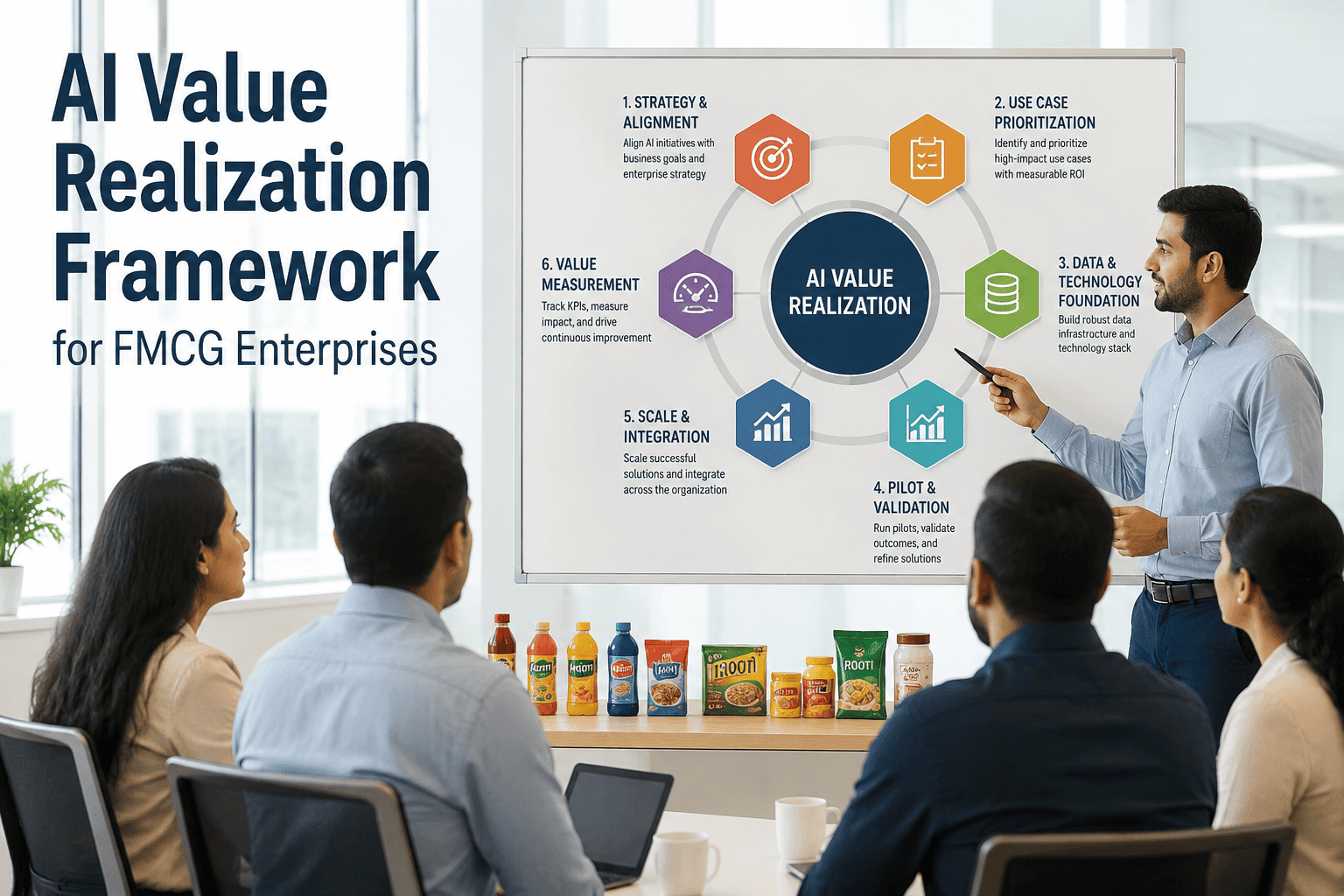
AI Value Realization Framework for FMCG Enterprises
A structured method for turning AI pilots into P&L-visible outcomes — problem framing, baseline capture, outcome definition, and continuous value tracking that finance teams can actually sign off on.
Why Value Tracking Breaks Down in Most AI Programs
FMCG enterprises typically run AI initiatives through the same reporting structure as any other IT project: a status update, a go-live date, a satisfaction survey. None of those actually measure business value, which is a specific, calculable number tied to waste reduced, downtime avoided, or labor hours reallocated. Without a framework that defines value before the project starts and tracks it consistently afterward, even a technically excellent AI deployment ends up unable to answer the one question every CFO eventually asks: what did this actually save us?
1
Problem Framing
Defining the specific operational problem in business language before any technical scoping begins
2
Outcome Definition
Setting a measurable target in dollars, hours, or percentage points — not a model accuracy score
3
Baseline Capture
Recording the true pre-AI number using the same method that will measure results afterward
4
Value Tracking
Ongoing measurement against baseline, reported in terms finance and operations both trust
The Four-Phase Framework in Practice
Each phase below builds directly on the one before it, and skipping any single phase is the most common reason FMCG AI programs cannot produce a defensible value number later. The framework is deliberately sequential — problem framing has to happen before outcome definition, and a baseline has to exist before any value can be tracked against it.
PHASE ONE
Problem Framing in Business Language
Before any data science work begins, the operational problem is written down in terms a plant manager and a CFO would both recognize — not "reduce false rejects" but "recover the 4% of saleable product currently being scrapped on line 3 due to inspection false positives." This framing step alone eliminates a large share of use cases that sound promising but carry limited financial upside.
PHASE TWO
Outcome Definition With a Real Number
The target is set as a specific, measurable figure agreed by both operations and finance before the pilot begins — a percentage reduction in scrap, a dollar figure in recovered throughput, or a defined number of labor hours reallocated. This is the number that gets revisited at every review, rather than a vague sense that "things have improved."
PHASE THREE
Baseline Capture Before Go-Live
A documented measurement window, typically two to four weeks, captures the true pre-AI performance using the exact same method that will be used to measure results afterward. Skipping this step is the single most common reason a technically successful pilot cannot later prove its own value — there is simply nothing to compare against.
PHASE FOUR
Continuous Value Tracking Post-Deployment
Results are tracked against baseline on a recurring cadence — typically monthly for the first two quarters — and reported in the same business language used during framing, so operations and finance are always reviewing the same number rather than translating between a technical metric and a business one.
Build a Value Realization Plan for Your Next AI Initiative
iFactory works with FMCG operations and finance teams jointly to frame the problem, define the outcome, and capture the baseline before any model is built — so the resulting number is one your CFO can actually approve budget against.
What Gets Measured vs What Actually Gets Reported
There is often a wide gap between the metrics a data science team tracks during a pilot and the metrics a finance or operations leader actually needs to make a scale-up decision. The table below shows the common mismatch, and the business-facing equivalent the value realization framework substitutes in its place.
| Commonly Tracked (Technical) | Business-Facing Equivalent | Owner |
|---|
| Model precision and recall | False reject rate translated into recovered saleable units | Operations + Data Science |
| System uptime percentage | Unplanned downtime hours avoided per month | Plant Operations |
| Alert volume generated | Labor hours redirected from manual inspection to higher-value tasks | Operations + Finance |
| Data pipeline latency | Time-to-decision improvement on quality or maintenance calls | IT + Operations |
| Number of predictions made | Dollar value of waste or rework prevented | Finance |
The Value Realization Scorecard
Each phase of the framework produces its own checkpoint, and an FMCG enterprise can score its own program against these four checkpoints at any point in a deployment to identify where value tracking is likely to break down before it becomes a problem at the board review.
Is the Problem Framed in Business Terms?
Can a plant manager and a finance leader both describe the target outcome the same way, without translation?
Is There a Signed-Off Target Number?
Does a specific dollar, hour, or percentage target exist, agreed jointly before the pilot began?
Does a Documented Baseline Exist?
Was the pre-AI number captured using the same measurement method that is used post-deployment?
Is Value Tracked on a Regular Cadence?
Is the result reviewed monthly against baseline, using language operations and finance both recognize?
A CFO's View on What Value Tracking Actually Requires
"
We had approved three different AI pilots over two years before we brought in a formal value realization process, and every single one of them was described internally as "a success" without a number attached to that word. When I asked the straightforward question — what did this save us, in dollars, compared to before — nobody could answer it cleanly, because nobody had captured what "before" actually looked like. That is not a technology failure, it is a measurement failure, and it is entirely on the business side to fix. Once we started requiring a documented baseline and a signed-off target before any pilot could get budget approval, the conversation changed completely. We stopped funding projects that sounded exciting and started funding ones with a defensible number attached, and the ones that did get funded were dramatically easier to scale, because the case for scaling them had already been made in the first thirty days.
— VP of Finance, Multi-Plant FMCG Manufacturer · Oversees AI Investment Portfolio Across 9 Facilities
Applying the Framework — A 12-Week Rollout View
Enterprises adopting this framework for the first time typically move through a defined twelve-week sequence before their first AI initiative reaches production, front-loading the business alignment work that most programs skip entirely.
Weeks 1-2
Problem framing workshops with operations, IT, and finance jointly in the room
Weeks 3-4
Outcome target defined and formally signed off by both operations and finance leadership
Weeks 5-8
Baseline measurement window runs while pilot infrastructure and integration work proceeds in parallel
Weeks 9-12
Model goes live, first value tracking report produced against the documented baseline
Frequently Asked Questions
How is a value realization framework different from a standard ROI calculation?
A standard ROI calculation is usually done once, retroactively, after a project is already considered finished — and it often relies on estimated or reconstructed baseline figures because nothing was documented beforehand. A value realization framework builds measurement into the project from the start: the outcome target and baseline are defined before go-live, and tracking continues on a recurring cadence afterward rather than as a single closing report. The result is a number that is verifiable in real time rather than a retrospective estimate built to justify a decision that has already been made.
Who should be in the room during the problem framing phase?
The strongest framing sessions include an operations leader who understands the process being improved, an IT or data leader who understands what is technically feasible, and a finance stakeholder who understands what number will actually be credible in a budget review. Leaving finance out of this early stage is one of the most common reasons a technically sound pilot later struggles to secure scale-up funding, because the business case has to be reconstructed after the fact instead of built in from the beginning.
What happens if the baseline period reveals the problem is smaller than expected?
This is actually one of the most valuable possible outcomes of a proper baseline capture, because it prevents budget from being spent on a use case with limited upside before any development work begins. If a documented baseline shows the underlying defect rate, downtime, or waste figure is already low, that is the moment to redirect the initiative toward a higher-value use case rather than after months of pilot work have already been invested. Catching this early is exactly what the framing and baseline phases are designed to do.
How often should value be reported once a system is in production?
Monthly reporting against baseline is the most common cadence during the first two quarters after go-live, since this window is when most operational adjustments and model tuning happen and stakeholders benefit from close visibility. After the deployment stabilizes, many organizations move to a quarterly cadence tied to broader operational reviews. What matters more than frequency is consistency — reporting the same metric, calculated the same way, on a predictable schedule, so trend lines are meaningful rather than noisy single-point comparisons.
Can this framework be applied retroactively to an AI system that is already in production without a baseline?
It is more difficult but not impossible. Where no formal baseline exists, teams can sometimes reconstruct an approximate pre-deployment figure from historical records, though this carries more uncertainty than a properly captured baseline would have. The stronger recommendation for any system currently running without documented value tracking is to establish a forward-looking baseline now and begin tracking from this point, rather than trying to prove historical impact with incomplete data.
Contact our team to discuss options for your specific deployment.
Turn Your Next AI Initiative Into a Number Finance Can Approve
iFactory's value realization framework builds problem framing, outcome definition, baseline capture, and ongoing tracking into every FMCG deployment — so the value of your AI investment is provable, not just assumed.