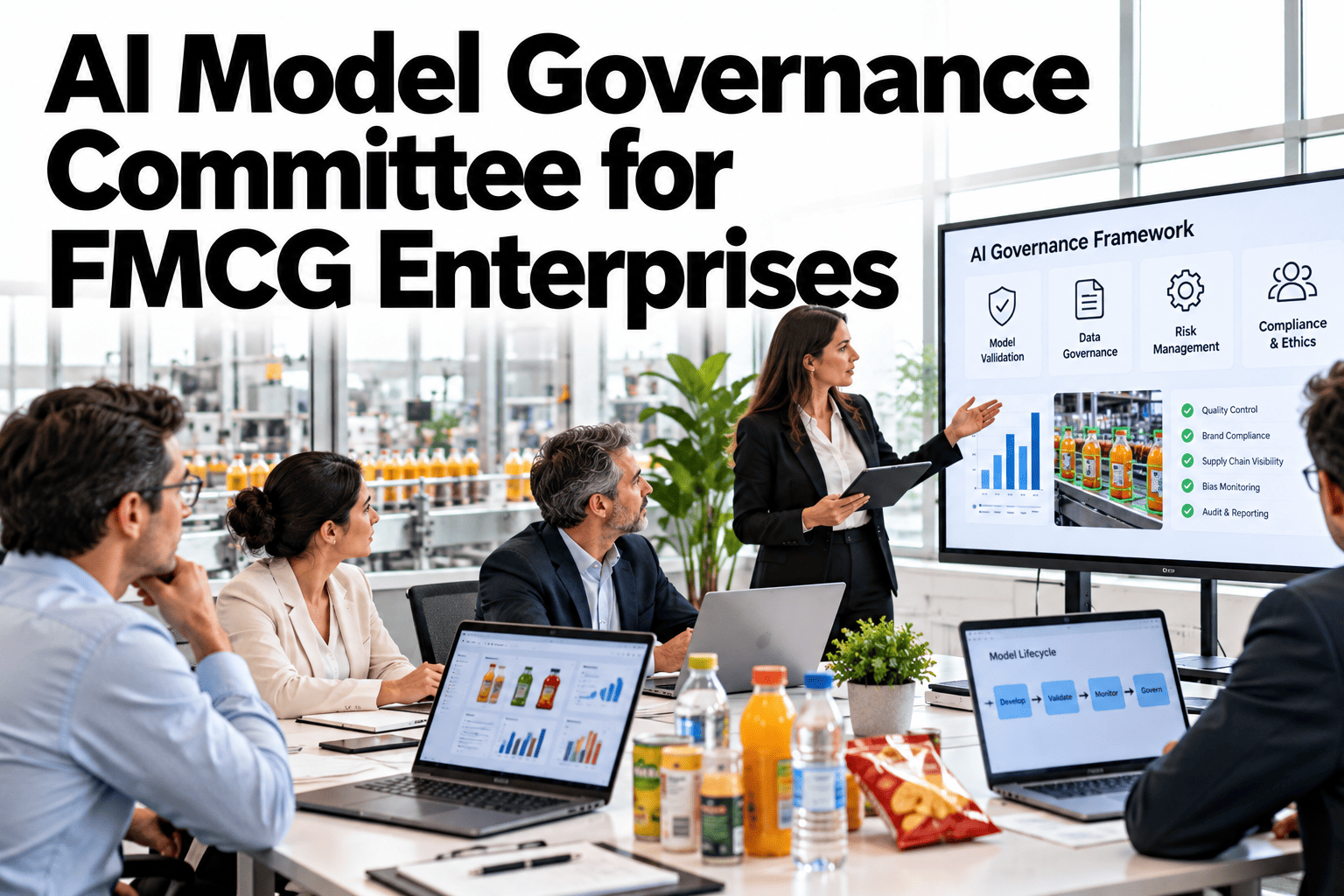
Responsible AI becomes real when someone is accountable, decisions are recorded and the group meets on a schedule. An AI model governance committee gives FMCG enterprises that structure through a charter, clear membership, decision rights and a regular rhythm. Without it, policies stay on paper while models are deployed, changed and forgotten in separate plants. A good committee is practical and light enough to keep pace with the business. To see a working example, you can review a committee charter with our team.
AI foundation and responsible AI
Turn Responsible AI From a Policy Into a Working Committee
iFactory AI supports governance with model records, approval trails and monitoring that give a committee the facts it needs.
What a committee decides about each model
Approve
Review
Monitor
Retire
Why a committeeWithout Ownership, Models Drift Out of Sight
AI models change behaviour as data and processes change. Someone needs to watch them.
Model is built
A team creates it for one plant
Model is deployed
It spreads without a record
Data changes
Accuracy quietly falls
Nobody notices
Decisions rely on an out-of-date model
A committee turns this into a managed lifecycle with clear owners at every stage.
The charterFour Layers Every Charter Should Cover
Purpose
Why the committee exists and what it protects.
Scope
Which models, plants and decisions are covered.
Authority
What the committee can approve, pause or retire.
Principles
Fairness, safety, transparency and accountability rules.
Keep the charter short enough to read in five minutes. A two-page charter that is used beats a twenty-page document that is not.
Who sits at the tableMembership That Balances Value and Risk
Operations lead
I make sure models solve real plant problems.
IT and OT security
We check data access, security and resilience.
Quality and safety
We assess product and people impact.
Legal, HR and finance
We cover compliance, people effects and value.
Keep the group small, around six to nine people, and invite specialists for specific topics.
See a Working Committee Charter and Model Register
Share your plants and current AI use cases and see how iFactory AI helps keep model records and approvals in one place.
Decision rightsMake It Clear Who Decides What
| Decision | Proposes | Approves | Informed |
|---|
| Start a new AI pilot | Plant or function team | Committee chair | Security and finance |
| Move a model to production | AI team | Committee | Plant manager |
| Change a live model significantly | AI team | Committee or delegate | Operations |
| Pause a model after an incident | Anyone | Committee chair or on-call lead | Whole committee |
| Retire a model | Owner | Committee | Affected teams |
Written rights prevent both delays and surprises. To adapt a decision table, ask our team for a decision rights template.
Risk tiersUse Light Review for Low Risk and Deep Review for High Risk
Low risk
Information only, easily reversed, no safety impact.
Medium risk
Influences decisions or costs, with human review.
High risk
Affects safety, product quality or people, and needs full committee review.
Tiering keeps the committee focused. Not every model needs the same attention.
The model lifecycleFive Gates From Idea to Retirement
1
Propose
State the purpose, data and expected value.
2
Assess
Review risk, data quality and controls.
3
Approve
Committee or delegate gives a decision.
4
Monitor
Track accuracy, drift and incidents.
5
Retire
Switch off and archive records cleanly.
Record every decision with a date and reason. The record is what makes governance real during audits and incidents.
CadenceA Rhythm That Fits a Busy Business
Monthly
Review new proposals and open incidents
Quarterly
Review model performance and risk tiers
Twice a year
Review the charter and policy
After any incident
Meet quickly to decide actions
Short, regular meetings with a standing agenda are better than long, rare ones.
MaturityGrow the Committee's Reach Step by Step
Level 1: InventoryList every model and owner
Level 2: ApproveStart formal approvals for new models
Level 3: MonitorTrack performance and drift routinely
Level 4: ImproveUse lessons to improve standards and training
The AI Risk Management Framework from NIST and the ISO/IEC 42001 management system standard offer useful reference points for mature programmes.
Getting startedA 90-Day Plan and a Checklist
Days 1 to 30
Draft the charter, name the chair and list existing models.
Days 31 to 60
Hold the first meetings and approve the decision table.
Days 61 to 90
Start monitoring reports and review the first incident drill.
Executive sponsor named
Charter drafted and agreed
Membership and chair confirmed
Model inventory started
Decision rights written
Risk tiers defined
Meeting cadence set
Incident procedure agreed
Expert reviewWhat a Chief Risk Officer Would Check First
Expert review
A committee earns its place by making decisions quickly and visibly. If it becomes a bottleneck or a talking shop, the business will work around it.
VerdictStrong when it is small, tiered by risk and backed by a clear record.
Watch forCommittees that review everything equally and slow every project.
Do nextStart with an inventory and one monthly meeting, then add structure.
Frequently asked questionsWhat Leaders Ask About AI Governance Committees
How big should the committee be?
Six to nine regular members is a good range. It should include operations, IT and OT security, quality, legal and finance. Larger groups slow decisions, so invite specialists for specific topics instead of adding permanent members.
See a sample membership.
Does every model need committee approval?
No. Use risk tiers so low-risk models follow a light process, while high-risk models get full review. This keeps the committee focused on what matters and avoids delaying simple, safe projects.
Ask about risk tiering.
How do we keep governance from slowing projects?
Set clear criteria and response times, delegate low-risk decisions and use a standard proposal template. Teams move faster when they know what is needed from the start and who decides.
Discuss a lightweight process.
What should we monitor after approval?
Track accuracy, drift in input data, incidents, overrides by users and complaints. Define thresholds that trigger review, and report them to the committee every quarter.
Ask about monitoring reports.
How do we handle an AI incident?
Have a simple procedure: contain, assess, decide whether to pause the model, inform affected teams and record lessons. Practise it once a year so people know their roles.
Plan an incident drill.
Clear owners, clear decisions
Make Responsible AI a Routine, Not a Slogan
Book a session with iFactory AI to draft your charter, set decision rights and build the model record your committee needs.