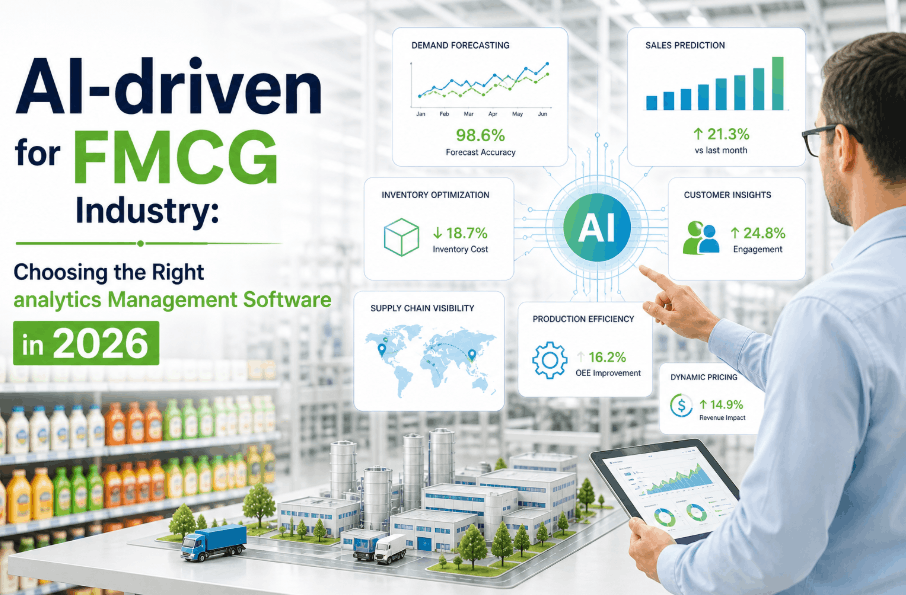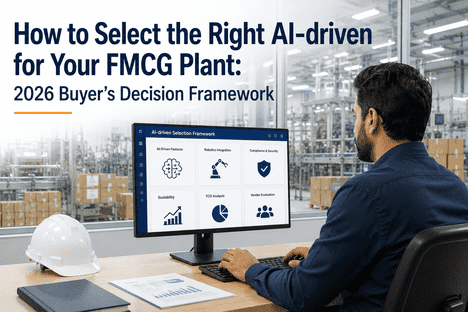
Selecting the right AI-driven platform for your FMCG plant is the single most consequential technology decision a maintenance, operations, or digital transformation leader will make in 2026. The market now offers over 120 AI-driven solutions claiming to serve manufacturing yet fewer than 15% are built specifically for FMCG requirements around food-grade compliance, high-speed packaging lines, diverse asset populations with 1,000–5,000+ maintainable assets, and integration with ERP systems including SAP, Oracle, and Microsoft Dynamics. A wrong selection wastes 12–18 months of implementation effort, $150,000–$500,000 in sunk costs, and erodes stakeholder trust in digital transformation. iFactory's 2026 Buyer's Decision Framework provides a structured evaluation methodology across six dimensions AI feature maturity, robotics integration capability, FMCG compliance coverage, platform scalability, total cost of ownership, and vendor ecosystem strength enabling FMCG decision-makers to evaluate platforms against their specific operational requirements rather than generic manufacturing checklists. Book a Demo to evaluate iFactory AI against your FMCG plant's specific requirements using this decision framework.
Evaluate AI-Driven Platforms Against FMCG-Specific Requirements With a Structured 6-Dimension Decision Framework
iFactory's 2026 Buyer's Decision Framework provides FMCG decision-makers with a structured evaluation methodology covering AI features, robotics integration, FMCG compliance, scalability, TCO, and vendor ecosystem — enabling platform selection aligned with your specific operational requirements, asset profile, and digital transformation roadmap.
AI Feature Maturity and Readiness
Not all AI-driven platforms deliver production-grade AI. Evaluate whether predictive maintenance models are pre-trained on FMCG asset types, whether AI vision systems are calibrated for food-grade inspection environments, and whether analytics models support FMCG-specific KPIs like OEE by SKU, changeover waste reduction, and hygiene compliance trending. The evaluation must distinguish between roadmap AI and production-deployed AI with verified FMCG reference cases.
Robotics and Automation Integration
FMCG plants increasingly deploy AMRs for material transport, collaborative robots for packaging, and autonomous inspection systems for quality control. The platform must provide native integration with robotics orchestration layers, enabling AI models to receive sensor data from robotic systems and trigger robotic responses to detected anomalies. Evaluate API maturity, supported robotic platforms, and demonstrated integration in FMCG environments.
FMCG Compliance and Regulatory Coverage
FMCG plants operate under FSSC 22000, SQF, BRCGS, and FDA regulatory frameworks that impose specific requirements on maintenance data management, spare part traceability, hygiene zone management, and audit trail completeness. The platform must support compliance workflows natively — not through workarounds — including digital audit trails, hygiene-compliant work order routing, and supplier documentation management for food-grade materials.
Scalability and Multi-Site Architecture
FMCG enterprises operate 5–50+ production sites with varying asset profiles, local regulatory requirements, and maturity levels. The platform must support multi-site deployment with centralized configuration management, site-specific customization, and role-based access across corporate, regional, and plant-level users. Evaluate data residency options, offline operation capability, and deployment models including cloud, on-premise, and hybrid.
4 Root Causes of AI-Driven Platform Selection Failure in FMCG and How to Avoid Them
FMCG organizations that select AI-driven platforms that fail to deliver value within 12 months typically share a common set of root causes spanning evaluation methodology, requirement definition, vendor assessment, and implementation planning. These predictable failure patterns can be eliminated by applying a structured decision framework before issuing an RFP.
The most common selection failure is evaluating platforms against generic manufacturing requirements without adapting criteria for FMCG-specific needs — hygiene zone compliance, high-speed packaging line asset profiles, food-grade spare part traceability, and changeover waste analytics. Platforms that excel at heavy industrial or discrete manufacturing often lack the FMCG-specific functionality that determines day-to-day usability for maintenance and operations teams.
Feature comparison matrices favor platforms with the longest checklists, but in FMCG environments the critical success factor is integration maturity — how well the platform connects with existing ERP systems (SAP, Oracle, Dynamics), PLC and SCADA layers, laboratory information systems, and robotic control platforms. A platform with fewer features but proven FMCG integration delivers more value than a feature-rich platform requiring custom integration development.
Platform selection decisions that focus exclusively on technical capabilities without evaluating vendor change management methodology, training programs, and user adoption track record in FMCG environments consistently underperform. The best AI models deliver zero value if maintenance technicians, planners, and operators do not adopt the platform into their daily workflows. Evaluate vendor-sponsored adoption programs, not just platform features.
Stop Comparing Feature Lists Start Evaluating Platforms Against Your FMCG Plant's Actual Operational Requirements
iFactory's 2026 Buyer's Decision Framework equips FMCG decision-makers with structured evaluation criteria across six dimensions, pre-built RFP templates adapted for FMCG requirements, and reference case library covering 40+ FMCG deployments across food, beverage, and consumer goods manufacturing.
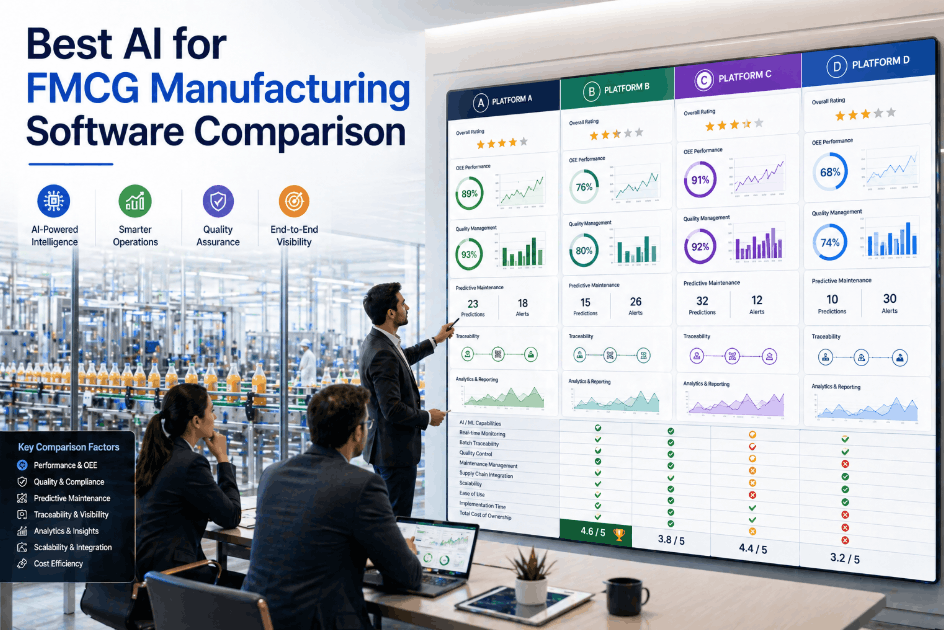
AI-Driven Platform Evaluation Criteria — Generic vs FMCG-Specific vs iFactory AI (2026)
| Evaluation Dimension | Generic Manufacturing Platform | FMCG-Adapted Platform | iFactory AI for FMCG |
|---|---|---|---|
| AI model pre-training | General industrial asset models | FMCG asset models: conveyors, fillers, labelers, packers, palletizers | 30+ pre-trained FMCG-specific models including packaging line, hygiene, and multi-site OEE models |
| Compliance framework support | Generic audit trail module | FSSC 22000, SQF, BRCGS templates | Native FSSC 22000, SQF, BRCGS, FDA workflows with auto-audit documentation |
| Robotics integration | Basic API connectivity | AMR and cobot interface documentation | Native integration with 12+ AMR/cobot platforms with bidirectional command and sensor data exchange |
| ERP integration depth | Standard API connectors | SAP PM, Oracle EAM connectors | Pre-built SAP, Oracle, Dynamics connectors with FMCG-specific data models for asset, procurement, and cost integration |
| Multi-site architecture | Single-tenant or cloud | Multi-site with basic hierarchy | Enterprise multi-site with centralized config, site-specific workflows, and offline operation capability |
| Implementation time to value | 6–12 months | 4–8 months | 4–8 weeks to pilot value, 3–6 months to full deployment |
| FMCG reference deployments | 0–5 referenceable FMCG sites | 5–15 referenceable FMCG sites | 40+ FMCG deployments across food, beverage, dairy, snacks, and personal care |
| Total cost of ownership (3-year) | $250K–$800K | $180K–$500K | $80K–$250K with predictable subscription model |
The 6-Step Decision Framework for Selecting the Right AI-Driven Platform for Your FMCG Plant
iFactory's 2026 Buyer's Decision Framework provides a structured six-step process that takes FMCG decision-makers from requirement definition through vendor evaluation to implementation planning. Each step produces a specific deliverable that builds toward an evidence-based selection decision aligned with your plant's operational priorities and digital transformation timeline.
Define FMCG-Specific Requirements and Weight Evaluation Criteria
Engage cross-functional stakeholders — maintenance, operations, quality, supply chain, IT, and finance — to document FMCG-specific requirements organized by dimension: AI features, robotics integration, compliance, scalability, TCO, and vendor ecosystem. Assign relative weights to each dimension based on your plant's strategic priorities. For example, a plant targeting FSSC 22000 certification in 2026 would weight compliance at 25% while a greenfield plant may prioritize scalability at 30%.
Build FMCG-Adapted RFP With Weighted Scoring Matrix
Develop a structured RFP document organized by the six dimensions with specific technical requirements, integration requirements, and service requirements for each dimension. Include a weighted scoring matrix that vendors can use for self-assessment alongside their proposal response. Require vendors to provide FMCG-specific reference cases — not generic manufacturing references — with named contacts and site visit availability.
Conduct FMCG-Specific Platform Demonstration and Use Case Validation
Require each vendor to demonstrate the platform against three FMCG-specific use cases selected from your plant's operations: a predictive maintenance scenario on a packaging line asset, a compliance workflow demonstration with hygiene zone routing and audit trail generation, and an analytics scenario showing OEE by SKU with changeover waste tracking. Evaluate the platform using your own data where possible rather than vendor-prepared demonstrations.
Validate Integration Maturity With Existing FMCG Systems
Conduct a technical integration workshop with each vendor to validate connectivity maturity with your specific ERP system (SAP, Oracle, or Dynamics), existing PLC and SCADA infrastructure, laboratory information systems, and any robotic platforms deployed or planned. Require vendors to demonstrate live data exchange — not architectural diagrams — during the workshop. Document integration complexity, data mapping effort, and any middleware requirements.
Calculate Total Cost of Ownership With FMCG Deployment Model
Develop a three-year total cost of ownership model for each vendor based on your specific FMCG deployment requirements: number of sites, assets per site, user counts, integration touchpoints, training requirements, and ongoing support model. Include costs for sensor and hardware infrastructure, label and tag deployment for asset tracking, integration development, change management programs, and annual subscription or maintenance fees.
Conduct Reference Site Visits and Make Evidence-Based Selection
Visit at least two reference FMCG sites per vendor — one of similar size and complexity to your operation and one that has been live for 12+ months. Interview maintenance managers, reliability engineers, and technicians about their experience with platform adoption, data quality, AI model accuracy over time, vendor support responsiveness, and unexpected costs or challenges. Use reference insights to adjust evaluation scores before making final selection.
Final Selection Gate"Having led four major platform selections across 18 FMCG manufacturing sites over the past eight years — including a painful failed implementation that cost us 14 months and $420,000 before we pulled the plug — I learned that the platform selection methodology matters more than the platform itself. Our first selection was driven by a feature comparison matrix that made the winning platform look superior on paper, but it could not integrate with our SAP instance without a $90,000 custom middleware project, its compliance module did not support SQF audit workflows, and its predictive maintenance models had never been trained on a high-speed packaging line. The platform we selected in 2024 using the structured 6-dimension framework — including FMCG-specific reference visits and a live integration workshop — has been operational for 18 months with measurable improvements across our pilot plants. The difference was not the platform; it was the discipline of evaluating against FMCG-specific requirements rather than generic manufacturing checklists."
The Platform You Select in 2026 Will Define Your Plant's Digital Trajectory for the Next 5–7 Years — Choose With Evidence, Not Checklists
The AI-driven platform you select for your FMCG plant in 2026 will shape your maintenance operations, asset management practices, production analytics, and digital transformation trajectory for the next half-decade. A selection driven by feature comparison matrices and generic manufacturing requirements will almost certainly underperform, wasting 12–18 months and $150,000–$500,000 while eroding organizational confidence in digital transformation. A selection driven by a structured, FMCG-specific decision framework — evaluating platforms against your actual operational requirements, integration landscape, compliance obligations, and organizational readiness — will deliver measurable value within 3–6 months and build momentum for enterprise-wide deployment.
iFactory AI was purpose-built for FMCG operations — not adapted from heavy industrial or discrete manufacturing platforms. Our platform delivers pre-trained AI models for FMCG-specific asset types, native compliance workflows for FSSC 22000, SQF, BRCGS, and FDA, pre-built integrations with SAP, Oracle, and Microsoft Dynamics, and a scalable multi-site architecture proven across 40+ FMCG deployments. For FMCG decision-makers ready to select their AI-driven platform with confidence, book a demonstration with iFactory's FMCG solutions team to evaluate the platform against your specific requirements using the complete 2026 Buyer's Decision Framework.
AI-Driven Platform Selection for FMCG Frequently Asked Questions
Select the Right AI-Driven Platform for Your FMCG Plant With iFactory's 2026 Buyer's Decision Framework
iFactory AI is purpose-built for FMCG operations — not adapted from heavy industrial manufacturing — with pre-trained AI models for FMCG asset types, native compliance workflows for FSSC 22000, SQF, BRCGS, and FDA, pre-built ERP integrations, and a scalable multi-site architecture proven across 40+ FMCG food, beverage, dairy, snacks, and personal care deployments worldwide.