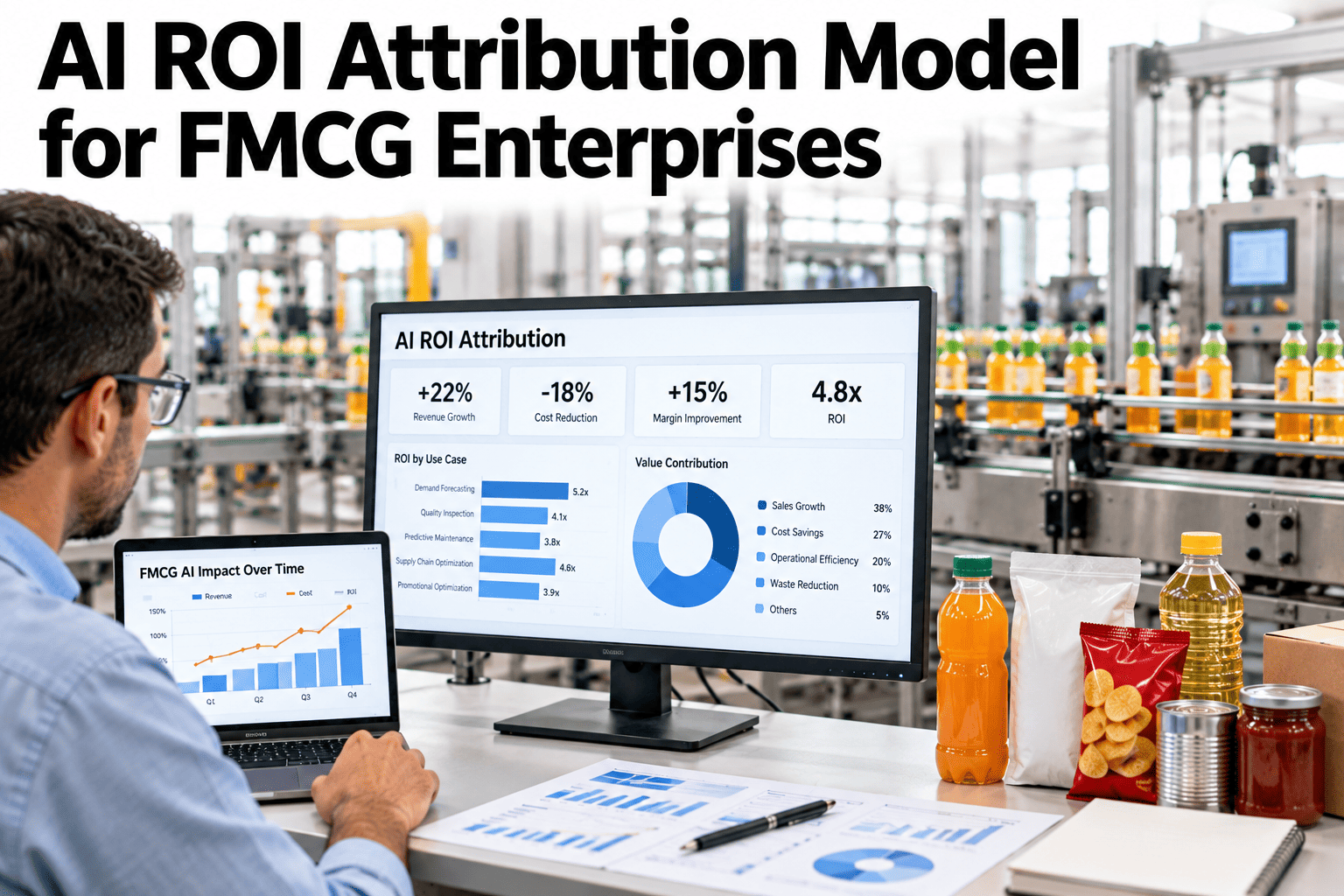
When an AI project saves money, several teams usually claim the result, and finance rightly asks who deserves the credit. A clear attribution model splits value into direct, indirect and enabling categories and sets allocation rules before the savings arrive. This keeps numbers credible, avoids double counting and survives scrutiny from finance and the leadership team. To see how this works for your own portfolio, you can review an attribution approach with our team.
AI foundation and value measurement
Attribute AI Value in a Way Finance Will Accept
iFactory AI helps FMCG enterprises classify value, allocate it fairly and report AI return with rules that hold up across functions.
Illustrative value by category
The credit problemEveryone Wants Credit and Finance Wants Proof
AI sits between operations, IT, quality and supply chain. Savings often appear in someone else's budget.
Double counting
Two teams claim the same saving
Weak baselines
No agreed starting point
Hidden costs
Platform and support costs left out
Lost trust
Finance discounts every claim
A simple set of rules, agreed before the project starts, removes most of these arguments.
Three value typesDirect, Indirect and Enabling Value Are Different Things
1
Direct value
Cash savings or gains clearly caused by the AI use case, such as lower scrap or less unplanned downtime.
2
Indirect value
Benefits that follow from the use case but are harder to isolate, such as time saved or better decisions.
3
Enabling value
Capabilities that make future use cases cheaper or faster, such as data foundations and integration layers.
Report the three types separately. Mixing them makes the strongest number look weaker and the weakest look stronger.
Classifying valueClassify Each Benefit Before You Count It
| Benefit | Type | Evidence needed | Who signs off |
|---|
| Scrap reduced on a line | Direct | Before and after scrap cost | Finance and production |
| Unplanned downtime avoided | Direct | Downtime log against baseline | Maintenance and finance |
| Analyst hours saved on reports | Indirect | Time study and redeployment plan | Function head and finance |
| Faster quality investigation | Indirect | Cycle time data | Quality lead |
| Shared data platform built | Enabling | Reuse across later use cases | Sponsor and finance |
Build an Attribution Model for Your AI Portfolio
Share your current and planned AI use cases and see how iFactory AI would classify value and set allocation rules.
Allocation rulesFour Rules That Keep the Numbers Honest
Rules written in advance avoid disputes when savings appear.
Agree the baseline
Define the starting point and the period before the project.
Isolate the effect
Separate AI impact from other changes where possible.
Share only once
Each saving is counted in one place or split by an agreed rule.
Review with finance
Finance signs off method and results on a schedule.
Where several projects affect the same cost, agree the split before results arrive rather than after.
A worked exampleSplitting One Scrap Saving Fairly
Suppose scrap fell by 400,000 per year after an AI inspection project. During the same period, a process team also tuned a machine. The numbers are illustrative.
400,000
Total scrap reduction
250,000
Attributed to AI inspection
150,000
Attributed to process tuning
62%
AI share of the saving
AI share = 250,000 / 400,000 = 62.5 percent, agreed using the baseline and a control line
Value mixMost Portfolios Contain More Than Direct Savings
This split shows an example of how value may divide across categories. It is illustrative.
45 percent: Direct
Measurable cash effects in scrap, downtime and yield.
25 percent: Indirect
Time saved and faster decisions.
20 percent: Enabling
Data and platform reuse across projects.
10 percent: Risk avoided
Lower chance of recalls and large failures.
Treat avoided risk carefully. State the assumptions and show the range rather than a single figure.
ConfidenceRate Each Claim by Measurability and Attribution Strength
Claim quality
Easy to attribute
Hard to attribute
Easy to measure
Count in full
Report as direct value
Count with a rule
Use a shared allocation rule
Hard to measure
Report as estimate
Show range and assumptions
Report as narrative
Do not add to the total
Reporting each claim by its confidence builds trust with finance. To set confidence rules, ask our team for a claim rating guide.
Common mistakesFive Ways Attribution Goes Wrong
1
Counting gross savings
Ignoring licence, support and internal team costs.
2
Using no control
Crediting AI for changes that would have happened anyway.
3
Annualising a short spike
Extending a one-month result to a full year.
4
Counting time saved as cash
Hours saved are only cash when they are redeployed or avoided.
5
Stopping tracking too early
Benefits fade without ongoing attention.
ReportingShow Value Growing as the Portfolio Matures
A simple, honest view helps leaders see the pattern over time. This chart is illustrative.
Year 3
Shared platform effects
Year 4
Portfolio compounding
Baseline agreed with finance
Three value types defined
Allocation rules written
Control or comparison used where possible
Costs included in return
Evidence stored for each claim
Quarterly review with finance
Owner named for each use case
Expert reviewWhat a Finance Business Partner Would Check First
Expert review
Finance accepts numbers that are conservative, explained and repeatable. A smaller claim with strong evidence beats a bigger one that cannot be defended.
VerdictStrong when baselines, costs and allocation rules are agreed before the work starts.
Watch forDouble counting across teams and time savings reported as cash.
Do nextApply the model to one finished project and review it with finance.
Frequently asked questionsWhat Leaders Ask About AI ROI Attribution
What is the difference between direct and indirect value?
Direct value is cash impact clearly caused by the AI use case and measurable against a baseline, such as scrap or downtime. Indirect value is a likely benefit that is harder to isolate, such as time saved. Report them separately so finance can weigh each.
See examples of each type.
How do we count enabling value?
Enabling value comes from shared foundations, such as data pipelines and integration, that make later use cases cheaper. Report it separately and allocate its cost across the use cases that use it, rather than adding a large benefit to the first project.
Ask about platform cost allocation.
How do we avoid double counting?
Record each saving in one place and agree split rules where several projects touch the same cost. A shared register of claims, reviewed by finance, makes overlaps visible early. Rules should be written before results arrive.
See a claims register example.
Should time saved count as money?
Only when the time is actually redeployed, avoided or turned into reduced cost, such as less overtime. Otherwise report it as indirect value with a clear note. Finance teams respect this distinction and trust the rest of the numbers more.
Ask about time-saving claims.
How often should we review attribution?
Review quarterly at first, then at least twice a year as the portfolio matures. Update baselines when processes change and revisit allocation rules when new projects overlap with old ones.
Plan a review rhythm.
Credible value, shared credit
Make Every AI Value Claim Easy to Defend
Book a session with iFactory AI to classify your AI benefits, agree allocation rules and build a value view that finance and leaders can trust.