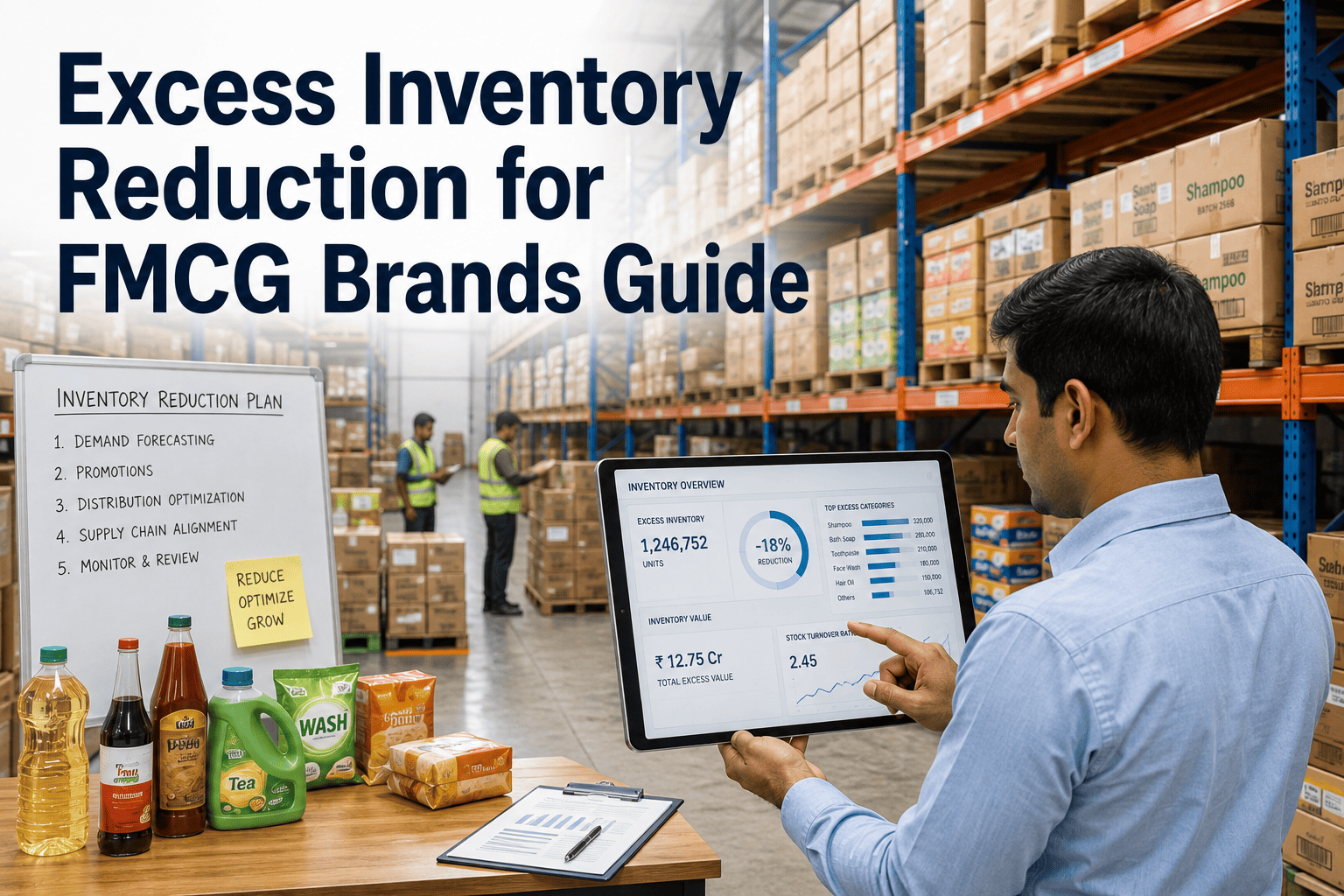
Excess inventory has a strange way of hiding in plain sight. Nothing about it triggers an alarm the way a stockout does, no customer complains, no shelf sits visibly empty, and yet a warehouse quietly filling up with slow-moving stock is tying up working capital and creeping toward markdown or spoilage the entire time nobody is looking closely. Industry research on inventory distortion consistently finds that overstock accounts for a substantial share of the total cost FMCG brands absorb every year, right alongside the more visible stockout problem on the other side of the ledger. Reducing excess inventory in a meaningful, lasting way starts with actually identifying which SKUs are slow-moving before they become dead stock, and brands ready to map that process for their own catalog can start with a conversation with iFactory support.
The Stock Nobody's Selling Is Still Costing You Every Single Day It Sits There.
iFactory identifies slow-moving and excess SKUs early, classifies them by actual risk and velocity, and builds a safe drawdown plan that frees working capital before markdowns or spoilage force the issue.
Four Kinds of Excess Inventory, and Why They Need Different Fixes
Not all excess stock is the same problem wearing a different label. A seasonal overbuy, a promotional leftover, a discontinued SKU, and a straightforward forecast miss all pile up on the same balance sheet line, but each one needs a genuinely different drawdown strategy to resolve without destroying margin.
Seasonal Overbuild
Stock produced ahead of a seasonal peak that didn't fully sell through, often recoverable through timed markdowns before the next relevant season.
Promotional Leftover
Volume produced for a specific promotion that outpaced actual lift, typically needing a faster, more aggressive clearance path.
Discontinued or Reformulated SKUs
Stock tied to a product being phased out, where the priority shifts from margin protection to simply clearing the balance sheet.
Persistent Forecast Miss
A SKU that consistently overshoots its reorder point due to a stale demand model, requiring a forecast fix as much as a drawdown plan.
ABC-XYZ Classification: Sorting Excess by What It Actually Deserves
Not every slow-moving SKU deserves the same level of urgency or the same drawdown tactic. ABC-XYZ classification combines sales value with demand predictability, giving a clearer picture of which excess stock needs immediate action and which can wait.
| Classification | Meaning | Recommended Approach |
|---|---|---|
| AX - High Value, Predictable | Reliable seller carrying excess from a one-time miss | Hold and let normal sell-through absorb it |
| AZ - High Value, Erratic | Valuable SKU with unpredictable demand swings | Targeted markdown timed to next demand spike |
| CX - Low Value, Predictable | Steady but low-margin excess, low urgency | Bundle or slow clearance over time |
| CZ - Low Value, Erratic | Highest-risk excess, unlikely to move on its own | Fast clearance or write-down before spoilage risk grows |
Know Exactly Which SKUs to Clear, and Which to Leave Alone
iFactory classifies every slow-moving SKU by value and demand predictability, then recommends the safest drawdown path for each one automatically.
A Safe Drawdown Process, Step by Step
Clearing excess inventory without damaging brand price perception or leaving money on the table follows a fairly disciplined sequence, and skipping steps tends to be exactly where margin gets lost unnecessarily.
Identify Slow-Moving SKUs Early
Continuous velocity tracking flags a SKU trending toward excess weeks before it becomes an obvious dead-stock problem.
Classify by Value and Predictability
ABC-XYZ scoring determines urgency, separating SKUs that need immediate action from those that can absorb naturally over time.
Match a Drawdown Tactic to Each Tier
High-value SKUs get protective, targeted markdowns while low-value erratic stock moves toward faster clearance before spoilage risk grows.
Execute Without Cannibalizing Full-Price Sales
Clearance channels and timing are chosen to avoid pulling demand away from full-price sell-through of the same or adjacent SKUs.
Feed Findings Back Into Forecasting
Every excess event gets analyzed for root cause, so the same forecast miss doesn't quietly repeat the following cycle.
A Composite Scenario: Clearing 40% Excess Without a Fire Sale
A household goods brand found itself carrying roughly 40 percent excess on a mid-tier SKU after a seasonal demand forecast overshot actual sell-through, a pattern that in prior years had typically ended in a steep, margin-damaging blanket discount applied across the entire remaining volume. Using ABC-XYZ classification, the brand's planning team found the SKU actually scored as high-value with reasonably predictable demand, meaning the underlying product was fine, the forecast had simply been wrong for one cycle.
Instead of an immediate blanket markdown, the team held the bulk of the excess and applied a smaller, targeted promotion timed to the SKU's next natural demand window roughly six weeks out. The stock cleared close to full margin, and the brand avoided training its regular customers to expect steep discounts on a product that didn't actually need them, a pattern the team had unintentionally reinforced with faster clearance decisions in previous years.
Mistakes That Turn Manageable Excess Into a Real Loss
Applying the Same Markdown to Every SKU
Treating all excess stock identically ignores the real difference between a high-value SKU worth protecting and low-value stock that needs to move fast.
Waiting Until Stock Is Visibly Overwhelming
By the time excess is obvious on a warehouse floor, the best drawdown window has usually already passed, and options narrow to steeper discounts.
Never Tracing the Root Cause
Clearing the stock without understanding why the forecast missed sets up the exact same excess pattern to repeat on the next cycle.
Discounting in a Way That Trains Bad Habits
Frequent steep markdowns on the same SKU teach loyal customers to wait for a sale, quietly eroding full-price demand over time.
Is Your Brand Carrying Hidden Excess Right Now?
You can't easily name your slowest-moving SKUs today
If identifying slow movers requires pulling a special report rather than checking a live view, excess is likely building somewhere unnoticed.
Markdowns tend to happen reactively, close to a deadline
Clearance decisions made under time pressure rarely preserve as much margin as ones planned weeks ahead of a natural demand window.
Forecast misses don't get traced back to a specific cause
Without a root-cause step, the same SKU or SKU family tends to generate excess repeatedly across multiple planning cycles.
Frequently Asked Questions
How early can excess inventory actually be identified before it becomes a real problem?
Continuous velocity tracking can flag a SKU trending toward excess several weeks before it becomes an obvious warehouse overflow, since the underlying signal is a sell-through rate falling behind the original forecast rather than a visible stock pile. Catching that trend early is what preserves the option of a protective, margin-friendly drawdown instead of a forced clearance. Brands can see how this applies to their own SKU mix through iFactory support.
Is ABC-XYZ classification difficult to set up for a large SKU catalog?
The classification itself runs automatically once sales value and demand variability data are connected, so it scales across a large catalog without requiring manual scoring of individual SKUs. Most brands see their full catalog classified within the early stages of onboarding, with the scores updating continuously as demand patterns shift.
Does reducing excess inventory always mean discounting the product?
Not necessarily. High-value SKUs with predictable demand often just need patience and a normal sell-through window rather than any markdown at all, while only the highest-risk, low-value excess typically needs an active clearance tactic. The classification step exists specifically to avoid discounting stock that didn't need it in the first place.
Can this help prevent the same excess pattern from happening again next cycle?
Yes, tracing each excess event back to its root cause, whether that's a stale forecast model, an overbuilt promotion, or a seasonal miscalculation, feeds directly back into how future demand plans are built for that SKU. Without that feedback loop, brands often find themselves clearing the same type of excess repeatedly. Book a demo to see how the root-cause tracking works in practice.
Turn Slow-Moving Stock Back Into Working Capital
iFactory identifies excess early, classifies it by real risk, and builds a drawdown plan that protects margin instead of forcing a fire sale.