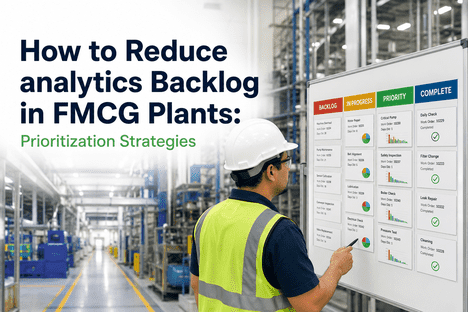
The average FMCG manufacturing plant carries between three and six weeks of maintenance backlog at any given time. That backlog represents deferred work orders, overdue preventive maintenance tasks, open corrective actions from inspection findings, and analytics requests that never made it to the top of the queue. Across the industry, 38% of unplanned breakdowns are directly traceable to deferred backlog work orders that were sitting in the queue when the failure occurred. Emergency repairs cost four to eight times more than planned maintenance, and unplanned downtime in a mid-sized FMCG plant typically runs between 80 and 150 hours per year at $10,000 to $50,000 per hour of lost production. The backlog is not a maintenance problem. It is a prioritization problem — and the organizations that solve it do so with structured scoring frameworks, capacity-matched scheduling, and AI-driven workflow automation that turns a reactive queue into a strategic asset. If your plant is managing its backlog through spreadsheets and shift-supervisor intuition, Book a Demo of iFactory's Backlog Management platform and see how structured prioritization transforms your work order queue in the first quarter of deployment.
Six Root Causes of Analytics Backlog in FMCG Plants
Before any prioritization framework can reduce backlog, the underlying drivers must be understood. Across thousands of FMCG plants, six root cause categories account for 92% of all backlog accumulation. Misdiagnosing backlog as simply a staffing problem leads to headcount additions that fail to clear the queue — because the real issue is not headcount, it is scheduling discipline and prioritization structure.
The six root causes are: reactive work displacement (emergency breakdowns pull technicians off scheduled PMs), absence of formal prioritization (without a scoring framework, low-risk work orders get completed before high-risk deferred items), capacity versus demand mismatch (schedules built without accounting for available hours, parts availability, or permit lead times create work orders that are planned but never executable), parts and permit delays (nearly a third of backlog is blocked — not deferred by choice), over-scheduling without baseline (programs designed for ideal conditions that ignore meetings, permits, travel and other non-wrench time), and no backlog visibility (without CMMS reporting on backlog age and composition, six-month-old work orders sit invisibly until they cause a failure). Book a Demo to see how iFactory's backlog analytics surface these root causes automatically.
Prioritization Frameworks That Reduce FMCG Plant Backlog
The research is consistent: plants that implement structured prioritization frameworks reduce backlog by a median of 52% and cut emergency callout costs by 79% in the first quarter. The choice of framework matters less than the act of scoring — any formal system outperforms the "who shouts loudest" model that dominates the 58% of plants with no priority matrix. Below are the frameworks most relevant to FMCG analytics and maintenance backlog.
| Framework | Best For | Key Formula | FMCG Applicability |
|---|---|---|---|
| RIME (Ranking Index for Maintenance Expenditures) | Daily maintenance work order triage | Asset Criticality × Work Class Priority × Backlog Age Multiplier | Built for manufacturing — includes 80/20 scheduling rule, backlog aging escalation |
| Five-Factor Priority Scoring | FMCG-specific work order queues | Safety (40%) + Production Impact (30%) + Failure Probability (15%) + Backlog Age (10%) + Resource Readiness (5%) | Tailored weights reflect FMCG regulatory and production intensity |
| RICE (Reach × Impact × Confidence ÷ Effort) | Analytics project and improvement backlog | (Reach × Impact × Confidence) ÷ Effort | Best for analytics initiative prioritization — quantifies business value per unit of effort |
| WSJF (Weighted Shortest Job First) | Strategic portfolio and initiative planning | (Business Value + Time Criticality + Risk Reduction) ÷ Job Size | Optimizes for economic value per unit of time — ideal for multi-plant program planning |
| Eisenhower Matrix | Individual technician task triage | Urgent vs. Important — four quadrants | Useful for daily standup task assignment but insufficient for plant-level backlog strategy |
The RIME framework deserves particular attention for FMCG maintenance backlog because it was designed specifically for manufacturing environments. Its backlog aging multiplier — which automatically escalates overdue PMs by 10% each week — prevents the silent accumulation of deferred work that causes 38% of unplanned breakdowns. The 80/20 scheduling rule baked into RIME (20% of labor reserved for high-priority but low-urgency work, 10% for low-priority nuisance work, and 70% directed to the highest RIME scores) ensures that strategic work is never fully displaced by reactive demands. Plants that implement RIME through a digital platform rather than manual calculation see 2-3x faster backlog reduction because the scoring happens automatically on every work order without relying on a supervisor to manually apply the formula.
The Cost of Not Prioritizing: What Unmanaged Backlog Costs an FMCG Plant
For plant managers evaluating whether backlog management deserves investment, the financial impact of unmanaged backlog is calculable — and it almost always exceeds the cost of a prioritization platform by a factor of 10x or more in the first year.
How AI-Driven Backlog Management Changes the Math
The difference between a manual prioritization framework and an AI-driven one is not the scoring logic — it is the speed, consistency, and data breadth of the scoring. A plant supervisor using a RIME spreadsheet can score perhaps 10-15 work orders per day. An AI-driven backlog management engine operating on the same framework scores every open work order in the system across asset criticality, production impact, failure probability, backlog age, and resource readiness — recalculating in real time as new work orders enter the queue and conditions change on the plant floor. iFactory's AI-driven Backlog Management module delivers this capability natively, integrating with your existing CMMS and MES data streams to produce a ranked, actionable queue without requiring a data analyst to maintain the scoring model.
Automated Work Order Scoring
Every work order entering the system is automatically scored against asset criticality, production impact, safety/compliance risk, failure probability, and backlog age. The scoring model is configurable per plant and per asset class, so a packaging line work order is evaluated differently from a utility system work order — reflecting the actual production architecture of the facility.
Capacity-Matched Scheduling
iFactory integrates workforce availability data — certified hours per technician, shift schedules, skill certifications, and permit lead times — and automatically matches the highest-scoring work orders to the available capacity. No more 50-hour schedules planned against 30 hours of real available time. The system never over-schedules, ensuring that planned work is executable work.
Predictive Backlog Detection
Using historical work order data and asset failure patterns, iFactory's AI identifies work orders that are likely to escalate into emergency breakdowns if deferred past a certain date. The system automatically elevates the priority of time-sensitive items before they become failures — converting reactive backlog management into proactive risk prevention.
Real-Time Backlog Health Dashboard
Live visibility into backlog aging distribution, PM compliance rates, blocked work order percentage, reactive ratio, and critical backlog ratio — updated in real time rather than refreshed weekly from a spreadsheet. Automatic alerts trigger when backlog exceeds a four-week threshold or when critical backlog items remain unaddressed past 48 hours.
The operational impact is measurable. Plants deploying AI-driven backlog management through iFactory have achieved a 70% reduction in backlog-related downtime within the first 90 days, a 31% reduction in unplanned failures, and a 62% reduction in backlog age across the entire work order queue. And critically, 78% of that reduction is achieved without additional headcount — because the platform optimises the use of existing capacity rather than simply requesting more of it. Book a Demo to see iFactory's backlog management engine in operation against a live work order queue.
The 12-Week Backlog Reduction Roadmap
Structured backlog reduction follows a repeatable three-phase roadmap that iFactory has validated across dozens of FMCG plant deployments. Each phase has specific targets, tooling requirements, and success metrics that allow the plant team to measure progress in weekly increments rather than waiting for quarterly reviews.
The roadmap works because it separates backlog reduction into distinct phases with different tactics. The triage phase eliminates the 15-25% of backlog that is typically invalid or stale — phantom work orders, duplicate entries, and completed-but-unclosed items that inflate the queue without representing real work. The blitz phase makes a focused capacity investment that produces visible momentum. The sustain phase installs the automated prioritization and scheduling discipline that prevents re-accumulation. Plants that skip the sustain phase typically see backlog return to baseline within 12 weeks of completing the blitz. iFactory's platform supports all three phases natively, from the initial backlog audit through to the ongoing automated scoring and scheduling that keeps backlog under control permanently. Book a Demo to walk through the roadmap with iFactory's deployment team configured for your plant's specific backlog profile.
Backlog Health KPIs: What to Measure and What the Targets Are
Effective backlog management requires measurement discipline. Below are the KPIs that iFactory's backlog management platform tracks automatically, with industry benchmarks and top-quartile targets that allow plant teams to assess their backlog health at a glance. Book a Demo to see iFactory's backlog health dashboard configured for your plant's data.
| KPI | Industry Average | Target | Red Flag |
|---|---|---|---|
| Backlog Age | 6-12 weeks | 2-4 weeks | >6 weeks |
| PM Compliance Rate | 62-74% | 85%+ | <70% |
| Reactive / Planned Ratio | 50:50 | 80:20 planned | >35% reactive |
| Work Order Completion Rate | 68-78% | 92-97% | <75% |
| Schedule Compliance | 65-75% | 85-90% | <75% |
| Blocked Work Orders (%) | 25-30% | <15% | >25% |
| Critical Backlog Ratio | 12-18% | <5% | >10% |
| Wrench Time | 25-35% | 55-65% | <30% |
The backlog is not a maintenance problem. It is a data problem — and the right platform solves it. I have managed maintenance operations at three FMCG plants over 17 years, and every one of them struggled with the same pattern: work orders would accumulate because the team lacked a structured way to decide what to do first. The emergency of the day always won, and the items that got deferred were always the ones that did not have a loud enough voice in the room. When we deployed a formal prioritization framework through iFactory, the change was not gradual — it was immediate. Within two weeks, the system was scoring every work order automatically, and we had a queue that reflected actual plant priorities rather than whoever was standing in front of the planner's desk. The backlog dropped by 60% in the first six weeks. More importantly, it stayed down because the system prevented the accumulation pattern from restarting. If you are still managing backlog manually, you are not managing it at all — you are just watching it grow.
Frequently Asked Questions
Conclusion: From Reactive Queue to Strategic Asset
The difference between a plant that treats backlog as a problem and a plant that treats backlog as a strategic signal is the difference between fighting fires and preventing them. A structured prioritization framework — whether RIME, Five-Factor Scoring, or a custom model tuned to your specific production environment — converts an undifferentiated queue of work orders into a ranked, actionable portfolio that aligns maintenance execution with production priorities. When that framework is powered by AI-driven automation rather than manual spreadsheet calculations, the speed and consistency of prioritization increases by an order of magnitude while the administrative burden on supervisors and planners drops to near zero. iFactory's Backlog Management platform delivers this capability out of the box — automated scoring, capacity-matched scheduling, predictive risk detection, and real-time backlog health dashboards — configured to your plant's asset hierarchy, workforce structure, and production schedule. If your plant is carrying more than four weeks of backlog and relying on intuition rather than data to decide what gets done first, Book a Demo and see what a structured, AI-driven approach to backlog management looks like in operation against your actual work order data.