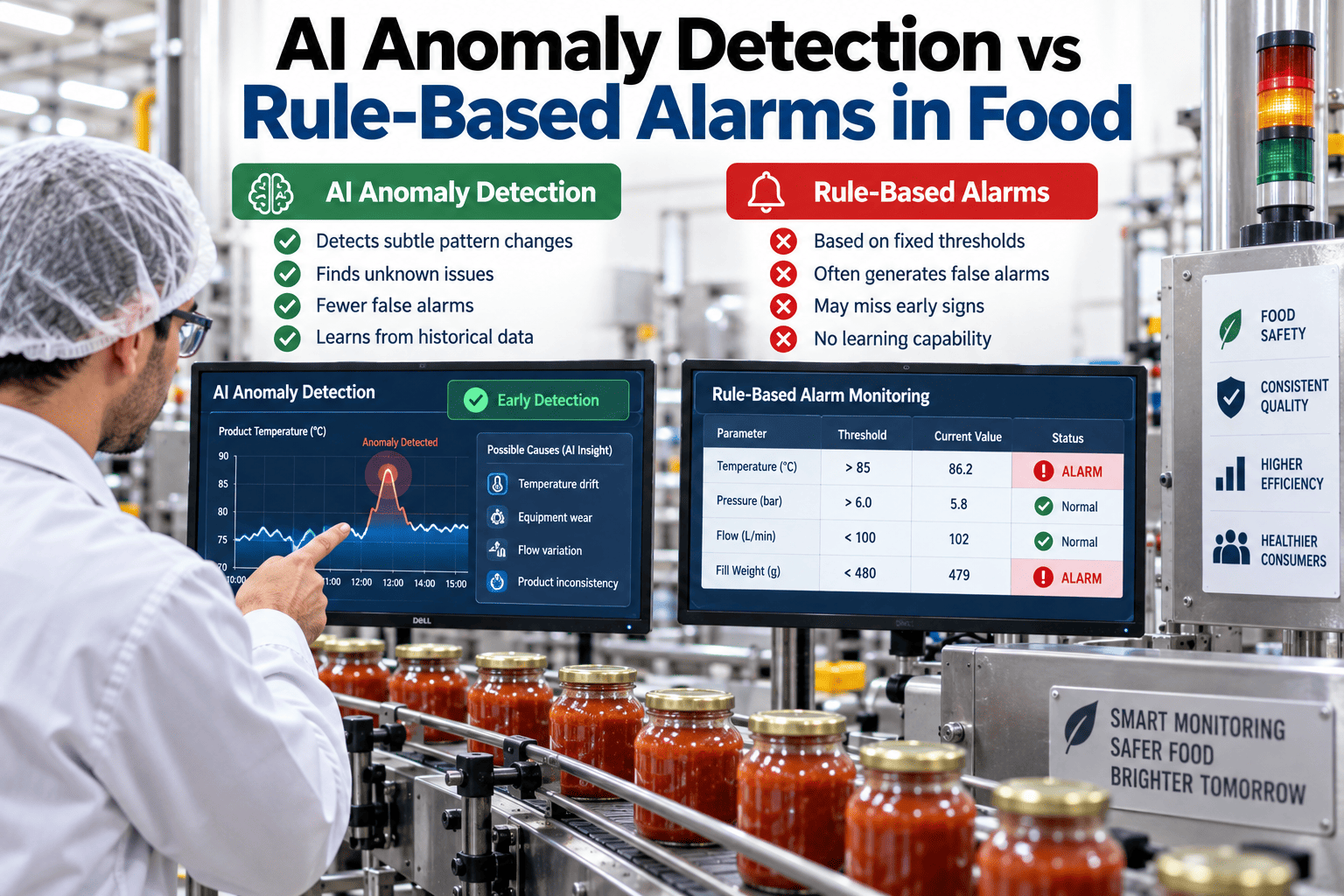
Every food and beverage plant already has alarms — a temperature threshold that trips if a chiller drifts too warm, a pressure limit that flags if a line runs too hot, a fixed setpoint someone configured years ago and nobody has revisited since. Those rule-based alarms catch the failures they were explicitly built to catch and stay completely silent on everything else, including the slow equipment drift and unusual combination of readings that often precede a real failure. Understanding exactly where each approach is strong and where it quietly fails is the foundation of how iFactory designs monitoring systems for F&B facilities.
FOOD & BEVERAGE MONITORING
AI Anomaly Detection vs Rule-Based Alarms in Food Plants
Where each approach catches faults, where each misses them entirely, and the hybrid monitoring stack most F&B facilities actually need to run safely and efficiently.
Rule-Based Alarms
Fixed thresholds, known limits
VS
AI Anomaly Detection
Learned patterns, unknown failures
Why This Isn't Actually an Either-Or Decision
The framing of "AI versus rule-based alarms" suggests a single winner, but the more accurate way to think about it is that each approach is solving a different problem, and most F&B facilities need both working together rather than one replacing the other. Rule-based alarms remain the right tool for known, well-understood failure conditions with a clear safety threshold. AI anomaly detection earns its place by catching the failures nobody wrote a rule for, because the failure pattern was never anticipated in advance.
How Rule-Based Alarms Actually Work
A rule-based alarm compares a live sensor reading against a fixed threshold set during commissioning or updated occasionally by an engineer, and fires the instant that threshold is crossed. The logic is simple, transparent, and completely predictable — which is exactly its strength for the specific failure modes it is built to catch.
Strength: Speed and Certainty
A threshold breach triggers an alarm instantly and unambiguously, with zero risk of a false negative on the specific condition the rule was written for.
Strength: Regulatory Traceability
Fixed thresholds tied to food safety critical control points are easy to document and defend during an audit, since the logic is explicit and unchanging.
Weakness: Blind to Unknown Patterns
A rule only catches the exact condition it was written for — any failure mode that develops through a combination of readings never crosses a single threshold and stays invisible.
Weakness: Static Thresholds Age Poorly
Equipment wears, seasons change, and product mixes shift, but a fixed threshold set at commissioning rarely gets revisited to reflect that drift.
How AI Anomaly Detection Actually Works
Rather than comparing a single reading against a fixed threshold, an AI anomaly detection model learns the normal relationship between many sensor readings simultaneously during regular operation, then flags any combination of readings that deviates meaningfully from that learned normal pattern — even if no individual reading crosses any fixed limit on its own.
Strength: Catches Multi-Signal Drift
A subtle combination of slightly elevated vibration, slightly lower flow, and slightly higher temperature can indicate developing equipment failure long before any single reading crosses a threshold.
Strength: Adapts to Operating Context
Models can learn different normal patterns for different product runs or seasonal conditions, avoiding the false alarms a rigid fixed threshold would generate under legitimate operating variation.
Weakness: Requires Quality Training Data
A model is only as good as the historical data it learns from — sparse or poor-quality sensor history limits how reliably the model can distinguish real anomalies from noise.
Weakness: Less Transparent to Auditors
Explaining exactly why a model flagged a specific pattern as anomalous is inherently more complex than pointing to a single fixed threshold, which requires additional documentation for regulatory contexts.
Find Out Which Failure Modes Your Current Alarms Are Missing
iFactory reviews your existing rule-based alarm configuration against your historical incident data to identify which failure patterns would have gone undetected — and where AI anomaly detection closes that gap.
Side by Side — Where Each Approach Actually Wins
Rather than treating this as an abstract debate, the table below maps specific, common F&B plant scenarios to whichever approach is genuinely better suited to catching that particular failure pattern.
| Scenario | Better Suited Approach | Why |
|---|
| Chiller temperature exceeding a food safety critical limit | Rule-based alarm | Clear, regulated threshold with zero tolerance for delay |
| Bearing beginning to fail through gradual vibration change | AI anomaly detection | No single threshold crossed; only visible as a multi-signal pattern |
| Allergen changeover verification failure | Rule-based alarm | Binary pass/fail condition with a defined acceptance criteria |
| Unusual combination of pressure, flow, and temperature on a filler | AI anomaly detection | Individual readings may be within range; the combination is not |
| Emergency stop and safety interlock conditions | Rule-based alarm | Requires instant, unambiguous, auditable response |
| Early-stage motor degradation before an audible or visible symptom appears | AI anomaly detection | Pattern develops gradually across signals well before any hard threshold |
The Hybrid Stack — How the Two Layers Work Together
The strongest monitoring architecture for an F&B plant treats rule-based alarms and AI anomaly detection as two complementary layers rather than competing systems, each covering the gap the other leaves open.
Layer 3 — Safety-Critical Rule-Based Alarms
Hard-coded thresholds for food safety critical control points and safety interlocks, unchanged and instantly triggered regardless of what the AI layer reports.
Layer 2 — AI Anomaly Detection
Continuous multi-signal pattern monitoring across equipment and process data, flagging developing issues before they reach a hard threshold.
Layer 1 — Standard Operational Alarms
Conventional rule-based alerts for known operational limits — pressure, speed, fill level — that remain the fastest and clearest response for well-understood conditions.
A Plant Reliability Engineer on Running Both Systems Together
"
We were skeptical of AI anomaly detection initially because our rule-based alarm system had been reliable for years and genuinely did catch the failures it was built to catch — the resistance internally was partly a feeling that we didn't need to fix something that wasn't broken. What changed our minds was a specific incident where a gearbox failed on a critical line, and afterward, when we looked back at the sensor history, there was a clear multi-signal pattern developing for almost three weeks beforehand that never once crossed any of our existing alarm thresholds individually. No rule we had would have caught that pattern, because no single reading was ever actually out of range. Once we added the AI layer specifically to catch that kind of gradual, multi-signal drift, we kept every one of our existing rule-based alarms exactly as they were for the safety-critical conditions they cover. The AI system isn't replacing anything — it's watching for a category of failure our rules were never designed to see in the first place, and in eighteen months of running both together, it has flagged two developing issues that would very likely have become unplanned downtime events otherwise.
— Plant Reliability Engineer, Beverage Manufacturing Facility · Runs Hybrid Monitoring Across 6 Production Lines
Deciding Where to Start — A Practical Framework
Facilities adopting a hybrid approach for the first time do not need to instrument every line simultaneously. The framework below reflects a practical sequence for prioritizing where AI anomaly detection adds the most value alongside existing rule-based alarms.
1
Review Historical Unplanned Downtime Events
Identify past failures where sensor data existed but no rule-based alarm fired in advance, revealing where a detection gap genuinely exists.
2
Prioritize High-Value, High-Failure-Cost Equipment
Focus initial AI monitoring on equipment where an undetected failure carries the highest downtime or safety cost, rather than instrumenting everything at once.
3
Keep All Safety-Critical Rules Unchanged
AI anomaly detection is added as an additional layer alongside existing safety and food-safety-critical alarms, never as a replacement for them.
4
Validate Model Alerts Against Real Outcomes
Track flagged anomalies against actual equipment condition over the following weeks to build confidence in the model before expanding its scope further.
Frequently Asked Questions
Should AI anomaly detection ever replace a food safety critical control point alarm?
No — food safety critical control point alarms tied to regulatory limits should remain rule-based, since these require the instant, unambiguous, and easily auditable response that a fixed threshold provides. AI anomaly detection is designed to add a complementary layer for failure patterns that rules cannot catch, not to replace the specific alarms your food safety plan and regulatory obligations depend on. Any hybrid monitoring architecture should keep safety-critical rule-based alarms fully intact and unchanged.
How much historical sensor data is needed before an AI anomaly detection model works reliably?
Most models need at least several months of representative operating data covering normal variation across different product runs, shifts, and seasonal conditions to establish a reliable baseline of what "normal" looks like. Facilities with less historical data can still start the process, but the model typically needs a longer initial learning period before its anomaly flags become highly reliable, and results should be validated closely against real outcomes during this early period rather than acted on with full confidence immediately.
Will adding AI anomaly detection increase the number of alerts our maintenance team has to respond to?
Initially, yes, and this is worth planning for — a newly deployed model often generates more alerts than the team is used to as it calibrates against your specific operating patterns, and some early alerts may prove to be false positives during the validation period. Over time, as the model is tuned and confidence in specific alert types builds, the alert volume typically settles into a more manageable, higher-signal set, but the transition period requires a defined process for triaging and validating early alerts rather than expecting immediate precision from day one.
How do you explain an AI-flagged anomaly to an auditor who expects a clear rule-based justification?
This is a genuine difference between the two approaches, and it requires additional documentation practice — rather than pointing to a single threshold, an AI anomaly detection system should log which sensor signals contributed to a given flag and by how much they deviated from the learned baseline, creating a documented trail an auditor can review even though the underlying logic is more complex than a fixed rule. Facilities using AI anomaly detection for anything with regulatory relevance should build this documentation practice in from the start rather than treating it as an afterthought.
Can iFactory help identify where our current alarm system has blind spots?
Yes — reviewing historical incident and sensor data against your existing rule-based alarm configuration is typically the first step in any engagement, identifying specific past events where a failure developed without triggering any existing alarm, which points directly to where AI anomaly detection would add the most immediate value. This analysis can usually be run against data you already have, without requiring new sensors or infrastructure to be installed first. To review your own alarm coverage,
book a demo with our team.
Close the Gap Your Rule-Based Alarms Can't See
Rule-based alarms and AI anomaly detection are not competing systems — they cover two different categories of failure. iFactory helps F&B facilities build the hybrid stack that catches both the known limits and the failures nobody wrote a rule for.