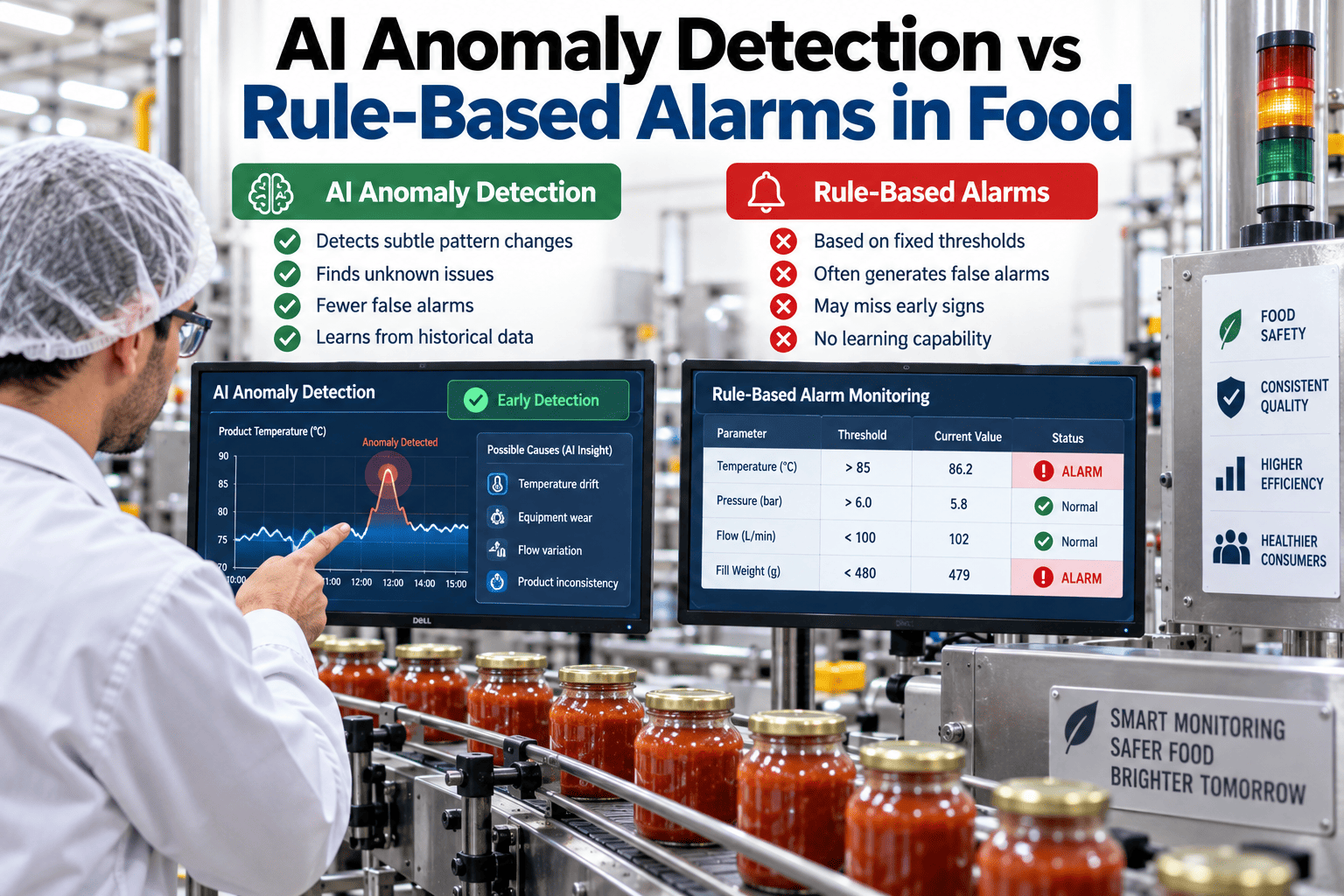
A pasteurizer's temperature sensor can read perfectly within its normal range for weeks while the pump feeding it is quietly drawing more current than it used to, and neither reading alone crosses any alarm threshold, so nothing flags until the two problems compound into an actual failure. Fixed-threshold alarms are built to catch one sensor crossing one line, which is exactly why they miss the slow, cross-sensor drift patterns that precede most real equipment failures in a food plant. This guide covers how multivariate anomaly detection catches those patterns earlier, and where it fits alongside the alarms you already have. You can book a demo to see it running against your own sensor data.
MULTIVARIATE ANOMALY DETECTION
Catch the Drift Pattern Fixed Thresholds Are Built to Miss
Real equipment failures rarely announce themselves through one sensor crossing one alarm line, they show up as a pattern across several sensors drifting together, which is exactly what multivariate detection is built to catch.
WHY FIXED THRESHOLDS FALL SHORT
A Single-Sensor Alarm Cannot See a Multi-Sensor Problem
Fixed-threshold alarms are set to catch a single reading crossing a known limit, which works well for catastrophic, single-cause failures but does almost nothing for the slower failures that build gradually across multiple interacting components. By the time any individual sensor crosses its threshold, the underlying problem has often been developing for days or weeks already.
70%+
of unplanned equipment failures show detectable cross-sensor drift patterns well before any single threshold is crossed
Days to Weeks
of advance warning multivariate detection can provide compared to a single-sensor threshold alarm
Fewer False Alarms
Pattern-based detection reduces nuisance alerts compared to overly sensitive single-point thresholds
WHERE THE SENSORS ACTUALLY SIT
Different Equipment, Different Signals, One Pattern
Multivariate detection pulls signals from across a piece of equipment, and often across adjacent equipment, since failures frequently show up as a pattern spanning several related sensors rather than isolated to one.
Pasteurizer
Temperature
Flow Rate
Pressure Drop
Filler
Fill Weight
Cycle Time
Vibration
Freezer or Blast Chiller
Ambient Temp
Compressor Current
Defrost Cycle Time
Air Compressor
Discharge Pressure
Motor Current
Oil Temperature
See What Your Sensor Data Is Already Telling You
Bring recent readings from one piece of equipment. We will show what a multivariate model would have flagged before any threshold was crossed.
FIXED THRESHOLD VS MULTIVARIATE
Two Different Ways of Watching the Same Equipment
The practical difference between the two approaches becomes clearest when comparing how each one actually behaves as a problem develops over time.
| Behavior | Fixed-Threshold Alarms | Multivariate Detection |
|---|
| Detects | A single sensor crossing a known limit | A pattern of drift across multiple related sensors |
| Warning Time | Only once the limit is actually crossed | Often days to weeks before any limit is crossed |
| Sensitivity Tuning | Fixed manually, often set conservatively to avoid nuisance alarms | Learns normal variation automatically from historical patterns |
| Best Suited For | Sudden, single-cause, catastrophic failures | Gradual, multi-component degradation and drift |
HOW A CAUGHT ANOMALY PROGRESSES
What Getting Ahead of a Failure Actually Looks Like
A typical caught anomaly does not arrive as a single dramatic alert, it develops as a sequence that gives the maintenance team a real window to act.
1Subtle drift begins across two or more related sensors
2Model flags the pattern as deviating from learned normal behavior
3Maintenance team reviews the flagged equipment during a scheduled check
4Root cause is addressed before it escalates into unplanned downtime
FREQUENTLY ASKED QUESTIONS
What Maintenance Teams Ask First
Do we need to replace our existing threshold alarms to use this?
No, multivariate detection is designed to run alongside existing threshold alarms rather than replace them, since threshold alarms still serve an important role catching sudden, catastrophic failures that need an immediate response. The two approaches cover different failure types and work best used together.
Book a demo to see both approaches running side by side.
How much sensor history is needed before the model can reliably detect anomalies?
Most equipment needs at least a few months of normal operating data to establish a reliable baseline of what typical variation looks like, including enough range to capture seasonal effects like ambient temperature swings. Equipment with very limited sensor history can still benefit, though the model's confidence improves as more baseline data accumulates.
Contact our support team to check whether your current sensor history is sufficient.
Will this create a flood of alerts that our maintenance team cannot realistically act on?
A well-tuned multivariate model typically reduces overall alert volume compared to overly sensitive threshold alarms, since it is specifically designed to distinguish genuine drift patterns from normal operating noise rather than flagging every minor fluctuation. Alert volume and sensitivity can also be adjusted based on how the maintenance team wants to prioritize their response capacity.
Book a demo to see alert tuning options in practice.
Can this work on older equipment that only has basic, non-networked sensors?
It depends on whether the existing sensors can be connected to a data collection system at all, since the model needs a continuous stream of readings to detect a pattern rather than a single manual gauge check. Older equipment can often be retrofitted with basic connected sensors specifically to enable this kind of monitoring without a full equipment replacement.
Contact our support team to assess retrofit options for older equipment.
How is a flagged anomaly different from a standard predictive maintenance alert?
A standard predictive maintenance alert is often built around a specific known failure mode for a specific part, while a multivariate anomaly flag identifies unusual pattern behavior even when the exact failure mode has not been seen before, which makes it useful for catching novel or unusual degradation patterns. Both approaches are complementary rather than competing.
Book a demo to see how the two approaches complement each other on your equipment.
Catch the Pattern Before It Becomes a Failure
iFactory watches sensor patterns across your equipment, not just single thresholds, flagging drift while there is still time to act. Book a demo to see it against your own sensor data.