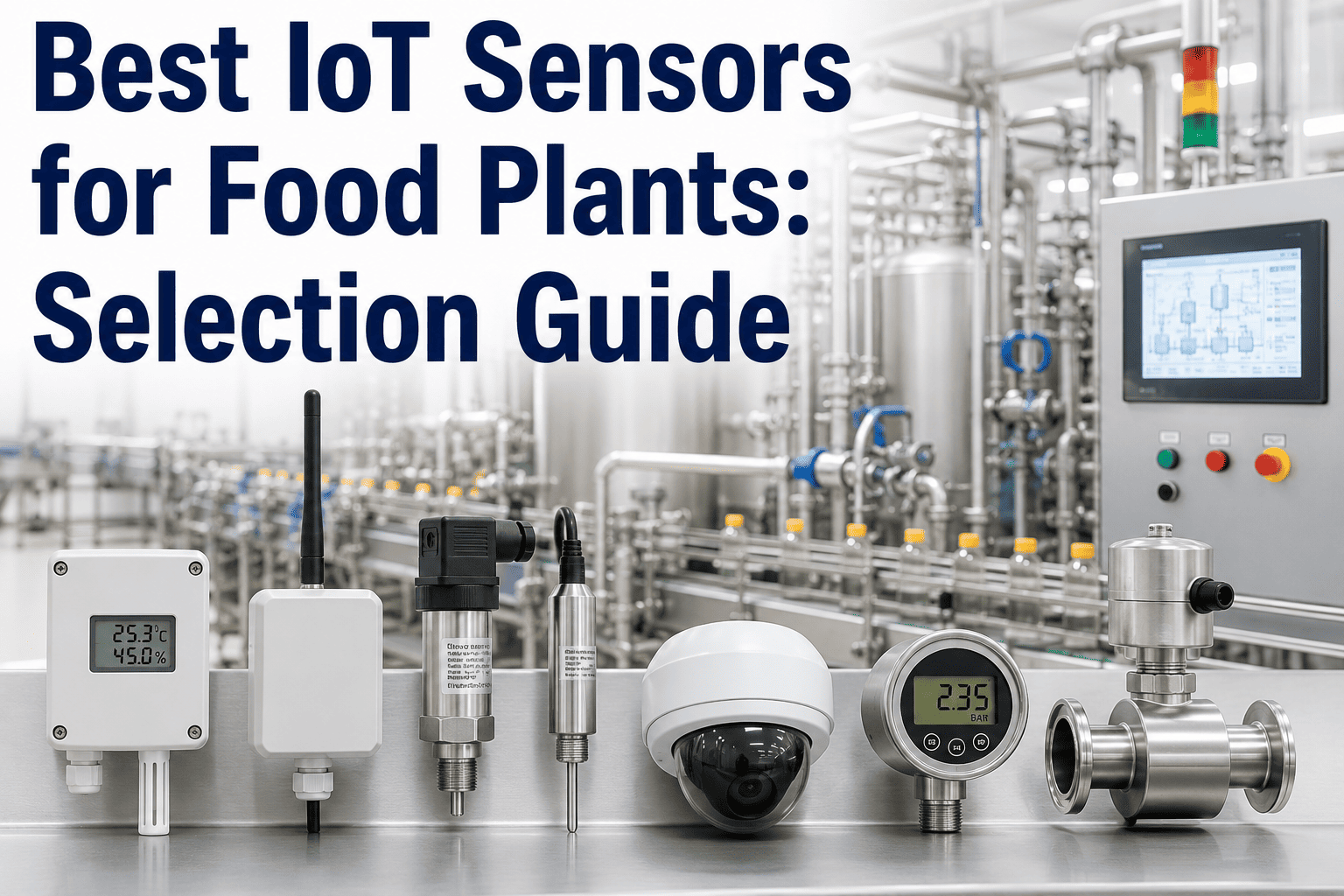
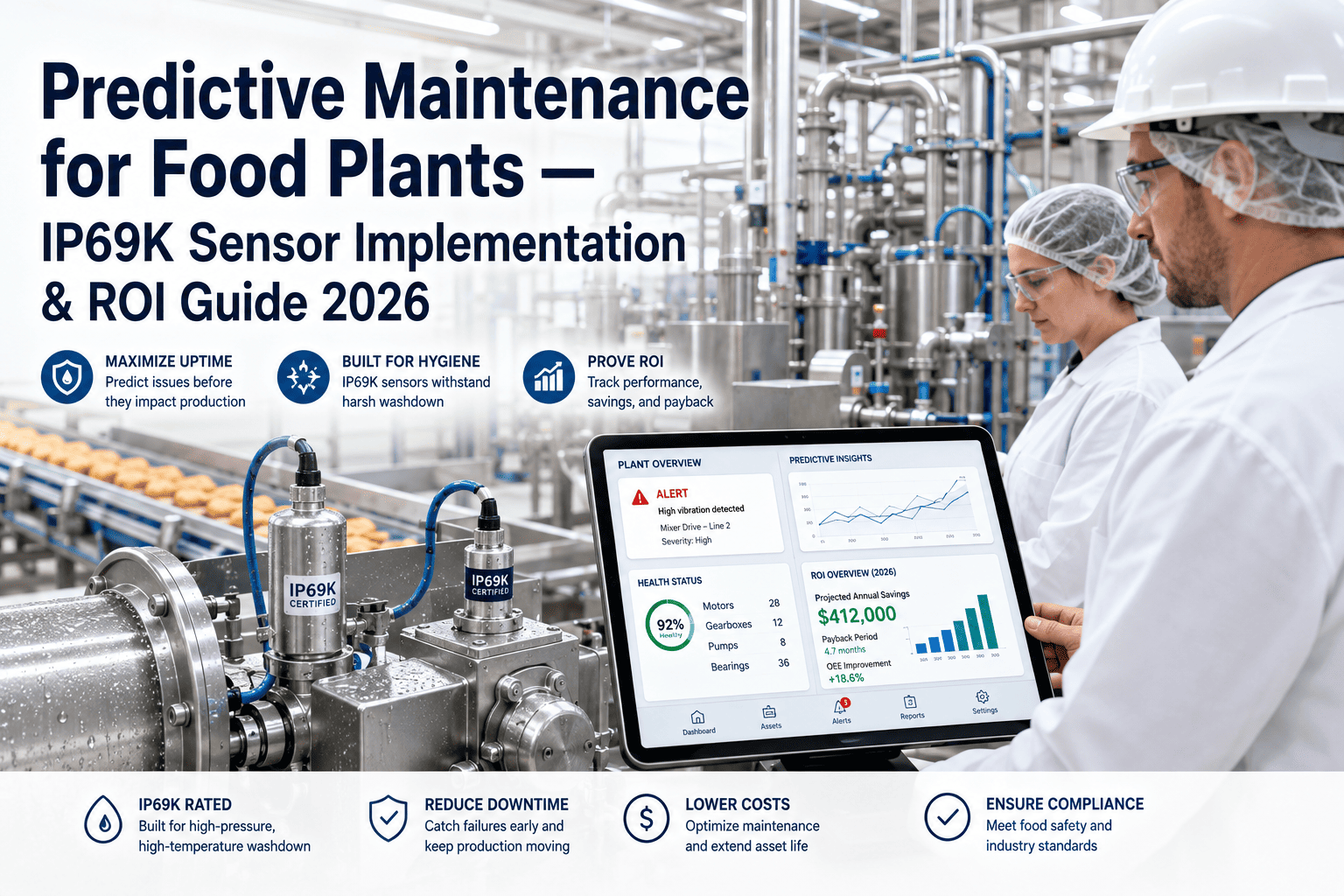
A vibration sensor rated IP67 looks perfectly adequate on a spec sheet and on a workbench, and then gets mounted on a yogurt filling line where it fails within ninety days because nobody accounted for the daily caustic CIP washdown driving moisture straight into the electronics. The plant team's conclusion, almost always, is "IoT doesn't work here," when the actual problem was never the technology, it was a sensor spec that was never matched to the environment it had to survive. Food and beverage plants are one of the harshest sensor environments in industrial manufacturing, and getting the selection wrong at the start quietly poisons the entire predictive maintenance program that gets built on top of it. If you're evaluating sensors for a new deployment, book a demo to see the exact spec checklist that separates a sensor that survives from one that doesn't.
FOOD & BEVERAGE · IOT SENSOR SELECTION
The Spec Sheet Details That Decide Whether a Sensor Survives
iFactory helps food and beverage plants specify, source, and deploy the right IoT sensors for the environment they'll actually run in, matched to the failure mode each sensor is meant to catch.
IP69K — CIP Washdown Rated
IP67 — Dust + Limited Water
IP65 — Low Pressure Spray Only
THE FIRST FILTER: SURVIVAL
Ingress Protection Isn't a Nice-to-Have in a Wash-Down Plant
Before a sensor's accuracy or its wireless range matters at all, it has to physically survive the environment it's installed in, and food plant environments are unusually punishing: daily caustic washdown, temperature swings between processing and cold storage, and constant exposure to moisture that a dry-goods facility never has to plan around.
IP69K
CIP / Washdown Zones
Rated for high-pressure, high-temperature washdown with caustic cleaning agents. The only rating that reliably survives a daily sanitation cycle on production equipment.
IP68
Submersion-Prone Areas
Suitable for equipment that may see standing water or occasional submersion, but not built for direct high-pressure spray exposure.
IP67
Dry Processing Zones
Adequate for dust and brief water immersion, commonly the point where a sensor spec'd for general industrial use quietly fails once installed near a washdown zone.
MATCH THE SENSOR TO THE FAILURE MODE
Not One Sensor Type, Four
Sensor selection isn't a single decision, it's four separate decisions, one per failure mode you're actually trying to catch. A generic "one sensor fits all" deployment is one of the most common reasons predictive maintenance programs underperform.
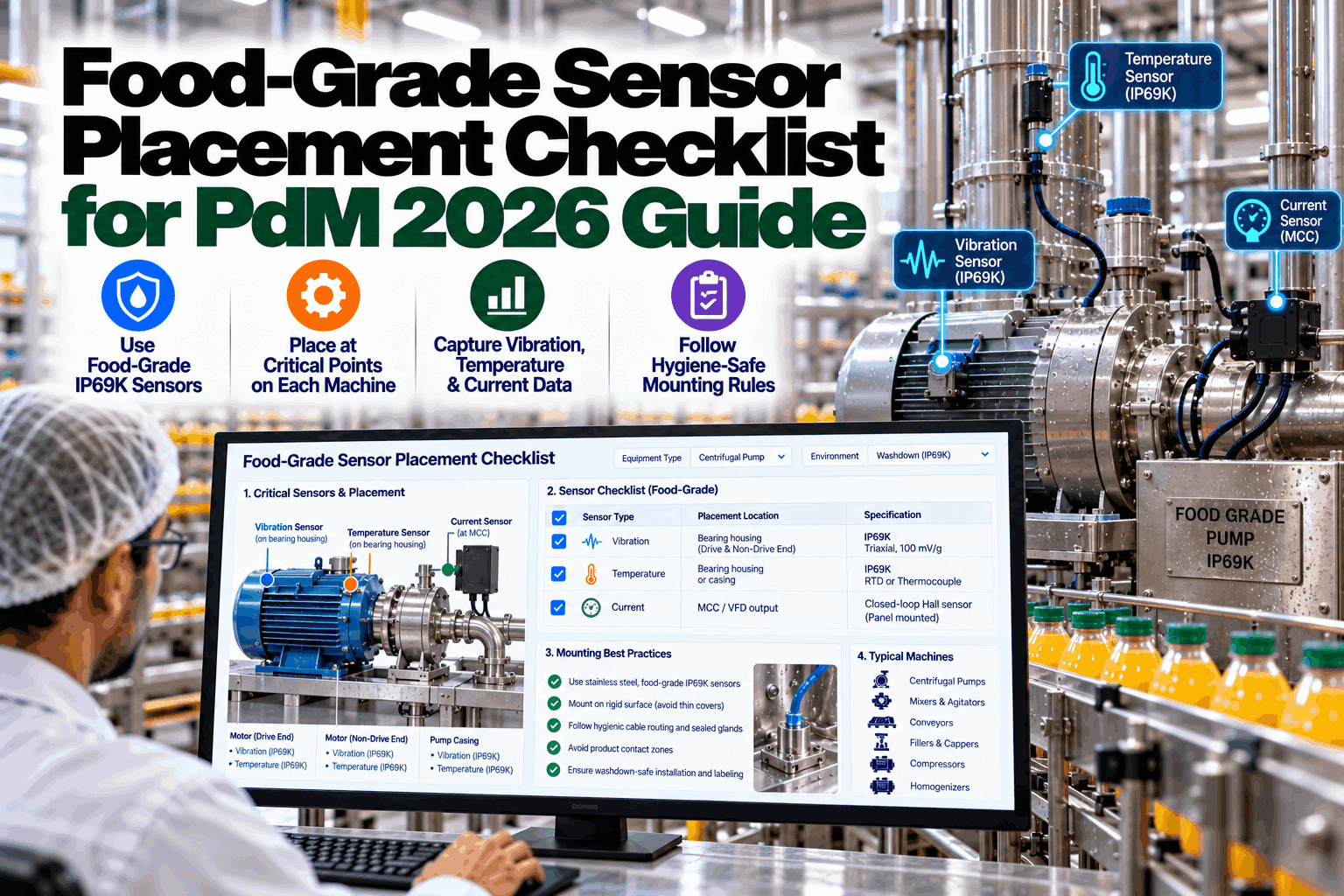
Vibration Sensors
Catch bearing wear, misalignment, and imbalance on rotating equipment weeks before a mechanical failure, the highest-value sensor category on most food lines.
Temperature Sensors
Cover both equipment health, motor and bearing overheating, and food safety documentation for cold storage, blast chillers, and thermal processing.
Pressure Transmitters
Detect filter blockage, pump degradation, and system leaks across hydraulic, pneumatic, and CIP fluid systems well before a visible failure.
Current & Power Sensors
Non-intrusive motor current signature analysis catches developing mechanical load issues without any modification to food-contact surfaces or equipment internals.
Get your sensor spec reviewed before you buy
iFactory can review your planned sensor deployment against your actual plant environment before a single unit gets ordered.
GETTING SIGNAL OFF THE SENSOR
Wireless Protocols Are the Second Most Common Failure Point
A perfectly specified sensor is still useless if the data never reliably reaches a dashboard. Wireless protocol selection depends on four factors specific to your plant: RF environment, data payload size, sensor density, and battery life requirements, and most food plants end up needing more than one protocol running side by side.
Wi-Fi
High bandwidth but degrades badly in metal-dense processing environments and drains battery life quickly on wireless sensors.
Bluetooth Low Energy
Good for short-range, high-density sensor clusters but limited range means it rarely covers a full plant floor on its own.
LoRaWAN
Long range on very low power, well suited to distributed condition monitoring sensors that only need to report small data packets periodically.
Most facilities land on a hybrid architecture, LoRaWAN for distributed low-frequency condition monitoring, and Wi-Fi or wired connections for high-bandwidth applications like continuous vibration streaming, rather than trying to force one protocol to do everything.
GENERIC VS MATCHED SELECTION
What Changes When Sensors Are Actually Matched to Their Job
| Factor |
Generic "One Sensor Fits All" |
Matched Selection |
| Environmental survival |
Frequent early failures in washdown zones |
IP69K spec'd specifically for CIP exposure |
| Prediction accuracy |
Often well below what the technology is capable of |
Meaningfully higher when sensor matches failure mode |
| Battery life |
Frequently far shorter than advertised |
Protocol and duty cycle matched to realistic expectations |
| CMMS integration |
Data sits in a standalone dashboard nobody checks |
Feeds directly into work order generation |
| Program outcome |
"IoT doesn't work here" conclusion after a failed pilot |
Measurable downtime reduction sustained over time |
TURNKEY DEPLOYMENT
How iFactory Gets Your Sensor Deployment Right the First Time
What Gets Delivered
Failure-mode-matched sensor selection for every priority asset
Environmental spec review against your actual washdown and thermal exposure
Wireless architecture designed around your plant's RF environment
Direct integration from sensor data into work order generation
Vendor-agnostic sourcing recommendations based on your specific requirements
Rollout Timeline
Week 1: Asset and environment audit, failure mode prioritization
Weeks 2-3: Sensor and protocol specification, sourcing support
Weeks 4-6: Installation support and CMMS integration
FREQUENTLY ASKED QUESTIONS
What Plants Ask Before Buying Sensors
Do we really need IP69K everywhere, or only in specific zones?
Only zones that actually experience direct high-pressure, high-temperature washdown genuinely require IP69K, and specifying it everywhere would mean paying a real cost premium for protection that dry processing or office-adjacent areas simply don't need. The mistake most plants make runs the other direction, though, under-specifying a sensor near a washdown zone because the mounting location looked borderline dry during the site walk, only to have it fail within months once the actual cleaning cycle reaches it more directly than expected. A proper environment audit zone by zone is what gets this right rather than guessing.
Book a demo to map IP rating requirements zone by zone across your specific plant.
How do we pick between vibration, temperature, pressure, and current sensors for a given asset?
The starting question is always which failure mode you're actually trying to catch on that specific asset, since each sensor type is built to detect a different physical signature and none of them substitute well for another. A rotating asset like a motor or pump benefits most from vibration monitoring since bearing wear and misalignment show up there first, while a pump or hydraulic system benefits more from pressure monitoring since a developing leak or filter blockage shows up as a pressure change well before vibration would catch it. Matching sensor type to failure mode, asset by asset, is the single biggest driver of whether a predictive maintenance program actually produces useful predictions.
Contact our support team to map sensor types against your specific asset list and failure history.
Why did our last sensor pilot fail even though the sensors seemed to be working?
The most common cause isn't the sensors themselves malfunctioning, it's that the data they collected never got connected to anything actionable, sitting in a standalone dashboard that nobody on the maintenance team checked regularly because it wasn't tied into their existing work order workflow. A close second cause is a wireless protocol mismatch with the plant's actual RF environment, where interference from steel structure or excessive sensor density on a single gateway causes data dropouts that look like sensor failure but are actually a network design problem.
Book a demo to diagnose what specifically went wrong with a previous pilot.
How much battery life should we actually expect from wireless sensors?
Advertised battery life figures often assume ideal conditions, a lower reporting frequency, moderate temperatures, and minimal wireless interference, none of which reliably hold in a real food plant environment, so a sensor advertised at several years of battery life can sometimes deliver a small fraction of that if it's over-specified to report more frequently than necessary or fighting interference to transmit. Matching the reporting frequency and protocol to what the failure mode actually requires, rather than defaulting to the highest frequency available, is usually the difference between realistic multi-year battery life and a sensor that needs replacement within months.
Contact our support team to review realistic battery life expectations for your specific sensor plan.
Can sensor data actually trigger a work order automatically, or does someone need to review it first?
Both models are possible depending on how confident your team is in a given threshold, sensor data can route directly into automatic work order generation once a defined threshold is crossed, or it can route to a review queue first for a technician or reliability engineer to confirm before a work order is created. Most plants start with the review queue approach for new sensor deployments while confidence in the thresholds builds, then shift toward more automated work order generation for well-understood, high-confidence failure signatures once the program has a track record.
Book a demo to see how sensor-to-work-order automation would be configured for your specific assets.
SPEC IT RIGHT THE FIRST TIME
Stop Learning Sensor Selection the Expensive Way
iFactory helps you specify, source, and deploy IoT sensors matched to your plant's actual environment and the specific failure modes you're trying to catch.