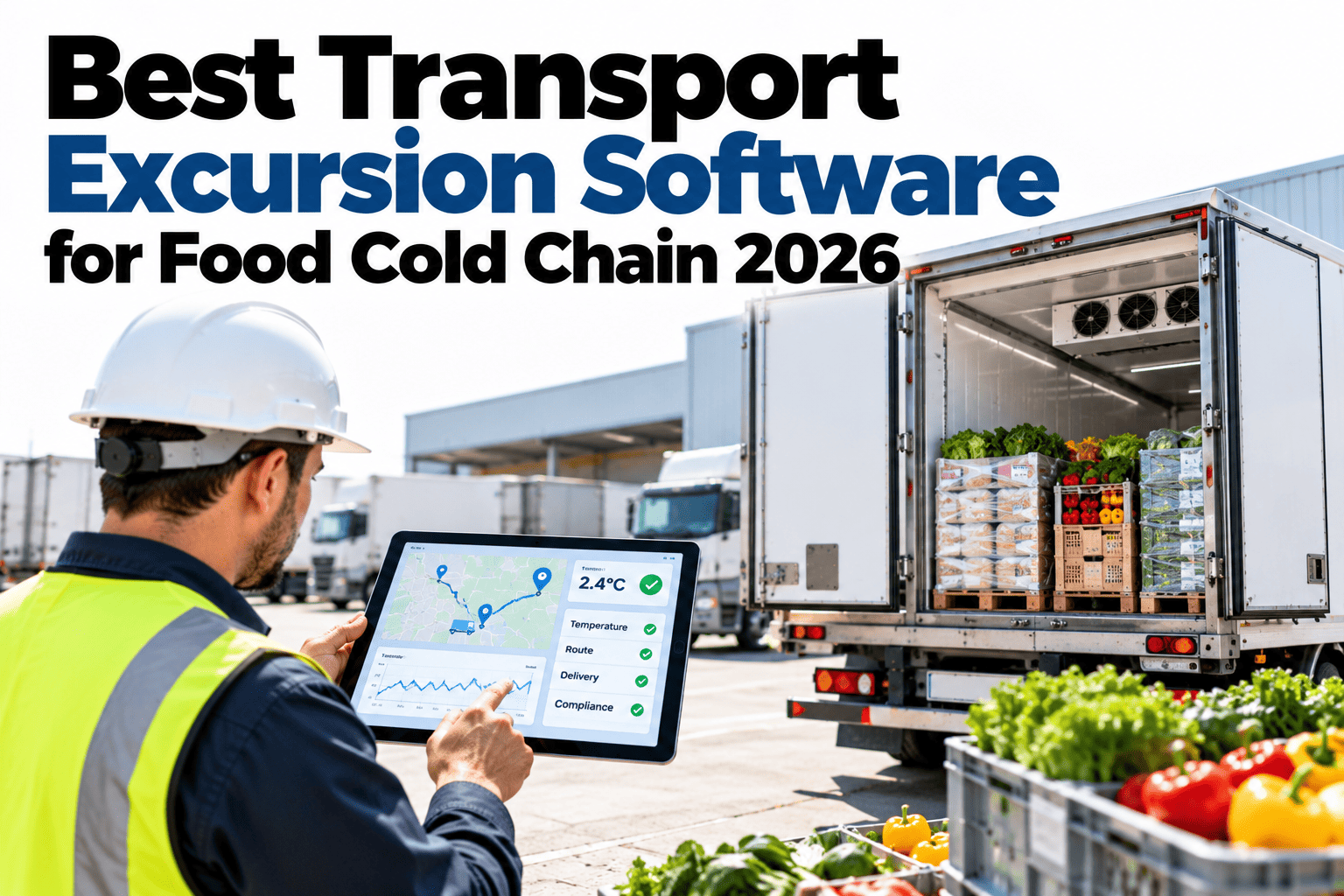
A reefer trailer excursion that is only discovered at the delivery dock has already cost the plant its best option: fixing the problem mid-route. By then the load has either recovered on its own or it has not, and nobody made a decision in between. Transport excursion detection closes that loop by putting the driver, the dispatcher and quality into the same alert the moment a trailer drifts out of range, so a mid-route reset, a reroute or a hold decision can happen while the truck is still moving. Logistics and quality teams can see a live in-transit excursion alert reach all three roles at once on iFactory AI.
Catch the Excursion While the Truck Is Still Moving
iFactory AI puts the driver, dispatcher and QA in one loop the moment a reefer drifts, so the decision happens mid-route, not at the dock.
Dock Discovery vs Mid-Route Detection
Three Roles, One Alert
Gets an immediate signal to check the unit, a door or a vent setting.
Sees the same alert with route and ETA context to plan next steps.
Reviews severity and duration to prepare a disposition decision early.
Close the Loop on Your Next In-Transit Alert
Bring a recent transport excursion to a 30-minute session and see how a mid-route alert would have changed the outcome.
Common Causes of an In-Transit Excursion
| Cause | Typical Signature | Mid-Route Response |
|---|---|---|
| Pre-cool skipped | Trailer starts warm from departure | Flag at loading, before the trailer leaves |
| Unit shutdown or fault | Reefer stops cycling mid-route | Driver checks unit, dispatch arranges support |
| Door left ajar | Sharp, sustained rise after a stop | Driver confirms and reseals the door |
| Set point changed | Sudden shift not tied to a stop | Dispatch confirms with driver and resets |
| Fuel or power loss | Gradual rise as unit loses capacity | Reroute to nearest service point |
A Composite Scenario: The Load Saved Two Hours From Delivery
Picture a reefer trailer where a door was not fully latched after a mid-route stop. Temperature begins climbing, and under the old process nobody would know until the delivery dock check, four hours later.
With a mid-route alert, the driver and dispatcher are notified within minutes. The driver reseals the door, the unit recovers, and the load arrives within range instead of being discarded on arrival.
Where iFactory AI Fits
Alerts in real time
Flags a reefer excursion within minutes of it starting, not at delivery.
Reaches all three roles
Driver, dispatcher and QA see the same alert at the same time.
Adds route context
Shows ETA and nearest service points to support a mid-route decision.
Prepares disposition early
Gives QA severity and duration data before the truck even arrives.
Expert Review
A cold-chain logistics perspective, reviewed for accuracy before publication: the single biggest difference between a recoverable in-transit excursion and a full discard is almost always how early the right people found out. A driver who notices a problem two hours into a six-hour route still has options a quality team at the dock does not. Closing that loop in real time is one of the highest-leverage changes a cold-chain operation can make, and seeing it on your own lanes is the fastest way to judge the fit.
Frequently Asked Questions
How is transport excursion detection different from the reefer's own alarm?
A reefer unit's built-in alarm typically alerts the driver only, often through an in-cab display the driver may not see immediately on a long route. Transport excursion detection routes the same event to dispatch and quality at the same time, with route context, so a decision can be made by the team rather than relying on one person noticing a dashboard light. You can see how a real excursion would route across your team in a short session.
What can actually be done about an excursion while the truck is still moving?
Options depend on the cause. A door left ajar can be resealed, a set point can be corrected remotely or by the driver, and a failing unit can sometimes be serviced at a stop along the route. Even when nothing can be physically fixed, early notice lets quality start preparing a disposition decision before the truck arrives instead of after. Ask for a walkthrough of typical mid-route response options.
Does this require the carrier to install new hardware?
It depends on what reefer monitoring hardware is already on the trailer. Many modern reefer units already report temperature data that can be connected into an alerting system; older units may need a retrofit sensor. A short review of your carrier fleet's current hardware clarifies what is needed. Explore a hardware review for your current carrier fleet.
How does this work with third-party carriers we do not own?
Many third-party carriers already use reefer telematics that can share data through an integration or a shared platform, though the specifics depend on the carrier's systems and willingness to connect. This is worth confirming directly with each carrier rather than assuming. Try a discussion of how to approach your current carrier partners about this.
How do we measure the value of catching excursions mid-route?
Track the share of transport excursions resolved in transit versus discovered at delivery, along with the cost difference between a partial recovery and a full discard. Because a late-discovered excursion often means the full cost of product, freight, disposal and replacement, even a modest shift toward mid-route catches can add up quickly. Join a session that estimates this value from your own transport history.
Give the Driver and Dispatch a Chance to Act
iFactory AI alerts driver, dispatcher and QA together the moment a reefer drifts out of range. Book a walkthrough on your own transport lanes.